Choosing vs. Chosing often creates confusion because these words look similar. However, only choosing is the correct form in standard English writing. The mistake usually happens because learners expect the word choose to change its spelling in a simple way. The right form keeps the double “o” before adding “-ing.” This small spelling detail can make a big difference in clear and accurate writing.
The verb choose has several important verb forms. Choose is used in the present tense, while chose is the simple past tense. Chooses works with third-person singular subjects, while choosed is not a correct form. The word choosing describes the action of making a selection. For example, “She is choosing a dress” shows an action happening now. Remembering these forms can improve your confidence and English usage.
To choose means to pick out, select, or make a choice when deciding between options. Helpful examples and practical examples can make this distinction easier to remember. Dictionaries recognize choosing as correct, while chosing is a common mistake. Once you understand the difference, your writing becomes clearer and more polished. This simple rule can help you write with greater clarity, precision, and professional accuracy.
Quick Answer
Choosing is correct. Chosing is incorrect in standard English.
| Word | Correct spelling? | Word type | Meaning |
| choosing | ✅ Yes | Present participle / gerund | Selecting or deciding |
| chosing | ❌ No | Misspelling | No standard English meaning |
The correct spelling follows this pattern:
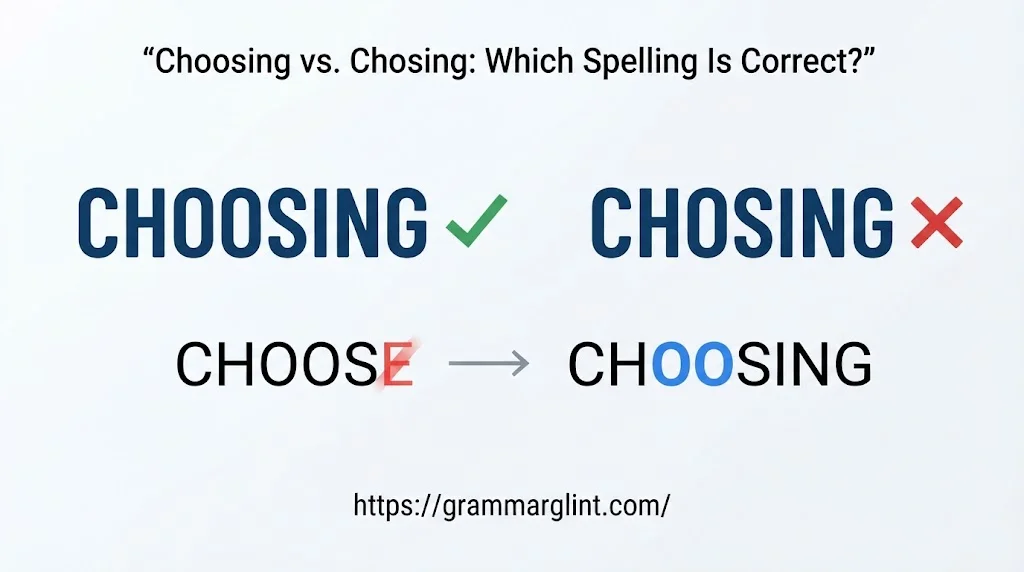
choose + -ing → choosing
Notice what happens. The final e disappears, but the oo stays.
So:
- choose → choosing ✅
- chose → choosing ❌
- chose → chosing ❌
That distinction explains most of the confusion.
What Does “Choosing” Mean?
Choosing means selecting something from two or more possibilities or deciding what you want to do.For example:
- I am choosing a new laptop.
- She is choosing between two colleges.
- They are choosing a restaurant for dinner.
- Choosing the right words can make your writing clearer.
In each sentence, someone is making a selection or decision.
The meaning can involve a simple preference, such as choosing an ice cream flavor, or a significant decision, such as choosing a career.
Choosing Can Describe an Action
When choosing appears in a continuous verb construction, it describes an action that is happening over a period of time.
For example:
She is choosing a dress for the wedding.
The person isn’t necessarily finished. She’s in the process of making the decision.
Compare these:
- She chooses a dress every year. — habitual action
- She is choosing a dress now. — action in progress
- She chose a dress yesterday. — completed past action
- She has chosen a dress. — completed action with present relevance
The spelling changes according to the grammatical form, but choosing always keeps the double o.
Why Is “Choosing” Correct?
The easiest way to understand the spelling is to start with the base verb choose.
The formation is:
choose → choosing
The final silent e is removed before the -ing ending is added. However, the oo remains part of the word.
That gives you:
ch + oo + s + e
becoming:
ch + oo + s + ing
So the correct spelling is:
choosing
Not:
chosing
The missing o in chosing is the problem.
Why Does the Final “E” Disappear?
English commonly drops a final silent e before adding -ing to certain verbs.
Consider these familiar patterns:
| Base verb | + -ing | Correct form |
| make | make + ing | making |
| write | write + ing | writing |
| take | take + ing | taking |
| use | use + ing | using |
| choose | choose + ing | choosing |
The important point is that dropping the final e doesn’t mean you should remove another letter from the base word.
With choose, only the final e disappears.
choose → choosing
The two o’s remain intact.
Why Is “Chosing” Incorrect?
Chosing is incorrect because it removes an o that belongs to the base word choose.
The spelling mistake becomes easier to understand when you compare the related forms:
| Form | Correct spelling |
| Base form | choose |
| Third-person singular | chooses |
| Past tense | chose |
| Present participle | choosing |
| Past participle | chosen |
The past tense chose has a different spelling. That can trick writers into assuming that the -ing form should also lose an o.
It shouldn’t.
Think of the forms as separate branches:
1. choose → chose
2. choose → chosen
3. choose → choosing
The spelling of chose doesn’t control the spelling of choosing.
Examples
The fastest way to spot the difference is to see the words in real sentences.
| Incorrect | Correct |
| I am chosing a new phone. | I am choosing a new phone. |
| She is chosing between two options. | She is choosing between two options. |
| We spent an hour chosing a topic. | We spent an hour choosing a topic. |
| They are chosing a team captain. | They are choosing a team captain. |
| He is chosing the best answer. | He is choosing the best answer. |
| Chosing the right words takes practice. | Choosing the right words takes practice. |
In every correction, only one letter changes: the missing o returns.
That tiny change makes the word standard English.
More Correct Examples With “Choosing”
- I’m choosing the blue shirt.
- We’re choosing a name for the new project.
- She is choosing between two universities.
- They spent the afternoon choosing furniture.
- Choosing a reliable source takes careful research.
- He had trouble choosing what to eat.
- The committee is choosing a new chairperson.
- Choosing wisely can save you time and money.
- I enjoy choosing gifts for my friends.
- She kept choosing the same answer.
These examples also show that choosing can appear in different grammatical environments.
Choosing as a Present Participle
Choosing functions as a present participle when it forms part of a continuous verb phrase.
The most obvious pattern is:
be + choosing
For example:
I am choosing a topic for my paper.
Here, am choosing describes an action in progress.
Other forms include:
- I am choosing
- you are choosing
- she is choosing
- we are choosing
- they are choosing
- I was choosing
- they were choosing
Examples:
She is choosing a seat near the window.
They were choosing which route to take.
We are choosing a new design for the website.
The word choosing doesn’t change when the helping verb changes. The tense comes from am, is, are, was, or were.
Read More: Grew or Grown? Difference Explained with Examples
Choosing as a Gerund
The word choosing can also function as a gerund. A gerund is an -ing form of a verb that functions as a noun.
For example:
Choosing the right college requires careful research.
Here, choosing the right college acts as the subject of the sentence.
Another example:
I enjoy choosing gifts for my family.
In this sentence, choosing gifts functions as the object of enjoy.
Compare the two uses:
| Use | Example | Function |
| Present participle | She is choosing a dress. | Part of the verb phrase |
| Gerund | Choosing a dress takes time. | Noun-like subject |
| Gerund | I enjoy choosing dresses. | Noun-like object |
The spelling remains choosing in every case.
Common Phrases With “Choosing”
Choosing appears naturally in several useful constructions.
Choosing Between
Use choosing between when someone must select one option from two or more alternatives.
Examples:
- I’m choosing between two laptops.
- She is choosing between studying abroad and staying home.
- They had difficulty choosing between the two candidates.
Choosing From
Use choosing from when options come from a larger group or collection.
Examples:
- We are choosing from several menu options.
- She spent an hour choosing from dozens of designs.
- Customers can choose from several plans.
The structure emphasizes the available group.
Choosing to
Choosing to means deciding to do something.
Examples:
- He is choosing to remain quiet.
- She is choosing to study at home.
- They are choosing to delay the decision.
Choosing the Right
This phrase commonly appears when someone needs to make a careful selection.
Examples:
- Choosing the right words can prevent misunderstandings.
- Choosing the right software depends on your needs.
- Choosing the right topic can make an assignment easier.
The phrase doesn’t require a specific object. You can choose the right words, tool, course, product, method, or person.
Choosing vs. Choose vs. Chose vs. Chosen
One of the best ways to understand choosing vs. chosing is to look at the entire verb family.
| Word | Form | Example |
| choose | Base/present form | I choose the blue one. |
| chooses | Third-person singular | She chooses the blue one. |
| chose | Simple past | She chose the blue one yesterday. |
| choosing | Present participle / gerund | She is choosing the blue one. |
| chosen | Past participle | She has chosen the blue one. |
Choose
Use choose for the base form and present-tense contexts.
I choose the cheaper option.
You can also use it after to:
I want to choose the blue one.
Chooses
Use chooses with a third-person singular subject in the present tense.
She chooses carefully.
The manager chooses the final candidate.
Chose
Use chose for a completed action in the simple past.
She chose the blue dress yesterday.
The spelling is chose, not choose and not chosing.
Choosing
Use choosing for an ongoing action or when the -ing form acts as a noun.
She is choosing a dress.
Choosing a dress can take time.
Chosen
Use chosen as the past participle.
She has chosen a dress.
He was chosen as team captain.
This distinction matters because chose, choosing, and chosen don’t serve the same grammatical purpose.
Why People Commonly Write “Chosing”
The mistake isn’t random. It has a few understandable causes.
The Pronunciation Can Mislead You
When people say choosing, the spelling isn’t obvious from the sound alone.
In US English, choose is pronounced /tʃuz/, while choosing has the corresponding -ing ending. Because English spelling and pronunciation don’t always match perfectly, writers sometimes spell words based on how they sound.
That’s especially easy when typing quickly.
“Chose” Creates Interference
The word chose contains only one o after the h:
chose
A writer who remembers the past-tense form may unconsciously transfer that spelling into the -ing form:
chose → chosing
But the correct relationship is:
choose → choosing
The forms don’t follow the same spelling change.
Fast Typing Encourages Letter Dropping
There’s also a simple practical reason. When people type quickly, repeated letters are easy to skip.
The sequence:
c-h-o-o-s-i-n-g
contains two consecutive o’s. A hurried writer may type only one.
That produces:
c-h-o-s-i-n-g
or chosing.
This is a spelling error, not a grammatical variation.
Common Mistakes
The main problem isn’t limited to chosing. The verb choose has several forms that writers often mix up.
Mistake: Chosing
❌ I am chosing a new course.
✅ I am choosing a new course.
Mistake: Choosen
❌ I have choosen the red one.
✅ I have chosen the red one.
Mistake: Choose in a Continuous Construction
❌ I am choose a new laptop.
✅ I am choosing a new laptop.
After am, is, or are in a present continuous construction, use the -ing form.
Mistake: Chose for a Current Action
❌ I am chose a new topic right now.
✅ I am choosing a new topic right now.
Chose describes a completed past action. Choosing describes an action in progress.
Mistake: Choosing for a Finished Past Action
❌ Yesterday, I am choosing the blue one.
✅ Yesterday, I chose the blue one.
The time expression yesterday normally calls for the simple past in this context.
A Simple Spelling Trick
If you regularly type chosing, use this three-step memory trick.
Step One: Start With “Choose”
Write:
CHOOSE
Step Two: Remove Only the Final “E”
That gives you:
CHOOS
Step Three: Add “ING”
The result is:
CHOOSING
That’s it.
choose → choos → choosing
The trick works because it forces you to preserve the double o.
Remember the “Double O”
A particularly simple memory cue is:
Choose has two O’s. Choosing keeps two O’s.
So:
- choose ✅
- choosing ✅
- chosing ❌
The word chose is different because it is an irregular past-tense form. Don’t use its spelling as the template for the -ing form.
In Academic and Professional Writing
A spelling mistake may look small, but context changes how noticeable it becomes.
In casual texting, someone might understand chosing immediately. In a university paper, cover letter, report, website, or business email, however, standard spelling matters more.
Consider this sentence:
The research team is chosing the most reliable method.
The meaning remains understandable, but the spelling error distracts from the message.
The corrected version is:
The research team is choosing the most reliable method.
That second sentence looks polished and professional.
Where Correct Spelling Matters Most
Pay particular attention to choosing when writing:
- academic assignments
- resumes and cover letters
- business emails
- research papers
- website copy
- reports
- presentations
- professional profiles
- formal applications
- published articles
Spell-checkers can catch many errors, but they don’t always replace careful proofreading. A reliable habit is to search your document for chosing before submitting or publishing it.
A Practical Editing Case Study
Imagine a student writing this sentence:
Choosing a research topic requires careful planning.
That’s correct.
Now suppose the student types:
Chosing a research topic requires careful planning.
The meaning hasn’t changed. The grammar around the word is still fine. The problem is entirely in the spelling of the -ing form.
The correction is straightforward:
chosing → choosing
This example shows why spelling and grammar aren’t identical. A sentence can have correct structure while still containing a spelling error.
Another Real-World Example
Consider a workplace message:
We’re chosing a vendor for the new project.
The intended meaning is obvious. However, the professional version should read:
We’re choosing a vendor for the new project.
The correction takes one extra letter, yet the result looks much more polished.
Choosing and Its Synonyms
Depending on the context, you can replace choosing with several related words.
| Word | General meaning | Example |
| choosing | Selecting among possibilities | She is choosing a course. |
| selecting | Choosing carefully or from a group | The panel is selecting three finalists. |
| picking | Informal way to say choosing | He’s picking a movie. |
| deciding | Reaching a decision | She’s deciding where to go. |
| opting for | Choosing one option or course | They are opting for the cheaper plan. |
| electing | Choosing formally, often by vote | Members are electing a chairperson. |
These words overlap, but they aren’t perfect substitutes in every sentence.
For example, electing often suggests a formal selection through voting. Picking is more casual. Selecting can suggest a deliberate or careful process.
Key Facts at a Glance
Here are the most important facts to remember:
- Choosing is the correct spelling.
- Chosing is a misspelling.
- Choosing comes from choose.
- The final e in choose is dropped before -ing.
- The two o’s remain.
- Chose is the simple past form.
- Chosen is the past participle.
- Choosing can function as a present participle.
- Choosing can also function as a gerund.
- Choose and choosing aren’t interchangeable in every grammatical construction.
- The easiest memory aid is choose → choosing.
- If you see chosing in formal writing, correct it to choosing.
Read More: Answer To, For, Or Of the Question? Correct Version Explained
FAQs
1. Is “choosing” or “chosing” correct?
Choosing is correct. Chosing is a common spelling mistake and should be avoided in standard English writing.
2. Why is “choosing” spelled with two o’s?
The verb choose keeps its original “oo” spelling when -ing is added. Therefore, the correct form is choosing.
3. What does choosing mean?
Choosing means selecting or deciding between two or more options. For example, “I am choosing a new book.”
4. Is “choosed” a correct word?
No. Choosed is incorrect. The simple past form of choose is chose.
5. What is the past tense of choose?
The past tense of choose is chose. For example, “She chose the blue dress.”
6. What is the present tense of choose?
Choose is the basic present-tense form. For example, “I choose coffee every morning.”
7. What is the difference between choose and choosing?
Choose usually describes the basic verb, while choosing describes an action that is happening or continuing. For example, “I choose tea” and “I am choosing tea.”
8. Is “chosing” accepted in English dictionaries?
Standard English dictionaries recognize choosing, not chosing, as the correct spelling.
9. How can I remember the spelling of choosing?
Remember that choose keeps its “oo” when you add -ing. Think of it as choose + ing = choosing.
10. What is the easiest way to avoid this spelling mistake?
Remember the pattern choose → choosing → chose. Practicing these three forms together can make the spelling much easier to remember.
Conclusion
Understanding choosing vs. chosing is simple once you remember the correct spelling pattern. Choosing is the standard form, while chosing is an incorrect spelling. The verb also changes to chose in the simple past tense, so keeping these forms separate can prevent common mistakes.
When you’re writing, take a quick moment to check whether you need choose, chooses, choosing, or chose. A little attention to these forms can make your sentences clearer, more accurate, and more professional.

Muhammad Haroon is the voice behind many of the clear, practical grammar guides you’ll find on Grammar Lantern. With a strong background in content writing and a genuine love for the English language, Haroon specializes in breaking down intimidating grammar topics into simple, digestible lessons. His goal is simple: to empower readers to write with confidence and clarity. Whether he’s explaining tricky tenses or demystifying punctuation, Haroon approaches each topic with patience, precision, and a touch of warmth—because he knows that learning grammar is a journey, not a race.