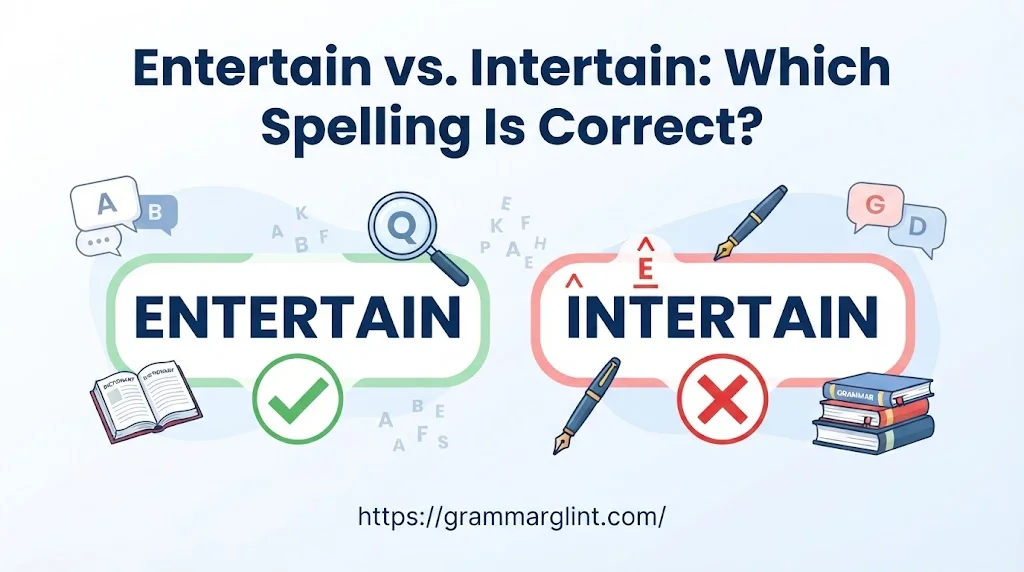
Entertain is the correct spelling in English and standard English, while Intertain is a common misspelling and incorrect in formal writing. As someone who regularly works with grammar, language usage, and writing, I often see this mistake because both forms can sound similar. Entertain is a verb meaning to keep someone or people interested or amused. It can also mean welcoming visitors or considering an idea or suggestion. For example, a musician may entertain guests, while families entertain friends at home.
The distinction matters in schoolwork, emails, articles, and other formal situations. A common misspelling might appear in informal messages, but standard usage requires Entertain. When checking content, I recommend considering the context, meaning, and grammatical role of the word. This approach is useful for semantic and NLP analysis because context can change how a word functions in a sentence.
For instance, she may entertain the suggestion before making a decision, or refused to entertain an idea. These examples show that Entertain can describe welcoming guests, making people feel amused, or considering a proposal. The word belongs in your regular vocabulary, while Intertain does not represent the accepted standard form. Using the right spelling makes your writing clearer and more reliable.
The Quick Answer
The correct spelling is entertain.
| Word | Standard English status | Meaning |
| Entertain | Correct | To amuse, interest, host, or consider something |
| Intertain | Usually incorrect | Common misspelling of entertain |
| Entertaining | Correct | Interesting or amusing |
| Entertainment | Correct | Activities or performances that entertain people |
| Entertainer | Correct | A person who performs or amuses others |
So, if you’re writing an email, essay, article, assignment, social media post, or formal document, use entertain.
Correct:
The comedian entertained the audience for two hours.
Incorrect:
The comedian intertained the audience for two hours.
The difference is only one letter, but that letter matters.
A useful spelling chain is:
Entertain → entertained → entertaining → entertainment → entertainer
Notice that each word keeps the entertain- spelling.
What Does “Entertain” Mean?
The verb entertain has more than one established meaning. Context determines which meaning the reader understands.
At its core, the word connects with the idea of holding someone’s attention, providing enjoyment, offering hospitality, or considering something mentally.
Those meanings may seem unrelated at first. They actually share an interesting underlying idea: something is being held or maintained.
Today, you’ll most commonly see entertain used in three ways.
Entertain Means to Amuse or Interest Someone
The first meaning is the one most people recognize.
To entertain someone means to keep that person interested, amused, or engaged.
A movie can entertain you. A comedian can entertain an audience. A storyteller can entertain children with an imaginative tale.
For example:
- The magician entertained the children.
- The movie entertained viewers from beginning to end.
- Her stories always entertain the audience.
- The band entertained the crowd throughout the evening.
- The presenter used humor to entertain the audience.
Entertainment doesn’t always require laughter.
That’s an important distinction.
A serious documentary can entertain you by holding your attention. A suspense novel can entertain you without being funny. A fascinating lecture can entertain while teaching something useful.
In other words, entertainment isn’t limited to comedy.
Entertainment captures attention and creates an enjoyable experience.
That’s why you can describe a thriller, concert, speech, game, podcast, or story as entertaining.
Entertain Can Mean to Host Guests
The word also has a social meaning.
When you entertain guests, you invite people to spend time with you and provide hospitality. That might involve food, drinks, conversation, music, or another activity.
For example:
- We love to entertain guests during the holidays.
- She often entertains friends at her home.
- They entertained several clients over dinner.
- My parents rarely entertain during the week.
- We plan to entertain relatives this weekend.
This meaning appears frequently in everyday American English.
You might hear someone say:
“We don’t entertain much these days.”
That doesn’t mean the person doesn’t amuse people.
It usually means they don’t often invite people over as guests.
The context does the heavy lifting.
Read More: Begun vs. Began: Which Is Correct? Helpful Examples
Entertain Can Mean to Consider an Idea
Here’s where the word becomes more interesting.
Entertain can also mean to consider or be willing to consider an idea, possibility, suggestion, hope, doubt, or thought.
This usage is more formal.
For example:
- She wouldn’t entertain the idea of leaving.
- The committee entertained several proposals.
- He refused to entertain the possibility of failure.
- The lawyer asked the court to entertain the argument.
- I wouldn’t even entertain the thought of doing that.
Here, entertain has nothing to do with comedy or parties.
If someone says:
“I won’t entertain that idea.”
They aren’t saying the idea isn’t funny.
They’re saying they won’t consider it.
This meaning often appears in academic writing, journalism, business communication, legal contexts, and serious conversations.
Is “Intertain” a Word?
When you’re asking about entertain vs. intertain, the safest answer is straightforward:
Use “entertain” in standard English when you mean to amuse, host, or consider something.
Intertain is commonly encountered as a misspelling of entertain. It isn’t the standard spelling of the English verb used in those meanings.
That distinction matters because English contains many words that look as though they should begin with inter-.
Consider words such as:
- interact
- international
- interrupt
- intervene
- interpret
- interest
- internal
Because inter- appears so frequently in English, intertain can look believable.
But familiar-looking isn’t the same as correct.
The standard form is:
E-N-T-E-R-T-A-I-N
Not:
I-N-T-E-R-T-A-I-N
If you’re writing professionally or academically, don’t use intertain when you mean entertain.
Why Do People Spell “Entertain” as “Intertain”?
Spelling errors rarely appear out of nowhere. Usually, there’s a reason a wrong form feels plausible.
The entertain vs. intertain confusion probably comes from several factors.
Pronunciation Can Create Spelling Confusion
The first syllable of entertain isn’t always pronounced with a strong, clear vowel sound.
In American English, the word is commonly pronounced roughly like:
en-ter-TAIN
The first syllable is relatively weak compared with the final stressed syllable.
That can make the opening vowel easy to overlook.
English has many words where pronunciation doesn’t give you a perfect spelling guide. That’s one reason learners often spell words according to how they hear them.
Consider this simple pattern:
Hear it → guess the spelling → type it → discover the spelling is different
That process happens constantly in English.
The cure isn’t complicated. Learn the written form as a complete word.
Similar Words Can Create False Patterns
English vocabulary contains plenty of words beginning with inter-.
That pattern can influence how someone spells an unfamiliar word.
For example:
- international
- interesting
- interact
- interfere
- interpret
- interconnect
A writer who knows these words may instinctively type intertain.
The spelling looks familiar enough to pass a quick visual check.
That’s precisely why proofreading matters.
Fast Typing Makes Small Errors More Likely
Sometimes there isn’t a linguistic explanation at all.
You’re typing quickly. Your fingers move faster than your proofreading. One letter slips into the wrong position.
It happens.
The problem becomes more noticeable when the incorrect spelling appears repeatedly. A single typo is easy to fix. A repeated spelling pattern can make an article, assignment, or professional message look careless.
When accuracy matters, search your document for:
intertain
Then replace it with:
entertain
You can also check related forms such as intertaining and intertainment.
Entertain: Pronunciation and Word Forms
Understanding pronunciation can help you remember the spelling.
In American English, entertain is pronounced approximately:
en-ter-TAYN
The final syllable receives the main stress.
Its common forms are:
| Word | Part of speech | Example |
| entertain | Verb | They entertain their guests regularly. |
| entertains | Verb | The comedian entertains the crowd. |
| entertained | Past tense/past participle | The show entertained everyone. |
| entertaining | Adjective/present participle | It was an entertaining story. |
| entertainment | Noun | The event included live entertainment. |
| entertainer | Noun | The entertainer performed for the crowd. |
The spelling pattern stays recognizable.
That’s useful because learning the entire word family can reduce future mistakes.
The Spelling Pattern to Remember
Think of the word family as one unit:
ENTERTAIN
↓
ENTERTAINED
↓
ENTERTAINING
↓
ENTERTAINMENT
↓
ENTERTAINER
If you remember that core entertain sequence, intertain becomes much easier to reject.
Entertain in Example Sentences
Seeing the word in different contexts is one of the best ways to understand it.
Entertain Meaning “Amuse”
These examples use entertain in the sense of creating enjoyment or holding attention.
- The comedian entertained the audience with clever jokes.
- The children watched cartoons to entertain themselves.
- The singer entertained the crowd for nearly an hour.
- The book is designed to entertain young readers.
- His stories always entertain his friends.
- The movie managed to entertain without relying on cheap humor.
Notice something important.
The subject doesn’t have to be a person.
A movie, book, show, game, or story can entertain someone.
Entertain Meaning “Host”
Now compare those examples with the hospitality meaning.
- We entertain guests every Saturday.
- She enjoys entertaining friends at home.
- They entertained their business partners over dinner.
- My family often entertains relatives during holidays.
- We don’t usually entertain large groups.
Here, entertain describes an act of hospitality.
The sentence isn’t necessarily about performing.
Entertain Meaning “Consider”
The meaning changes again in these examples:
- She wouldn’t entertain the possibility of moving.
- The manager agreed to entertain the proposal.
- He refused to entertain any doubts about the plan.
- The committee will entertain the suggestion.
- I wouldn’t entertain the thought of giving up.
These constructions are especially useful to recognize:
1. entertain an idea
2. entertain a possibility
3. entertain a suggestion
4. entertain a thought
5. entertain a doubt
6. entertain a hope
They’re common combinations in formal English.
Common Mistakes
The most obvious mistake is spelling the word with inter-.
However, several related forms can suffer from the same problem.
Mistake: “Intertain”
❌ The movie intertained everyone.
✅ The movie entertained everyone.
The past-tense form uses entertained.
Mistake: “Intertaining”
❌ The documentary was very intertaining.
✅ The documentary was very entertaining.
The adjective keeps the entertain- base.
Mistake: “Intertainment”
❌ The hotel offers live intertainment.
✅ The hotel offers live entertainment.
The noun uses entertainment.
Mistake: Changing the Spelling Because of Pronunciation
Some writers hear the word and try to reconstruct its spelling.
That strategy can work with simple words. English has too many irregularities to make it reliable.
Instead, memorize the written family:
Entertain → entertaining → entertainment
Once that pattern becomes familiar, you don’t have to reinvent the spelling every time.
Entertain vs. Entertainment vs. Entertaining
These words belong to the same family, but they perform different grammatical jobs.
| Word | Function | Meaning | Example |
| Entertain | Verb | Amuse, host, or consider | The show entertains millions. |
| Entertained | Verb | Past form of entertain | The performance entertained us. |
| Entertaining | Adjective/verb form | Amusing or interesting | It was an entertaining speech. |
| Entertainment | Noun | Something that entertains | The festival offers live entertainment. |
| Entertainer | Noun | A person who entertains | The entertainer performed on stage. |
This distinction becomes especially important in formal writing.
For example:
The performer entertained the audience.
Here, entertained is a verb.
But:
The performance was entertaining.
Here, entertaining describes the performance.
And:
The audience enjoyed the entertainment.
Here, entertainment functions as a noun.
Same word family. Different grammatical roles.
Entertain vs. Amuse
Entertain and amuse overlap, but they aren’t identical in every context.
To amuse someone usually means to make them laugh or give them pleasure.
To entertain someone can mean much more broadly to keep them interested or provide an enjoyable experience.
For example:
The comedian amused the audience.
This strongly suggests humor.
Now compare:
The documentary entertained the audience.
That doesn’t necessarily mean everyone laughed.
The documentary may have been fascinating, suspenseful, emotionally engaging, or enjoyable.
You can think of the difference like this:
Amuse often points toward pleasure or laughter.
Entertain can cover the entire experience of holding attention and providing enjoyment.
That’s why a serious historical documentary can be entertaining without being funny.
Entertain vs. Engage
The words entertain and engage can also overlap.
To engage someone means to capture their attention or involve them.
To entertain someone means to provide enjoyment while holding their attention.
A technical lecture might engage you because the subject is fascinating. It may not entertain you.
A comedy show can both engage and entertain you.
Consider these examples:
The speaker engaged the audience with difficult questions.
The comedian entertained the audience with jokes.
The documentary engaged viewers with compelling evidence.
The documentary entertained viewers with a gripping story.
The right word depends on what you want to emphasize.
Entertain vs. Host
When you’re talking about guests, entertain and host can sometimes describe the same event.
Still, their focus differs.
Host emphasizes receiving or organizing guests.
Entertain emphasizes providing hospitality or an enjoyable experience.
Compare:
We hosted a dinner for our neighbors.
We entertained our neighbors at dinner.
Both sentences can describe the same evening.
The first focuses on the role of the hosts.
The second focuses more on the act of entertaining the guests.
In everyday conversation, host is often more direct when discussing organized gatherings.
Read More: Scoup vs. Scoop: Which Spelling Is Correct?
A Practical Case Study: Choosing the Right Form
Imagine you’re writing about a company’s annual event.
You want to describe the performers, the guests, and the overall experience.
Here’s how the word family works:
The company hired musicians to entertain employees during the event.
That’s the verb.
Then:
The live music was highly entertaining.
That’s the adjective.
Next:
The event offered several hours of entertainment.
That’s the noun.
Finally:
The lead entertainer performed three songs.
That’s the person.
Now imagine replacing these forms with intertain.
The result looks immediately wrong:
- ❌ intertain
- ❌ intertaining
- ❌ intertainment
- ❌ intertainer
The correct family keeps the entertain spelling.
This is a useful editing technique. When you’re unsure about one word, check its related forms.
Another Case Study: “Entertain” With an Idea
Consider this sentence:
The manager wouldn’t entertain the proposal.
A beginner might interpret entertain as “amuse.”
That interpretation doesn’t fit.
The manager isn’t laughing at the proposal.
Instead, the manager is considering whether to accept it.
Now compare:
The manager entertained the employees with a funny story.
Here, the meaning is completely different.
The first sentence means considered.
The second means amused.
This is a perfect example of why context matters in vocabulary.
The same verb can shift meaning without changing its spelling.
How to Remember the Correct Spelling
If entertain vs. intertain keeps tripping you up, use a simple memory strategy.
Remember the word as part of its family:
ENTERTAIN
ENTERTAINING
ENTERTAINMENT
The repeated opening sequence acts like a spelling anchor.
Another useful trick is to associate entertain with entertaining.
If you know how to spell:
entertaining
you already know the core spelling of:
entertain
You simply remove -ing.
Likewise:
entertainment
begins with the same entertain- sequence.
A spelling family is often easier to remember than one isolated word.
Why “Entertain” Has More Than One Meaning
The different meanings of entertain aren’t random.
The word has a long history. Its earlier development involved ideas related to holding, maintaining, and keeping. Over time, its uses expanded into hospitality, amusement, and mental consideration.
That historical development helps explain something that otherwise seems strange.
Why can you both entertain a guest and entertain an idea?
In modern English, the meanings have become distinct. Yet both involve the broader notion of receiving or holding something.
1. You can receive a guest.
2. You can hold an idea in your mind.
3. You can hold someone’s attention.
That semantic connection gives the word more depth than its everyday use might suggest.
Common Collocations
A collocation is a combination of words that naturally appears together.
Learning common collocations can make your English sound more fluent.
Here are useful combinations with entertain:
| Collocation | Example |
| entertain guests | We entertain guests during the holidays. |
| entertain an audience | The performer entertained the audience. |
| entertain children | The clown entertained the children. |
| entertain the crowd | The band entertained the crowd. |
| entertain the idea | She wouldn’t entertain the idea. |
| entertain the possibility | He entertained the possibility of moving. |
| entertain a proposal | The board entertained the proposal. |
| entertain doubts | She entertained doubts about the plan. |
| entertain hopes | He entertained hopes of winning. |
| entertain a suggestion | The committee entertained the suggestion. |
These phrases can help you recognize the correct meaning quickly.
For example, entertain guests almost always relates to hospitality.
Meanwhile, entertain the possibility usually means consider.
The noun following the verb provides a strong contextual clue.
In Formal and Informal English
The word works comfortably across different registers.
In casual conversation:
We entertained some friends last night.
In professional writing:
The committee entertained several proposals.
In entertainment journalism:
The series continues to entertain audiences worldwide.
In academic writing:
The study entertains the possibility that several factors contributed to the result.
The meaning changes with context, but the spelling doesn’t.
That consistency makes entertain a useful word across many types of writing.
Quick Comparison
| Question | Answer |
| Correct spelling? | Entertain |
| Is intertain standard English? | No, not as the standard spelling of entertain |
| Part of speech? | Verb |
| Can it mean “amuse”? | Yes |
| Can it mean “host guests”? | Yes |
| Can it mean “consider an idea”? | Yes |
| Past tense? | Entertained |
| -ing form? | Entertaining |
| Noun form? | Entertainment |
| Person who entertains? | Entertainer |
FAQs
1. Is Entertain or Intertain correct?
Entertain is the correct spelling in standard English. Intertain is a common misspelling.
2. What does entertain mean?
Entertain can mean to amuse someone, keep people interested, welcome guests, or consider an idea or suggestion.
3. Is Intertain a real English word?
Intertain is not the standard spelling of the verb entertain in modern English.
4. How do you use entertain in a sentence?
You can say, “The musician will entertain the guests,” or “She refused to entertain the suggestion.”
5. Can entertain mean to consider an idea?
Yes. Entertain an idea means to consider or be willing to consider an idea.
6. Can entertain refer to guests?
Yes. Entertain guests means to welcome or host people, usually in your home or another social setting.
7. Why do people spell entertain as intertain?
The mistake may happen because entertain and intertain can sound similar in casual speech.
8. Is entertain suitable for formal writing?
Yes. Entertain is appropriate for schoolwork, emails, articles, and other forms of formal writing.
9. What is the past tense of entertain?
The past tense is entertained. For example, “The performer entertained the audience.”
10. What is an easy way to remember the spelling?
Remember that the standard spelling begins with ent-: entertain, entertained, and entertaining.
Conclusion
Entertain is the correct spelling, while Intertain is a common spelling mistake. The word has several useful meanings, including amusing people, welcoming guests, and considering an idea. Using the correct form helps keep your English clear and polished.
Whether you are writing schoolwork, an email, an article, or a casual message, choose entertain. Once you connect the spelling with familiar expressions such as entertain guests and entertain an idea, the correct form becomes much easier to remember.

For Shafiq ur Rehman, writing is an art form and grammar is the toolbox that makes it beautiful. As a dedicated content writer at Grammar Lantern, Shafiq approaches every topic like an architect carefully laying down strong foundations of understanding before adding the finer details. He loves diving into the trickiest grammar points and resurfacing with simple, bite-sized takeaways that anyone can grasp. When he’s not crafting articles, you’ll likely find him strategizing over a game of chess, exploring dusty local bookshops, or quietly jotting down poetic observations in his notebook.