
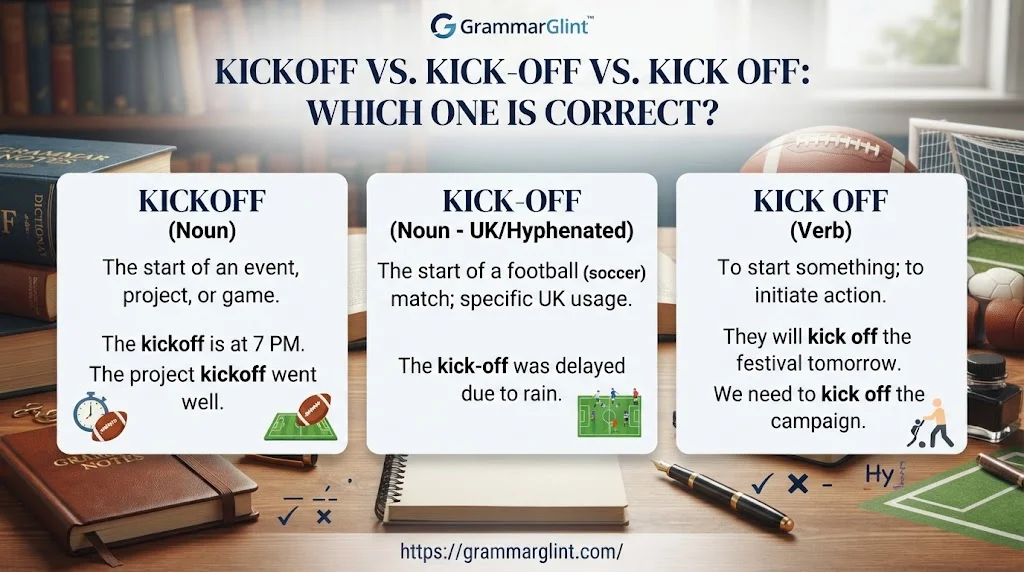
When you see kickoff, kick-off, and kick off, the differences can seem tiny. However, punctuation, spacing, and the hyphenated form can change the part of speech. Kickoff is generally a noun meaning the start or beginning of something. Kick-off is also used as a noun variant. By contrast, kick off is a phrasal verb that means to start something. For example, you might mention the kickoff of a holiday or say that a meeting will kick off at noon.
The confusion often comes from seeing these forms in different print sources, articles, and books. You may wonder which spelling is correct, especially when all three appear in everyday writing. In American football, the kickoff refers to the beginning of a game. The word is also common when discussing sporting events, where the excitement of the crowd adds energy to the occasion.
A simple way to remember the difference is to focus on how the word works in the sentence. Use kickoff or kick-off as a noun when you’re naming an event or its start. Use kick off when you’re describing the action of starting something. Once you understand this pattern, choosing the right form becomes much easier.
| Form | Typical function | Meaning | Example |
| kickoff | Noun in US English | The start of something | The kickoff is at noon. |
| kick-off | Noun, especially UK English | The start of something | The kick-off is at noon. |
| kick off | Verb or phrasal verb | To start something | The meeting will kick off at noon. |
The easiest rule is this: if you’re naming the start, use kickoff in US English. If you’re describing the action of starting, use kick off.
At a Glance
Before getting into the finer points, here’s the distinction that solves most usage questions.
Kickoff Is a Noun in US English
Use kickoff when the word refers to the start of an event, game, campaign, project, or activity.
- The kickoff is scheduled for 8 p.m.
- We attended the project kickoff.
- The campaign kickoff attracted hundreds of people.
- The football kickoff was delayed by rain.
In these examples, kickoff names the beginning of something. It doesn’t describe an action performed by the subject.
For example:
The kickoff is scheduled for 8 p.m.
Here, the word refers to the scheduled start. That’s why it works as a noun.
Kick-Off Is the Common UK Noun Spelling
British English commonly uses kick-off as a noun.
- The kick-off is at 8 p.m.
- We arrived before kick-off.
- The project kick-off takes place tomorrow.
- The campaign’s kick-off attracted considerable attention.
The meaning remains essentially the same as American kickoff. The main difference is the spelling convention.
This distinction matters when you’re writing for a particular audience. If you’re preparing content for American readers, kickoff is generally the better noun form. For British readers, kick-off is commonly preferred.
Kick Off Is the Verb
Use kick off when the expression acts as a verb and means start or begin.
- The game will kick off at 8 p.m.
- The meeting will kick off after lunch.
- The campaign kicked off last week.
- Let’s kick off the discussion with a quick overview.
Notice the spacing. The verb remains two words.
That’s true even when the expression appears in different verb forms:
- kick off
- kicks off
- kicked off
- kicking off
For example:
1.The conference kicks off tomorrow.
2.The conference kicked off yesterday.
3.The conference is kicking off at noon.
The grammatical function determines the form.
What Does “Kickoff” Mean?
Kickoff is a noun that refers to the beginning of something. Its most familiar use comes from sports, particularly football, but modern English uses it much more broadly.
In sports, kickoff can refer to the kick that starts play or the beginning of a game. Outside sports, it can describe the beginning of a project, campaign, event, meeting, or other activity.
Consider these examples:
The kickoff is at 7 p.m.
Here, kickoff names a scheduled event or point in time.
Read More: Point of View: Meaning, Types, and How to Choose the Right One
The tournament kickoff attracted thousands of fans.
Again, kickoff names the beginning of the tournament.
The project kickoff went smoothly.
Now the sports meaning disappears completely. The word refers to the beginning of a project.
That broader meaning explains why kickoff appears so often in workplaces, marketing, politics, education, entertainment, and event planning.
Kickoff as a Sports Noun
In sports, kickoff commonly refers to the beginning of play.
For example:
- The kickoff is at 7:30.
- The referee delayed the kickoff.
- The team scored immediately after the kickoff.
- We arrived ten minutes before kickoff.
The word can refer to the actual kick that starts play or the scheduled beginning of the game, depending on context.
Compare these two sentences:
The kickoff is at 7:30.
Here, the focus is on the scheduled start.
The player took the kickoff.
Here, the focus is closer to the actual sporting action.
The same grammatical principle applies outside sports. If kickoff names the beginning, it’s functioning as a noun.
Kickoff for Projects, Campaigns, and Events
Modern business English has expanded kickoff far beyond the playing field.
Common expressions include:
- project kickoff
- kickoff meeting
- kickoff call
- campaign kickoff
- season kickoff
- sales kickoff
- kickoff event
- kickoff date
- kickoff time
For example:
The project kickoff is scheduled for Monday.
Here, kickoff is a noun. It identifies the beginning of the project.
You could also write:
The project will kick off on Monday.
The meaning remains similar, but the grammar changes. Kick off now acts as the verb.
That small change explains many of the spelling mistakes people make.
What Does “Kick-Off” Mean?
Kick-off usually has the same basic meaning as kickoff when it functions as a noun. The main difference is regional convention.
In UK English, writers commonly use kick-off:
- The kick-off is at 3 p.m.
- We arrived just before kick-off.
- The campaign’s kick-off is tomorrow.
- The project kick-off begins next week.
In US English, kickoff is generally preferred:
- The kickoff is at 3 p.m.
- We arrived just before kickoff.
- The campaign’s kickoff is tomorrow.
- The project kickoff begins next week.
The important point is that these noun forms generally share the same meaning. The spelling reflects regional usage.
Is “Kick-Off” Wrong?
No. Calling kick-off simply “wrong” would oversimplify English usage.
If you’re writing British English, kick-off is an established noun spelling. If you’re writing American English, kickoff is generally the better choice.
Think of it as a regional spelling preference rather than a battle between a correct word and an incorrect one.
English contains many differences between regional varieties. Spelling, punctuation, vocabulary, and usage can vary without making one variety inherently incorrect.
The best approach is consistency.
If an article uses US English, keep the American convention throughout. If a publication follows British English, use its established convention instead.
What Does “Kick Off” Mean?
Kick off is a phrasal verb. In ordinary modern usage, it means to start or begin something.
For example:
- The game will kick off at 7 p.m.
- The meeting kicks off at 10.
- The festival kicked off yesterday.
- The new campaign will kick off next week.
Notice that kick off stays as two words.
You wouldn’t normally write:
- The game will kickoff at 7 p.m. ❌
- The game will kick-off at 7 p.m. ❌
For the verb, the standard form is:
- The game will kick off at 7 p.m. ✅
The noun and verb may sound similar when spoken, but their grammatical roles are different.
“Kick Off” as an Intransitive Verb
An intransitive verb doesn’t require a direct object. In this construction, something simply begins.
The meeting will kick off at noon.
The meeting performs no literal kicking. Kick off simply means begin.
Other examples include:
- The concert kicked off at sunset.
- The conference kicks off tomorrow.
- The tournament will kick off next month.
- The discussion kicked off with a question from the audience.
This use is especially common when talking about scheduled events.
“Kick Something Off” as a Transitive Verb
You can also use kick off with a direct object.
The manager kicked off the meeting.
Here, the manager started the meeting.
Compare that with:
The meeting kicked off at 9 a.m.
The first sentence identifies a person who starts something. The second simply states that something began.
This distinction gives you two useful patterns:
| Pattern | Function | Example |
| Something kicks off | Something begins | The meeting kicks off at 9. |
| Someone kicks something off | Someone starts something | The manager kicks off the meeting. |
This structure works with many nouns:
- kick off a meeting
- kick off a project
- kick off a campaign
- kick off a discussion
- kick off an event
- kick off a presentation
“Kick Off With” Means Start With
Another useful structure is kick off with.
- Let’s kick off with introductions.
- The conference kicked off with a keynote speech.
- The presentation will kick off with three important statistics.
- The workshop kicked off with a short activity.
The phrase means that something begins with a particular element.
For example:
The meeting kicked off with a brief introduction.
This tells you what happened first.
You could also say:
The meeting kicked off at 9 a.m.
That sentence tells you when it began.
The two constructions provide different details while using the same phrasal verb.
Kickoff vs. Kick-Off: US English vs. UK English
Regional usage is one of the most important parts of the kickoff vs. kick-off vs. kick off question.
The distinction becomes easy once you separate the noun from the verb.
US English
In American English, the usual noun is:
kickoff
Examples:
- The kickoff is at 6 p.m.
- We have a project kickoff tomorrow.
- The campaign kickoff begins at noon.
- The season kickoff attracted a large audience.
The verb remains:
kick off
Examples:
- The game will kick off at 6 p.m.
- The project will kick off tomorrow.
- The campaign kicks off next week.
- The event kicked off yesterday.
UK English
British English commonly uses:
kick-off
as the noun.
Examples:
- The kick-off is at 6 p.m.
- We arrived before kick-off.
- The project kick-off is tomorrow.
- The campaign kick-off begins next week.
The verb remains:
kick off
Examples:
- The game will kick off at 6 p.m.
- The project will kick off tomorrow.
- The campaign will kick off next week.
- The event kicked off yesterday.
Here’s the distinction in one table:
| Meaning | US English | UK English |
| Noun | kickoff | kick-off |
| Verb | kick off | kick off |
| Start of a game | kickoff | kick-off |
| Start of a project | project kickoff | project kick-off |
| Start an activity | kick off an activity | kick off an activity |
The important point is that the verb doesn’t become one word just because you’re writing British English.
Kickoff vs. Kick Off: Noun or Verb?
This is the most useful distinction to remember.
Ask yourself one question:
Am I naming the beginning, or am I describing the act of beginning?
If you’re naming the beginning in US English, use kickoff.
If you’re describing the action of starting, use kick off.
Compare These Sentences
The kickoff is at 8 p.m.
Here, kickoff is a noun. It names the scheduled start.
The game will kick off at 8 p.m.
Here, kick off is a verb. It tells you what the game will do.
Now consider a workplace example:
The project kickoff is Monday.
Noun.
The project will kick off Monday.
Verb.
Another example:
We attended the campaign kickoff.
Noun.
The campaign will kick off tomorrow.
Verb.
The meaning is closely connected, but the grammatical structure determines the spelling.
The “Start” Test
Here’s a handy shortcut.
Replace kickoff or kick off with start.
If start works as a noun, use kickoff in US English.
The start is at 8 p.m.
The kickoff is at 8 p.m.
If start works as a verb, use kick off.
The game will start at 8 p.m.
The game will kick off at 8 p.m.
This isn’t a perfect test for every sentence, but it’s remarkably useful in everyday writing.
Another quick test is to ask whether you could put the, a, or an before the word.
The kickoff was delayed.
That signals noun usage.
You can’t normally write:
The game will the kickoff at 8.
The verb requires the two-word form:
The game will kick off at 8.
Kickoff vs. Kick Off in Workplace Writing
The workplace is where this distinction causes some of the most frequent confusion.
Terms such as kickoff meeting and project kickoff are common business expressions. They refer to meetings or events that formally begin projects, campaigns, initiatives, or collaborations.
Project Kickoff
Project kickoff is a noun phrase in US English.
The project kickoff is scheduled for Tuesday morning.
Here, project modifies kickoff, and kickoff names the event.
Now change the sentence:
The team will kick off the project Tuesday morning.
The phrase has become verbal. Kick off describes the action of starting the project.
Both sentences communicate nearly the same idea. Their structures are different.
Kickoff Meeting
A kickoff meeting is a meeting held at the beginning of a project or initiative.
A typical kickoff meeting may establish:
- project goals
- roles and responsibilities
- deadlines
- deliverables
- communication channels
- risks and constraints
- decision-making processes
- immediate next steps
For example:
The marketing team held a kickoff meeting before launching the campaign.
In US English, kickoff is written as one word here.
British English may use:
The marketing team held a kick-off meeting before launching the campaign.
Again, the regional convention changes the noun spelling. The underlying meaning remains the same.
Kickoff Call
A kickoff call usually refers to an introductory meeting conducted by phone or video conference.
For example:
We scheduled a kickoff call with the client.
Compare it with:
We will kick off the client project tomorrow.
The first sentence names an event. The second describes an action.
Kickoff Event
The same principle applies to broader events.
The annual kickoff event takes place Friday.
Here, kickoff is a noun.
But:
The annual conference will kick off Friday.
Here, kick off is the verb.
Common Mistakes
These forms become much easier when you see the mistakes side by side.
Mistake: “The Game Will Kickoff at 8.”
Incorrect in standard US usage.
Write:
The game will kick off at 8.
Why? Because kick off is functioning as a verb.
Mistake: “The Kick Off Is at 8.”
In US English, the noun should normally be written:
The kickoff is at 8.
In UK English, you may write:
The kick-off is at 8.
The two-word kick off form isn’t the usual US noun spelling.
Mistake: “The Meeting Will Kickoff the Event.”
Write:
The meeting will kick off the event.
The expression is functioning as a verb phrase.
The same pattern applies to:
The speaker will kick off the presentation.
The director will kick off the campaign.
The host will kick off the discussion.
Mistake: Assuming “Kick-Off” Is Always Incorrect
That’s not accurate.
Kick-off is a recognized noun form, particularly in British English.
If you’re writing American English, use kickoff as the noun. If you’re writing British English, kick-off is a natural choice.
Mistake: Mixing Regional Styles
A sentence such as this isn’t grammatically broken:
The kick-off is at noon and the campaign will kick off tomorrow.
The noun and verb forms are doing different jobs.
However, if you’re writing specifically for a US audience, you would normally choose:
The kickoff is at noon and the campaign will kick off tomorrow.
Consistency makes professional writing look cleaner.
Examples
Seeing the forms side by side makes the pattern much easier to remember.
| Sentence | Correct form | Why |
| The kickoff is at 7 p.m. | kickoff | US noun |
| The game will kick off at 7 p.m. | kick off | Verb |
| We planned the project kickoff. | kickoff | US noun |
| We will kick off the project tomorrow. | kick off | Verb |
| The campaign kickoff was successful. | kickoff | US noun |
| The campaign will kick off Monday. | kick off | Verb |
| The kick-off is at 3 p.m. | kick-off | UK noun |
| The match will kick off at 3 p.m. | kick off | Verb |
Example Pair: Sports
Noun:
The kickoff is scheduled for 8 p.m.
Verb:
The match will kick off at 8 p.m.
The first sentence names the start. The second describes the action.
Example Pair: Business
Noun:
The project kickoff is tomorrow.
Verb:
The team will kick off the project tomorrow.
Example Pair: Campaigns
Noun:
The campaign kickoff drew a large crowd.
Verb:
The campaign will kick off next week.
Example Pair: Events
Noun:
The festival kickoff included live music.
Verb:
The festival will kick off with a concert.
Notice the recurring pattern. The noun identifies the beginning as a thing or event. The verb describes beginning as an action.
Is “Kickoff” One Word or Two?
In US English, kickoff is one word when it functions as a noun.
- kickoff
- kickoffs
Examples:
- The kickoff starts at noon.
- Several kickoffs are scheduled throughout the season.
- We attended three project kickoffs this month.
However, kick off remains two words when it’s a verb.
- kick off
- kicks off
- kicked off
- kicking off
Examples:
- The event kicks off tomorrow.
- The event kicked off yesterday.
- The event is kicking off at noon.
The word form changes with grammatical function, not merely with pronunciation.
Why the Difference Matters
Consider these two sentences:
The kickoff begins at 9.
The event will kick off at 9.
Both are perfectly understandable, but they use different grammatical structures.
In the first sentence, kickoff is the subject and therefore a noun.
In the second, kick off forms the verb phrase.
This distinction becomes especially important in edited writing because spelling errors can make otherwise polished content look careless.
Is “Kick-Off” Correct in American English?
Kick-off isn’t an invented or meaningless spelling. It’s a recognized form of the expression. However, if the goal is conventional US English, kickoff is generally the better noun choice.
This distinction becomes particularly important when you’re preparing:
- website copy
- business documents
- academic papers
- marketing materials
- press releases
- newsletters
- professional emails
If an organization follows a specific style guide, that guide should take priority. Otherwise, kickoff is the standard US noun form while kick off remains the standard verb form.
The important thing is consistency.
Don’t switch between kickoff and kick-off randomly in the same document unless you’re deliberately discussing regional usage.
A Practical Case Study: Choosing the Right Form
Imagine a company is launching a new software product.
The company schedules a meeting for Monday.
You could write:
The product kickoff is Monday.
That’s correct because kickoff is a noun. It names the starting event.
Now suppose you want to describe what the team will do:
The team will kick off the product launch Monday.
That’s correct because kick off is a verb phrase.
Now imagine the company is using British English:
The product kick-off is Monday.
The noun changes to the hyphenated British form.
But the verb remains:
The team will kick off the product launch Monday.
This example shows why trying to memorize one spelling for every situation doesn’t work. Grammar and regional usage both matter.
What the Case Study Teaches
The three forms aren’t interchangeable.
| Situation | Correct form |
| Naming a US project start | project kickoff |
| Describing the act of starting | kick off the project |
| Naming a UK project start | project kick-off |
When in doubt, identify the part of speech first. Then consider the regional style.
A Second Case Study: Sports Writing
Suppose you’re writing a US sports article.
You write:
The kickoff is scheduled for 7:30 p.m.
Correct.
Now write:
The game will kick off at 7:30 p.m.
Also correct.
Now change the sentence to British English:
The kick-off is scheduled for 7:30 p.m.
Correct for that regional convention.
But this remains:
The game will kick off at 7:30 p.m.
The verb doesn’t become kickoff.
That’s the key lesson: don’t let the noun spelling influence the verb spelling.
What About “Kickoff Meeting” vs. “Kick-Off Meeting”?
Both forms can appear in real English, but regional style helps determine which one you should choose.
For general US English, prefer:
kickoff meeting
For British English, you’ll commonly see:
kick-off meeting
The underlying meaning doesn’t change. Both refer to a meeting held at the beginning of a project, activity, or initiative.
The important point is not to confuse this compound noun with the verb:
We have a kickoff meeting tomorrow. ✅
We will kick off the meeting tomorrow. ✅
The first sentence names a type of meeting. The second describes an action.
Why “Kickoff Meeting” Is a Noun Phrase
In kickoff meeting, the word kickoff modifies meeting.
The phrase identifies a particular type of meeting: one held to begin something.
Compare:
- project kickoff
- kickoff meeting
- kickoff event
- kickoff call
In each case, kickoff acts as a noun or noun modifier.
By contrast:
We will kick off the meeting at 10.
Here, kick off is a verb phrase.
That grammatical difference is more useful than trying to memorize dozens of individual phrases.
Why Does English Use Different Forms for Related Words?
English frequently turns phrases into single words over time. A phrase may begin as two words, develop a hyphenated form, and eventually become a solid compound in some varieties of English.
Kickoff illustrates this process well.
The expression has long been associated with sports, where the literal action of kicking begins play. From there, the figurative meaning developed naturally: if something kicks off, it begins.
That’s why the word now appears in contexts far removed from sports.
A business project can kick off.
A conference can kick off.
A political campaign can kick off.
A festival can kick off.
A discussion can kick off.
The meaning has broadened while the grammatical distinction has remained useful.
Why Pronunciation Doesn’t Solve the Problem
When spoken aloud, kickoff and kick off can sound almost identical.
That’s why relying only on pronunciation can lead to mistakes.
You may hear:
The project will kick off tomorrow.
and mistakenly write:
The project will kickoff tomorrow.
The ear doesn’t always reveal the grammatical boundary.
Writing does.
The space tells the reader that kick off is functioning as a phrasal verb.
The solid spelling kickoff tells the reader that you’re using the noun form in US English.
Quick Decision Guide
When you’re stuck, use this three-step check.
Are You Using the Expression as a Verb?
Use:
kick off
The conference will kick off tomorrow.
Are You Using It as a Noun in US English?
Use:
kickoff
The conference kickoff is tomorrow.
Are You Using It as a Noun in UK English?
Use:
kick-off
The conference kick-off is tomorrow.
Here’s the shortcut worth remembering:
US noun = kickoff
UK noun = kick-off
Verb = kick off
That rule handles most everyday cases.
A Simple Grammar Diagram
The relationship can be visualized like this:
KICK OFF
│
┌─────────┴─────────┐
│ │
NOUN VERB
│ │
Regional spelling Two words
│ │
┌─────┴─────┐ │
│ │ │
US English UK English │
│ │ │
kickoff kick-off kick off
The diagram gives you the core rule at a glance.
Noun:
- US → kickoff
- UK → kick-off
Verb:
- US → kick off
- UK → kick off
Read More: Goodmorning or Good Morning: Which Is Correct?
FAQs
1. Is “kickoff” one word?
Yes. Kickoff is commonly written as one word when used as a noun or adjective.
2. Is “kick-off” correct?
Yes. Kick-off is a legitimate hyphenated form, especially in some styles and contexts.
3. Is “kick off” two words?
Yes. Kick off is written as two words when it functions as a verb.
4. What does “kickoff” mean?
Kickoff usually means the start or beginning of an event, activity, or process.
5. What does “kick off” mean?
Kick off means to start something. It is a phrasal verb.
6. Is “kickoff” a noun or a verb?
Kickoff is primarily a noun. For example, “The kickoff begins at noon.”
7. Is “kick off” a noun?
No. Kick off is normally used as a phrasal verb, such as “The meeting will kick off at noon.”
8. Which form is used in American football?
Kickoff is commonly used as a noun for the beginning of play in American football.
9. Are “kickoff” and “kick-off” synonyms?
They can have the same meaning when used as nouns. The main difference is their spelling.
10. How can I remember the difference?
Think of kickoff and kick-off as noun forms, while kick off is the verb form used for an action.
Conclusion
Kickoff, kick-off, and kick off look almost identical, but their grammatical roles are different. Kickoff and kick-off can function as nouns referring to the start of something, while kick off works as a phrasal verb meaning to start something. Paying attention to the spelling and the way the word functions in a sentence makes the difference much easier to understand.
When you’re writing about a meeting, event, holiday, or American football game, simply check whether you’re naming the start or describing the action. If you’re naming it, kickoff or kick-off may fit. If you’re describing the action of starting, kick off is the form you need. Once this small pattern becomes familiar, these three forms are much less confusing.

For Shafiq ur Rehman, writing is an art form and grammar is the toolbox that makes it beautiful. As a dedicated content writer at Grammar Lantern, Shafiq approaches every topic like an architect carefully laying down strong foundations of understanding before adding the finer details. He loves diving into the trickiest grammar points and resurfacing with simple, bite-sized takeaways that anyone can grasp. When he’s not crafting articles, you’ll likely find him strategizing over a game of chess, exploring dusty local bookshops, or quietly jotting down poetic observations in his notebook.



[…] Read More: Kickoff vs. Kick-Off vs. Kick Off: Which One Is Correct? […]