The Submission vs Submittion question often appears when you are writing quickly and suddenly wondered which word looks correct. The correct spelling is submission, not submittion. This confusion can happen often, especially when writers are testing their English spelling. An extra letter can easily slip into your writing, making a familiar word seem unfamiliar.
The good news is that this common mistake is easy to fix when you understand the pattern. Submission is formed from the verb submit, but the noun does not keep an extra “t.” When I check spelling, I find that connecting the word with its noun form makes it easier to remember. This simple approach can help you avoid the mistake and feel more confident.
English spelling can sometimes feel almost right even when it is wrong. If you have paused, doubted yourself, or felt stuck mid-sentence, take a moment to think about the spelling. Every time you use submission, remember the correct form. This habit helps you write clearly, professionally, and confidently, while making the word easier to recognize.
Which One Is Correct?
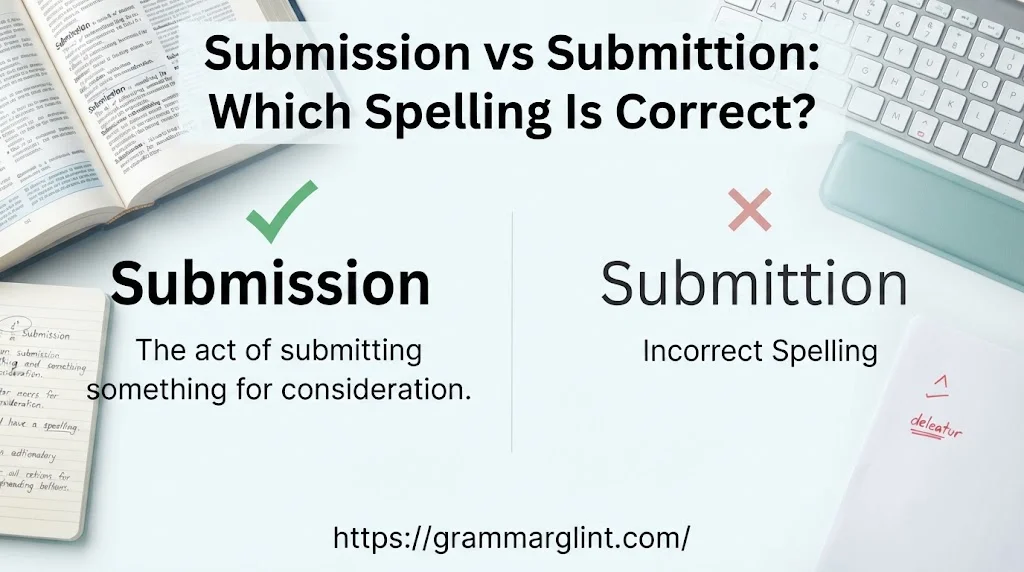
The correct spelling is submission.
Submittion is not the standard noun form of submit. Although it may look logical, it doesn’t follow the established spelling of the English word.
Consider these examples:
- Correct: Please upload your submission before midnight.
- Incorrect: Please upload your submittion before midnight.
- Correct: The committee reviewed every submission.
- Incorrect: The committee reviewed every submittion.
The reason for the confusion is easy to understand. The verb is submit, and many English nouns ending in -tion come from verbs.
For example:
- educate → education
- inform → information
- communicate → communication
- organize → organization
That pattern can tempt writers to form submit + tion = submittion.
Unfortunately, English doesn’t work that mechanically. The established noun is submission, with -ssion at the end.
Remember: submit is the verb. Submission is the noun.
This small spelling difference can make a big difference in academic papers, emails, applications, reports, and other formal writing.
What Does Submission Mean?
Submission is a noun with several related meanings. The exact meaning depends on the context.
The most common meaning involves something that someone presents or sends for consideration, review, approval, or evaluation.
For example:
The student uploaded her assignment submission before the deadline.
Here, submission refers to the assignment that the student sent.
The word can also describe the act of submitting something.
The online system confirmed the submission of the application.
In this sentence, submission refers to the act or process of sending the application.
Submission Can Mean Something That Was Submitted
In many situations, submission refers directly to the material someone sends.
For example:
- The editor received five article submissions.
- The competition attracted hundreds of submissions.
- The committee rejected the submission because it arrived late.
- Your submission must include three supporting documents.
Here, the word doesn’t simply describe the act of sending something. It can refer to the document, entry, application, proposal, or piece of work itself.
That’s why phrases such as essay submission, application submission, and manuscript submission are so common.
Submission Can Also Mean the Act of Submitting
The word can describe an action or process as well.
For example:
The submission of the final report took place on Monday.
In this sentence, submission means the act of formally presenting the report.
This distinction becomes clearer when you compare these two sentences:
- The submission was excellent.
- The submission of the report took five minutes.
The first sentence focuses on the thing submitted. The second focuses on the act of submitting it.
Submission Has Another Meaning
Submission can also describe the act of yielding to another person’s authority, control, or judgment.
For example:
The agreement required the submission of the parties to the court’s jurisdiction.
This meaning is more formal and appears in legal, political, historical, and social contexts.
So, submission isn’t limited to school assignments or online forms. Its meaning changes according to the situation.
Why Is “Submittion” Incorrect?
The spelling submittion seems reasonable at first glance. After all, submit ends in t, and the noun seems to need -tion.
That’s where the trap lies.
English contains many word-formation patterns, but they aren’t perfectly predictable. A verb doesn’t always produce its noun by simply adding a suffix to its unchanged spelling.
The correct relationship is:
submit → submission
Not:
submit → submittion
The spelling changes as the word moves from the verb to the noun.
Think of it like changing the shape of a key. The original key and the new key belong to the same family, but they don’t have exactly the same shape.
Read More: Chose vs. Chosen: Which Is Correct? A Complete Guide
The Spelling Pattern to Remember
The easiest way to remember the correct spelling is to focus on the ending:
submission
not
submittion
The correct word contains:
- sub
- mis
- sion
Put together:
sub + mis + sion = submission
The spelling submittion incorrectly keeps the t before -tion.
Submission Spelling: A Simple Breakdown
If the spelling keeps tripping you up, break the word into recognizable parts.
Correct
submission
Incorrect
submittion
Now compare the middle and ending:
submis + sion ✅
submitt + ion ❌
You don’t need to memorize a complicated linguistic rule. Instead, remember the complete noun as a word family:
- submit
- submitted
- submitting
- submission
Each word serves a different grammatical purpose.
Submit vs Submission
Understanding the difference between submit and submission makes the spelling much easier.
Submit is a verb. It describes an action.
Submission is a noun. It names the act or the thing involved in that action.
Compare the following:
| Word | Function | Example |
| Submit | Verb | Please submit your assignment. |
| Submitted | Past-tense/past-participle form | She submitted her application. |
| Submitting | Present participle/gerund | He is submitting the form now. |
| Submission | Noun | Her submission was accepted. |
This distinction is useful because writers sometimes focus so heavily on spelling that they overlook grammar.
Submit
Use submit when someone performs the action.
Please submit your application by Friday.
Submitted
Use submitted when the action has already happened.
She submitted the application yesterday.
Submitting
Use submitting when the action is happening or functions as a gerund.
He is submitting his paper now.
Submission
Use submission when you need a noun.
His submission was accepted.
A quick test can help:
If you can replace the word with send, you probably need the verb submit.
If you can replace it with the thing sent or the act of sending, submission may be the better choice.
Submission vs Submittion Examples
Real examples make the distinction much easier to remember.
Academic examples
- The submission deadline is Friday.
- Your assignment submission must be uploaded through the student portal.
- The professor reviewed every submission.
- Late submission may result in a penalty.
- The student received confirmation after completing the submission.
Workplace examples
- The proposal submission is due tomorrow.
- We received your submission this morning.
- The review team accepted the submission.
- Please check the document before submission.
- The final submission included all required attachments.
Publishing examples
- The magazine accepts online submissions.
- Her manuscript is ready for submission.
- The editor rejected the submission after reviewing it.
- Writers should prepare their work carefully before submission.
Online forms
- The website confirmed the form submission.
- You should receive an email after submission.
- The system rejected the submission because one field was incomplete.
Incorrect “Submittion” Examples and Their Corrections
The easiest way to spot the problem is to see the incorrect spelling beside the correct one.
| Incorrect | Correct |
| Your submittion was received. | Your submission was received. |
| The submittion deadline is tomorrow. | The submission deadline is tomorrow. |
| Please complete your submittion. | Please complete your submission. |
| The professor reviewed my submittion. | The professor reviewed my submission. |
| I made the submittion yesterday. | I made the submission yesterday. |
| The online submittion failed. | The online submission failed. |
Notice something important: the rest of each sentence can remain exactly the same. The spelling error occurs specifically in the noun.
Submission vs Submitting
Submission and submitting are related, but they aren’t interchangeable.
The difference comes down to grammar.
Submission is a noun.
Submitting is the -ing form of the verb submit.
Compare:
The submission was successful.
Here, submission functions as a noun.
She is submitting the application.
Here, submitting describes an action.
Another comparison makes the distinction clearer:
| Sentence | Correct word | Why? |
| Please ___ the form. | submit | The sentence needs a verb. |
| She is ___ the form. | submitting | The sentence describes an ongoing action. |
| The ___ was successful. | submission | The sentence needs a noun. |
| He ___ the form yesterday. | submitted | The sentence describes a completed action. |
This is more than a spelling issue. It’s also a matter of choosing the correct grammatical form.
Submission vs Submittal
Here’s another distinction worth knowing: submittal is a real word.
That makes it very different from submittion.
Both submission and submittal can refer to something submitted. However, they aren’t used with exactly the same frequency or in exactly the same settings.
Submission is the broader and more familiar term.
Submittal often appears in specialized professional or technical contexts. For example, construction and engineering documents may use submittal when referring to materials, drawings, product information, or documents presented for review.
| Word | Meaning | Common context |
| Submission | The act of submitting or something submitted | General, academic, business, legal, publishing |
| Submittal | Something formally submitted for review | Technical and professional settings |
| Submittion | Incorrect spelling | Avoid |
For everyday writing, submission is usually the safest choice.
Example:
Please send your submission before the deadline.
That sentence sounds natural in almost any general context.
In a highly specialized construction document, however, you might encounter:
The contractor prepared the required submittals for review.
The important point is that submittal is not the correct spelling of submittion. They’re separate words.
Common Misspellings
Submittion isn’t the only spelling mistake people make.
Other incorrect forms can include:
- submittion ❌
- submition ❌
- submisson ❌
- submisison ❌
The standard spelling is:
- submission ✅
The mistake often happens because several letters appear close together.
The ending -ssion is especially easy to mistype. Writers may remove one s, insert an unnecessary t, or switch the order of letters.
Why These Errors Happen
English spelling doesn’t always match pronunciation perfectly.
When you say submission, the ending doesn’t sound like the letters -tion in the way a learner might expect from the verb submit. The pronunciation and spelling therefore don’t provide a simple one-to-one relationship.
That makes visual memory useful.
Instead of trying to rebuild the word every time, remember:
submission = sub + mission
That little connection can save you from the submittion trap.
A Simple Trick to Remember the Correct Spelling
Here’s one of the easiest memory tricks:
Think “mission”
Look at the word:
submission
You can visually connect it with:
sub + mission
The word contains mission after sub.
So when you’re unsure, don’t think:
submit + tion
Think:
sub + mission
That gives you:
submission
Another Memory Trick
Remember this short contrast:
Submit it. Make a submission.
For example:
Submit your paper before Friday.
Your submission must follow the formatting rules.
The first word describes the action. The second names the thing or process.
In Academic Writing
Few contexts use the word submission more frequently than education.
Students regularly submit:
- Assignments
- Essays
- Research papers
- Theses
- Projects
- Presentations
- Applications
- Discussion posts
You might therefore encounter phrases such as:
- assignment submission
- paper submission
- thesis submission
- online submission
- late submission
- final submission
- submission deadline
Consider this sentence:
Students must complete their final submission by 11:59 p.m. on Friday.
Here, submission identifies the work that students must provide or the process of providing it.
A common mistake would be:
Students must complete their final submittion by Friday.
The sentence contains a straightforward spelling error. Submission fixes it.
In Professional and Business Writing
Businesses also use submission frequently.
Companies submit proposals, applications, reports, bids, forms, and other documents.
For example:
The company sent its proposal submission before the deadline.
However, context sometimes determines whether submission itself is necessary. In many cases, a simpler construction sounds more natural:
The company submitted its proposal before the deadline.
This illustrates an important writing principle: correct spelling doesn’t automatically make a sentence the best sentence.
You should also choose between the verb and noun form based on what you want to emphasize.
Compare the Two
The team submitted the proposal on Monday.
This sentence focuses on the action.
The team’s submission arrived on Monday.
This sentence focuses on the proposal or the act of submitting it.
Both can be correct. The surrounding sentence determines which form works best.
In Publishing
Publishing uses submission as a standard term.
Authors may prepare:
- Manuscript submissions
- Article submissions
- Story submissions
- Book proposals
- Journal submissions
- Competition submissions
For example:
The journal accepts research paper submissions throughout the year.
Here, submissions refers to papers sent to the journal for consideration.
Another example:
Her manuscript is ready for submission.
In this case, the noun describes the process or act of sending the manuscript to the publisher or editor.
You may also see:
Submission guidelines
These are instructions that explain what an author needs to provide.
Such guidelines might cover:
- Word count
- File format
- Formatting
- Deadlines
- Required information
- Supporting documents
Read More: Begun vs. Began: Which Is Correct? Helpful Examples
In Legal and Formal Language
The word also appears in formal legal contexts.
In legal writing, submission can refer to material, arguments, documents, or statements presented for consideration.
For example:
The court considered the written submissions from both parties.
The word can also describe an act of yielding to authority or accepting a particular legal process.
This broader meaning explains why submission isn’t simply a technical term for uploading a file.
Its core idea is presenting, offering, or yielding something for consideration or acceptance, depending on context.
A Practical Case Study
Imagine a university student named Sara preparing a final research paper.
Her professor says:
“Submit your paper through the online portal by Thursday.”
Sara completes the paper and uploads the file.
The action is:
Sara submits the paper.
Once the upload succeeds, she receives a confirmation:
“Your submission has been received.”
Now notice the difference:
- submit = the action Sara performs
- submitted = the action after it happens
- submitting = the action while it happens
- submission = the noun referring to the act or item submitted
If Sara writes:
“My submittion was successful.”
The sentence contains a spelling error.
The correct version is:
“My submission was successful.”
This simple scenario captures the difference better than memorizing isolated definitions.
Is “Submittion” Ever Acceptable?
In standard English writing, submittion should not be used as the noun form of submit.
If you’re writing an:
- Academic assignment
- Resume
- Cover letter
- Business email
- Research paper
- Application
- Report
- Blog post
- Formal document
use submission.
You don’t need to treat submittion as a stylistic alternative. It isn’t simply a less common version of the same word.
The correct choice is straightforward:
submission ✅
submittion ❌
Quick Reference
When you’re in a hurry, this is all you need to remember:
| Question | Answer |
| Correct spelling? | Submission |
| Incorrect spelling? | Submittion |
| Verb? | Submit |
| Past tense? | Submitted |
| -ing form? | Submitting |
| Noun? | Submission |
| Related specialized noun? | Submittal |
| Best spelling memory trick? | sub + mission |
FAQs
1. Is “submission” or “submittion” correct?
Submission is the correct spelling. Submittion is a misspelling and should be avoided in formal writing.
2. Why is “submittion” incorrect?
The noun form of submit is submission. It does not add an extra “t” before “ion.”
3. What does “submission” mean?
Submission can mean the act of submitting something, such as an assignment, application, proposal, or document.
4. Is “submission” a noun?
Yes. Submission is a noun formed from the verb submit.
5. What is the verb form of “submission”?
The verb form is submit. For example, you can submit an assignment before the deadline.
6. Can I use “submittion” in formal writing?
No. Use submission instead. “Submittion” is not the standard English spelling.
7. How can I remember the spelling of “submission”?
Remember the pattern submit → submission. The noun changes slightly instead of simply adding “tion” to the unchanged verb.
8. Is “submission” used in professional English?
Yes. It is common in professional, academic, legal, business, and administrative writing.
9. What is an example of “submission”?
You might write, “The submission must be completed before Friday.” Here, submission refers to something being submitted.
10. What is the easiest way to avoid this spelling mistake?
Whenever you hesitate between submission and submittion, choose submission. Repeated exposure and practice can make the correct spelling automatic.
Conclusion
Submission is the correct spelling, while submittion is a common spelling mistake. Although the incorrect version may look natural at first, remembering the relationship between submit and submission makes the difference easier to understand.
Once you recognize this spelling pattern, you can avoid unnecessary confusion in academic, professional, and everyday writing. Using submission consistently will also help your writing look more accurate, polished, and confident.

Muhammad Haroon is the voice behind many of the clear, practical grammar guides you’ll find on Grammar Lantern. With a strong background in content writing and a genuine love for the English language, Haroon specializes in breaking down intimidating grammar topics into simple, digestible lessons. His goal is simple: to empower readers to write with confidence and clarity. Whether he’s explaining tricky tenses or demystifying punctuation, Haroon approaches each topic with patience, precision, and a touch of warmth—because he knows that learning grammar is a journey, not a race.