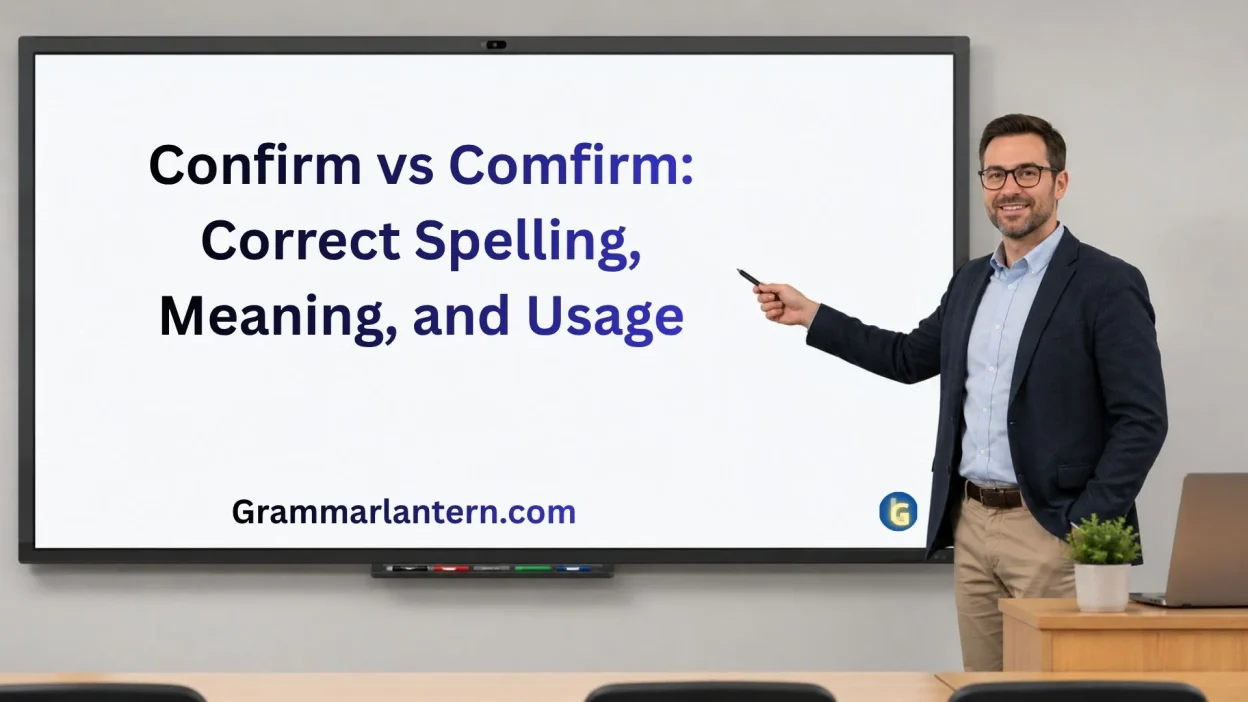
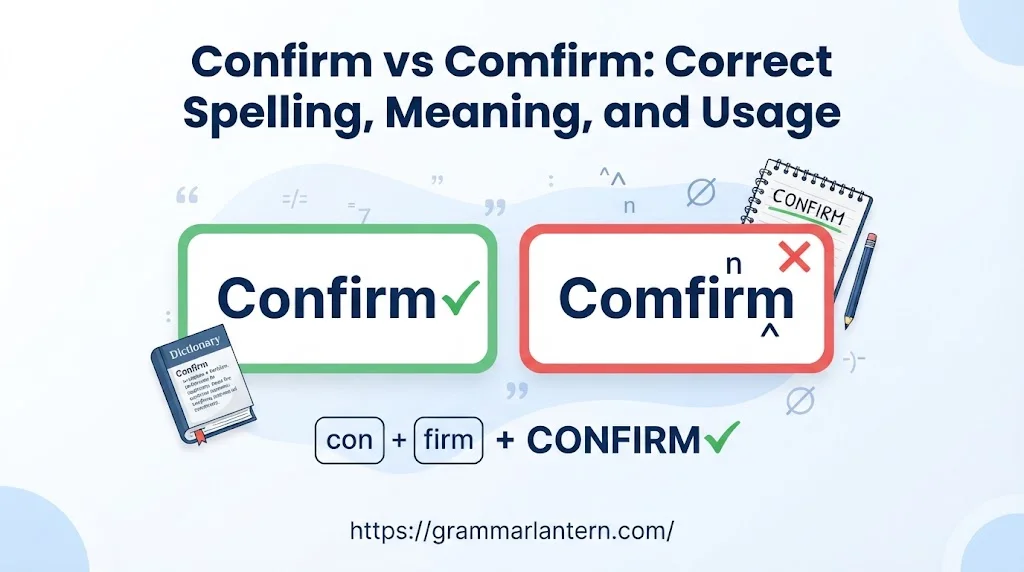
When people compare Confirm vs Comfirm, the first thing to know is that Comfirm is a misspelling of Confirm. Confirm means to verify, approve, or make something certain. You can confirm an appointment, an order, a plan, or a fact. For example, “Please confirm your appointment” means you should verify that the arrangement is correct. In my experience, this is the mistake people make most often because the two spellings look almost identical.
Conform, however, is a different word with a different meaning. It means to follow rules, standards, customs, or expectations. Someone may conform to workplace policies, rules and regulations, or social customs. It can also mean behaving like the majority or following a model that has been provided. For instance, students may need to conform to school requirements, while submissions must conform to specific standards.
A simple way to remember the difference is this: confirm is about checking or making something certain, while conform is about following something. If you want to verify a fact, use confirm. If you want to say that someone follows a rule or standard, use conform. Keeping this distinction in mind can prevent a surprisingly common spelling and usage mistake.
Quick Answer
Confirm is the correct spelling. Comfirm is incorrect.
The verb confirm means to establish that something is true, accurate, certain, or arranged. You can confirm information, confirm a date, confirm an appointment, or confirm that something happened.
| Word | Correct spelling? | Meaning | Example |
| Confirm | Yes | To verify, establish, or make something definite | Please confirm the meeting time. |
| Comfirm | No | Misspelling of confirm | Please comfirm the meeting time. ❌ |
A simple way to remember the spelling is to divide confirm into two parts:
con + firm = confirm
The word contains firm, not mfirm.
Remember: If you’re deciding between confirm and comfirm, choose confirm every time.
What Does Confirm Mean?
Confirm is a verb used when you establish that something is true, correct, definite, or valid. It often involves checking information and removing uncertainty.
For example, imagine that someone tells you the meeting starts at 3:00 p.m. You check the official schedule and discover that the meeting really does begin at 3:00 p.m. You have confirmed the time.
The word can also describe making an arrangement definite. If you tell a hotel that you’ll arrive on Friday and the hotel records your reservation, the booking becomes confirmed.
In everyday English, confirm commonly relates to:
- Information
- Facts
- Dates
- Times
- Appointments
- Reservations
- Decisions
- Plans
- Addresses
- Details
- Results
- Suspicions
- Statements
- Arrangements
Examples of Confirm in Sentences
Here are some natural examples:
- Please confirm your email address.
- Can you confirm the meeting time?
- The manager confirmed the appointment.
- We need to confirm the reservation.
- She called to confirm the details.
- The test results confirmed his diagnosis.
- Please confirm that you received the document.
- I contacted the office to confirm the schedule.
- The evidence confirmed what investigators already suspected.
- They sent a message confirming the delivery date.
Notice how confirm doesn’t always mean simply “check.” In many contexts, it means checking something and then establishing it as certain.
Read More: Stub vs. Stab: Meaning, Difference, Pronunciation, and Usage
Is Comfirm a Correct Word?
No. Comfirm is not the standard spelling of the English word.
When you see comfirm, it almost always represents a spelling mistake involving confirm. The intended meaning is normally obvious, but the spelling remains incorrect.
For example:
Incorrect:
Please comfirm your attendance.
Correct:
Please confirm your attendance.
The same problem appears in different forms:
- comfirm ❌
- comfirmed ❌
- comfirming ❌
- comfirmation ❌
The correct forms are:
- confirm ✅
- confirmed ✅
- confirming ✅
- confirmation ✅
This distinction matters more in formal writing. A typo in a casual text may go unnoticed, but repeated spelling errors can make professional communication look rushed.
Why Do People Spell Confirm as Comfirm?
The mistake isn’t completely random. There are several reasons comfirm can look or feel plausible.
The Pronunciation Trap
When people say confirm quickly, the sounds can blend together. The transition between the final sound of con and the following f may not feel as clear as the written spelling suggests.
That can encourage a writer to substitute m for n.
The same general phenomenon appears in many spelling errors. People often write a word according to how they think it sounds rather than according to its established spelling.
However, pronunciation isn’t a reliable spelling guide in English. The language contains countless examples where letters don’t map neatly onto individual sounds.
Fast Typing Can Cause the Error
Typing quickly creates another opportunity for comfirm to appear.
Your fingers may move toward a familiar letter pattern before your brain fully processes the spelling. If you’re writing quickly, especially on a phone, one incorrect letter can slip through.
This becomes particularly common when a word has a familiar-looking alternative.
A quick spell-check can catch the error. Still, understanding the correct spelling is better than relying entirely on software.
The Brain Predicts Familiar Patterns
Your brain doesn’t read every word letter by letter. It recognizes familiar patterns and often predicts what comes next.
Because comfirm looks visually plausible at a glance, you might miss the error during proofreading.
That’s why reading slowly can help. When accuracy matters, don’t rely only on how the whole word looks. Check the critical letter sequence.
How to Remember It
The easiest way to remember confirm is to recognize its internal structure.
The Correct Letter Sequence
Think of the word like this:
CON + FIRM = CONFIRM
The second part is firm.
That gives you a useful visual anchor:
confirm → firm
You don’t need to memorize every letter independently. Instead, remember the word as a combination of familiar pieces.
A Simple Memory Trick
Use this sentence:
“I want to make the information firm, so I confirm it.”
The connection between confirm and firm can make the spelling easier to recall.
Another quick trick is to focus on the middle:
con-FIRM
If you can remember firm, you’re much less likely to type comfirm.
Confirm: Meaning and Grammar
Confirm functions primarily as a verb. It can appear in several useful grammatical patterns.
Understanding these patterns helps you use the word naturally rather than simply spelling it correctly.
Confirm Something
The simplest structure is:
confirm + noun
Examples:
- Please confirm your address.
- We need to confirm the date.
- She called to confirm the appointment.
- The company emailed us to confirm the order.
Here, the object after confirm identifies the information or arrangement being established.
Confirm That Something Is True
You can also use:
confirm + that + clause
Examples:
- Please confirm that you received the package.
- The manager confirmed that the meeting was canceled.
- The results confirmed that the system was working correctly.
This structure works especially well when you need to report a complete fact.
Confirm Whether or If Something Is True
When you’re asking someone to establish which possibility is correct, you can use whether or if.
Examples:
- Please confirm whether the office is open.
- Could you confirm if the payment went through?
- We need to confirm whether the information is accurate.
In formal writing, whether can sometimes sound more precise. However, if is common in everyday communication.
Confirm With Someone
The phrase confirm with means to check information with another person or group.
Examples:
- I’ll confirm with the manager.
- Please confirm with your teacher before submitting the form.
- She confirmed the details with the customer.
This structure emphasizes the person you contact during the checking process.
Confirm vs Verify vs Validate
These three words overlap, but they aren’t identical.
Confirm usually means establishing that something is true, correct, or definite.
Verify emphasizes checking accuracy, authenticity, or truth.
Validate often means establishing that something meets a particular standard, requirement, or condition.
| Word | Main idea | Example |
| Confirm | Establish something as true or definite | Confirm the appointment. |
| Verify | Check accuracy or authenticity | Verify the account details. |
| Validate | Check whether something meets requirements | Validate the application. |
Consider a job application.
You might verify the applicant’s contact information,you might confirm the interview time. You might validate the application to ensure all required fields meet the system’s rules.
The words overlap, but their emphasis differs.
Confirm vs Affirm
Confirm and affirm can both relate to statements of certainty. Their uses aren’t identical, though.
To confirm something is to establish that it is true, accurate, or definite.
To affirm something is to state or declare it positively, often with emphasis.
Compare these examples:
- The laboratory results confirmed the findings.
- The witness affirmed that the statement was accurate.
In the first sentence, evidence establishes the result. In the second, someone makes a positive assertion.
A useful distinction is this:
Confirm = establish certainty.
Affirm = assert or declare positively.
In Common Sentences
Seeing the correct word in realistic situations makes the distinction easier to remember.
Email and Workplace Examples
Professional communication frequently uses confirm because people need to establish details and arrangements.
Correct examples include:
- Please confirm receipt of this email.
- Please confirm your availability for Thursday.
- Could you confirm the meeting location?
- We are writing to confirm your appointment.
- Please confirm that the information is correct.
Incorrect:
Please comfirm your availability.
Correct:
Please confirm your availability.
The spelling doesn’t change the intended meaning. It simply determines whether the sentence is written correctly.
School and Academic Examples
Students and teachers may use confirm when discussing information, submissions, results, or attendance.
Examples:
- Please confirm your attendance.
- The experiment confirmed the original hypothesis.
- The student emailed the instructor to confirm the deadline.
- The records confirmed the student’s enrollment.
Everyday Conversation Examples
You don’t need formal writing to use confirm.
People use it constantly in ordinary situations:
- Can you confirm the address?
- Just confirm the time with me.
- I’ll call to confirm our reservation.
- Can you confirm that you’re coming?
- Let me confirm the details first.
These examples show why learning the word is useful. Confirm belongs to everyday English as much as formal writing.
Common Mistakes
Mistake: Writing Comfirm
This is the central spelling mistake.
Comfirm ❌
Confirm ✅
Don’t add an m after co. The correct sequence is:
c-o-n-f-i-r-m
A useful visual reminder is:
con + firm
Mistake: Confusing Confirm With Conform
This is a different problem because conform is a real English word.
Confirm means to establish that something is true or definite.
Conform means to follow a rule, standard, expectation, or established pattern.
Compare:
Please confirm the appointment.
This asks someone to establish or verify the appointment.
Employees must conform to company policies.
This means employees must follow the policies.
| Word | Meaning | Example |
| Confirm | Establish as true or definite | Confirm the appointment. |
| Conform | Follow a rule or standard | Conform to the regulations. |
| Comfirm | Incorrect spelling | ❌ |
The first two are legitimate words. The third isn’t.
Mistake: Confusing Confirm With Confirmation
Confirm is a verb.
Confirmation is a noun.
Compare:
- Please confirm your booking.
- We received your confirmation.
The first sentence describes an action. The second refers to the evidence or message that establishes the booking.
Other examples include:
- confirm the appointment
- receive confirmation of the appointment
- confirm the order
- receive confirmation of the order
Confirm, Confirmed, Confirming, and Confirmation
The word appears in several grammatical forms.
Confirm
Confirm is the base form.
Examples:
- Please confirm your details.
- We need to confirm the schedule.
Confirmed
Confirmed is the past tense and past participle of confirm.
Examples:
- She confirmed the appointment yesterday.
- The booking is confirmed.
- We received a confirmed delivery date.
It can also work as an adjective in contexts such as confirmed reservation or confirmed appointment.
Confirming
Confirming is the present participle and can function in progressive constructions or as a modifier.
Examples:
- She is confirming the details now.
- I called the office, confirming the appointment time.
- A confirming email arrived shortly afterward.
Confirmation
Confirmation is the noun form.
Examples:
- We received a confirmation email.
- Please send confirmation of payment.
- The reservation requires confirmation.
- I need written confirmation before proceeding.
These forms are related, but they don’t occupy the same grammatical position.
Confirm Pronunciation and Spelling
Pronunciation can help explain why people make the comfirm spelling mistake.
The written form contains the sequence n + f. When spoken naturally, consonants can interact with nearby sounds. Fast speech can make individual sound boundaries less obvious.
That doesn’t mean the word contains an m in writing.
English spelling often preserves word structure even when connected speech sounds less distinct. Therefore, learning the spelling pattern con + firm provides a more dependable memory tool than trying to spell the word purely from pronunciation.
Does Confirm Sound Like Comfirm?
Comfirm isn’t a separate standard pronunciation of an English word. It’s simply an incorrect written form of confirm.
If someone writes comfirm, readers will usually understand what they intended. Yet understanding the intended word doesn’t make the spelling correct.
This distinction matters in proofreading:
A readable mistake is still a mistake.
Professional writing benefits from accuracy even when the meaning remains obvious.
Quick Comparison
| Feature | Confirm | Comfirm |
| Standard English word | Yes | No |
| Correct spelling | Yes | No |
| Part of speech | Verb | — |
| Meaning | Verify, establish, or make definite | — |
| Common usage | Facts, details, plans, appointments, arrangements | Misspelling |
| Correct example | Please confirm the date. | Please comfirm the date. ❌ |
If you’re unsure which spelling to choose, there isn’t really a difficult decision here.
Use confirm.
How to Use Confirm Correctly
The word becomes much easier once you recognize its common sentence patterns.
Confirm + Noun
Use confirm + noun when you want to establish a particular detail.
Examples:
- Confirm the date.
- Confirm the address.
- Confirm the booking.
- Confirm the payment.
- Confirm the schedule.
Confirm That + Clause
Use confirm that when a complete statement follows.
Examples:
- Please confirm that the information is accurate.
- The company confirmed that the order had shipped.
- She confirmed that she would attend.
Confirm Whether or If + Clause
Use these structures when the issue involves uncertainty between possibilities.
Examples:
- Please confirm whether the office is open.
- Could you confirm if the payment was received?
- We need to confirm whether the meeting is still scheduled.
Confirm With + Person
Use confirm with when you identify the person or organization you contact for verification.
Examples:
- I’ll confirm with the manager.
- Please confirm with the school office.
- She confirmed the information with her supervisor.
These patterns cover a large portion of the word’s everyday use.
Formal and Informal Usage of Confirm
Confirm works comfortably across different levels of English.
In professional writing, you might write:
Please confirm your availability by Friday.
In a casual message, you might write:
Can you confirm the time?
Both are natural. The difference comes from the surrounding language rather than the word confirm itself.
You can also make the sentence softer or more direct depending on the situation:
- Could you confirm the date? — polite
- Please confirm the date. — direct and professional
- Can you confirm the date? — conversational
- Just confirm the date for me. — casual
The core verb stays the same.
A Practical Case Study: In an Email
Imagine an employee writes:
Hi Sarah,
Please comfirm whether the meeting is still scheduled for Monday.
Thanks.
The intended meaning is perfectly clear. However, the spelling error immediately stands out in a professional setting.
A corrected version would read:
Hi Sarah,
Please confirm whether the meeting is still scheduled for Monday.
Thanks.
Only one letter changed. Yet that small correction makes the message look more polished.
This is a useful lesson in proofreading: small spelling errors can have a disproportionate effect on perceived accuracy.
When a word repeatedly appears in your writing, it’s worth learning its structure rather than simply correcting it each time.
Facts About Confirm and Comfirm
Here are the key facts worth remembering:
- Confirm is the correct English spelling.
- Comfirm is a misspelling.
- Confirm functions primarily as a verb.
- The word can mean verify, establish, or make definite.
- Confirmed is its past-tense and past-participle form.
- Confirming is its present-participle form.
- Confirmation is the related noun.
- Conform is a different word with a different meaning.
- The spelling is easier to remember as con + firm.
- Comfirm does not become correct simply because readers understand it.
Read More: Labeler vs. Labeller: Which Spelling Is Correct?
FAQs
1. What is the correct spelling: Confirm or Comfirm?
The correct spelling is confirm. Comfirm is a common spelling mistake and should not be used in standard English.
2. What does confirm mean?
Confirm means to verify, approve, or make something certain. For example, you can confirm an appointment, order, fact, or arrangement.
3. Is comfirm a word?
No. Comfirm is not the standard English spelling. The correct word is confirm.
4. What does conform mean?
Conform means to follow rules, standards, customs, or expectations. For example, employees must conform to workplace rules.
5. Are confirm and conform the same?
No. Confirm means to verify or make something certain, while conform means to follow or comply with something.
6. Can confirm be used as a verb?
Yes. Confirm is a verb. It can mean to verify information, approve something, or establish that something is true.
7. Can conform be used as a verb?
Yes. Conform is a verb meaning to behave according to a particular rule, standard, custom, or expectation.
8. How can I remember confirm?
Think of confirm as checking something and making it certain. For example, you confirm a booking, appointment, or piece of information.
9. How can I remember conform?
Think of conform as following a form, rule, or standard. You conform when you adjust your behavior to meet an expected pattern.
10. What is the easiest difference between confirm and conform?
Use confirm when you mean “verify.” Use conform when you mean “follow.” This simple distinction can help you avoid both spelling and usage mistakes.
Conclusion
Confirm and conform may look similar, but they perform different jobs in a sentence. Confirm is connected with verification, approval, certainty, and removing doubt. You might confirm an appointment, confirm information, or confirm that something is true. Comfirm, on the other hand, is simply an incorrect spelling of confirm.
Conform is about following rules, standards, customs, or expectations. You can conform to regulations, workplace policies, social customs, or specific requirements. Remembering confirm = verify and conform = follow gives you a quick and reliable way to choose the correct word.

For Shafiq ur Rehman, writing is an art form and grammar is the toolbox that makes it beautiful. As a dedicated content writer at Grammar Lantern, Shafiq approaches every topic like an architect carefully laying down strong foundations of understanding before adding the finer details. He loves diving into the trickiest grammar points and resurfacing with simple, bite-sized takeaways that anyone can grasp. When he’s not crafting articles, you’ll likely find him strategizing over a game of chess, exploring dusty local bookshops, or quietly jotting down poetic observations in his notebook.