Many English learners get confused when they see kneck or neck because the two spellings look almost identical. At first glance, adding a k seems possible, especially because English has familiar words such as knee, knife, and knock that begin with kn. However, the spelling of this body part is much simpler. Neck is the correct modern English word, while kneck is not the standard spelling.
The word neck refers to the part of the body connecting your head to your shoulders. You might talk about a stiff neck, a long neck, or pain in your neck. In everyday writing, schoolwork, professional communication, and formal English, you should always choose neck. Writing kneck will usually be treated as a spelling mistake, even though it may occasionally appear in informal online writing.
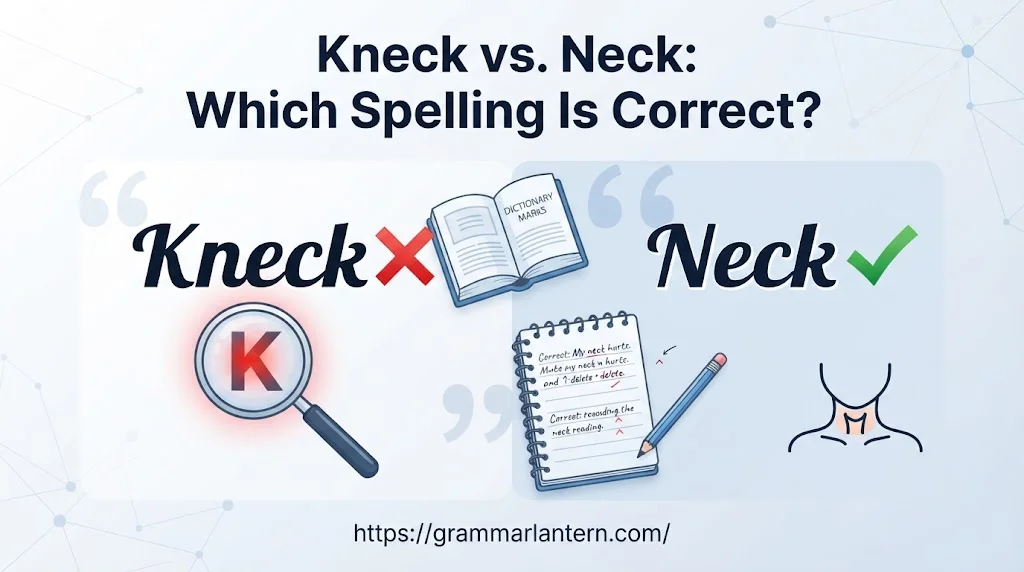
So, if you are wondering kneck or neck, the answer is clear: use neck. The confusion mostly comes from English spelling patterns and the unusual history of words beginning with kn. Interestingly, kneck has appeared in some older or specialized uses, but that does not make it the correct spelling for the body part today. Understanding this small distinction can help you avoid an easy mistake.
Quick Answer
Neck is the correct spelling in modern English.
Kneck is generally an incorrect spelling when you mean the body part. You should write neck in school assignments, emails, articles, professional documents, and everyday messages.
| Spelling | Modern status | Meaning |
| neck | Correct | The part connecting the head and torso |
| kneck | Incorrect in ordinary modern writing | Usually a misspelling of neck |
| necklace | Correct | Jewelry worn around the neck |
| neckline | Correct | The upper edge or opening of a garment |
Here are a few simple examples:
- My neck hurts after sitting at the computer all day.
- She wore a scarf around her neck.
- He turned his neck to look behind him.
- The shirt has a high neck.
- The giraffe has an unusually long neck.
The key point is easy to remember:
Knee has a silent K. Neck does not.
What Does “Neck” Mean?
The word neck has several related meanings. Its most familiar meaning refers to human or animal anatomy, but English has extended the word to objects, clothing, geography, competition, and idiomatic expressions.
Neck as a Body Part
The neck is the part of the body that connects the head to the torso. It supports the head and allows it to move in different directions.
In everyday English, people commonly talk about the neck when discussing:
- movement
- posture
- clothing
- stiffness
- pain
- injuries
- appearance
- jewelry
For example, you might say:
- I slept badly and woke up with a stiff neck.
- He stretched his neck before starting his workout.
- The necklace rested against her neck.
- She turned her neck slightly toward the window.
The word works naturally in both casual and formal writing.
Neck for Parts of Objects
English also uses neck for a narrow section that connects or leads into a wider part.
This meaning follows a simple visual idea. A human neck is narrower than the head and torso. When an object has a similarly narrow connecting section, English often calls it a neck.
You can find this usage in:
- neck of a bottle
- neck of a guitar
- neck of a violin
- neck of a vase
- neck of a garment
- neck of a flask
Consider a glass bottle. Its main body may be broad, while the upper portion becomes narrow before reaching the opening. That narrow section is called the neck.
The same idea explains why musicians talk about the neck of a guitar.
Neck as a Verb
Neck can also function as a verb, although this use is informal.
In informal English, to neck can mean to kiss or engage in romantic physical affection. The expression is more common in casual contexts than formal writing.
For example:
- The teenagers were caught necking in the back row.
Because this meaning is informal, context matters. The noun neck remains far more common in ordinary English.
Read More: 27 Best Replies to “I Don’t Care” Witty & Clever
Why Do People Spell “Neck” as “Kneck”?
The spelling kneck isn’t completely random. English gives learners plenty of reasons to expect a silent k.
Confusion With Silent-K Words
Think about these common English words:
- knee
- knife
- knock
- knot
- know
- knight
- knowledge
In each case, the k comes before n in spelling but doesn’t receive its own /k/ sound.
That spelling pattern can create a mental shortcut:
kn + e → knee
A learner may then assume:
kn + eck → kneck
Unfortunately, English doesn’t work that neatly.
The correct spelling is:
neck
There is no silent k hiding before the n.
Confusion Between “Knee” and “Neck”
The words knee and neck are both common body-part words. They also begin with similar consonant sounds when spoken.
That similarity can cause spelling interference.
| Word | Correct spelling | Silent K? |
| knee | knee | Yes |
| neck | neck | No |
| knife | knife | Yes |
| nail | nail | No |
| knuckle | knuckle | Yes |
| necklace | necklace | No |
This comparison reveals an important lesson about English spelling: sound alone doesn’t always tell you how a word should be written.
Pronunciation Does Not Require a Silent K
The word neck begins with an /n/ sound.
That means you don’t pronounce a separate k before the /n/. More importantly, you don’t need to add a written k simply because some other English words use kn-.
The spelling neck already represents the word correctly.
A useful memory trick is to connect it with words such as:
- deck
- check
- peck
- wreck
They all share the -eck spelling pattern.
So instead of thinking:
“Maybe neck needs a silent k.”
Think:
“Neck belongs with deck, check, and peck.”
That small association can make the spelling much easier to remember.
Neck Pronunciation and Spelling
Neck is a one-syllable word.
Its pronunciation stays stable across standard American English and British English. The spelling also remains neck in both varieties.
That makes this an easy case where regional spelling differences don’t create confusion.
For example, English has pairs such as:
- color / colour
- center / centre
- favorite / favourite
But neck doesn’t change in this way.
You should write:
neck
whether you’re writing for an American, British, Canadian, Australian, or international English audience.
Is “Kneck” Ever a Real Word?
Here’s where the story gets more interesting.
Although kneck isn’t the standard modern spelling of the body part, historical English records contain forms resembling it. The modern word neck traces back through Middle English nekke to Old English hnecca, referring to the neck or nape. The history of the word also connects it with related Germanic forms.
That historical background helps explain why an older spelling might occasionally appear in historical texts or dictionaries.
However, historical spelling and modern spelling aren’t the same thing.
English has changed dramatically over the centuries. Many spellings that once appeared in written English have disappeared from ordinary use. A historical form doesn’t automatically become acceptable in modern standard English.
So there is an important distinction:
Kneck may have historical evidence, but neck is the standard modern spelling.
If you’re writing a modern sentence such as “My neck hurts,” don’t replace neck with kneck.
Historical Spelling vs. Modern Usage
Think of historical spelling like an old road sign. It can tell you something valuable about the past, but you wouldn’t necessarily use it to navigate a modern highway.
The same principle applies to kneck.
| Context | Preferred spelling |
| Modern conversation | neck |
| School assignment | neck |
| Business writing | neck |
| Blog article | neck |
| Medical discussion | neck |
| Historical language research | Historical forms may be discussed |
| Standard modern English | neck |
The practical answer remains unchanged.
Side-by-Side Comparison
| Feature | Neck | Kneck |
| Standard modern spelling | Yes | No |
| Refers to the body part | Yes | Usually intended but misspelled |
| Used in American English | Yes | No as the standard spelling |
| Used in British English | Yes | No as the standard spelling |
| Used in compounds | Yes | No |
| Used in idioms | Yes | No |
| Historical forms | Yes | Historical occurrences exist |
| Recommended today | Yes | No |
The contrast is especially clear when you look at compounds.
You write:
- necklace
- neckline
- necktie
- neckwear
- neckband
- turtleneck
You don’t normally write these with an extra k after the initial n.
Common Mistakes and Their Corrections
The easiest way to understand the issue is to see the error in context.
Body Pain
❌ My kneck hurts after sleeping on the couch.
✅ My neck hurts after sleeping on the couch.
The extra k doesn’t change the meaning. It simply creates a spelling error.
Clothing
❌ He wore a shirt with a high kneck.
✅ He wore a shirt with a high neck.
Here, neck describes the upper part of the garment.
Jewelry
❌ She bought a silver knecklace.
✅ She bought a silver necklace.
The correct compound begins with neck, not kneck.
Exercise
❌ Stretch your kneck before running.
✅ Stretch your neck before running.
The same correction applies whether the sentence is casual or formal.
Animal Description
❌ The giraffe has a long kneck.
✅ The giraffe has a long neck.
The word neck applies to animals as well as humans.
Neck in Common Words and Expressions
One reason neck is worth learning properly is that it appears in a surprisingly large number of everyday expressions.
Words Built From “Neck”
Some common compounds include:
- necklace — jewelry worn around the neck
- neckline — the edge or opening around the neck of clothing
- necktie — a tie worn around the neck
- neckwear — clothing or accessories worn around the neck
- neckband — a band surrounding or fitting around the neck
- turtleneck — clothing with a high close-fitting neck
- neckerchief — a small scarf worn around the neck
Once you know the spelling of neck, these compounds become easier to spell.
“Neck and Neck”
The expression neck and neck describes two competitors who are extremely close in a race or competition.
For example:
The two runners were neck and neck during the final lap.
The expression comes from the visual image of two competitors moving side by side at nearly the same pace.
“Neck of the Woods”
Neck of the woods is an informal expression meaning a particular area or neighborhood.
For example:
What brings you to this neck of the woods?
Here, neck doesn’t refer to someone’s anatomy. It describes a particular area.
“Pain in the Neck”
A pain in the neck can mean an annoying person, problem, or situation.
For example:
That broken printer has been a real pain in the neck.
This expression is often a milder alternative to stronger language.
“Stick Your Neck Out”
To stick your neck out means to take a risk or put yourself in a vulnerable position.
For example:
She stuck her neck out and recommended the new strategy.
The image is easy to understand. If you physically expose your neck, you make yourself more vulnerable.
“Save Your Neck”
To save your neck means to avoid trouble, danger, or serious consequences.
For example:
His quick decision saved his neck during the crisis.
“Up to Your Neck”
If you’re up to your neck in something, you’re deeply involved or overwhelmed by it.
For example:
I’m up to my neck in paperwork this week.
The expression creates a strong visual image. Imagine being surrounded by something until it reaches your neck.
In Different Contexts
The word neck works across several areas of English.
Everyday Conversation
In normal conversation, neck usually refers to the body part.
Examples include:
- My neck feels stiff.
- Turn your neck slowly.
- She wore a scarf around her neck.
- He rubbed the back of his neck.
These are ordinary, natural uses.
Health and Anatomy
English frequently uses neck in health-related language.
Common expressions include:
- neck pain
- neck stiffness
- neck injury
- neck muscles
- neck movement
- neck strain
The word remains unchanged regardless of whether the discussion is casual or technical.
Clothing and Fashion
Fashion uses neck in several ways.
You may encounter:
- V-neck
- round neck
- high neck
- crew neck
- turtleneck
- neckline
For example:
She chose a black V-neck sweater for the meeting.
Here, neck describes the design of the garment rather than a person’s anatomy.
Animals
Animals have necks too.
You might describe:
- a horse’s strong neck
- a giraffe’s long neck
- a swan’s curved neck
- a turtle’s short neck
This broader meaning has existed for centuries and isn’t limited to human anatomy.
Objects
The same word appears in descriptions of physical objects.
Consider:
the neck of a bottle
or:
the neck of a guitar
The underlying idea remains consistent: a narrower section connects to a larger part.
British English vs. American English
There is no spelling dispute between American and British English here.
Both use:
neck
That makes kneck vs. neck different from spelling pairs that vary between English varieties.
| Meaning | American English | British English |
| Body part | neck | neck |
| Garment section | neck | neck |
| Bottle section | neck | neck |
| Guitar section | neck | neck |
| Necklace | necklace | necklace |
So if someone tells you that kneck is a British spelling, that’s incorrect in standard modern usage.
The extra k isn’t a regional alternative.
How to Remember the Correct Spelling
Spelling becomes easier when you build a small mental connection instead of memorizing a rule mechanically.
Use the “No K” Rule
Remember:
Neck starts with N, not KN.
That’s short enough to recall whenever you’re unsure.
Connect It to “Necklace”
If you can spell necklace, you can spell neck.
Break the compound apart:
neck + lace = necklace
The first part is simply neck.
Compare “Knee” and “Neck”
This is one of the best memory tricks:
knee → silent K
neck → no K
They’re both body parts, but their spellings aren’t built from the same pattern.
Use Rhyming Words
Connect neck with:
- deck
- check
- peck
- wreck
- speck
If you remember the -eck pattern, neck becomes easier to visualize.
Think of the Letter Shape
Another quick trick is to picture:
N + E + C + K
There are only four letters.
Adding another k makes the word longer without adding anything useful:
K + N + E + C + K
The second version may look plausible, but it doesn’t represent the standard modern spelling.
Correct Examples: In Sentences
Here are examples across different contexts:
- My neck feels better after a good night’s sleep.
- The doctor examined his neck after the accident.
- She wore a blue scarf around her neck.
- The giraffe stretched its long neck toward the leaves.
- The bottle has a narrow neck.
- He adjusted the neck of his guitar.
- She prefers sweaters with a high neck.
- The two cyclists were neck and neck near the finish.
- That old computer has become a real pain in the neck.
- He stuck his neck out by defending the unpopular proposal.
Notice how the spelling never changes.
Whether you’re discussing anatomy, clothing, objects, animals, or idioms, the standard spelling is neck.
Incorrect Examples: Why “Kneck” Doesn’t Work
Now compare the common mistakes:
| Incorrect | Correct |
| My kneck hurts. | My neck hurts. |
| He injured his kneck. | He injured his neck. |
| She wore a knecklace. | She wore a necklace. |
| The shirt has a high kneck. | The shirt has a high neck. |
| The giraffe has a long kneck. | The giraffe has a long neck. |
| He stretched his kneck. | He stretched his neck. |
| The bottle has a narrow kneck. | The bottle has a narrow neck. |
The pattern is consistent. When the modern English word is neck, related compounds also retain the spelling neck.
A Practical Case Study: Why “Kneck” Feels Correct
Imagine a student writing the sentence:
“My kneck hurts after playing basketball.”
The student already knows words such as knee, knife, and knock. Each begins with kn-. The brain recognizes a familiar spelling pattern and applies it to neck.
That’s a classic example of spelling analogy.
The problem isn’t a lack of intelligence or effort. English spelling encourages pattern recognition, but its patterns aren’t always perfectly predictable.
A better correction strategy is therefore not simply:
“That’s wrong.”
Instead, connect the mistaken pattern with a stronger one:
knee → silent k
neck → no k
neck → deck → check → peck
Once the learner sees those relationships, the correct spelling becomes easier to retrieve.
The Key Difference
The distinction can be reduced to one practical rule:
Neck is the standard modern English spelling.
Kneck is not the standard spelling when referring to the body part.
The confusion usually comes from English words that begin with kn-, especially knee, knife, and knock. However, neck doesn’t belong to that modern spelling group.
There is also a historical reason not to dismiss the question too quickly. Older English contains related spellings and forms, including the historical form hnecca from which the modern word developed.
That history makes the spelling question more interesting, but it doesn’t change the modern answer.
Read More: Chose vs. Chosen: Which Is Correct? A Complete Guide
FAQs
1. Is neck the correct spelling?
Yes. Neck is the correct standard English spelling for the body part between your head and shoulders.
2. Is kneck a correct English word?
Kneck is not the standard modern spelling of the body part. In normal English writing, use neck instead.
3. Why do people spell neck as kneck?
People may write kneck because several common English words begin with kn, including knee, knife, and knock. This spelling pattern can cause confusion.
4. Does kneck appear in dictionaries?
You may find kneck mentioned in historical or obsolete contexts, but it is not the normal modern spelling for the body part. Neck is the word you should use today.
5. How do you spell the body part correctly?
The correct spelling is neck: N-E-C-K. There is no k before the n.
6. What is the plural of neck?
The plural of neck is necks. For example, “The shirts have different necks.”
7. Is neck pronounced with a silent letter?
No. In neck, the n and k are both pronounced. It sounds roughly like “nek.”
8. Can I use kneck in formal writing?
No. Avoid kneck in formal writing, school assignments, emails, and professional documents. Use neck instead.
9. Is neck related to the word knee?
They may look similar because both can involve body parts, but their modern spellings are different. Knee begins with kn, while neck simply begins with n.
10. What is the easiest way to remember neck?
Remember that neck has no extra k at the beginning. Think of the simple spelling: N-E-C-K.
Conclusion
When choosing between kneck or neck, there is one clear answer for modern English: neck. It is the standard spelling for the body part connecting your head and shoulders. Although kneck may appear because of confusion with words such as knee and knife, it should not be used in ordinary writing.
A quick spelling check can save you from this common mistake. Whenever you mean the body part, remember neck, not kneck. Once you connect the correct spelling with the familiar word, this confusing pair becomes much easier to remember.

For Shafiq ur Rehman, writing is an art form and grammar is the toolbox that makes it beautiful. As a dedicated content writer at Grammar Lantern, Shafiq approaches every topic like an architect carefully laying down strong foundations of understanding before adding the finer details. He loves diving into the trickiest grammar points and resurfacing with simple, bite-sized takeaways that anyone can grasp. When he’s not crafting articles, you’ll likely find him strategizing over a game of chess, exploring dusty local bookshops, or quietly jotting down poetic observations in his notebook.