The difference between Princesses or Princess’s or Princess’ becomes much easier when you first identify whether you are talking about one princess, more than one princess, or ownership. Princesses is the plural form of princess, so it refers to two or more princesses. For example, “The princesses attended the ceremony.” By contrast, princess’s is a possessive form used when something belongs to one princess. You might write, “The princess’s crown was beautiful.”
The apostrophe is what makes possessive nouns confusing for many English learners. If you mean several princesses, use princesses without an apostrophe. If one princess owns something, use princess’s, such as “the princess’s dress.” When the noun is plural, the possessive form can change. For example, “the princesses’ dresses” means the dresses belong to several princesses. Checking the number first makes these forms much easier to understand.
In English grammar, plural nouns and possessive forms serve different purposes. Princesses tells us about quantity, while princess’s and princesses’ show ownership. The form princess’ may appear in some style guides, but princess’s is commonly preferred for singular possession because it clearly shows the possessive relationship. Understanding these small differences helps with professional writing, emails, essays, blog posts, online content, and everyday communication.
Quick Answer
The standard forms become much easier when you look at what you mean.
| Form | What it means | Example |
| princesses | More than one princess | The princesses arrived together. |
| princess’s | Something belonging to one princess | The princess’s crown was beautiful. |
| princesses’ | Something belonging to multiple princesses | The princesses’ crowns were displayed. |
| princess’ | An alternative singular possessive style sometimes used in edited writing | The princess’ crown was beautiful. |
For ordinary US English, princess’s is the clearest choice when one princess possesses or is associated with something.
So, if you’re writing:
The princess’s horse waited outside.
you mean one princess.
If you’re writing:
The princesses’ horses waited outside.
you mean multiple princesses.
Meanwhile, princesses without an apostrophe simply means more than one princess.
The key rule is simple:
Plural = princesses
Singular possessive = princess’s
Plural possessive = princesses’
The form princess’ can occur under certain editorial styles, but it isn’t the default choice needed for most general writing.
What Does “Princess” Mean?
Princess is a singular countable noun. It refers to a female member of a royal family or, in some contexts, a woman who holds a particular princely title.
Because princess is singular, you can make it plural or possessive depending on what the sentence requires.
Its basic grammatical forms look like this:
- Singular: princess
- Plural: princesses
- Singular possessive: princess’s
- Plural possessive: princesses’
Notice something important here: the final s in princess doesn’t make the noun plural.
That’s where many mistakes begin.
The word princess already ends in the letter s, but it still refers to one person. The plural adds -es, creating princesses.
Think of the progression this way:
one princess → two princesses
Then possession adds another layer:
one princess → one princess’s crown
two princesses → two princesses’ crowns
Once you understand that pattern, the apostrophe stops looking like a tiny grammatical trap.
When to Use “Princesses”
Use princesses when you mean two or more princesses.
This is simply the plural form of princess. No apostrophe belongs in the word because you’re not showing possession.
For example:
- The princesses attended the ceremony.
- Three princesses stood beside the king.
- The story follows two princesses on a dangerous journey.
- Several princesses gathered in the royal garden.
- The princesses wore different gowns.
In each example, the word identifies multiple people. Nothing belongs to anyone merely because the noun is plural.
Examples of Princesses in Sentences
Consider the difference between these sentences:
The princesses entered the castle.
This means several princesses entered the castle.
Now compare it with:
The princess’s castle stood on the hill.
This means one princess is associated with the castle.
The words differ by only a couple of characters, but the grammatical meaning changes completely.
Another useful comparison:
The princesses waved to the crowd.
Here, princesses is the subject.
The crowd admired the princesses.
Here, princesses is the object.
Neither sentence needs an apostrophe.
The word remains plural because the sentence refers to more than one princess rather than something belonging to them.
Read More: 27 Best Replies to “I Don’t Care” Witty & Clever
When to Use “Princess’s”
Use princess’s when one princess owns, controls, possesses, creates, experiences, or is otherwise associated with something.
This is the standard singular possessive form for general writing.
For example:
- The princess’s crown sparkled under the lights.
- The princess’s horse escaped from the stable.
- The princess’s decision surprised everyone.
- The princess’s dress was covered with embroidery.
- The princess’s room overlooked the garden.
The important point is that possession doesn’t always mean literal ownership.
For instance:
The princess’s decision changed the kingdom.
A decision isn’t something you can physically own. Still, the decision is associated with one princess. The possessive construction therefore makes sense.
The same pattern works with relationships, actions, characteristics, and ideas.
1. The princess’s arrival caused excitement.
2. The princess’s kindness impressed the villagers.
3. The princess’s journey lasted three months.
In each sentence, princess’s connects one princess with something related to her.
Why Does Princess’s Have Two S’s?
This question causes plenty of confusion.
The first s belongs to the noun itself:
princess
The second s belongs to the possessive ending:
princess + ’s = princess’s
The apostrophe appears before the added s.
This follows the ordinary pattern for singular possessives:
- girl → girl’s
- teacher → teacher’s
- queen → queen’s
- princess → princess’s
The fact that princess already ends in s doesn’t automatically remove the possessive s.
That’s an important distinction.
Is “Princess’” Correct?
Princess’ can appear in writing, but it shouldn’t automatically replace princess’s simply because princess ends in s.
Some style systems allow or prefer an apostrophe alone for certain singular nouns ending in s. Other systems prefer adding ’s. In modern general US writing, princess’s is the clearer default when referring to one princess.
So these two forms may appear:
The princess’s crown was missing.
The princess’ crown was missing.
The first form makes the singular possessive relationship explicit and is the safer general choice.
The second can reflect an editorial convention. It doesn’t mean that every singular noun ending in s must use only an apostrophe.
Is “Princess’” Grammatically Correct?
The answer depends partly on style.
Grammar and editorial style aren’t always identical. A construction may occur in published writing because a particular style system permits it.
For example, some editorial traditions use an apostrophe alone after certain singular names ending in s. Other styles consistently add ’s.
That distinction matters because writers often encounter forms such as:
- James’
- Dickens’
- princess’
and assume the apostrophe-only pattern must always be correct.
That’s too broad.
A better approach is to ask two questions:
- Is the noun singular or plural?
- What possessive style does the publication or organization follow?
For a normal sentence about one princess, princess’s is the clearest standard choice.
Side-by-Side Comparison
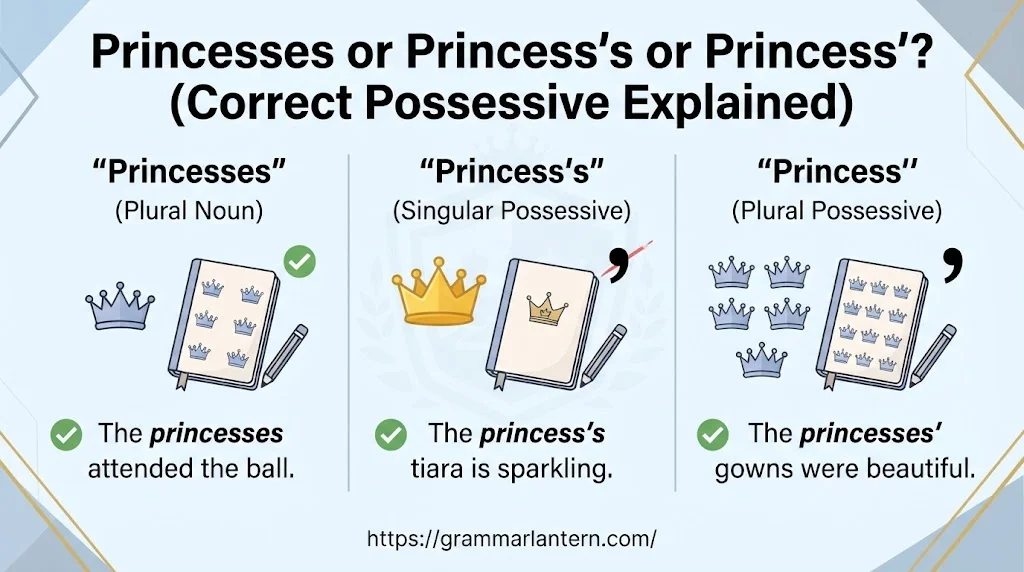
The easiest way to remember these forms is to compare their jobs.
| Form | Number | Possessive? | Meaning |
| princess | Singular | No | One princess |
| princesses | Plural | No | More than one princess |
| princess’s | Singular | Yes | Belonging to one princess |
| princesses’ | Plural | Yes | Belonging to multiple princesses |
| princess’ | Singular | Yes, in some styles | Alternative singular possessive |
Here’s a practical test.
If you can replace the word with one princess, you probably need the singular form.
The princess’s necklace was missing.
If you can replace it with several princesses, you need the plural form.
The princesses arrived before sunset.
If you mean several princesses possess or are associated with something, use the plural possessive.
The princesses’ costumes were handmade.
This substitution trick works surprisingly well.
How to Form the Possessive of Singular Nouns Ending in “S”
The word princess belongs to a larger group of singular nouns that end in s.
That doesn’t make the possessive rule unusual. The important question is whether the noun itself is singular.
For general US English, singular nouns normally form the possessive by adding ’s.
Examples include:
| Singular noun | Singular possessive |
| princess | princess’s |
| business | business’s |
| witness | witness’s |
| actress | actress’s |
| hostess | hostess’s |
| waitress | waitress’s |
For example:
The business’s future depends on its customers.
The witness’s statement changed the case.
The actress’s performance received praise.
The same grammatical principle applies to princess’s.
The final letter of the noun doesn’t erase the possessive ending simply because it happens to be s.
Princesses or Princess’s: How to Tell Which One You Need
When you’re stuck between princesses and princess’s, don’t stare at the apostrophe. Start with the meaning.
Ask:
Am I talking about several princesses?
If yes, use princesses.
The princesses traveled together.
Now ask:
Am I talking about something associated with one princess?
If yes, use princess’s.
The princess’s carriage arrived late.
This works because the apostrophe marks the possessive relationship.
Compare:
The princesses visited the palace.
The princess’s visit attracted reporters.
The first sentence talks about several people.
The second talks about one princess’s visit.
A Quick Replacement Test
Try replacing the possessive phrase with of the princess.
The princess’s crown
becomes:
The crown of the princess
That confirms the singular possessive relationship.
For a plural possessive:
The princesses’ crowns
becomes:
The crowns of the princesses
This method isn’t always elegant in final writing, but it’s excellent for checking grammar.
Princess’s vs. Princess’: Why Both Forms Appear
The reason you may see both princess’s and princess’ is that possessive punctuation has more than one established style tradition.
Some styles prefer ’s with singular nouns ending in s. Others have historically used an apostrophe alone in particular circumstances, especially with certain proper names.
That doesn’t mean writers should switch randomly between the two.
Consistency matters.
Imagine a document containing:
The princess’s crown
The princess’ dress
The princess’s carriage
The princess’ palace
The reader can understand every sentence, but the punctuation looks inconsistent.
A polished document should follow one coherent style.
For most everyday US English, princess’s is the straightforward choice for a singular possessive.
Princess’s vs. Princesses’: Singular and Plural Possession
This is one of the most useful distinctions to learn.
Princess’s means possession or association with one princess.
Princesses’ means possession or association with multiple princesses.
Look at this pair:
The princess’s crown was made of gold.
One princess has the crown.
Now:
The princesses’ crowns were made of gold.
Multiple princesses have crowns.
The apostrophe changes position because the number changes.
One Princess
princess + ’s → princess’s
The princess’s castle
Multiple Princesses
princesses + ’ → princesses’
The princesses’ castles
This follows the broader rule for regular plural nouns ending in s.
Compare:
- student → student’s
- students → students’
- teacher → teacher’s
- teachers → teachers’
- princess → princess’s
- princesses → princesses’
The pattern becomes much easier when you focus on number first.
Real-World Examples
The distinction becomes clearer when you see the forms working naturally in different contexts.
Fiction and Storytelling
The princess’s journey began before sunrise.
Here, one princess owns no physical object. The journey simply belongs to her story.
Historical Writing
The princess’s marriage changed the relationship between the two royal families.
Again, the possessive expresses association rather than literal ownership.
News-Style Writing
The princess’s appearance attracted thousands of spectators.
The appearance is associated with one princess.
Multiple Characters
The princesses gathered in the courtyard before the ceremony.
No possession exists, so no apostrophe appears.
Shared Possession
The princesses’ royal residence was renovated last year.
The residence belongs to or is associated with multiple princesses.
Separate Possessions
The princesses’ crowns were placed in separate cases.
The plural possessive can also describe multiple individual objects associated with multiple people.
Context tells the reader whether the princesses share one thing or each have something.
Princesses’ Does Not Mean the Same as Princess’s
A common mistake is to focus on the apostrophe and ignore the number of people involved.
Consider:
The princess’s dresses were stored upstairs.
One princess has multiple dresses.
Now compare:
The princesses’ dresses were stored upstairs.
Multiple princesses have dresses.
The noun after the possessive doesn’t determine the number of possessors.
Instead, look at the possessive noun itself.
princess’s = one princess
princesses’ = more than one princess
That’s why punctuation and spelling work together.
Common Mistakes
Several errors appear repeatedly when writers deal with this word.
Adding an Apostrophe to Make a Plural
Incorrect:
Three princess’s attended the event.
Correct:
Three princesses attended the event.
The apostrophe doesn’t create an ordinary plural.
Using Princesses When You Mean Possession
Incorrect:
The princesses crown was missing.
Correct:
The princess’s crown was missing.
The first version doesn’t clearly mark the possessive relationship.
Using Princess’ Automatically
Some writers think:
The word ends in s, so just add an apostrophe.
That’s not a reliable rule for singular nouns.
For standard general writing, prefer:
The princess’s crown
rather than automatically writing:
The princess’ crown
Confusing Princesses’ With Princess’s
These forms indicate different numbers.
The princess’s dress
One princess.
The princesses’ dresses
Multiple princesses.
The apostrophe’s location provides a useful visual clue.
A Practical Case Study
Imagine a royal ceremony involving three sisters.
At first, the sentence says:
The princesses entered the hall.
No possession exists.
Later, you describe one sister:
The youngest princess’s gown was blue.
Only one princess is connected to that gown.
Then you describe all three:
The princesses’ gowns reflected their different personalities.
Now the possessive belongs to the plural noun.
This tiny scenario demonstrates all three major forms without changing the basic grammar rule.
| Sentence | Meaning |
| The princesses entered the hall. | Several princesses |
| The princess’s gown was blue. | One princess’s gown |
| The princesses’ gowns were different. | Several princesses’ gowns |
Once you can identify how many princesses the sentence refers to, most of the confusion disappears.
Can “Princess” Be a Proper Name?
The word princess can function as a common noun or as part of a title or name-like expression.
For example:
The princess spoke to the guests.
Here, princess is a common noun.
In a title-like expression, capitalization and surrounding words can change the context:
Princess Anne
Here, Princess forms part of a person’s title.
That distinction matters because possessive treatment can depend on the exact construction.
For a regular sentence involving one person described as a princess, however, the basic possessive rule remains straightforward:
The princess’s speech was brief.
Don’t assume capitalization alone changes the underlying grammar.
Read More: Chose vs. Chosen: Which Is Correct? A Complete Guide
Does Princess’s Always Mean Ownership?
No.
Possessives often express relationships broader than ownership.
Consider:
The princess’s arrival surprised everyone.
The princess doesn’t own the arrival. The arrival is an event associated with her.
Similarly:
1. The princess’s smile calmed the child.
2. The princess’s decision ended the dispute.
3. The princess’s journey took several months.
In each example, the possessive construction establishes a relationship.
English uses possessives to express association, connection, origin, responsibility, and belonging, not merely physical ownership.
That’s why calling every possessive an “ownership form” can sometimes oversimplify the grammar.
Pronunciation of Princesses and Princess’s
Pronunciation can also help you recognize the difference.
The plural princesses normally has an extra syllable compared with the singular princess. The ending reflects the regular plural pattern used with words ending in similar sounds.
The possessive princess’s is pronounced as a singular possessive rather than as the ordinary plural princesses.
In careful speech, the grammatical difference is audible.
That’s useful when you’re proofreading spoken dialogue or checking whether a sentence means one princess or several.
However, pronunciation shouldn’t be your only test. Context remains more reliable, especially in fast conversational speech.
A Simple Memory Trick
Use this three-part formula:
Princesses = many
Princess’s = one + possession
Princesses’ = many + possession
For example:
Two princesses arrived.
One princess’s crown was missing.
Two princesses’ crowns were missing.
The apostrophe behaves almost like a tiny signpost.
First determine number. Then determine possession.
1. If there is no possession, don’t add an apostrophe.
2. If one person possesses or is associated with something, use the singular possessive.
3. If multiple people possess or are associated with something, use the plural possessive.
How to Choose the Correct Form in Seconds
When you’re proofreading, use this quick checklist.
- Do you mean one princess?
Use princess. - Do you mean multiple princesses?
Use princesses. - Does something belong to or relate to one princess?
Use princess’s in standard general US writing. - Does something belong to or relate to multiple princesses?
Use princesses’. - Are you following a specific editorial style that permits princess’?
Follow that style consistently.
A useful mental shortcut is:
Count first. Add the apostrophe second.
That one habit prevents many possessive errors.
Quick Reference Table
| Meaning | Correct form | Example |
| One female royal | princess | The princess smiled. |
| More than one | princesses | The princesses smiled. |
| One princess + possession | princess’s | The princess’s crown glittered. |
| Multiple princesses + possession | princesses’ | The princesses’ crowns glittered. |
| Alternative singular possessive style | princess’ | The princess’ crown glittered. |
For most general writing, the safest working pattern is:
princess → princesses → princess’s → princesses’
FAQs
1. Is Princesses a plural noun?
Yes. Princesses is the plural form of princess and means more than one princess.
2. What does Princess’s mean?
Princess’s is the singular possessive form. It shows that something belongs to one princess, such as “the princess’s crown.”
3. Is Princess’ grammatically correct?
Yes, princess’ can be used in some writing styles to show possession. However, princess’s is commonly preferred for a singular princess.
4. What is the plural possessive form of princess?
The plural possessive form is princesses’. For example, “The princesses’ gowns were beautiful.”
5. Should I write princesses or princess’s?
Use princesses when you mean more than one princess. Use princess’s when you mean something belongs to one princess.
6. What is the difference between princesses and princess’s?
Princesses indicates a plural noun, while princess’s indicates possession by one princess. The apostrophe changes the grammatical function.
7. Is princess’s singular or plural?
Princess’s is connected to a singular noun. It normally means that something belongs to one princess.
8. Is princesses’ possessive?
Yes. Princesses’ is the plural possessive form and indicates that something belongs to two or more princesses.
9. Why does princess’s have an apostrophe?
The apostrophe helps show possession. In princess’s, the apostrophe comes before the final s because the noun is singular.
10. How can I remember these forms easily?
First, decide how many princesses you mean. Princesses means several. Princess’s means one princess owns something. Princesses’ means several princesses own something.
Conclusion
Understanding princesses, princess’s, and princesses’ becomes simple once you separate plural from possession. Use princesses for more than one princess, princess’s for something belonging to one princess, and princesses’ for something belonging to several princesses.
The form princess’ may also appear depending on the chosen style guide, but consistency is important. When writing, check the number of people involved first, then decide whether you need a plural or a possessive form. This quick habit can prevent common apostrophe mistakes and make your writing much clearer.

For Shafiq ur Rehman, writing is an art form and grammar is the toolbox that makes it beautiful. As a dedicated content writer at Grammar Lantern, Shafiq approaches every topic like an architect carefully laying down strong foundations of understanding before adding the finer details. He loves diving into the trickiest grammar points and resurfacing with simple, bite-sized takeaways that anyone can grasp. When he’s not crafting articles, you’ll likely find him strategizing over a game of chess, exploring dusty local bookshops, or quietly jotting down poetic observations in his notebook.