
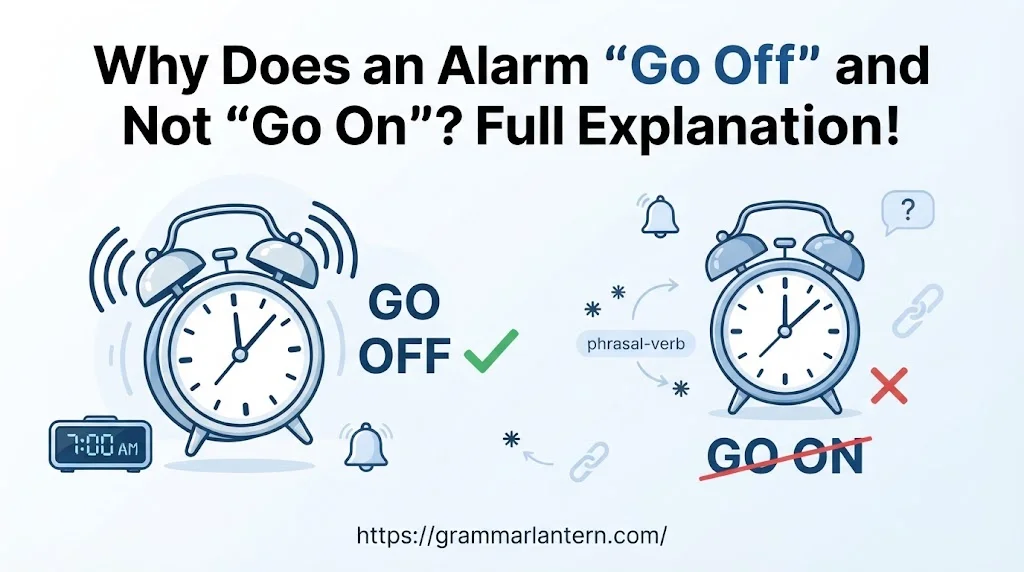
Why does an alarm go off and not go on? The answer lies in English usage, not strict logic. When an alarm clock, phone alarm, or alarm system starts making its sound, native speakers say it goes off. Here, “go off” works as a phrasal verb meaning to activate, ring, or produce a signal. Although “go on” may seem more logical, it does not carry the same meaning in this context.
The expression becomes especially useful in scheduling, time management, calendar reminders, meetings, and task management. For example, you might say, “My alarm went off at 7 a.m.” or “The reminder goes off before the meeting.” In these sentences, the phrase describes the moment an alarm or notification becomes active and alerts someone. This familiar pattern is common in both everyday and professional communication.
The difference between go off and go on becomes clearer when we consider context, grammar, and phrasal verbs. “Go on” can mean continue, happen, or remain active, while “go off” can describe an alarm ringing, among other meanings. This is a good example of how language evolution, semantics, and idiomatic usage often make English different from what strict logic might suggest.
Quick Answer
An alarm “goes off” because go off is an established English phrasal verb meaning that an alarm begins to sound, ring, or signal.
For example:
My alarm went off at 7:00 this morning.
This means the alarm started ringing at 7:00.
The phrase “go on” has a different usual meaning. It often means continue, happen, or proceed. Therefore, saying “My alarm went on at 7:00” doesn’t normally express the idea that the alarm started sounding at that moment.
The easiest sequence to remember is:
Set an alarm → the alarm goes off → you turn the alarm off.
That’s the natural pattern in everyday English.
What Does “Go Off” Mean When We Talk About Alarms?
When an alarm goes off, it reaches its trigger point and produces its intended signal.
The signal might be a ringing sound, a buzzing noise, a siren, a flashing light, or another warning. The exact mechanism doesn’t matter. The important point is that the alarm activates its warning function.
Consider these examples:
- “My alarm went off at 6:00.”
- “The fire alarm went off during the drill.”
- “The car alarm went off in the parking lot.”
- “The security alarm went off after someone opened the door.”
- “The timer went off while I was cooking.”
In each sentence, go off describes the moment when the signal begins.
The Alarm Meaning of “Go Off”
The alarm meaning of go off is common in both everyday speech and writing.
You can use it with many kinds of devices:
| Alarm or device | Example |
| Alarm clock | “My alarm went off at 6:30.” |
| Fire alarm | “The fire alarm went off suddenly.” |
| Car alarm | “The car alarm went off overnight.” |
| Security alarm | “The security alarm went off after the door opened.” |
| Timer | “The timer went off after ten minutes.” |
| Warning siren | “The warning siren went off across the town.” |
Notice something important: go off describes the signal, not necessarily the physical switch.
An alarm can be electronically activated without anyone touching it. A timer can trigger an alarm automatically. A smoke detector can activate because it detects smoke.
That’s why “go off” works so naturally.
“Go Off” Does Not Mean “Stop”
This is the part that confuses many English learners.
In ordinary contexts, off can mean that something isn’t operating:
- “Turn the light off.”
- “The television is off.”
- “Please switch off the fan.”
So why does go off mean that an alarm starts?
Because phrasal verbs don’t always preserve the simple dictionary meaning of their individual parts.
The phrase go off has several meanings. The alarm meaning is simply one of those established meanings.
It’s similar to how “give up” doesn’t mean physically giving an object upward. The complete phrase means stop trying or quit.
Likewise, “go off” can function as a single semantic unit.
Read More: Begun vs. Began: Which Is Correct? Helpful Examples
Why Do We Say “Go Off” Instead of “Go On”?
The short answer is that go off and go on perform different jobs.
When an alarm goes off, it activates or begins its warning signal.
When something goes on, it usually continues or happens.
Compare these sentences:
My alarm went off at 7:00.
This tells you when the alarm started sounding.
My alarm went on for ten minutes.
This can describe continued operation.
The distinction is subtle but important.
“Go On” Has a Different Meaning
The phrasal verb go on has several common uses.
It can mean:
- continue — “The meeting went on for hours.”
- happen — “What’s going on?”
- proceed — “Please go on with your story.”
- continue operating or occurring — “The noise went on all night.”
None of these meanings naturally replaces the alarm-specific sense of go off.
For example:
❌ “My alarm went on at 6:00.”
If you mean that the alarm started ringing at 6:00, this sounds unnatural.
Instead:
✅ “My alarm went off at 6:00.”
However, go on can appear with an alarm when the meaning involves continuation:
“The alarm went on ringing for another five minutes.”
Here, went on means continued. It doesn’t mean that the alarm initially activated.
That’s the crucial difference.
English Phrasal Verbs Aren’t Always Literal
English contains thousands of phrasal verbs. Many don’t make perfect sense if you translate every word separately.
Consider these:
| Phrasal verb | Meaning |
| Go off | Activate, explode, become spoiled, leave, or react angrily, depending on context |
| Go on | Continue, happen, or proceed |
| Go out | Leave or stop burning |
| Go over | Review or examine |
| Go through | Experience or examine carefully |
| Give up | Quit |
| Put off | Delay |
| Take off | Remove something or leave the ground |
This is why English can feel slippery at first.
You can’t always build the meaning like a mathematical equation:
go + off = move + not on
Language doesn’t work that neatly.
Instead, speakers learn common combinations as meaningful expressions.
The Different Meanings of “Go Off”
The phrase go off has several established meanings. Context tells you which one the speaker intends.
“Go Off” Means an Alarm Sounds
This is the meaning at the center of this article.
“The alarm went off at midnight.”
The alarm began producing its signal.
“Go Off” Can Mean Something Explodes
English also uses go off when an explosive device detonates.
“The device went off unexpectedly.”
Here, go off refers to a sudden explosive event.
The underlying idea is still that something reaches a trigger point and then produces a sudden result.
“Go Off” Can Mean Food Becomes Spoiled
In everyday English, particularly British English, people can say that food has gone off when it has spoiled.
“I think the milk has gone off.”
This clearly has nothing to do with an alarm.
The context changes the meaning.
“Go Off” Can Mean Leave
Another use describes someone leaving or departing.
“She went off to college.”
Here, went off means she left for another place or purpose.
Again, the individual word off doesn’t give you the complete meaning by itself.
“Go Off” Can Mean Suddenly Become Angry
In informal English, someone can go off when they suddenly become very angry or start criticizing something intensely.
“He went off when he heard what happened.”
The exact interpretation depends on context and dialect.
“Go Off” Can Describe Something Happening
In some contexts, go off can describe an event or process taking place.
This meaning is less central to everyday alarm usage, but it demonstrates an important lesson: one phrasal verb can carry several related meanings.
What Does “Alarm” Mean in “Go Off”?
An alarm normally exists to produce a signal when a particular condition occurs.
That condition might be:
- A specific time
- Smoke detection
- Unauthorized entry
- Movement
- A timer reaching zero
- A safety condition
- A vehicle disturbance
The process can be understood in three simple stages:
Trigger condition → alarm activates → warning signal begins
For an alarm clock:
Set time → scheduled time arrives → alarm goes off
For a smoke alarm:
Smoke detected → alarm activates → warning sounds
For a security alarm:
Trigger detected → system activates → siren sounds
The phrase go off fits the moment when the system crosses that trigger point.
“Set an Alarm” vs. “An Alarm Goes Off”
These expressions describe two different parts of the same process.
When you set an alarm, you configure it.
When the alarm goes off, it reaches the programmed trigger point and activates its signal.
For example:
“I set my alarm for 6:30.”
Later:
“My alarm went off at 6:30.”
Finally:
“I turned my alarm off at 6:35.”
The three expressions form a natural sequence.
| Expression | What it means |
| Set an alarm | Program the alarm |
| An alarm goes off | The alarm activates and signals |
| An alarm sounds | The alarm produces its sound |
| Turn an alarm off | Stop the alarm |
| Snooze an alarm | Delay the alarm temporarily |
This distinction makes the vocabulary much easier to remember.
“Go Off” vs. “Go On” vs. “Turn On”
These expressions may seem interchangeable at first. They aren’t.
| Expression | Main idea | Example |
| Go off | An alarm activates or signals | “The alarm went off.” |
| Go on | Something continues or happens | “The alarm went on for five minutes.” |
| Turn on | Someone activates a device | “I turned the alarm system on.” |
| Sound | An alarm produces an audible signal | “The alarm sounded.” |
| Ring | Something produces a ringing sound | “My alarm rang.” |
The biggest distinction involves go off and turn on.
You can turn on an alarm system when you activate the system yourself.
You can say the alarm goes off when that system later triggers its warning signal.
Those aren’t necessarily the same moment.
“The Alarm Went Off” vs. “The Alarm Was Turned On”
Imagine leaving your house.
You activate the security system before walking away:
“I turned on the alarm.”
An hour later, someone opens a protected door:
“The alarm went off.”
The first sentence focuses on deliberate activation of the system.
The second focuses on the alarm responding to a trigger.
That’s a useful distinction because modern alarm systems often have multiple stages. A system can be armed without sounding. The warning signal comes later when the programmed condition occurs.
Why “Off” Can Describe Activation
The word off has more uses in English than simply “not operating.”
This becomes obvious when you look at other expressions.
Something can:
- take off
- set off
- go off
- break off
- cut off
- come off
- fall off
In each phrase, off contributes to a meaning shaped by the whole expression.
With go off, English has developed a meaning associated with something being triggered, suddenly happening, departing, or changing state, depending on context.
That’s why asking, “Why doesn’t off mean off here?” doesn’t quite solve the puzzle.
The better question is:
“What does the complete phrasal verb go off mean in this context?”
For an alarm, the answer is clear: it begins signaling.
Is “The Alarm Went On” Wrong?
Not necessarily.
It depends on what you want to say.
If you mean:
The alarm started sounding at 7:00.
Use:
The alarm went off at 7:00.
If you mean:
The alarm continued sounding for ten minutes.
You can say:
The alarm went on for ten minutes.
You can also combine the two:
The alarm went off at 7:00 and went on ringing until 7:05.
Now each phrasal verb has a separate job.
Went off marks the beginning.
Went on describes the continuation.
That’s a clean example of how context controls meaning.
Common Mistakes
Small wording changes can completely alter the meaning.
“My Alarm Went On at 7”
If the intended meaning is that the alarm started ringing, this isn’t the normal expression.
Use:
My alarm went off at 7.
Use went on when you’re describing something continuing.
“I Went Off My Alarm”
This doesn’t naturally mean that you heard your alarm.
If you want to say that the alarm woke you, you could write:
“My alarm went off, and it woke me up.”
Or:
“I woke up when my alarm went off.”
“I Turned My Alarm Off at 7”
This sentence is perfectly natural, but it means something different.
It means you stopped the alarm at 7:00.
Compare:
My alarm went off at 7:00.
The alarm started signaling.
I turned my alarm off at 7:00.
I stopped the signal.
One describes activation. The other describes deactivation.
“My Alarm Set Off”
This construction is generally incorrect when you mean that the alarm activated itself.
Say:
My alarm went off.
However, set off works when something or someone triggers an alarm:
“The smoke set off the alarm.”
Or:
“Someone accidentally set off the alarm.”
The grammatical structure matters.
Active vs. Passive Uses: “Go Off” and “Set Off”
This distinction becomes especially useful in more precise writing.
Compare:
The alarm went off.
The alarm itself is the grammatical subject. The sentence simply reports what happened.
Now compare:
Someone set off the alarm.
Here, someone caused the alarm to activate.
You can also use a passive construction:
The alarm was set off by smoke.
The three sentences describe closely related events from different angles.
| Sentence | Focus |
| The alarm went off. | The alarm activated |
| Someone set off the alarm. | Someone caused activation |
| Smoke set off the alarm. | Smoke caused activation |
| The alarm was set off by smoke. | The alarm was activated because of smoke |
This difference is especially helpful when writing reports, instructions, or technical descriptions.
Examples in Everyday English
The phrase appears in countless ordinary situations.
Alarm Clock
“My alarm went off before sunrise.”
The alarm reached its programmed time and began signaling.
Smoke Detector
“The smoke alarm went off while I was cooking.”
The detector responded to smoke or particles that triggered its sensor.
Security System
“The security alarm went off after the door opened.”
The system detected a condition that triggered the warning.
Timer
“The timer went off, so I took the cookies out of the oven.”
Here, go off means that the timer signaled that the preset period had ended.
Unexpected Activation
“The alarm went off by mistake.”
The alarm activated even though the person didn’t expect it to.
A False Alarm
“The alarm went off, but there wasn’t a fire.”
Again, went off means the warning signal activated. It doesn’t tell you whether the danger was genuine.
A Practical Case Study: One Morning, Three Different Phrases
Imagine a typical weekday morning.
At night, you program your phone:
“I set my alarm for 6:30.”
At 6:30, the phone begins ringing:
“My alarm went off.”
You reach for the phone and stop the sound:
“I turned my alarm off.”
Now imagine the alarm keeps ringing because you don’t touch it.
You could say:
“The alarm went on for several minutes.”
Notice how four expressions describe four different moments:
| Stage | Natural expression |
| Programming | I set my alarm. |
| Activation | My alarm went off. |
| Continued ringing | The alarm went on. |
| Stopping | I turned it off. |
Once you see the sequence, the apparent contradiction largely disappears.
Why Native Speakers Don’t Usually Notice the Contradiction
Native speakers rarely analyze go off word by word.
They recognize the entire phrase immediately.
That’s normal with idiomatic language.
For example, nobody expects “break a leg” to describe an actual broken bone when someone wishes a performer good luck. Likewise, “spill the beans” usually isn’t about dropping food.
The brain stores familiar combinations as meaningful units.
The same thing happens with go off.
When someone hears:
“The alarm went off.”
They don’t normally stop and think:
“Wait, off means not operating.”
They understand the established expression immediately.
Language is full of these compact combinations. Once you learn the phrase as a unit, the strange-looking wording becomes much less strange.
Why English Doesn’t Need “Go On” for Every Beginning
Another useful point is that English doesn’t use on simply because something begins.
The word on can indicate activation in certain contexts:
“Turn the light on.”
But turn on and go off aren’t mirror-image expressions.
English doesn’t require every pair of opposite concepts to use perfectly symmetrical grammar.
You can have:
- turn on a light
- turn off a light
- switch on a machine
- switch off a machine
- set off an alarm
- go off an alarm
The language has developed different expressions for different situations.
That’s why searching for a perfect logical opposite can lead you down the wrong path.
“The Alarm Sounded” Is Also Correct
If go off feels confusing, sound offers a very straightforward alternative.
You can say:
“The alarm sounded at 6:30.”
This simply means that the alarm produced its audible signal.
Other natural alternatives include:
- “The alarm rang.”
- “The alarm started ringing.”
- “The alarm began sounding.”
- “The alarm was triggered.”
- “The warning siren sounded.”
However, go off remains one of the most natural everyday expressions.
It sounds especially normal in casual conversation:
“What time did your alarm go off?”
That’s a question most English speakers would understand instantly.
A Simple Way to Remember
Here’s the easiest memory trick:
Set it → it goes off → turn it off.
Think of an alarm clock.
First, you set the time.
Then the alarm goes off when that time arrives.
Finally, you turn it off when you wake up.
You can remember the whole pattern like this:
Set → Go Off → Turn Off
For example:
“I set my alarm for 6:00. It went off at 6:00. I turned it off at 6:05.”
That sequence captures the everyday meanings perfectly.
Read More: Scoup vs. Scoop: Which Spelling Is Correct?
FAQs
1. Why does an alarm “go off”?
An alarm goes off because “go off” is an established phrasal verb meaning that an alarm begins ringing or producing a signal.
2. Is “the alarm went off” grammatically correct?
Yes. “The alarm went off” is completely correct and natural in standard English usage.
3. Why don’t we say “the alarm went on”?
“Go on” usually means to continue, happen, or proceed. It does not normally describe an alarm beginning to ring.
4. What does “go off” mean in English?
The meaning of “go off” depends on context. It can mean an alarm rings, an event happens, something explodes, or a person leaves.
5. Can I say “my phone alarm went off”?
Yes. “My phone alarm went off” is a natural sentence used in everyday communication.
6. Is “go off” an idiom or a phrasal verb?
“Go off” is commonly classified as a phrasal verb. Its meaning changes according to the context in which it is used.
7. Does “go on” ever describe an alarm?
It can describe an alarm continuing to operate or remain active, but it does not normally mean that the alarm has started ringing.
8. What is the difference between “alarm goes off” and “alarm goes on”?
“Alarm goes off” means the alarm activates or starts making a sound. “Alarm goes on” would suggest continuation or remaining active rather than activation.
9. Is “go off” used only for alarms?
No. “Go off” has several meanings. For example, a bomb can go off, food can go off, and someone can go off somewhere.
10. Why does English contain phrases that seem illogical?
English has developed through centuries of language evolution, borrowing, cultural changes, and everyday usage. As a result, many expressions become standard even when their wording does not seem logically obvious.
Conclusion
The phrase “an alarm goes off” may initially sound strange, but it is perfectly natural English. The expression developed through established language patterns, where “go off” came to describe an alarm activating, ringing, or producing a signal. It is now widely understood in everyday speech, professional communication, and modern technology.
So, although “go on” might seem more logical at first, it does not normally carry the same meaning. Learning expressions like “go off” is a reminder that English depends heavily on context, phrasal verbs, and accepted usage. Once you understand that pattern, the phrase becomes much easier to remember and use confidently.