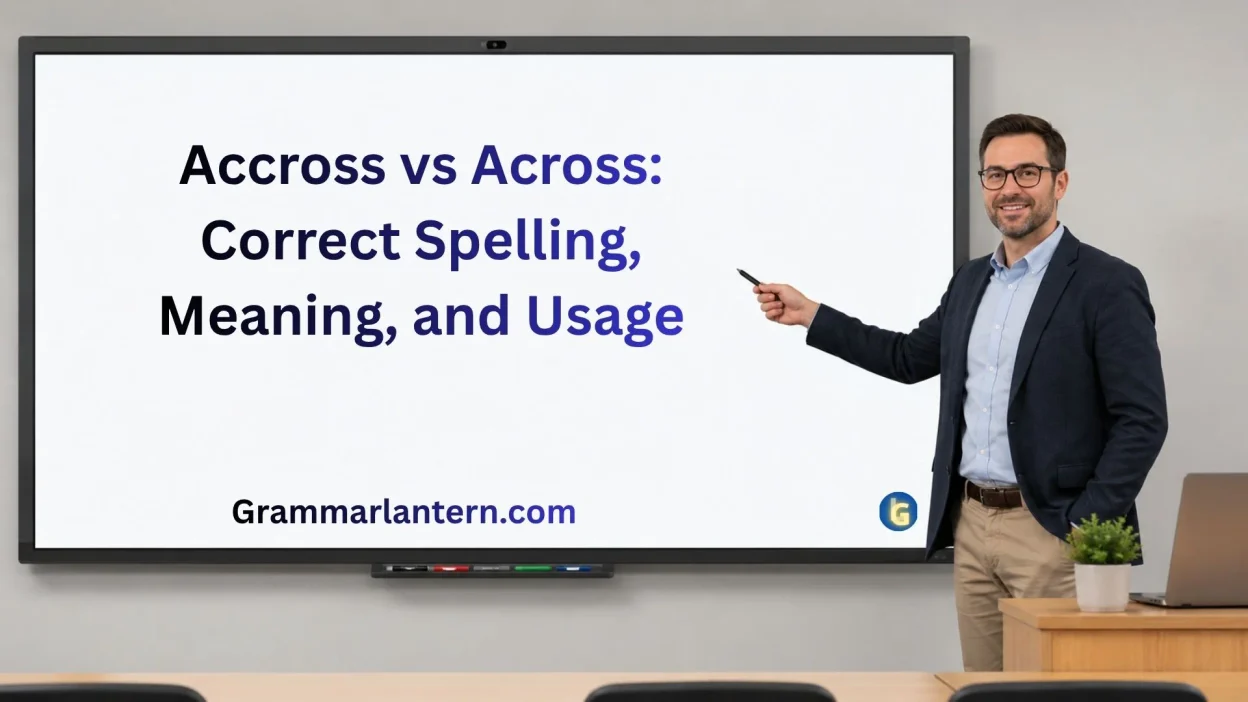
Have you ever typed “accross” and then stopped to wonder whether the spelling looked right? You are definitely not alone. The confusion between Accross vs Across is common among English learners and native speakers, especially when writing quickly. Fortunately, the correct spelling is easy to remember once you understand the pattern.
The answer is simple: across is correct, while accross is incorrect in standard English. Across can function as both a preposition and an adverb. It usually describes movement from one side to another, something located on the opposite side, or something spread throughout an area. For example, you might walk across a street or see a shop across the road.
The spelling mistake happens because some English words use double c, such as accept and accident. However, across does not follow that pattern. It contains only one c. In this guide, you will learn the meaning and usage of across, understand why accross is wrong, explore common examples, and discover a simple memory trick to avoid this mistake.
Quick Answer
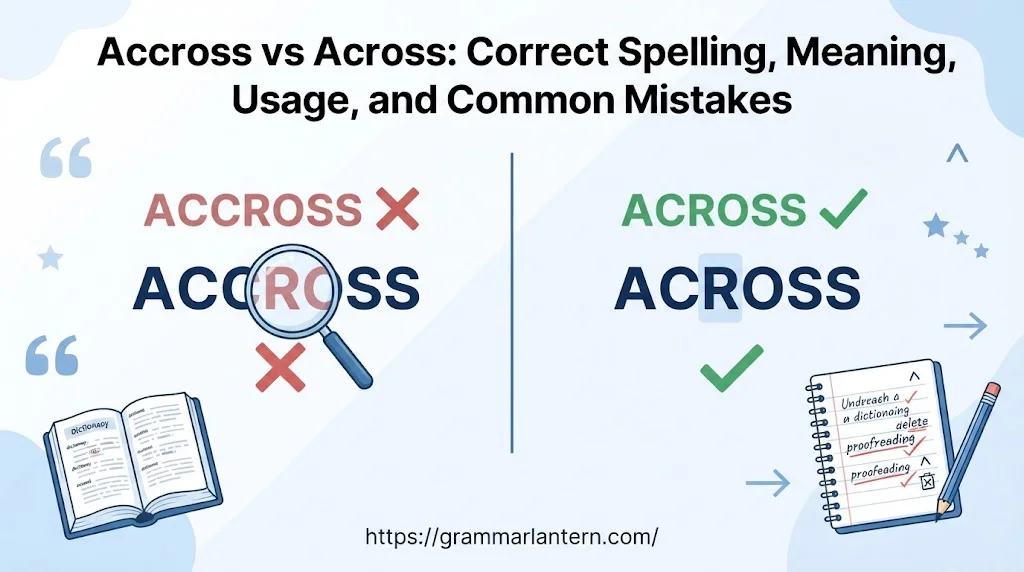
Across is the correct spelling.
Accross is an incorrect spelling and should not be used in standard English.
| Word | Correct? | Meaning | Example |
| Across | ✅ Yes | From one side to another; on the opposite side; throughout an area | We walked across the bridge. |
| Accross | ❌ No | Misspelling of across | ❌ We walked accross the bridge. |
A simple memory trick works well:
A + CROSS = ACROSS
Think of across as the letter A placed before cross. There is no second c.
So, if you’re writing an email, essay, report, caption, or professional document, choose across.
What Does Across Mean?
Across is a common English word with several related meanings. Its central idea usually involves moving from one side to another or extending from one point to another.
For example:
- We walked across the road.
- She swam across the lake.
- There’s a bank across the street.
- The company operates across several countries.
- His message came across clearly.
Notice how the meaning changes slightly depending on the sentence. In the first two examples, across describes movement. In the third, it describes location, in the fourth, it describes distribution and in the fifth, it relates to communication and impression.
Across as a Preposition
As a preposition, across usually connects an action or position with a place, surface, distance, or area.
Consider these examples:
- The children ran across the playground.
- We drove across the country.
- A bridge stretches across the river.
- She looked across the room.
- They traveled across the desert.
The noun following across identifies the area or space being crossed, covered, or viewed.
Across as an Adverb
Across can also work as an adverb when the destination or area is understood from context.
For example:
- He walked across.
- She glanced across.
- The dog ran across.
- The boat moved across quickly.
It also appears in phrasal expressions such as come across and get across.
These uses show why across is more than a simple word for physical movement.
Is Accross a Word?
In standard modern English, accross is not the accepted spelling of the word you intend.
If you write accross, readers generally understand that you mean across. However, understanding your meaning doesn’t make the spelling correct.
This is especially important in formal writing. A typo might seem harmless in a casual text, yet repeated spelling mistakes can make an otherwise strong piece of writing look careless.
Compare:
- ❌ The road runs accross the valley.
- ✅ The road runs across the valley.
The meaning hasn’t changed. Only the spelling has gone wrong.
Why Do People Write Accross?
The mistake probably feels natural because English contains many words with doubled consonants. Words such as accompany, accomplish, address, and according can make English spelling patterns feel unpredictable.
There’s another reason, too. The word is closely related in appearance and meaning to cross, so writers sometimes instinctively add another c.
That creates:
A + CCROSS ❌
Instead, remember:
A + CROSS = ACROSS ✅
The second version is the one to keep.
Why Is Accross Incorrect?
The problem is simple: accross adds an unnecessary second c.
English spelling doesn’t require a doubled consonant here. The standard form is across, which has six letters:
A-C-R-O-S-S
Notice something important. The word does contain two s’s at the end.
That may contribute to another spelling trap. You might remember that across has a doubled letter and accidentally double the c instead.
The correct structure is:
| Part | Letters |
| Beginning | A |
| Main word element | CROSS |
| Full spelling | ACROSS |
The doubled consonant belongs to the end of cross, not between a and cross.
Across as a Preposition
One of the most common uses of across describes movement from one side of something to another.
For example:
We walked across the bridge before sunset.
The bridge provides the space being crossed. The movement begins on one side and continues toward the other.
You can use the same pattern with countless places:
- across the street
- across the river
- across the field
- across the room
- across the road
- across the lake
- across the country
The word can also describe position rather than movement.
The grocery store is across the street.
Here, nobody necessarily moves. The phrase simply tells you where the grocery store is located.
That distinction is useful. Across can describe either movement through a space or a position on the opposite side.
Across as an Adverb
An adverb modifies a verb, adjective, or another part of a sentence. Across can function as an adverb when it doesn’t directly introduce a noun.
Consider:
The child ran across.
The sentence can work when the surrounding context already makes the destination clear.
You’ll also encounter across in common expressions:
- come across
- get across
- come across as
- run across
- get something across
These expressions often carry meanings that go beyond physical movement.
For example:
I came across an old photograph.
Here, came across means found or encountered unexpectedly.
Likewise:
She got her point across.
This means she communicated her idea successfully.
Read More: Stub vs. Stab: Meaning, Difference, Pronunciation, and Usage
Common Uses and Expressions
The word across appears in several everyday expressions. Learning these combinations helps you recognize the correct spelling naturally.
Across the Street
Across the street means on the opposite side of a street.
The coffee shop is across the street.
You could also say:
The coffee shop is on the other side of the street.
Both communicate a similar idea, although across the street is shorter and very common.
Across From
Across from identifies something positioned opposite another thing.
The hotel is across from the train station.
She sat across from me at the table.
This expression works for both physical locations and seating arrangements.
Come Across
Come across can mean to find, encounter, or discover something unexpectedly.
I came across an interesting book at the library.
It doesn’t mean that you physically crossed something.
That’s an important point. English phrasal verbs often develop meanings that aren’t obvious from their individual words.
Come Across As
Come across as describes the impression someone gives to other people.
He comes across as friendly.
She came across as confident during the interview.
Here, across has nothing to do with crossing a road or river. It describes how someone’s personality, attitude, or message is perceived.
Get Across
Get across means to communicate an idea successfully.
The teacher used an example to get the concept across.
The advertisement gets its message across quickly.
This phrase is especially useful when discussing communication, writing, teaching, speeches, and presentations.
Across the Board
Across the board means something applies broadly or to every relevant part of a group or system.
For example:
The company introduced changes across the board.
The phrase often appears in business, education, sports, and general discussion.
In Different Contexts
One reason across appears so frequently is its flexibility.
Physical Movement
This is perhaps the easiest use to understand.
The runner sprinted across the track.
We walked across the bridge.
She swam across the pool.
The word highlights movement from one side toward another.
Location
Across can also describe where something is located.
The pharmacy is across the road.
He lives across the river.
There’s a small park across the street.
The person or object doesn’t necessarily need to move. The word establishes a relationship between two locations.
Communication
The word becomes more figurative in communication.
The speaker’s enthusiasm came across clearly.
The writer got the main idea across.
His tone came across as aggressive.
These sentences describe how information, emotions, or impressions reach another person.
Distribution and Coverage
Across can describe something that extends over multiple places, groups, or categories.
Examples include:
- across the country
- across the world
- across several industries
- across multiple platforms
- across different age groups
- across various departments
For example:
The survey included workers across several industries.
Here, across shows broad coverage rather than literal physical movement.
Across vs Over
Sometimes Across and Over appear in similar sentences, but they don’t always mean the same thing.
Across usually emphasizes movement from one side to another.
Over can emphasize movement above something.
Compare these sentences:
We walked across the bridge.
The bird flew over the bridge.
In the first sentence, the people move along the bridge from one side toward the other.
In the second sentence, the bird moves above the bridge.
Here’s another example:
| Sentence | Main idea |
| She walked across the field. | Movement from one side of the field to another |
| She walked over the hill. | Movement above or beyond the hill |
| The plane flew over the city. | Movement above the city |
| The train traveled across the country. | Movement from one region to another |
Context determines the best choice.
Across vs Through
The difference between across and through can be subtle.
Across generally focuses on crossing an area from one side to another.
Through emphasizes movement within an area, space, passage, or enclosure.
Compare:
We walked across the park.
We walked through the park.
The first sentence emphasizes crossing the park. The second emphasizes moving within the park.
Another comparison makes the distinction clearer:
The hikers walked across the desert.
The hikers walked through the forest.
A desert can be treated as a broad expanse being crossed. A forest can be treated as an environment through which people move.
Neither word is automatically right in every situation. The intended image determines the better choice.
Across vs Cross
This is one of the most useful distinctions to learn.
Cross commonly functions as a verb.
Across commonly functions as a preposition or adverb.
Compare:
We crossed the street.
We walked across the street.
The first sentence uses crossed as the main verb. The second uses walked as the main verb and across to describe the direction or path.
Quick Comparison
| Word | Typical function | Example |
| Cross | Verb | We crossed the road. |
| Across | Preposition | We walked across the road. |
| Across | Adverb | The dog ran across. |
This difference helps prevent awkward constructions.
For instance, you wouldn’t normally say:
❌ We across the street.
You need a verb:
✅ We crossed the street.
Or:
✅ We walked across the street.
Common Spelling Mistakes
The most common error is simply adding an unnecessary c.
Incorrect and Correct Examples
| Incorrect | Correct |
| ❌ accross the road | ✅ across the road |
| ❌ accross the country | ✅ across the country |
| ❌ accross from the bank | ✅ across from the bank |
| ❌ come accross something | ✅ come across something |
| ❌ get the idea accross | ✅ get the idea across |
| ❌ accross the room | ✅ across the room |
The error can occur anywhere the word appears. It isn’t limited to one particular phrase.
Why the Mistake Matters
In casual texting, people often overlook minor spelling errors. Formal writing has different expectations.
A misspelled across can look particularly noticeable because the correct form is common and familiar.
Pay extra attention when writing:
- School assignments
- Business emails
- Resumes
- Cover letters
- Reports
- Blog posts
- Professional documents
- Website copy
- Academic work
A quick proofreading pass can catch this error immediately.
How to Remember the Correct Spelling
The easiest trick is also the most practical:
A + CROSS = ACROSS
Think about the word cross first.
Then place a in front of it.
A + CROSS → ACROSS
Don’t insert another c.
Another useful memory device is to focus on the ending:
ACROSS
The word contains one c and two s’s.
A Simple Spelling Test
When you’re unsure, mentally split the word:
A | CROSS
If you find yourself writing:
A | CCROSS
stop and remove the extra c.
This works because the correct word visually contains the familiar word cross.
Read More: Labeler vs. Labeller: Which Spelling Is Correct?
Across in Real-Life Sentences
Seeing the word in different situations makes its usage easier to remember.
Everyday Conversation
- The store is across the street.
- He ran across the yard.
- I saw her across the room.
- There’s a restaurant across from the hotel.
Travel
- We drove across the country.
- They flew across the Atlantic.
- The train traveled across several states.
- We walked across the bridge.
Business
- The company has offices across multiple countries.
- The new policy applies across all departments.
- The campaign reached customers across different markets.
Communication
- Her meaning came across clearly.
- The presentation got the main idea across.
- He came across as calm and prepared.
Academic Writing
- The pattern appears across several studies.
- The issue affects students across different age groups.
- Similar results appeared across multiple categories.
These examples demonstrate an important point: across isn’t limited to physical spaces. It can describe relationships, communication, distribution, and broad coverage.
A Practical Case Study: Catching the Accross Mistake
Imagine you’re preparing a professional report.
You write:
“The company expanded accross three new markets.”
The meaning is perfectly clear. Yet the spelling is incorrect.
The corrected sentence is:
“The company expanded across three new markets.”
Now consider a different sentence:
“The message came accross as too aggressive.”
Again, the correct version is:
“The message came across as too aggressive.”
This example is useful because across appears in a figurative expression rather than a physical one. The spelling doesn’t change just because the meaning changes.
That’s the key lesson: the context can change the meaning of across, but it never changes its spelling to accross.
Facts to Remember
Keep these points handy:
- Across is the correct standard spelling.
- Accross is a misspelling.
- Across contains one c.
- Across contains two s’s at the end.
- Across can function as a preposition.
- Across can also function as an adverb.
- Across can describe physical movement.
- Across can describe location.
- Across can describe broad distribution.
- Across appears in many phrasal expressions.
- Cross and across have different grammatical roles in common constructions.
- The memory trick A + CROSS = ACROSS can help prevent the spelling error.
Accross vs Across: Quick Comparison
| Feature | Across | Accross |
| Standard spelling | ✅ Yes | ❌ No |
| Number of C’s | 1 | 2 |
| Number of S’s | 2 | 2 |
| Standard English word | Yes | No |
| Can describe movement | Yes | No |
| Can describe location | Yes | No |
| Can describe broad coverage | Yes | No |
| Used in “across from” | Yes | No |
| Used in “come across” | Yes | No |
| Used in “come across as” | Yes | No |
FAQs
1. What is the correct spelling, accross or across?
Across is the correct spelling. Accross is a misspelling and is not accepted in standard English.
2. Why is accross incorrect?
Accross is incorrect because the standard spelling of the word contains only one c. There is no rule that requires a second c in this word.
3. What does across mean?
Across generally means from one side to another or on the opposite side. It can also describe something spread throughout an area or group.
4. Is across a preposition or an adverb?
Across can be both a preposition and an adverb. For example, “We walked across the bridge” uses it as a preposition, while “She ran across” uses it as an adverb.
5. Can I ever use accross in English?
No. Accross is considered a spelling error in standard English. Whenever you mean across, use the spelling with only one c.
6. Why do people spell across as accross?
People often add a second c because several familiar English words contain cc, including accept, accident, and account. Fast typing and pronunciation can also contribute to the mistake.
7. What is an easy way to remember the spelling of across?
Remember that across has one c. You can think of the word as a + cross. Since cross already begins with one c, you do not need another one.
8. What is an example of across in a sentence?
A simple example is: “We walked across the street.” Here, across shows movement from one side of the street to the other.
9. Is across the same as through?
Not always. Across usually emphasizes movement from one side to another, while through suggests movement into and out of something or within an enclosed or surrounding space.
10. Is across commonly used in everyday English?
Yes. Across is extremely common in everyday speech and writing. You can use it when talking about streets, rooms, places, distances, groups, or ideas.
Conclusion
The difference between Accross vs Across is straightforward once you remember the correct spelling. Across is always written with one c, while accross is an incorrect spelling. Although the extra letter may seem natural because other English words use double c, this particular word does not.
A simple memory trick can save you from this mistake: think of across as a + cross. The word cross already has one c, so there is no reason to add another. Whenever you mean moving from one side to another, being on the opposite side, or spreading throughout an area, across is the word you need.

Muhammad Haroon is the voice behind many of the clear, practical grammar guides you’ll find on Grammar Lantern. With a strong background in content writing and a genuine love for the English language, Haroon specializes in breaking down intimidating grammar topics into simple, digestible lessons. His goal is simple: to empower readers to write with confidence and clarity. Whether he’s explaining tricky tenses or demystifying punctuation, Haroon approaches each topic with patience, precision, and a touch of warmth—because he knows that learning grammar is a journey, not a race.