
Confused between descision vs decision? You’re not alone. This common spelling mistake can easily sneak into everyday writing, especially because the word’s pronunciation may make the extra “s” seem natural. Whether you are writing an email, an essay, or a professional report, knowing the correct spelling of decision can help your writing look clear and polished.
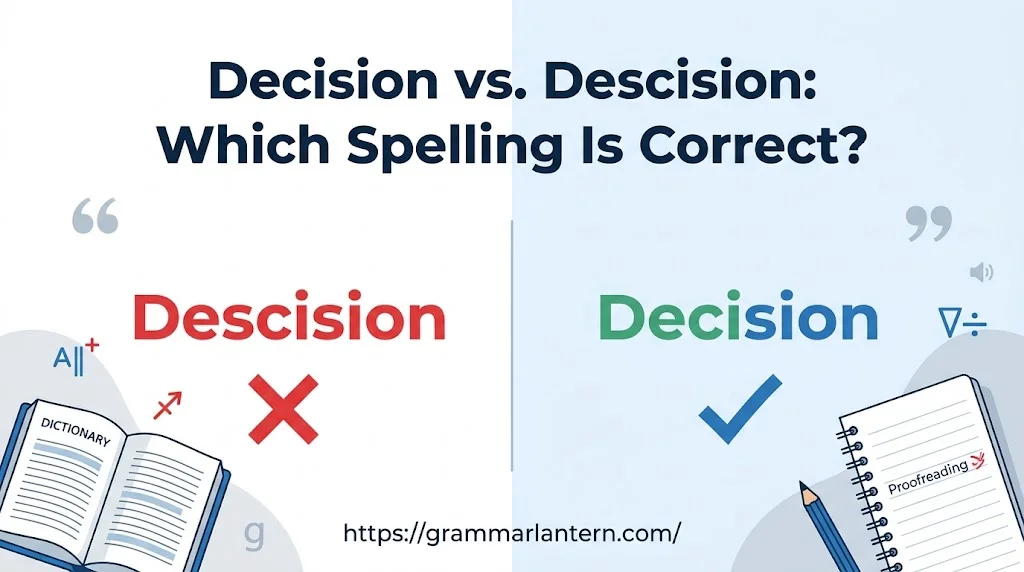
The correct form is decision, while descision and decission are incorrect spellings. The noun decision describes a choice or conclusion reached after considering different possibilities. It is a common word that appears in both casual conversations and formal English, so learning to spell it correctly is worth the effort.
In this guide, we’ll explore descision vs decision, explain the meaning of decision, and look at useful examples in everyday English. You’ll also learn how to spell decision, understand why these spelling errors happen, and discover a simple way to remember the correct form. By the end, choosing decision should feel like an easy decision.
Quick Answer
Decision is the correct spelling.
Descision is incorrect.
The correct word is spelled:
D-E-C-I-S-I-O-N
The incorrect form adds an unnecessary s after the first two letters:
D-E-S-C-I-S-I-O-N
| Word | Correct Spelling? | Meaning | Example |
| Decision | ✅ Yes | A choice or judgment | She made an important decision. |
| Descision | ❌ No | Misspelling of decision | ❌ She made an important descision. |
A useful way to remember it is to connect decision with the verb decide.
Decide → Decision
Once you remember that connection, the extra s in descision becomes much easier to spot.
What Does Decision Mean?
Decision is a noun that describes a choice, judgment, or conclusion reached after considering one or more possibilities.
When you choose between two restaurants, you make a decision. When a company selects a new strategy, it makes a decision and when a court reaches a ruling, that ruling can also be described as a decision.
The word works in both ordinary conversation and formal writing.
For example:
- I need to make a decision before Friday.
- She made the difficult decision to move.
- The manager announced his decision this morning.
- We’re still waiting for the final decision.
- The court issued its decision after reviewing the case.
The meaning changes slightly with context, but the central idea remains the same: a decision is a choice or conclusion reached after consideration.
Decision in Everyday English
You probably use decision more often than you realize.
You make small decisions throughout the day. What should you eat? Which route should you take? Should you buy something now or wait?
These choices may feel insignificant, but grammatically they still qualify as decisions.
For example:
“Choosing the blue shirt was an easy decision.”
The sentence doesn’t suggest a major life event. It simply describes a choice.
Decision in Formal English
In formal settings, decision often carries more weight.
A business might make a strategic decision. A committee might make a policy decision. A judge might issue a decision. A government agency might announce an administrative decision.
For example:
“The board reached a decision after reviewing the financial report.”
Here, decision refers to a considered conclusion rather than a casual preference.
Why Is Descision Incorrect?
The main problem with descision is simple: it contains an extra s.
English spelling can make this mistake tempting because pronunciation doesn’t always reveal every letter clearly. When people hear the word decision, they may mentally associate its middle sound with the spelling sc.
However, standard English spells the word:
decision
Not:
descision
The incorrect form doesn’t represent a separate English word with a different meaning. It is simply a spelling error.
Read More: Stub vs. Stab: Meaning, Difference, Pronunciation, and Usage
Why People Spell Decision as Descision
Several factors can encourage this mistake.
First, English contains many words where sc creates a sound associated with /s/, such as science and scene. That pattern can influence how someone tries to spell an unfamiliar word.
Second, decision contains a soft s sound in the middle. The pronunciation can make the spelling feel less obvious.
Third, writers sometimes connect the word incorrectly to other words beginning with des- or containing sc.
For example, someone may unconsciously write:
de + scision
instead of the correct:
decision
The difference is only one letter. Yet that one letter makes the spelling wrong.
Decision Spelling Breakdown
Knowing the exact letters can help you catch the mistake before you submit your writing.
The correct spelling is:
D-E-C-I-S-I-O-N
Look closely at the beginning:
DEC…
The word does not begin with DESC…
That gives you a quick visual test.
If you see descision, stop and check it. The correct spelling should have dec at the beginning.
How to Spell Decision
Break the word into a familiar visual pattern:
DEC + ISION
You don’t need to pronounce every letter separately. Instead, train yourself to recognize the complete spelling.
A useful memory sequence is:
decide → decision
The verb decide contains the same opening pattern:
DECIDE
The noun changes form:
DECISION
Compare them:
| Verb | Noun |
| decide | decision |
| We need to decide. | We need to make a decision. |
| She decided quickly. | Her decision was quick. |
This relationship provides a practical spelling anchor.
Decision and Decide
Decide is a verb. It describes the act of choosing or reaching a conclusion.
Decision is a noun. It names the choice or conclusion itself.
For example:
“They need to decide which option to choose.”
Afterward:
“They made a decision.”
This distinction also helps you avoid another common grammatical problem. You don’t normally say “make a decide.” You say “make a decision.”
Likewise, you don’t usually use decision where a verb is required.
Meaning and Usage
The difference isn’t really a difference in meaning.
There is only one standard English spelling here:
decision
The word descision doesn’t function as an alternative spelling. If you encounter it in a sentence, treat it as a typo.
Consider these examples:
❌ The committee made a final descision.
✅ The committee made a final decision.
❌ I haven’t made my descision yet.
✅ I haven’t made my decision yet.
❌ His descision surprised everyone.
✅ His decision surprised everyone.
The correction is always the same: replace descision with decision.
Common Phrases With Decision
Some expressions occur with decision so frequently that learning them can strengthen your vocabulary and spelling at the same time.
Make a Decision
Make a decision is one of the most common expressions.
It means to choose something after considering the available options.
Examples:
- We need to make a decision today.
- She finally made a decision about the job.
- Take your time before you make a decision.
The phrase works in casual and formal English.
Reach a Decision
Reach a decision emphasizes the process of arriving at a conclusion.
For example:
“The committee reached a decision after three hours of discussion.”
It often sounds slightly more formal than make a decision.
Final Decision
A final decision is a choice or conclusion that is considered settled.
Examples:
- The manager has the final decision.
- We’re waiting for the final decision.
- Once you make a final decision, the team can move forward.
Difficult Decision
A difficult decision involves competing choices, uncertainty, consequences, or strong emotions.
For example:
“Leaving a job she loved was a difficult decision.”
The phrase works especially well when the available options all have advantages and disadvantages.
Decision-Making
Decision-making refers to the process of making decisions.
For example:
“Good decision-making requires accurate information.”
It can describe an individual skill, a management process, or an organizational activity.
Decision vs. Related Words
The word decision overlaps with several other nouns. However, these words aren’t always interchangeable.
Decision vs. Choice
A choice usually refers to the act or possibility of selecting one option from several.
A decision often emphasizes the conclusion reached after thinking about those options.
For example:
“You have three choices.”
This focuses on the available options.
“You need to make a decision.”
This focuses on choosing one.
The distinction can be subtle. In everyday conversation, the two words often overlap.
Decision vs. Judgment
A judgment usually involves forming an opinion or assessment after considering evidence or circumstances.
A decision involves choosing what should happen or which option to take.
For example:
1.“The manager made a decision about the schedule.”
The manager chose an action.
2.“The manager used good judgment.”
The sentence focuses on the quality of the manager’s assessment.
Decision vs. Determination
Determination can mean a conclusion reached after examination. It can also mean strong resolve.
For example:
“The investigation resulted in a determination about eligibility.”
But:
“Her determination helped her finish the project.”
The first meaning overlaps with decision. The second refers to persistence or resolve.
Common Spelling Mistakes
Descision isn’t the only incorrect form people may write.
Here are several forms you may encounter:
| Incorrect Form | Correct Form |
| descision | decision |
| desicion | decision |
| decison | decision |
| decission | decision |
| decison | decision |
The most important point is to recognize the correct pattern:
decision
Once that spelling becomes familiar, these variations stand out immediately.
Pronunciation of Decision
The pronunciation of decision can contribute to spelling confusion because the middle sound doesn’t make every letter obvious.
In standard US English, the word has three syllables, with the main stress on the second syllable:
de-CI-sion
The middle consonant has a sound similar to the zh sound heard in words such as vision.
That pronunciation explains why simply sounding out the word isn’t always enough to reconstruct its spelling.
This is an important lesson about English spelling: pronunciation and spelling don’t always match perfectly.
If you rely entirely on sound, you may produce a spelling that looks reasonable but isn’t correct.
How to Remember the Spelling
A good spelling trick should be simple enough to remember when you’re writing quickly.
Use the Decide-to-Decision Connection
The easiest strategy is probably this:
DECIDE → DECISION
Both words begin with DECI.
Think:
I decide. I make a decision.
That small grammatical connection gives you two words to reinforce each other.
Remember That Decision Has No Extra S
The incorrect form inserts an s after de:
❌ descision
The correct word keeps the opening:
✅ decision
When proofreading, scan the first four letters. If you see DESC, you’ve probably found the error.
Write the Word in Context
Memorizing isolated spelling patterns can help. However, using the word in real sentences makes the memory stronger.
Try sentences such as:
- I need to make a decision.
- That was a difficult decision.
- We support your decision.
- The final decision will come tomorrow.
- She explained her decision clearly.
Context gives the word meaning. Meaning makes the spelling easier to remember.
In Different Contexts
The word decision appears across nearly every area of modern English.
Everyday Decisions
Daily decisions include:
- choosing what to eat
- selecting an outfit
- deciding where to travel
- choosing a movie
- changing a schedule
- buying a product
- accepting an invitation
For example:
“Choosing where to eat became the hardest decision of the evening.”
Sometimes the decision is more dramatic than the problem itself.
Business Decisions
Businesses use decision in strategic and operational contexts.
Examples include:
- hiring decisions
- investment decisions
- pricing decisions
- marketing decisions
- purchasing decisions
- management decisions
- strategic decisions
A business report might say:
“The company made a strategic decision to expand into a new market.”
Here, decision refers to a deliberate organizational choice.
Academic Decisions
Students and educators also make decisions constantly.
Examples include:
- choosing a major
- selecting a course
- changing a research topic
- choosing a study method
- deciding which evidence to use
For example:
“Choosing a research question was an important decision for the student.”
Legal or Official Decisions
In formal contexts, decision can refer to a ruling or official determination.
For example:
“The court’s decision changed how the case proceeded.”
The word can therefore describe much more than everyday personal choices.
Decision as a Verb? Understanding the Grammar
One common grammatical mistake is treating decision as a verb.
It isn’t.
Decision is a noun.
The related verb is decide.
| Word | Part of Speech | Example |
| Decide | Verb | We need to decide soon. |
| Decision | Noun | We need to make a decision soon. |
Several common verbs work naturally with decision:
- make a decision
- reach a decision
- announce a decision
- explain a decision
- change a decision
- reverse a decision
- support a decision
- question a decision
This pattern is worth learning because natural English depends heavily on these word combinations.
Decision-Making: Spelling and Usage
Decision-making is a compound expression built from decision and making.
When it functions as a compound modifier before another noun, the hyphen is standard:
- decision-making process
- decision-making skills
- decision-making ability
- decision-making system
For example:
“Strong decision-making skills can help managers handle uncertainty.”
When the phrase functions differently in a sentence, style conventions can vary depending on the construction and publication style. However, the hyphenated form is especially common when the compound directly modifies another noun.
The key point is that decision-making contains the correct spelling decision. It doesn’t become descision-making.
In Common Sentences
Seeing the mistake beside the correction makes the difference easy to recognize.
| Incorrect | Correct |
| I need to make a descision. | I need to make a decision. |
| It was a difficult descision. | It was a difficult decision. |
| She changed her descision. | She changed her decision. |
| The manager announced his descision. | The manager announced his decision. |
| We’re waiting for their descision. | We’re waiting for their decision. |
| That descision surprised everyone. | That decision surprised everyone. |
A useful proofreading habit is to search specifically for descision. If your writing software allows custom searches, this can help you catch the error quickly.
A Simple Case Study: Catching the Extra S
Imagine that a student writes:
“After thinking for several days, I finally made my descision.”
The sentence communicates the intended meaning. The grammar is otherwise fine. Yet the spelling error makes the sentence less polished.
The correction is straightforward:
“After thinking for several days, I finally made my decision.”
Now compare the two spellings:
descision
decision
The extra s is easy to miss during fast typing. That’s why proofreading matters. Your eyes often recognize the shape of a familiar word before your brain consciously examines every letter.
This is especially common with frequently used words. Familiarity can actually make small errors harder to notice.
Read More: Labeler vs. Labeller: Which Spelling Is Correct?
Is Descision Ever Correct?
No.
Descision is not a standard alternative spelling of decision.
If you’re writing an email, essay, report, application, article, or professional document, use decision.
If you see descision somewhere else, the intended word is almost certainly decision.
This distinction matters because some spelling variations are legitimate. American and British English sometimes differ in spelling, such as color/colour or organize/organise.
Decision vs. descision isn’t that kind of variation.
There is no standard US-versus-UK spelling distinction here.
Quick Comparison
| Feature | Decision | Descision |
| Standard English spelling | ✅ Yes | ❌ No |
| Part of speech | Noun | Not a standard word |
| Meaning | A choice or judgment | None in standard English |
| Related verb | Decide | None |
| Correct opening | Deci- | Desc- |
| Use in formal writing | Yes | No |
| Example | We made a decision. | ❌ We made a descision. |
The simplest rule is worth repeating:
Use decision. Never use descision as an alternative spelling.
FAQs
1. Is “descision” a correct spelling?
No. Descision is an incorrect spelling. The correct spelling is decision.
2. Is it “decision” or “decission”?
The correct spelling is decision. The word has only one s after the i.
3. What does “decision” mean?
Decision is a noun that means a choice or conclusion made after considering different options or possibilities.
4. How do you spell “decision” correctly?
Spell it as D-E-C-I-S-I-O-N. A useful way to remember it is to focus on the -cision ending.
5. Why do people spell decision as “descision”?
The pronunciation can cause confusion. Some people hear an extra s sound and mistakenly insert another letter when writing the word.
6. Is “decission” an English word?
No. Decission is a misspelling of decision. It should not be used in standard English writing.
7. What is the plural of decision?
The plural form is decisions. For example, “We need to make several important decisions today.”
8. What is the verb form of decision?
The related verb is decide. For example, “She needs to decide which option is best.”
9. Can decision be used in formal writing?
Yes. Decision is completely appropriate in formal, academic, business, and everyday English.
10. What is an easy trick to remember the spelling of decision?
Remember that decision contains “cis” rather than “scis” or “ciss.” Think of decide → decision to connect the related words.
Conclusion
The confusion between descision vs decision is understandable, but the correct spelling is simple: decision. Both descision and decission are incorrect. Since decision is used frequently in everyday and professional English, learning its spelling can prevent an easy mistake from appearing in your writing.
When you need to describe a choice, conclusion, or judgment, use decision with confidence. Remember the connection between decide and decision, and pay attention to the single s in the middle. Once this spelling becomes familiar, you’ll never have to second-guess whether it is descision or decision again.

For Shafiq ur Rehman, writing is an art form and grammar is the toolbox that makes it beautiful. As a dedicated content writer at Grammar Lantern, Shafiq approaches every topic like an architect carefully laying down strong foundations of understanding before adding the finer details. He loves diving into the trickiest grammar points and resurfacing with simple, bite-sized takeaways that anyone can grasp. When he’s not crafting articles, you’ll likely find him strategizing over a game of chess, exploring dusty local bookshops, or quietly jotting down poetic observations in his notebook.