
Pace vs Phase can be confusing because the words sound similar, but their meanings are quite different. Pace describes speed or the rate at which something happens. For example, you can talk about the pace of a race, a project, or your daily work. When someone says, “Work at your own pace,” they mean you should control how quickly you work. I often find that asking, “How fast is it happening?” makes the correct choice easier.
Phase is connected to a stage, period, or part of a process. A project may go through several phases before it is finished. The lunar phase of the moon is another familiar example. We can also use phase as a verb when something is introduced or removed gradually. For instance, a company might phase in a new policy over several months.
A simple way to remember the difference is to connect pace with speed and phase with stages. If you are describing how quickly something happens, choose pace. If you are describing where something stands in a process or cycle, choose phase. This small trick can make everyday writing clearer and prevent common spelling and usage mistakes.
Quick Answer
Pace means the speed, rate, or rhythm at which something happens or progresses.
Phase means a distinct stage, period, or part of a larger process.
| Word | Basic meaning | Main question | Example |
| Pace | Speed or rate | How fast? | The team is working at a rapid pace. |
| Phase | Stage or period | Which stage? | The project has entered its final phase. |
A quick memory trick is:
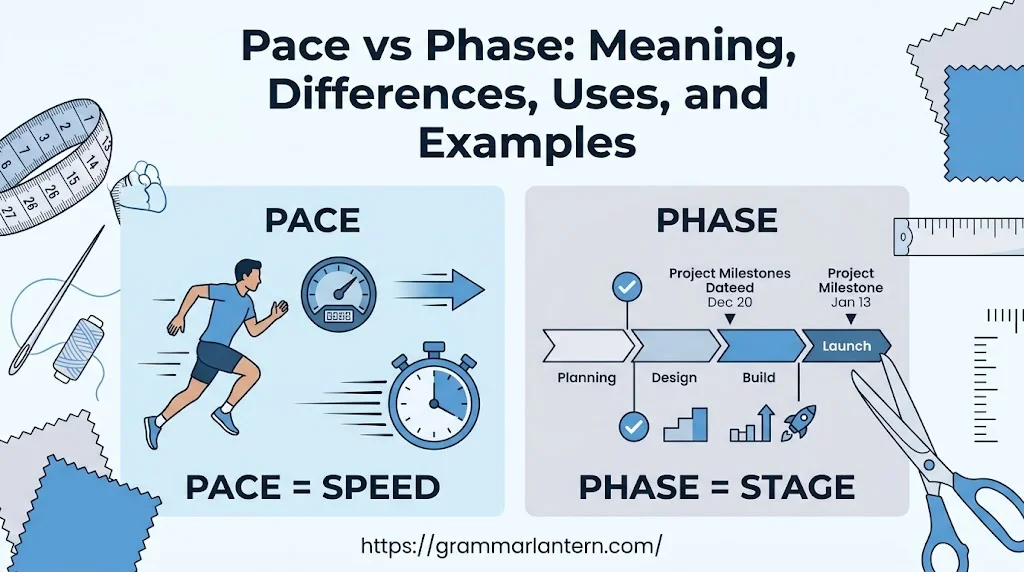
Pace = speed. Phase = stage.
If you’re describing how quickly something happens, choose pace. If you’re describing where something is in a process, choose phase.
What Does Pace Mean?
Pace describes the rate at which something moves, develops, happens, or progresses. It can refer to physical movement, mental work, business activity, learning, conversation, or broader social change.
Think of pace as the speedometer of an activity. It tells you whether something is moving slowly, quickly, steadily, or unpredictably.
Pace as a Noun
As a noun, pace commonly refers to speed or rate.
Consider these examples:
- The runner increased her pace during the final mile.
- The company is growing at an impressive pace.
- He prefers to work at a comfortable pace.
- The conversation moved at a surprisingly fast pace.
- Technology continues to change at a rapid pace.
In each sentence, pace describes how fast something happens.
It doesn’t necessarily mean physical speed. You can have a fast pace of work, a slow pace of learning, or a steady pace of development.
That broader meaning makes pace useful in everyday and professional English.
Read More: 27 Best Replies to “I Don’t Care” Witty & Clever
Pace as a Verb
Pace can also function as a verb.
One meaning is to walk back and forth, often because someone feels nervous, restless, or impatient.
For example:
He began to pace around the room while waiting for the phone call.
Here, pacing describes physical movement.
Another use involves controlling or adjusting the speed of an activity.
For example:
The teacher paced the lesson carefully to give students enough time to understand each concept.
In this sentence, paced means that the teacher controlled the rate at which the lesson progressed.
Common Uses of Pace
You’ll encounter pace in many common expressions.
- At your own pace — at a speed that feels suitable for you
- At a fast pace — quickly
- At a slow pace — gradually
- Keep pace with — remain at the same rate as something else
- Set the pace — establish the speed or standard for others
- Pick up the pace — become faster
- Slow the pace — reduce the speed
- The pace of change — how quickly change occurs
For example:
You can complete the course at your own pace.
This doesn’t mean the course has a particular stage. It means you control how quickly you move through it.
What Does Phase Mean?
A phase is a distinct stage, period, or part of a larger process.
Imagine a long journey divided into several sections. Each section represents a different phase. The word doesn’t tell you how quickly you move through that section. Instead, it tells you where you are in the overall process.
For example:
The construction project has entered its testing phase.
The sentence identifies a particular stage of the project.
Phase as a Noun
The noun phase appears frequently when people describe development, change, projects, research, and periods of life.
Examples include:
- The project is entering a new phase.
- The company is in the early phase of expansion.
- The final phase involves testing the equipment.
- Adolescence is an important phase of development.
- The patient is moving into a different phase of treatment.
Notice that none of these sentences primarily describes speed.
Instead, phase identifies a particular stage or period.
Phase as a Verb
It can also work as a verb, especially when combined with in or out.
Phase in means to introduce something gradually.
The school will phase in the new curriculum over two years.
Phase out means to remove or discontinue something gradually.
The company plans to phase out the older software.
These expressions are common in business, education, government, technology, and everyday discussions about change.
The key idea remains the same: phase involves stages or gradual transitions.
Key Differences
The easiest way to distinguish pace vs phase is to focus on the question each word answers.
Pace answers “How fast?”
Phase answers “Which stage?”
| Feature | Pace | Phase |
| Core idea | Speed or rate | Stage or period |
| Common part of speech | Noun and verb | Noun and verb |
| Main question | How fast? | Which stage? |
| Physical use | Walking or running speed | A stage of physical development |
| Work use | Rate of work | Stage of a project |
| Learning use | Rate of learning | Stage of learning |
| Change | Speed of change | Stage of change |
| Common expressions | Keep pace, pick up the pace | Phase in, phase out |
Here’s the simplest comparison:
The project is moving at a fast pace.
This tells you the project is progressing quickly.
The project is entering a new phase.
This tells you the project has reached another stage.
Both sentences can describe the same project. However, they communicate different information.
In Sentences
Context makes the distinction even clearer.
Work
Pace:
The team is working at a steady pace.
The sentence describes how quickly the team works.
Phase:
The team has entered the testing phase.
The sentence identifies the team’s current stage.
Learning
Pace:
Students learn at different paces.
This focuses on the rate at which students learn.
Phase:
The students are now in the advanced phase of the program.
This identifies a stage in the program.
Exercise
Pace:
Try to maintain a consistent pace during the run.
This refers to running speed.
Phase:
The rehabilitation program has entered its final phase.
This refers to a stage of the program.
Business
Pace:
The company expanded at a remarkable pace.
The focus is the speed of expansion.
Phase:
The company is entering a new phase of international growth.
The focus is the stage of development.
Pace of Progress vs Phase of Progress
This distinction causes particular confusion because both words can appear with progress.
Consider these two phrases:
- pace of progress
- phase of progress
They aren’t interchangeable.
The pace of progress describes the speed of progress.
The pace of progress has increased significantly.
This means progress is happening faster.
The phase of progress describes a particular stage of progress.
The project is entering a new phase of progress.
This points toward a new period or stage in the overall development.
Here’s another way to see it:
| Expression | Meaning |
| Fast pace of progress | Progress is happening quickly |
| Slow pace of progress | Progress is happening slowly |
| Early phase of progress | Progress is in an early stage |
| Final phase of progress | Progress is in a later stage |
So, if you can replace the word with speed, use pace.
If you can replace it with stage, use phase.
In Academic and Professional Writing
Professional writing frequently uses both words, especially when describing projects and development.
Use pace when discussing:
- Productivity
- Growth rate
- Learning speed
- Economic change
- Technological development
- Work speed
- Progress rate
- Research activity
For example:
The pace of technological development has accelerated.
Use phase when discussing:
- Project stages
- Product development
- Research stages
- Business transitions
- Construction stages
- Treatment periods
- Developmental periods
For example:
The research has entered a new experimental phase.
The difference may seem tiny at first. In professional writing, however, precision matters. A reader should immediately understand whether you’re describing speed or stage.
In Science and Technical Contexts
The word phase has several specialized meanings in technical fields.
In science, phase can describe a distinct physical state or form of matter. For example, water can exist in solid, liquid, and gas phases.
In physics, phase can also describe the position of a periodic motion within its cycle. That technical meaning differs from the everyday idea of a stage, yet the underlying concept still involves a particular position or condition within a process.
Pace, meanwhile, generally retains its core idea of rate or speed.
For example:
The reaction proceeds at a faster pace under these conditions.
Here, pace concerns the rate of the process.
By contrast:
The substance changes into a different phase.
Here, phase identifies a different physical state.
This distinction is especially important in technical writing because substituting one word for the other can change the meaning substantially.
Common Expressions With Pace
At Your Own Pace
At your own pace means moving or working at a speed that suits you.
Online lessons allow students to study at their own pace.
The expression emphasizes personal control over speed.
Keep Pace With
Keep pace with means to maintain the same rate or level of progress as someone or something else.
Businesses must keep pace with changing technology.
The idea is not simply movement. It involves staying current with another rate of development.
Set the Pace
To set the pace means to establish the speed or standard that others follow.
The leading runner set the pace for the entire race.
The expression can also be figurative:
The company has set the pace for innovation in its industry.
Pick Up the Pace
To pick up the pace means to become faster.
We need to pick up the pace if we want to finish on time.
It’s common in conversations about work, travel, exercise, and deadlines.
Slow the Pace
To slow the pace means to reduce the speed or intensity of an activity.
The instructor slowed the pace to explain the difficult concept.
This expression can describe physical movement as well as abstract progress.
Common Expressions With Phase
Phase In
Phase in means to introduce something gradually rather than all at once.
The company will phase in the new system over several months.
The important idea is gradual introduction.
Phase Out
Phase out means to remove or discontinue something gradually.
The manufacturer plans to phase out the older model.
The product doesn’t necessarily disappear overnight. Its use declines through a planned transition.
In a Phase
When someone says they are in a phase, they usually mean they’re experiencing a particular temporary period.
For example:
I’m in a phase where I prefer working early in the morning.
This describes a current period or tendency.
A New Phase
A new phase describes a new stage in development or change.
Moving abroad marked a new phase in her life.
The sentence doesn’t tell us how quickly her life changed. It identifies a significant new period.
Common Mistakes
The most common error is using phase when you mean speed.
Incorrect:
The project is moving at a fast phase.
Correct:
The project is moving at a fast pace.
The second common mistake is using pace when you mean stage.
Incorrect:
The project has entered its final pace.
Correct:
The project has entered its final phase.
Another mistake occurs when discussing change.
The pace of change is accelerating.
This means change is happening faster.
The phase of change is nearing completion.
This means a particular stage of change is approaching its end.
The words may appear in similar sentences, but they perform different jobs.
Pronunciation and Spelling
The spelling difference is small:
- Pace → P-A-C-E
- Phase → P-H-A-S-E
The pronunciation is also different.
Pace rhymes with words such as face, race, and place.
Phase has the same long vowel sound but begins with a different consonant sound. It rhymes with words such as days, gaze, and raise.
The spelling can cause confusion because both words contain a and e and both are relatively short. Their meanings, however, are not closely interchangeable.
An Easy Memory Trick
Here’s a simple trick that works well:
Pace = speed.
Phase = stage.
You can also remember the difference through two questions.
How fast is it happening?
→ Pace
Which stage is it in?
→ Phase
Imagine a road trip. Your pace tells you how quickly you’re driving. Your phase could describe which part of the journey you’re currently completing.
One measures rate. The other identifies position in a process.
Which Word Should You Use?
When you’re unsure, replace the word mentally.
If speed, rate, or rhythm fits, use pace.
If stage, period, or part of a process fits, use phase.
Choose Pace When You Mean:
- Speed
- Rate
- Rhythm
- Progress speed
- Work speed
- Movement speed
- Rate of change
Choose Phase When You Mean:
- Stage
- Period
- Part of a process
- Developmental stage
- Project stage
- Transition period
- Physical or technical state
The distinction becomes almost automatic once you train yourself to ask the right question.
Examples
Correct Examples With Pace
- She studies at her own pace.
- The runner maintained a steady pace.
- The company grew at a remarkable pace.
- We need to increase the pace of production.
- Technology is advancing at a rapid pace.
- The teacher adjusted the pace of the lesson.
- The conversation moved at a comfortable pace.
Correct Examples With Phase
- The project has entered its final phase.
- The company is going through a difficult phase.
- Researchers have begun the next phase of the study.
- The machine is currently in a testing phase.
- The program will phase in the new requirements.
- The manufacturer will phase out the older product.
- Adolescence is a major phase of development.
Side-by-Side Examples
| With Pace | With Phase |
| The project is moving at a fast pace. | The project has entered a new phase. |
| She learns at her own pace. | She is in an advanced phase of training. |
| The company is growing at a rapid pace. | The company is entering a new phase of growth. |
| We need to increase the pace of production. | We have reached the final phase of production. |
| The runner slowed his pace. | The athlete began a new training phase. |
A Practical Case Study: Understanding Both Words
Imagine a software company developing a new mobile application.
During the first few months, the team works slowly because it is still planning the product. Later, the developers work faster to meet an approaching launch date.
The phase changes when the company moves from planning to development and then from development to testing.
The pace changes when the team begins working faster.
So you might say:
The project has entered its testing phase.
You could also say:
The development team has increased its pace to meet the deadline.
Both statements are accurate. They simply describe different aspects of the same project.
This example captures the entire distinction. Phase tells you where the project is. Pace tells you how quickly it is moving.
Read More: Chose vs. Chosen: Which Is Correct? A Complete Guide
FAQs
1. What is the main difference between pace and phase?
Pace means the speed or rate at which something happens. Phase means a stage or period in a process, development, or cycle.
2. What does pace mean?
Pace refers to how quickly something happens, moves, or changes. It can also describe a walking speed or a single step.
3. What does phase mean?
Phase refers to a particular stage, period, or part of a process. It is also used for stages in repeating cycles, such as the phases of the moon.
4. Is pace a noun or a verb?
Pace can be both a noun and a verb. As a noun, it describes speed. As a verb, it can mean walking back and forth or controlling a rate.
5. Is phase a noun or a verb?
Phase can also work as both a noun and a verb. As a noun, it means a stage. As a verb, it means introducing or removing something gradually.
6. What is an example of pace?
“The team maintained a fast pace throughout the race.” Here, pace refers to the speed of the race.
7. What is an example of phase?
“The project has entered its final phase.” Here, phase means the final stage of the project.
8. How can I remember pace vs phase?
Think of pace when you mean speed. Think of phase when you mean a stage in a process or cycle.
9. Can pace and phase be used interchangeably?
No. Although they sound somewhat similar, they have different meanings and cannot normally replace each other in a sentence.
10. Why are pace and phase commonly confused?
They are often confused because their pronunciation is similar, especially during quick conversation. Seeing the words in writing can make their different spellings and meanings easier to remember.
Conclusion
Pace and phase may sound similar, but they describe two different ideas. Pace is about speed, while phase is about a stage or period. Once you connect each word with its core meaning, choosing between them becomes much easier.
When writing or speaking, ask yourself a quick question: Am I talking about how fast something happens, or which stage it is in? If it is about speed, use pace. If it is about a stage or process, use phase.