When writing Hers or Her’s or Hers’, the correct choice is hers. It is a possessive pronoun that shows ownership without an apostrophe. The word her is used before a noun, while hers stands alone. This different pattern can feel confusing because many possessive words follow other rules. However, once you understand the basic form, the difference becomes simple. In standard English grammar, hers is the only correct possessive form.
Use hers when the owner is her or she and the item has already been specified. For example, if someone asks whose notebook is on the desk, you can say, “The notebook is hers.” This sentence clearly shows ownership and does not need an apostrophe. From my experience explaining grammar, this example helps learners recognize the correct pattern quickly.
The forms her’s and hers’ may look familiar, but they are not standard. Hers can replace a longer possessive phrase, whereas her normally appears with a noun. This distinction makes the usage easier to remember and helps you avoid common mistakes when writing.
Quick Answer
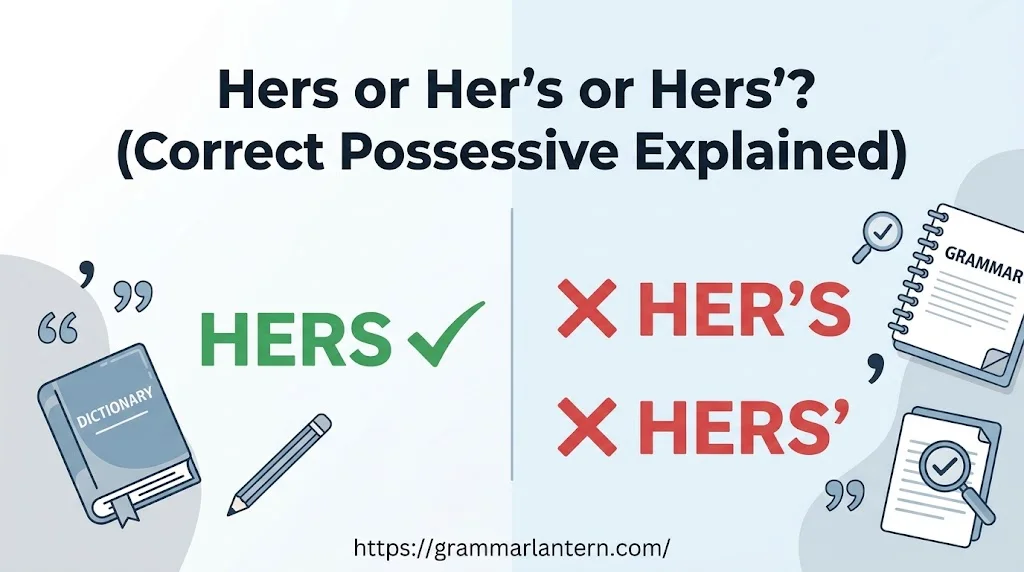
The correct spelling is hers.
| Form | Correct? | Function | Example |
| hers | ✅ Yes | Possessive pronoun | That jacket is hers. |
| her | ✅ Yes | Possessive determiner | That is her jacket. |
| her’s | ❌ No | Incorrect form | Her’s is on the chair. |
| hers’ | ❌ No | Incorrect form | The jacket is hers’. |
Here’s the easiest rule to remember:
Use “her” before a noun and “hers” when the noun is understood.
For example:
- Her phone is ringing.
- The phone is hers.
- I borrowed her book.
- The book is hers.
Neither her’s nor hers’ belongs in standard English.
What Does “Hers” Mean?
Hers is a possessive pronoun. It shows that something belongs to or is associated with a female person or someone referred to with her.
Consider this sentence:
That blue backpack is hers.
The word hers tells you who owns the backpack. It also replaces the longer phrase her backpack.
That replacement is important.
You could say:
- That is her backpack.
- That backpack is hers.
The meaning remains essentially the same, but the grammatical structure changes.
A possessive pronoun can stand independently. It doesn’t need to sit directly before a noun.
Examples of “Hers”
- The red umbrella is hers.
- That desk is hers.
- The final decision was hers.
- I thought the notebook was hers.
- This seat isn’t hers.
- The idea was completely hers.
Notice something in all these examples: hers doesn’t directly modify a noun.
You don’t say:
- ❌ hers notebook
- ❌ hers car
- ❌ hers jacket
Instead, standard English uses:
- her notebook
- her car
- her jacket
That small distinction solves a surprising number of grammar questions.
Read More: Begun vs. Began: Which Is Correct? Helpful Examples
Hers vs. Her: What’s the Difference?
The difference between her and hers becomes much easier once you look at what comes after each word.
“Her” as a Possessive Determiner
Her works as a possessive determiner when it appears before a noun.
Examples include:
- Her car is parked outside.
- I found her keys.
- Her sister lives nearby.
- We read her article.
- They admired her painting.
In each sentence, her introduces or determines a noun.
Think of the pattern as:
her + noun
So:
- her book
- her phone
- her house
- her opinion
- her project
“Hers” as a Possessive Pronoun
Hers takes the place of a possessive phrase and stands independently.
Examples:
- The book is hers.
- The phone is hers.
- The house is hers.
- The opinion was hers.
- The project is hers.
The basic pattern becomes:
noun + linking verb + hers
For example:
The laptop is hers.
You could expand the meaning to:
The laptop is her laptop.
The second version sounds repetitive, which is exactly why hers exists.
Her vs. Hers Side by Side
| With “her” | With “hers” |
| This is her coat. | This coat is hers. |
| I borrowed her pen. | The pen is hers. |
| We visited her house. | The house is hers. |
| I liked her idea. | The idea was hers. |
| They found her wallet. | The wallet was hers. |
A useful mental shortcut is simple:
If the noun appears immediately afterward, use “her.” If the noun has already been mentioned or is understood, “hers” may replace it.
Why Doesn’t “Hers” Have an Apostrophe?
This is where English possession can feel slightly mischievous.
Many writers learn that apostrophes indicate possession:
- Maria’s book
- John’s car
- the dog’s collar
That rule is useful, but it doesn’t apply to every possessive form.
English has a special group of words called possessive pronouns. These words already express possession without apostrophes.
Common examples include:
- mine
- yours
- his
- hers
- ours
- theirs
Consider these examples:
- This book is mine.
- That seat is yours.
- The jacket is his.
- The purse is hers.
- The house is ours.
- The decision is theirs.
None of these needs an apostrophe.
That’s why hers is correct rather than her’s.
A Useful Comparison
| Possessive noun | Possessive pronoun |
| Maria’s | hers |
| James’s | his |
| the students’ | theirs |
| the children’s | theirs |
The forms don’t follow one single visual pattern. Grammar determines the form.
So don’t use an apostrophe simply because you see an s.
Why “Her’s” Is Incorrect
The spelling her’s looks tempting because English often adds an apostrophe and s to a singular noun.
For example:
- Anna → Anna’s
- teacher → teacher’s
- brother → brother’s
But her isn’t a noun that needs to become a possessive noun. It’s already a pronoun.
The standard possessive-pronoun form is simply:
hers
Therefore:
- ❌ her’s
- ✅ hers
Think of her’s as trying to apply the wrong grammatical recipe.
You don’t need to add anything to her with an apostrophe. The language already has a separate possessive pronoun: hers.
Compare These Forms
Maria’s bag
Here, Maria’s is a possessive noun phrase.
Her bag
Here, her is a possessive determiner.
The bag is hers
Here, hers is a possessive pronoun.
These three constructions express related ideas, but they aren’t built in the same way.
Why “Hers’” Is Incorrect
The form hers’ creates a different kind of problem.
Some writers assume that because hers ends in s, possession requires an apostrophe afterward. That’s not how possessive pronouns work.
Hers is already complete.
You don’t turn it into hers’.
So:
- ❌ The blue car is hers’.
- ✅ The blue car is hers.
The apostrophe isn’t missing. It simply doesn’t belong there.
Compare Genuine Plural Possessives
An apostrophe after s can be correct with plural nouns.
For example:
- the students’ books
- the teachers’ lounge
- the parents’ meeting
- the players’ uniforms
Here, students, teachers, parents, and players are plural nouns. The apostrophe marks possession.
Hers, however, isn’t a plural noun.
That’s why you shouldn’t treat it like students’.
Hers in a Sentence: Correct Usage
Once you understand its grammatical role, hers becomes easy to use.
“Hers” After a Linking Verb
One of the most common patterns places hers after a linking verb.
Examples:
- The black coat is hers.
- That office was hers.
- The choice is hers.
- The responsibility remains hers.
- The last seat is hers.
Words such as is, was, and remains connect the subject with the possessive pronoun.
The structure is often:
Subject + linking verb + hers
For example:
The notebook is hers.
The sentence doesn’t need to repeat notebook after hers.
“Hers” After a Preposition
You’ll also see hers in constructions such as a friend of hers.
Examples:
- She is a friend of hers.
- I found an old photograph of hers.
- He mentioned a former colleague of hers.
- We read a short story of hers.
This construction is completely standard.
The phrase a friend of hers means roughly one of her friends.
Likewise, a book of hers means one of her books.
This pattern can sound slightly unusual at first, but it’s common in natural English.
Common Sentence Errors With Hers
A few mistakes appear again and again. Fortunately, each one has a straightforward correction.
Incorrect: “Her’s is on the table.”
Correct: Hers is on the table.
The word stands alone, so hers is the appropriate possessive pronoun.
Incorrect: “That laptop is her’s.”
Correct: That laptop is hers.
The laptop belongs to her, so use the possessive pronoun hers.
Incorrect: “The red dress is hers’.”
Correct: The red dress is hers.
Adding an apostrophe after hers is unnecessary.
Incorrect: “Hers book is expensive.”
Correct: Her book is expensive.
Here, a noun follows the possessive form. Therefore, use her, not hers.
Incorrect: “I borrowed hers pencil.”
Correct: I borrowed her pencil.
Again, pencil directly follows the possessive word.
A Quick Correction Table
| Incorrect | Correct | Why |
| Her’s is here. | Hers is here. | Possessive pronoun |
| The bag is her’s. | The bag is hers. | No apostrophe needed |
| The bag is hers’. | The bag is hers. | No apostrophe needed |
| Hers bag is heavy. | Her bag is heavy. | “Her” comes before a noun |
| I borrowed hers book. | I borrowed her book. | “Hers” doesn’t modify a noun |
Hers vs. Her’s: The Fastest Test
When you’re unsure, don’t stare at the apostrophe. Look at the sentence structure.
Ask:
Does a noun come immediately after the word?
If yes, her is usually the correct choice.
- her phone
- her desk
- her answer
- her jacket
If the possessive word stands independently, hers is usually correct.
- The phone is hers.
- The desk is hers.
- The answer is hers.
- The jacket is hers.
This isn’t merely a spelling trick. It reflects the grammatical difference between a possessive determiner and a possessive pronoun.
The Substitution Test
Here’s another handy method.
Take:
This is her jacket.
You can replace her jacket with hers:
This jacket is hers.
The noun has disappeared because hers carries the possessive meaning on its own.
This test works beautifully when proofreading.
Hers vs. His, Yours, Ours, and Theirs
Looking at the entire family of possessive pronouns can make the pattern easier to remember.
| Personal form | Possessive determiner | Possessive pronoun |
| I | my | mine |
| you | your | yours |
| he | his | his |
| she | her | hers |
| we | our | ours |
| they | their | theirs |
Notice the interesting detail with his.
His has the same form in both roles:
- His car is outside.
- The car is his.
That doesn’t happen with her.
For she, the forms are:
she → her → hers
The grammatical role changes the word.
A Simple Pattern to Memorize
- my book → the book is mine
- your book → the book is yours
- her book → the book is hers
- our book → the book is ours
- their book → the book is theirs
Once you see the pattern, hers stops looking like an odd exception.
Hers vs. Her vs. She
The three forms she, her, and hers belong to the same grammatical family, but each serves a different role.
She
She is a subject pronoun.
- She called me.
- She wrote the article.
- She owns the store.
Her
Her can function as an object pronoun or possessive determiner.
As an object:
- I called her.
- We invited her.
- They helped her.
As a possessive determiner:
- Her car is new.
- Her brother lives nearby.
- I read her article.
Hers
Hers is a possessive pronoun.
- The car is hers.
- The article is hers.
- The decision was hers.
This distinction matters because replacing one form with another can change the grammar even when the general meaning remains understandable.
Hers and Apostrophes: The Rule You Actually Need
Apostrophes can show possession, but possession doesn’t automatically require an apostrophe.
Consider:
Sarah’s notebook
Here, Sarah’s is a noun in possessive form.
Now compare:
Her notebook
There is no apostrophe because her is a possessive determiner.
Finally:
The notebook is hers
Again, there is no apostrophe because hers is a possessive pronoun.
| Sentence | Possessive form | Apostrophe? |
| Sarah’s notebook is here. | Possessive noun | Yes |
| Her notebook is here. | Possessive determiner | No |
| The notebook is hers. | Possessive pronoun | No |
The bigger lesson is worth remembering:
Don’t add an apostrophe simply because something expresses ownership.
First identify the grammatical form.
Special Case: “Hers” at the End of a Sentence
Writers sometimes hesitate when hers appears at the end of a sentence.
There’s nothing unusual about that construction.
For example:
- The final decision is hers.
- That apartment is hers.
- The blue folder is hers.
- The responsibility was hers.
- The choice remains hers.
In each case, hers completes the possessive meaning.
The sentence could contain a longer phrase, but English naturally avoids unnecessary repetition.
Compare:
The blue folder is her folder.
with:
The blue folder is hers.
The second sentence is cleaner. It also sounds more natural.
Special Case: “A Friend of Hers”
The expression a friend of hers deserves special attention because learners sometimes expect a friend of her.
Standard English uses:
a friend of hers
For example:
“She introduced me to a friend of hers.”
The same pattern works with other possessive pronouns:
- a friend of mine
- a colleague of yours
- an idea of his
- a neighbor of ours
- a relative of theirs
This construction is sometimes called a double possessive because possession appears through both of and the possessive pronoun.
You don’t need to fear the terminology. The structure itself is straightforward.
In Formal and Informal English
Hers is standard English. You can use it in practically any normal register.
It works in:
- academic writing
- business communication
- everyday conversation
- emails
- reports
- essays
- journalism
- professional documents
For example:
The final recommendation was hers.
That sentence is perfectly suitable for formal writing.
Likewise:
That umbrella is hers.
Nothing about hers makes the sentence informal.
The issue isn’t register. It’s correctness.
Using her’s in formal writing can make a sentence look like a basic proofreading error because standard English doesn’t recognize it as the correct possessive pronoun.
Hers vs. Herself
Another useful distinction involves hers and herself.
These words look unrelated grammatically, even though both connect to she.
Hers expresses possession:
- The decision was hers.
Herself is a reflexive pronoun:
- She made the decision herself.
The meaning changes considerably.
Compare:
| Word | Function | Example |
| hers | Possessive pronoun | The idea was hers. |
| herself | Reflexive/emphatic pronoun | She wrote it herself. |
You can even use both concepts in related sentences:
The design was hers, and she created it herself.
The first clause identifies ownership. The second emphasizes who performed the action.
Case Study: Fixing a Realistic Paragraph
Consider this short paragraph:
Sarah brought her laptop to class. The laptop was her’s, but the charger was hers’. She said the notebook was hers too. Later, a friend of her’s borrowed the notebook.
Several mistakes appear here.
A corrected version would read:
Sarah brought her laptop to class. The laptop was hers, but the charger was hers too. She said the notebook was hers. Later, a friend of hers borrowed the notebook.
The important corrections aren’t random spelling changes.
They follow clear grammatical rules:
- her laptop → her modifies a noun.
- the laptop was hers → hers stands independently.
- the charger was hers → hers is a possessive pronoun.
- a friend of hers → standard double-possessive construction.
Once you identify the role of each word, the corrections become almost automatic.
At-a-Glance Guide
When you’re proofreading quickly, use this table.
| Form | Status | Use | Example |
| hers | ✅ Correct | Possessive pronoun | The coat is hers. |
| her | ✅ Correct | Possessive determiner | Her coat is warm. |
| her | ✅ Correct | Object pronoun | I called her. |
| her’s | ❌ Incorrect | Not standard English | Avoid her’s. |
| hers’ | ❌ Incorrect | Not standard English | Avoid hers’. |
The Three-Second Memory Trick
Remember this contrast:
Her + noun
Hers = no noun after it
For example:
- her phone
- the phone is hers
That’s the core rule.
Read More: Scoup vs. Scoop: Which Spelling Is Correct?
FAQs
1. Is “hers” the correct possessive form?
Yes. Hers is the correct possessive pronoun used to show that something belongs to a female person.
2. Is “her’s” grammatically correct?
No. Her’s is incorrect in standard English because hers does not need an apostrophe.
3. Is “hers’” correct?
No. Hers’ is also incorrect. The correct form is simply hers.
4. What is the difference between “her” and “hers”?
Her usually comes before a noun, as in “her book.” Hers stands alone, as in “The book is hers.”
5. Can “hers” be used without a noun?
Yes. In fact, hers commonly appears without a noun because it replaces a possessive phrase.
6. Why does “hers” not have an apostrophe?
Possessive pronouns such as hers, yours, ours, and theirs do not use apostrophes. Their possessive meaning is already built into the word.
7. Is “hers” a noun or pronoun?
Hers is a possessive pronoun. It refers to something that belongs to a female person without repeating the noun.
8. Which is correct: “This is her” or “This is hers”?
When you mean something belongs to her, “This is hers” is correct. Her normally needs a noun after it, such as “This is her bag.”
9. How can I remember the correct spelling?
A simple trick is to remember that hers is already possessive. Adding an apostrophe creates an unnecessary form, so avoid her’s and hers’.
10. Is “hers” always used for one female owner?
In traditional grammar, hers refers to something belonging to one female person. The important point is that it functions as a possessive pronoun rather than a possessive noun form.
Conclusion
Choosing between hers, her’s, and hers’ becomes easy once you remember one simple rule: hers is always the correct possessive pronoun. You don’t need an apostrophe to show ownership. Use her before a noun, as in “her notebook,” and use hers when the noun is already clear, as in “The notebook is hers.” This small difference can make your writing clearer and help you avoid common grammar mistakes.
The next time you’re unsure which form to use, remember that her’s and hers’ are incorrect in standard English. Whether you’re writing an email, completing an assignment, or having a casual conversation, stick with hers to express ownership correctly. With a little practice, you’ll recognize the right form naturally and write with greater confidence.