Choosing between inexcusable and unexcusable can be confusing because both words seem to express the same idea. They describe something that cannot be justified, forgiven, or accepted. However, inexcusable is the standard and widely accepted word in modern English. Unexcusable is rare and may sound awkward or unfamiliar to many readers.
The difference comes down to common usage and familiarity. Although both words can be understood, English speakers strongly prefer inexcusable in everyday conversations, academic writing, and professional communication. For example, if someone repeatedly ignores an important responsibility, you might call their behavior inexcusable. Using the more familiar word helps your message sound natural and clear.
In this guide, you’ll discover the meanings, definitions, differences, and correct usage of inexcusable vs. unexcusable. You’ll also explore practical examples that show how these words work in real sentences. Understanding this distinction will help you avoid common mistakes and choose the right word confidently. Whether you’re writing an essay, sending a professional email, or having a casual conversation, remember that inexcusable is almost always the better choice.
Quick Answer
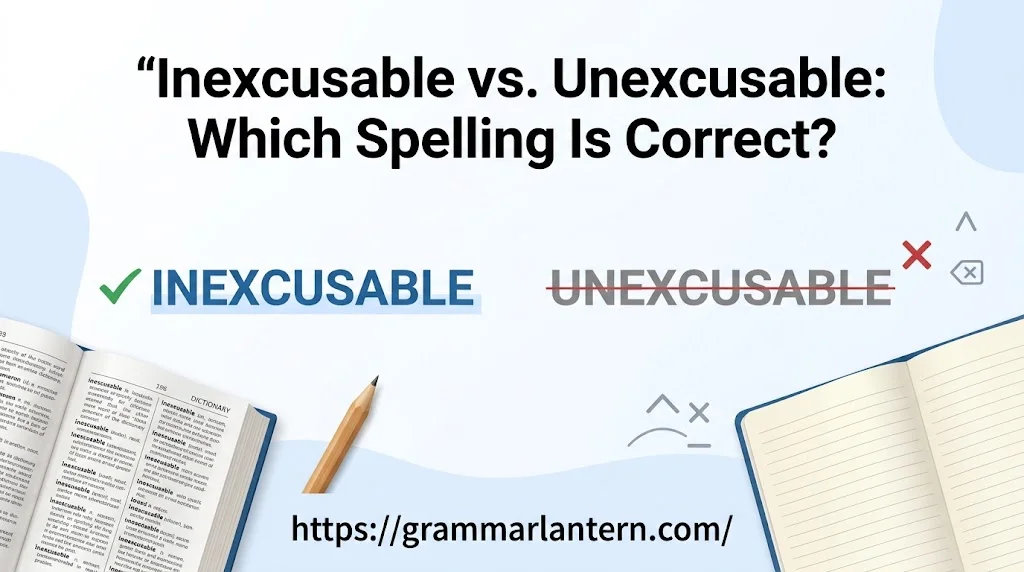
Inexcusable is the standard spelling. It means impossible or very difficult to excuse, justify, or defend.
Unexcusable is a nonstandard variant that you should generally avoid in modern English writing. Although readers may understand what you mean, inexcusable is the conventional form used in both formal and everyday communication.
| Word | Meaning | Standard usage | Example |
| Inexcusable | Impossible to excuse or justify | Standard and recommended | His rude behavior was inexcusable. |
| Unexcusable | Intended to mean impossible to excuse | Nonstandard; generally avoid | His rude behavior was unexcusable. |
Remember this simple rule: When you mean that something cannot reasonably be excused or justified, use inexcusable.
For example, you might describe a serious breach of trust as inexcusable. You could also call repeated negligence in the workplace inexcusable if the circumstances don’t provide a reasonable defense.
What Does Inexcusable Mean?
Inexcusable is an adjective that describes an action, mistake, or behavior that cannot reasonably be excused or justified.
When you call something inexcusable, you’re making a strong judgment about its seriousness. You’re suggesting that the circumstances don’t provide a good enough reason to overlook or defend what happened.
Consider this example:
“Leaving the building’s emergency exit blocked was inexcusable.”
The sentence doesn’t simply say that someone made a mistake. It suggests that the mistake created a serious problem and that a reasonable excuse isn’t available.
The Meaning of Inexcusable in Everyday English
In everyday conversations, inexcusable often expresses disappointment, frustration, or disapproval. People use it when they believe someone has crossed a clear boundary or failed to meet an important responsibility.
For example:
- Inexcusable behavior: “His insulting comments toward the new employee were inexcusable.”
- Inexcusable negligence: “The company considered the repeated safety violations inexcusable.”
- An inexcusable mistake: “Forgetting to include the patient’s critical allergy information was an inexcusable oversight.”
- An inexcusable delay: “The team considered the unexplained delay inexcusable because it put the entire project at risk.”
- An inexcusable failure: “Ignoring repeated warnings about the faulty equipment was an inexcusable failure of judgment.”
Notice that the word often appears before a noun. It describes the nature of the action or situation and communicates the speaker’s judgment.
When Should You Use Inexcusable?
Use inexcusable when you want to emphasize that a mistake, action, or failure lacks an acceptable justification.
It can fit several situations:
- At work: A manager repeatedly ignores serious safety concerns.
- At school: A student deliberately plagiarizes another person’s work.
- In relationships: Someone repeatedly breaks an important promise without taking responsibility.
- In public life: An official knowingly misuses a position of trust.
- In everyday situations: A person deliberately insults someone and refuses to acknowledge the harm.
However, the word is strong. Calling a minor inconvenience inexcusable may make you sound overly harsh.
If someone arrives five minutes late because of an unexpected traffic jam, inexcusable might be excessive. If someone repeatedly misses critical deadlines without communicating or making an effort to improve, the word may be more appropriate.
The context matters as much as the spelling.
Read More: As Of, As At, As From: Difference Explained With Examples
What Does Unexcusable Mean?
Unexcusable is a form that some writers use when they want to express the same idea as inexcusable. However, it isn’t the standard spelling you should choose in ordinary modern English.
The word may seem logical because un- frequently creates negative forms. For instance, unacceptable means not acceptable, while unfair means not fair.
That familiar pattern can tempt writers to form unexcusable by adding un- to excusable. Unfortunately, English doesn’t allow every prefix to replace another wherever the meaning seems suitable.
Is Unexcusable a Real Word?
The answer depends on what you mean by “real.”
People sometimes use nonstandard forms, and readers can often understand their intended meanings. A word’s appearance in informal writing doesn’t automatically make it the conventional spelling for standard English.
For practical writing purposes, treat unexcusable as a nonstandard alternative and use inexcusable instead.
This distinction is especially important when writing:
- Academic assignments and research papers
- Professional emails and business reports
- Articles, blog posts, and other published content
- Formal complaints or statements
- Resumes, cover letters, and other professional documents
Choosing the standard form helps your writing appear polished and credible.
Why Do People Write Unexcusable?
There are several understandable reasons for this spelling mistake.
First, English uses un- in many familiar negative adjectives, including unacceptable, unreasonable, and unforgivable. Writers may assume that the same pattern applies to excusable.
Second, inexcusable contains a sequence of letters that some people find less intuitive. The familiar prefix un- may seem easier to recognize or remember.
Finally, writers sometimes rely on sound rather than established spelling. Because both forms communicate a similar intended idea, the incorrect choice may go unnoticed during quick typing.
The solution is straightforward: learn the conventional spelling as a complete word rather than trying to build it from scratch each time.
Key Differences
The main difference between inexcusable and unexcusable concerns standard spelling. They aren’t two equally established alternatives with different meanings.
| Feature | Inexcusable | Unexcusable |
| Spelling status | Standard | Nonstandard |
| Part of speech | Adjective | Intended as an adjective |
| Intended meaning | Impossible to excuse or justify | Usually intended to mean the same thing |
| Formal writing | Recommended | Generally avoid |
| Professional communication | Appropriate when the context supports it | May appear as a spelling error |
| Best choice for learners | Yes | No |
The table highlights an important point: you don’t need to memorize two separate definitions. You need to remember which spelling is conventional.
Does Inexcusable Have a Different Meaning From Unexcusable?
In ordinary usage, writers who choose unexcusable generally intend the same meaning as inexcusable. The issue isn’t a useful distinction in meaning but the nonstandard spelling.
For example:
Nonstandard: “The manager’s decision was unexcusable.”
Standard: “The manager’s decision was inexcusable.”
The corrected sentence preserves the original meaning while following conventional spelling.
This is a useful editing principle. When you encounter unexcusable, you usually don’t need to rewrite the entire sentence. Replace it with inexcusable and check that the surrounding wording remains natural.
Why Is Inexcusable the Correct Spelling?
Understanding the related words makes the spelling easier to remember.
The word family includes excuse, excusable, and inexcusable. Each word has a distinct grammatical role, but they share the same underlying idea.
Understanding Excuse and Excusable
Excuse can function as both a noun and a verb.
As a noun, it refers to a reason offered to explain or defend an action.
Example: “She gave a reasonable excuse for missing the meeting.”
As a verb, it means to forgive, pardon, or release someone from an obligation.
Example: “Please excuse my interruption.”
Excusable is an adjective that describes something that can reasonably be excused or justified.
Example: “Her brief absence was excusable because she had a medical emergency.”
Inexcusable adds a negative meaning to excusable. It describes something that cannot reasonably be excused or justified.
Example: “Ignoring the emergency warning was inexcusable.”
The relationship is easy to see:
- Excuse: a reason or the act of excusing.
- Excusable: capable of being excused.
- Inexcusable: not reasonably capable of being excused.
This word family gives you a reliable way to remember the standard spelling.
Why Doesn’t the Prefix Un- Work Here?
English uses several prefixes to express negative or opposite meanings. Common examples include un-, in-, im-, il-, and ir-.
However, these prefixes aren’t interchangeable in every word. Their use depends on established vocabulary and spelling conventions.
Consider these examples:
| Word | Correct negative form | Example |
| Accurate | Inaccurate | The report contained inaccurate figures. |
| Appropriate | Inappropriate | His remark was inappropriate for the occasion. |
| Possible | Impossible | Finishing the entire project in one minute was impossible. |
| Legal | Illegal | The action was illegal under the applicable rules. |
| Responsible | Irresponsible | Leaving the equipment unattended was irresponsible. |
| Excusable | Inexcusable | Repeatedly ignoring the warning was inexcusable. |
These examples show why guessing from a prefix alone can lead to errors. The spelling of a negative word is often determined by established usage rather than a rule that works for every adjective.
The safest approach is to learn common word forms together. If you already know excusable, remember inexcusable as its standard negative form.
How to Use Inexcusable in a Sentence
Inexcusable is an adjective. It usually appears before a noun or after a linking verb such as is, was, seems, or became.
Both positions are natural and grammatically correct.
Inexcusable Before a Noun
When the adjective comes before a noun, it describes the action, mistake, or behavior being discussed.
Examples:
- “The company investigated the inexcusable breach of customer trust.”
- “Her inexcusable conduct damaged the team’s reputation.”
- “The report identified an inexcusable failure to follow safety procedures.”
- “He apologized for the inexcusable comment he made during the meeting.”
- “The customer complained about the inexcusable delay in receiving the order.”
In each sentence, inexcusable emphasizes the seriousness of the issue.
Inexcusable After a Linking Verb
You can also place the adjective after a linking verb.
Examples:
- “His decision was inexcusable.”
- “The repeated safety violations were inexcusable.”
- “Leaving confidential documents exposed is inexcusable.”
- “Her treatment of the customer seemed inexcusable.”
- “The failure to report the incident became inexcusable once the risks were known.”
This structure works particularly well when you want to make a direct statement about an action.
Using Inexcusable in Professional Writing
In professional settings, inexcusable can communicate that a problem deserves serious attention. However, it may sound accusatory if you use it without explaining the underlying issue.
Compare these two statements:
“Your handling of the project was inexcusable.”
“The failure to report the project’s safety risks was inexcusable because it exposed employees to preventable harm.”
The first sentence expresses disapproval but offers little explanation. The second identifies the specific failure and explains why it matters.
When writing a formal complaint, performance review, or incident report, focus on the action and its consequences. Clear details make your criticism more useful and defensible.
Common Examples
One of the easiest ways to learn the correct spelling is to compare incorrect examples with their corrected versions.
| Nonstandard or incorrect sentence | Correct sentence |
| His behavior was unexcusable. | His behavior was inexcusable. |
| The delay was completely unexcusable. | The delay was completely inexcusable. |
| She made an unexcusable mistake. | She made an inexcusable mistake. |
| Their failure to respond was unexcusable. | Their failure to respond was inexcusable. |
| Such negligence is unexcusable. | Such negligence is inexcusable. |
| The manager called the employee’s conduct unexcusable. | The manager called the employee’s conduct inexcusable. |
The corrections follow the same pattern: replace unexcusable with inexcusable.
Example From a Workplace Situation
Imagine that a supervisor repeatedly ignores reports about a faulty machine. Eventually, an employee gets hurt because the machine remains in use.
A report might state:
“The supervisor’s repeated failure to address the reported hazard was inexcusable.”
The word fits because the situation involves a serious responsibility and a potentially preventable risk. The statement also identifies the specific failure rather than relying on a vague accusation.
Example From an Academic Situation
Suppose a student copies another student’s assignment and submits it as original work.
A teacher might write:
“Submitting another student’s work without acknowledgment was an inexcusable breach of academic integrity.”
Here, inexcusable emphasizes the seriousness of the misconduct. It doesn’t merely describe an imperfect assignment or an accidental formatting error.
Example From Everyday Life
Imagine that a friend shares private information after promising to keep it confidential.
You might say:
“Sharing that private conversation without permission was inexcusable.”
The word communicates that the behavior crossed an important boundary. Whether the relationship can recover is a separate question, but the adjective clearly expresses your judgment.
Synonyms of Inexcusable
Sometimes, inexcusable isn’t the most precise word for the situation. A synonym may communicate your meaning more clearly or emphasize a different aspect of the problem.
Unjustifiable
Unjustifiable describes something that cannot be supported by reasonable arguments or evidence.
Example: “The manager’s decision to ignore the safety warnings was unjustifiable.”
Use this word when you want to focus on the absence of a reasonable justification.
Unforgivable
Unforgivable emphasizes the idea that an action is too serious to forgive, or that the speaker considers forgiveness impossible.
Example: “He considered the deliberate betrayal unforgivable.”
The word focuses on forgiveness rather than the availability of an excuse.
Unpardonable
Unpardonable is a stronger, relatively formal word for something that cannot be pardoned or forgiven.
Example: “The deliberate misuse of public funds was an unpardonable violation of trust.”
It can sound more formal or emphatic than inexcusable.
Indefensible
Indefensible describes something that cannot reasonably be defended against criticism or challenged successfully with sound arguments.
Example: “The evidence made the company’s decision indefensible.”
This word works well in discussions involving arguments, evidence, decisions, and public accountability.
Unacceptable
Unacceptable means that something doesn’t meet an expected standard or cannot be tolerated in a particular situation.
Example: “Repeatedly arriving late without notifying the team is unacceptable.”
Unlike inexcusable, it doesn’t necessarily mean that no excuse exists. It emphasizes that the behavior fails to meet a requirement or standard.
Unreasonable
Unreasonable describes something that lacks sound judgment, fairness, or a sensible basis.
Example: “The demand for employees to work without adequate breaks was unreasonable.”
This word is useful when the main issue concerns fairness or practical judgment rather than forgiveness.
Antonyms of Inexcusable
An antonym expresses an opposite or contrasting meaning. The best antonym for inexcusable depends on the context.
| Antonym | Meaning | Example |
| Excusable | Capable of being excused | Her absence was excusable under the circumstances. |
| Justifiable | Supported by reasonable grounds | The emergency action was justifiable. |
| Forgivable | Able to be forgiven | The minor misunderstanding was forgivable. |
| Understandable | Reasonable or easy to comprehend in context | His frustration was understandable. |
| Defensible | Capable of being supported with arguments or evidence | The decision was defensible given the available information. |
Excusable is often the most direct antonym because it shares the same base word.
For example:
“Inexcusable negligence caused serious problems.”
“An excusable oversight occurred because the instructions were unclear.”
The second sentence suggests that the mistake can reasonably be explained or forgiven. It doesn’t necessarily mean that the mistake had no consequences.
Remember that these antonyms aren’t perfect substitutes for one another. Understandable means that you can comprehend a situation, while forgivable concerns forgiveness. Something can be understandable without being fully excusable.
Inexcusable vs. Unforgivable vs. Unjustifiable
These three words overlap, but each emphasizes a slightly different idea.
| Word | Main emphasis | Example |
| Inexcusable | The lack of an acceptable excuse | Ignoring the emergency alert was inexcusable. |
| Unforgivable | The seriousness of an action in terms of forgiveness | He considered the betrayal unforgivable. |
| Unjustifiable | The absence of a reasonable justification | The expense was unjustifiable given the available budget. |
When Should You Choose Inexcusable?
Choose inexcusable when the main point is that a person or organization had no acceptable reason for an action.
Example: “Failing to secure the confidential files was inexcusable.”
When Should You Choose Unforgivable?
Choose unforgivable when the focus is on the harm caused and whether someone can forgive the person responsible.
Example: “She considered the deliberate betrayal unforgivable.”
When Should You Choose Unjustifiable?
Choose unjustifiable when the issue involves reasons, evidence, logic, or a decision that cannot be defended.
Example: “The unnecessary expenditure was unjustifiable.”
Choosing the right word helps you express your point without overstating or distorting the situation.
Common Mistakes to Avoid
Even after learning the correct spelling, you can improve your writing by avoiding a few related mistakes.
Using Unexcusable in Formal Writing
The most obvious mistake is choosing unexcusable because it seems to follow a familiar spelling pattern.
Incorrect: “The company’s response was unexcusable.”
Correct: “The company’s response was inexcusable.”
When editing, search for unexcusable and replace it with inexcusable wherever the intended meaning is clear.
Assuming In- and Un- Are Interchangeable
English prefixes follow established word patterns. Although both in- and un- can express negative meanings, you can’t freely exchange them.
For example, inaccurate is standard, while unaccurate isn’t the normal choice in standard English. Similarly, inexcusable is the conventional spelling you should learn.
Confusing Inexcusable With Excusable
These words have opposite meanings, so confusing them can change the entire message.
Compare:
“Her mistake was excusable because she never received the updated instructions.”
“Her mistake was inexcusable because she knowingly ignored the updated instructions.”
The first sentence presents a reasonable explanation. The second suggests that the circumstances don’t justify the mistake.
Always check the prefix before submitting your writing.
Using Inexcusable for Every Small Mistake
Although inexcusable is grammatically correct in many situations, it can sound excessive when the issue is minor.
For example, calling a friend’s small spelling error inexcusable may sound unnecessarily harsh. Words such as understandable, unfortunate, or easily corrected might communicate your meaning more accurately.
Strong language works best when the seriousness of the situation supports it.
Repeating Inexcusable Too Often
Repeatedly using the same adjective can make your writing feel monotonous.
Instead, choose words that match the specific point you’re making. Unacceptable may emphasize standards, unjustifiable may focus on reasoning, and indefensible may highlight the weakness of an argument.
However, don’t replace inexcusable with a synonym merely to avoid repetition. Accuracy matters more than variety.
A Simple Way to Remember the Correct Spelling
If you frequently confuse inexcusable and unexcusable, remember the relationship between excusable and inexcusable.
The standard word is inexcusable, not unexcusable.
Try this three-step memory trick:
- Start with excuse, the base word.
- Add -able to form excusable, meaning capable of being excused.
- Remember inexcusable as the standard negative form.
You can reinforce the spelling by writing a simple sentence:
“Repeatedly ignoring a serious warning is inexcusable.”
Read it aloud and pay attention to the spelling whenever you use the word in your own writing.
Another helpful habit is to keep a personal list of commonly confused words. Include the correct form, a brief definition, and one example sentence. Reviewing the list occasionally can make the spelling easier to recall.
Read More: Choosing vs. Chosing: Which Spelling Is Correct?
FAQs
1. Is inexcusable or unexcusable correct?
Inexcusable is the standard and preferred word in modern English. It describes something that cannot be justified, forgiven, or accepted. Although unexcusable exists, it is rarely used.
2. What does inexcusable mean?
Inexcusable means something is so wrong, careless, or unacceptable that no reasonable excuse can justify it. For example, repeatedly lying to a trusted friend may be considered inexcusable.
3. Is unexcusable a real word?
Yes, unexcusable is a recognizable word, but it is uncommon. Most English speakers prefer inexcusable because it is more familiar and widely accepted in everyday and formal writing.
4. What is an example of inexcusable in a sentence?
Here is a simple example: “His decision to ignore the safety rules was inexcusable.” The sentence shows that his behavior was unacceptable and could not reasonably be justified.
5. Why do people use inexcusable instead of unexcusable?
People use inexcusable because it is the established form in modern English. It sounds natural to most readers and appears more frequently in everyday conversations, books, and professional documents.
6. What is the opposite of inexcusable?
The opposite of inexcusable is usually excusable or understandable, depending on the context. An excusable mistake is one that can reasonably be explained or forgiven.
7. Can I use unexcusable in formal writing?
You can use unexcusable, but it is generally better to avoid it in formal writing. Choosing inexcusable makes your writing clearer, more natural, and easier for readers to understand.
8. Does inexcusable mean unforgivable?
Not exactly. Inexcusable means something cannot reasonably be justified, while unforgivable means something is too serious to forgive. The words overlap, but they emphasize different ideas.
9. Is inexcusable stronger than unacceptable?
The words have similar meanings, but they emphasize different things. Inexcusable suggests that no reasonable excuse can justify an action, while unacceptable means something does not meet an expected standard.
10. How can I remember the correct spelling?
The easiest way is to remember that inexcusable is the standard spelling. Practice using it in sentences, such as “Being rude to customers is inexcusable.” With regular use, the correct form will become easier to remember.
Conclusion
Choosing between inexcusable and unexcusable becomes much easier once you understand their usage. Both words can convey the idea of something that cannot be justified, but inexcusable is the standard choice in modern English. It sounds natural in everyday conversations, academic assignments, and professional writing.
Although you may occasionally encounter unexcusable, it is uncommon and can distract readers from your message. When you want to describe behavior that cannot reasonably be defended or excused, stick with inexcusable. Remembering this simple distinction will help you write more clearly, avoid unnecessary confusion, and communicate your ideas with confidence.

For Shafiq ur Rehman, writing is an art form and grammar is the toolbox that makes it beautiful. As a dedicated content writer at Grammar Lantern, Shafiq approaches every topic like an architect carefully laying down strong foundations of understanding before adding the finer details. He loves diving into the trickiest grammar points and resurfacing with simple, bite-sized takeaways that anyone can grasp. When he’s not crafting articles, you’ll likely find him strategizing over a game of chess, exploring dusty local bookshops, or quietly jotting down poetic observations in his notebook.