Have you ever wondered whether Holliday and Holiday mean the same thing? Although these spellings look almost identical, they serve different purposes. Holiday is the correct English word for a vacation, public holiday, or day of celebration. In contrast, Holliday is primarily a surname, not a standard spelling of the word holiday. Understanding this small difference can improve your grammar, writing, and everyday communication.
The confusion often appears in emails, school assignments, professional documents, and casual conversations. For example, writing “Happy Hollidays” is incorrect when referring to a festive season. The correct phrase is “Happy Holidays.” That extra l might seem insignificant, but it changes the word’s usage and can make your writing less accurate. Learning the distinction helps you avoid common spelling mistakes and communicate more clearly.
In this guide, we’ll explore Holliday vs. Holiday: Which Spelling Is Correct in English? You’ll discover their definitions, origins, and practical examples, along with simple memory tips to remember the difference. Whether you’re writing for school, work, or personal communication, knowing when to use Holiday and when Holliday refers to a family name will help you write with greater clarity, accuracy, and confidence.
Quick Answer
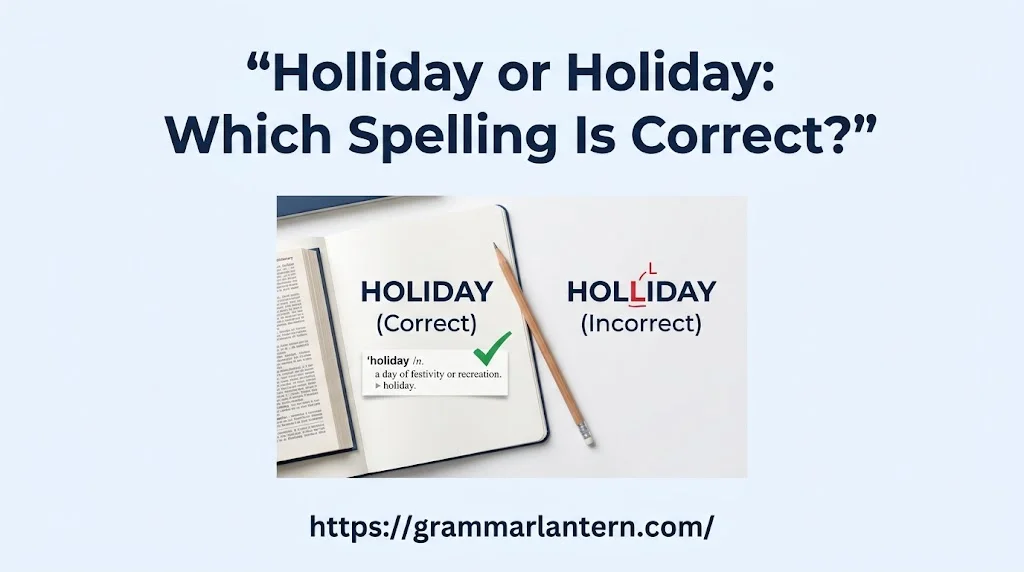
Holiday is the correct spelling of the ordinary English word for a special day, a period of rest, or a vacation. Holliday is generally incorrect when used with these meanings, but it can be correct as a surname or part of a proper name.
The difference is simple: holiday has one l after the first letter o in its spelling sequence, while Holliday has two.
| Spelling | Correct usage | Example |
| Holiday | A vacation or day of celebration | We’re planning a holiday in December. |
| Holliday | A surname or established proper name | Ms. Holliday will attend the meeting. |
| Holidays | The plural form of holiday | The holidays begin next week. |
| Hollidays | A possible surname form, depending on the family | The Hollidays invited us to dinner. |
Remember this rule: Use holiday for ordinary writing and Holliday when that is the established spelling of a name.
What Does Holiday Mean?
The word holiday is a noun that refers to a special day, a period of rest, or time away from regular work or school. Its exact meaning depends on the sentence and the variety of English you’re using.
For example, a holiday might commemorate an important historical event, mark a religious celebration, or give employees a day off. It can also describe a leisure trip, particularly in British English.
Consider these examples:
- Public holiday: The bank will close for the public holiday.
- Religious holiday: Our family gathers together for this religious holiday.
- Vacation: We’re going on holiday to Spain next summer.
- Time away from work: She took a holiday to relax after a busy year.
Although these situations differ, the spelling remains the same: holiday.
Holiday as a Day of Celebration
A holiday can mark a religious, cultural, national, or historical occasion. Some holidays involve public celebrations, while others are observed privately with family and friends.
For example, Thanksgiving is a major holiday in the United States. Christmas is celebrated by Christians and observed in various ways by people around the world. Independence Day commemorates the adoption of the Declaration of Independence in the United States.
Some holidays also have official recognition, while others are primarily cultural or religious observances.
Here are a few examples in everyday sentences:
- Thanksgiving is my favorite holiday because my whole family gets together.
- Many businesses close on Christmas Day.
- Independence Day is a federal holiday in the United States.
- The school organized a special event for the religious holiday.
Notice that holiday doesn’t need an extra l in any of these examples.
Read More: Investor vs Investee: Meaning, Differences, and Examples
Holiday as a Vacation or Break
In some contexts, holiday refers to time away from your usual responsibilities. You might spend a holiday traveling, visiting relatives, relaxing at home, or exploring a new place.
For example:
- We’re planning a holiday in California.
- She needs a short holiday after working for several months without a break.
- They spent their summer holiday visiting family.
- I’m looking forward to my holiday next week.
In American English, people usually say vacation when referring to a leisure trip or an extended break from work. In British English, holiday is commonly used for the same purpose.
Both expressions are correct within their usual contexts. The difference is primarily one of regional usage rather than spelling.
Holiday in American and British English
American and British English share the word holiday, but they don’t always use it in exactly the same way.
In American English, holiday commonly refers to a special day or celebration. When Americans take time away from work for travel or relaxation, they generally call it a vacation.
British English uses holiday more broadly. Someone in the United Kingdom might say they’re going on holiday when they mean they’re taking a trip.
Compare the following examples:
| Situation | American English | British English |
| A leisure trip | We’re going on vacation. | We’re going on holiday. |
| A day of celebration | It’s a national holiday. | It’s a national holiday. |
| Time away from work | I’m taking a vacation. | I’m taking a holiday. |
| A summer break | We have a summer vacation. | We have a summer holiday. |
These are common patterns rather than absolute rules. People may use different expressions depending on their circumstances, workplace, or personal preferences.
Most importantly, the spelling holiday remains correct in both American and British English.
What Does Holliday Mean?
Unlike holiday, holliday is not the standard spelling of the ordinary English noun referring to a vacation or a special day.
However, Holliday can be a legitimate surname or part of an established proper name. In that situation, the spelling is intentional and should be preserved.
For example, consider this sentence:
Mr. Holliday will present the report at tomorrow’s meeting.
Here, Holliday identifies a person. It isn’t a misspelling of the word holiday.
Now compare it with this sentence:
We’re taking a Holliday next month.
If the writer means a vacation, the sentence contains a spelling error. It should read, “We’re taking a holiday next month,” although an American writer would more commonly say, “We’re taking a vacation next month.”
The surrounding words help you identify the intended meaning.
Holliday as a Surname
Holliday is an established family name. Like other surnames, it may have a spelling that differs from an ordinary English word.
A person’s name must follow its established spelling, even when it resembles another word.
For example:
- Ms. Holliday will lead the training session.
- The Holliday family invited their neighbors to dinner.
- I sent the documents to Jordan Holliday.
- Please confirm the spelling of Dr. Holliday’s last name before printing the invitation.
In each sentence, the spelling serves a naming function.
Proper names don’t have to follow the spelling of similar common words. If someone’s surname is Holliday, changing it to Holiday would alter the person’s name rather than correct an error.
Is Holliday Ever Correct?
Yes. Holliday is correct when it appears in a person’s established name or another proper name that uses that spelling.
However, it isn’t a standard alternative to holiday in ordinary writing.
The distinction matters in professional communication. Imagine preparing an invitation for a person named Alex Holliday. Changing the surname to Alex Holiday could create an embarrassing error.
The reverse mistake can also happen. If you’re writing about a vacation and accidentally type Holliday, the extra letter doesn’t make the word a valid alternative spelling.
Context determines whether the spelling is appropriate.
Key Differences
The main difference between holiday and Holliday is their function in a sentence.
Holiday is the standard common noun. It describes a celebration, a designated day off, or a vacation in contexts where that usage is customary.
Holliday, by contrast, is generally a proper name. It may identify a person or family, so its spelling depends on the name itself.
| Feature | Holiday | Holliday |
| Standard common noun | Yes | No |
| Refers to a celebration | Yes | Not as a standard spelling |
| Refers to a vacation | Yes, especially in British English | No |
| Used as a surname | Possible if established as a name | Yes |
| Usually capitalized in the middle of a sentence | No, unless required by context | Yes, when used as a proper name |
| Correct for ordinary references to time off | Yes | No |
The capitalization difference provides a helpful clue, but it isn’t the only test.
For instance, Holiday can appear with a capital letter at the beginning of a sentence. That capitalization doesn’t change the spelling rule. Likewise, writing Holliday with a capital letter doesn’t make it correct when you mean a vacation.
Meaning and context matter more than capitalization alone.
Why Do People Confuse?
The confusion is understandable. The words differ by just one letter, and English contains many spelling patterns that aren’t easy to predict.
When you’re typing quickly, an extra letter can slip into a familiar word without attracting attention. If you’ve encountered Holliday as a surname, you might also assume that both forms are acceptable.
Several factors contribute to the mistake.
The Extra-L Spelling Mistake
The most obvious difference is the additional l in Holliday.
Compare the spellings carefully:
- H-O-L-I-D-A-Y: holiday
- H-O-L-L-I-D-A-Y: Holliday
The first spelling is the standard common noun. The second includes an extra l and is generally used as a proper name.
A useful way to remember the difference is to associate holiday with familiar expressions such as holiday plans, holiday season, and public holiday.
Write these phrases a few times if the spelling regularly trips you up. Familiarity can help you spot the incorrect form more quickly.
Autocorrect and Typing Errors
Typing tools can help catch mistakes, but they aren’t perfect. A spell-checker may recognize a surname or accept a word in a context that doesn’t match your intended meaning.
For example, you might type Holliday in a message about a vacation because your keyboard has learned that spelling from previous text.
Before sending an email or publishing an article, check whether the word refers to a person or an ordinary noun.
This small proofreading habit can prevent errors in blog posts, business emails, school assignments, invitations, and social media updates.
Familiar Names Can Influence Spelling
People sometimes remember the spelling of a name more clearly than the spelling of a similar common word.
Suppose you’ve recently read about someone named Holliday. Later, while writing about your upcoming holiday, you might accidentally reproduce the surname’s spelling.
This is a simple memory mix-up. It doesn’t mean the two spellings have the same meaning.
When in doubt, ask yourself: Am I describing a break or identifying someone?
If you’re describing a break, holiday is the standard spelling. If you’re identifying someone, use that person’s correct name.
Examples of Holiday in Sentences
Seeing the word in different contexts makes its spelling and meaning easier to understand.
Here are examples involving celebrations, vacations, workplace breaks, and common expressions.
Holiday Examples for Everyday Writing
- We’re planning a holiday in Florida next month.
- Christmas is an important holiday for many families.
- The office will remain closed during the national holiday.
- She spent the holiday visiting her grandparents.
- Our school organized a program for the cultural holiday.
- I’m saving money for a summer holiday.
- Monday is a public holiday, so the bank will be closed.
- The family gathered for a peaceful holiday at home.
Each sentence uses the standard spelling holiday.
Holiday Examples in American and British English
Consider these common expressions:
- American English: We’re taking a vacation during the summer.
- British English: We’re going on holiday during the summer.
- American English: Thanksgiving is my favorite holiday.
- British English: Christmas is a popular holiday.
- American English: I need some vacation time.
- British English: I need some holiday time.
These examples illustrate typical regional preferences. They don’t suggest that one variety of English is more correct than the other.
If you’re writing for an American audience, vacation will usually sound more natural when discussing a leisure trip. If you’re writing for a British audience, holiday may be the more familiar choice.
Regardless of the expression you choose, don’t add another l to holiday.
Examples of Holliday in Sentences
The spelling Holliday belongs in sentences where it functions as a proper name or appears in an established name.
Here are several examples:
- Mr. Holliday will attend the conference tomorrow.
- The Holliday family hosted a reunion last weekend.
- I emailed Jordan Holliday about the appointment.
- Please address the invitation to Dr. Holliday.
- The receptionist confirmed that Taylor Holliday had arrived.
- We thanked the Holliday family for their hospitality.
In each example, the word identifies a person or family.
How Context Changes the Meaning
Compare these two sentences:
Sentence A: “The Holliday family is visiting us this weekend.”
Sentence B: “Our holiday begins this weekend.”
Sentence A uses Holliday as a surname. Sentence B uses holiday as a common noun.
The difference isn’t merely stylistic. Each spelling serves a different purpose.
Now consider another pair:
- Incorrect for the intended meaning: We’re planning a Holliday to London.
- Correct for the intended meaning: We’re planning a holiday to London.
For an American audience, “We’re planning a vacation to London” may sound more natural.
This comparison demonstrates why you should check the meaning of a word rather than rely on how familiar its spelling looks.
Common Mistakes to Avoid
A small spelling error can change how polished your writing appears. Fortunately, avoiding this particular mistake requires only a few simple habits.
Writing Holliday When You Mean Holiday
This is the most common error to watch for.
If you’re discussing a vacation, celebration, or day off, use holiday.
Incorrect: We’re looking forward to our Christmas holliday.
Correct: We’re looking forward to our Christmas holiday.
The correction removes the extra l.
Assuming Both Spellings Are Interchangeable
The words aren’t interchangeable when you’re using them as an ordinary noun.
You can’t simply choose whichever spelling looks better. Use holiday for the standard word and preserve Holliday when referring to a name that is spelled that way.
Confusing Holiday With Vacation
Another common mistake is assuming that holiday means exactly the same thing in every English-speaking country.
American English usually favors vacation for a leisure trip. British English commonly uses holiday.
For example, an American might say, “I’m taking a two-week vacation,” while a British speaker might say, “I’m taking a two-week holiday.”
Both expressions are acceptable in their respective contexts.
Capitalizing Holiday Unnecessarily
The common noun holiday generally stays lowercase unless it begins a sentence or forms part of a proper name or title.
Correct: We’re preparing for the holiday.
Correct: Holiday celebrations begin next week.
Correct: The Holliday family arrived early.
The first sentence uses lowercase because the word is an ordinary noun. The second capitalizes it because it begins the sentence. The third capitalizes Holliday because it is a surname.
How to Remember the Correct Spelling
Spelling becomes easier when you have a simple rule you can apply without hesitation.
The best approach is to remember the standard form and practice recognizing it in familiar expressions.
Use a Simple Spelling Trick
Remember this phrase:
A holiday needs no extra L.
Whenever you write about a vacation, celebration, or day off, check that you’ve used holiday rather than holliday.
You can also practice with these familiar combinations:
- Holiday plans
- Holiday season
- Public holiday
- Holiday greetings
- Summer holiday
- Holiday weekend
Because the word appears in many everyday expressions, learning the correct form helps you avoid errors in different types of writing.
Proofread Your Writing
Proofreading is especially useful when you write quickly or prepare content for publication.
Try these steps:
- Search your document for holliday.
- Check whether each occurrence refers to a surname or proper name.
- Replace the incorrect form with holiday wherever you mean the ordinary noun.
- Confirm the spelling of people’s names before editing them.
- Read the sentence again to ensure the intended meaning is clear.
Don’t automatically replace every occurrence of Holliday. A person’s surname may genuinely require that spelling.
The goal is accuracy, not simply removing every word that contains an extra letter.
Holiday and Related Expressions
Learning common expressions can help you recognize the correct spelling naturally.
These phrases appear in everyday conversations, emails, advertisements, and articles.
Holiday Season
The holiday season refers to a period associated with one or more celebrations. In the United States, the expression often describes the time around Thanksgiving, Christmas, and New Year’s Day.
Example: Stores often become busier during the holiday season.
Public Holiday
A public holiday is a day officially recognized for a public observance or time off, depending on the country and its rules.
Example: The office will close for the public holiday.
Holiday Plans
Holiday plans are arrangements for a vacation or a period of celebration.
Example: We’ve finalized our holiday plans for December.
Holiday Greetings
Holiday greetings are messages that express good wishes during a festive period.
Example: The company sent holiday greetings to its customers.
Holiday Weekend
A holiday weekend is a weekend extended or associated with a holiday.
Example: We’re visiting our relatives over the holiday weekend.
All these expressions use holiday with one l after the initial ho sequence. None requires the spelling holliday.
A Practical Case Study
Imagine you’re preparing two documents on the same afternoon. One is a travel announcement for your company newsletter. The other is an invitation addressed to a client.
For the newsletter, you write:
“Our employees can now submit their holiday plans for December.”
Here, holiday refers to time away from work. The spelling is correct, although an American company might prefer vacation plans depending on its usual terminology.
Next, you prepare the invitation:
“Dear Ms. Holliday, we’d be delighted to welcome you to our annual dinner.”
In this sentence, Holliday is the client’s surname. The spelling is correct if that is how the client spells her name.
Now imagine that you accidentally type this sentence in the newsletter:
“Our employees can now submit their holliday plans for December.”
The extra l creates a spelling error because you’re not referring to a person named Holliday.
This example highlights the central rule: The correct spelling depends on whether you’re using the word as a common noun or as a proper name.
A quick review of the sentence’s meaning will usually resolve the confusion.
Read More: As Of, As At, As From: Difference Explained With Examples
FAQs
1. Is Holliday or Holiday the correct spelling?
Holiday is the correct spelling when referring to a vacation, public holiday, or celebration. Holliday is generally a surname. For example, “We’re going on holiday next week” is correct, while “We’re going on holliday” is a spelling mistake.
2. What does the word Holiday mean?
Holiday refers to a day of celebration, an official day off, or a period spent away from your usual work or routine. For example, “We spent our summer holiday at the beach.” The exact meaning can vary depending on the context and regional English usage.
3. Is Holliday ever a correct word?
Yes, Holliday is a correct spelling when used as a proper name, particularly a family surname. However, it is not the standard spelling for a vacation or festive occasion. Always consider the context before deciding whether the spelling is appropriate.
4. Why do people confuse Holliday and Holiday?
People often confuse these words because they look and sound almost identical. The only spelling difference is the extra l in Holliday. Since the standard word is Holiday, writers sometimes add an unnecessary letter by mistake when typing quickly or relying on memory.
5. Should I write Happy Hollidays or Happy Holidays?
You should write Happy Holidays when greeting someone during the festive season. The word Holidays contains one l after the initial “Ho,” followed by “idays.” Writing “Hollidays” adds an unnecessary letter and is incorrect for this meaning.
6. What is the plural of Holiday?
The plural of Holiday is Holidays. You use it when referring to multiple holidays or celebrations. For example, “The holidays are a wonderful time to reconnect with family.” Remember that the plural form does not add another l.
7. Is Holliday a first name or a last name?
Holliday is most commonly used as a last name, although names can have different uses depending on personal or family preferences. When you encounter it in a person’s name, preserve the spelling they use rather than automatically changing it to Holiday.
8. How can I remember the difference between Holliday and Holiday?
An easy way to remember the difference is to associate Holiday with time off, travel, and celebrations. It has only one l. Think of Holliday as a name that may belong to a particular person or family. This simple distinction can help you avoid spelling errors.
9. Is Holiday the correct spelling in American English?
Yes, Holiday is the standard spelling in American English when referring to a vacation, a day off, or a celebration. Americans also commonly use the word vacation for a leisure trip. Holliday remains appropriate when it is part of a proper name.
10. Can I use Holliday in formal writing?
You can use Holliday in formal writing when it is someone’s actual surname or part of a proper name. However, when discussing vacations, public holidays, or celebrations, use Holiday. Checking the context and proofreading your work can help you maintain professional and accurate writing.
Conclusion
Understanding Holliday vs. Holiday is simple once you recognize how each spelling is used. Holiday is the standard English word for a vacation, public holiday, or special celebration, while Holliday is primarily a surname. Although the difference is only one letter, choosing the correct spelling makes your writing clearer and helps you avoid unnecessary mistakes in emails, assignments, and everyday conversations.
The easiest way to remember this distinction is to associate Holiday with celebrations and time off, while reserving Holliday for names spelled that way. Before submitting an assignment or sending a professional message, take a moment to check your spelling and consider the context. With this small habit, you can use both forms correctly and communicate with greater confidence, clarity, and accuracy.

For Shafiq ur Rehman, writing is an art form and grammar is the toolbox that makes it beautiful. As a dedicated content writer at Grammar Lantern, Shafiq approaches every topic like an architect carefully laying down strong foundations of understanding before adding the finer details. He loves diving into the trickiest grammar points and resurfacing with simple, bite-sized takeaways that anyone can grasp. When he’s not crafting articles, you’ll likely find him strategizing over a game of chess, exploring dusty local bookshops, or quietly jotting down poetic observations in his notebook.