
Have you ever typed transferring and wondered whether the word needs one r or two? You’re not alone. This spelling mistake is surprisingly common, even among people who write in English every day. It often happens when you’re writing emails, completing school assignments, or preparing professional documents. Although the difference looks tiny, choosing the correct spelling matters when you want your writing to look polished and professional.
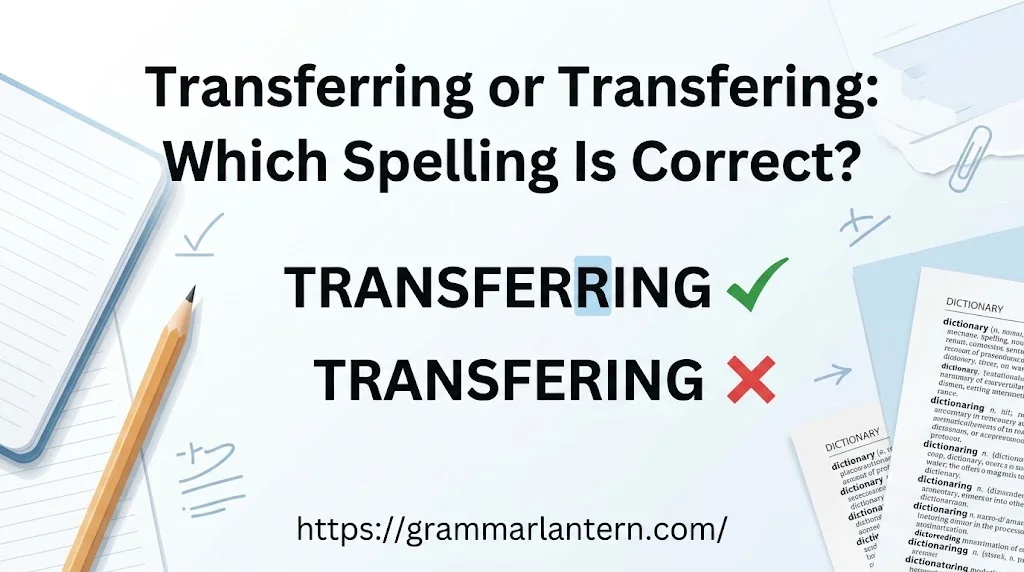
The answer is simple: transferring is correct, while transfering is a misspelling. When you add -ing to transfer, you must double the final consonant before adding the suffix. That’s why the correct spelling contains two r letters together.
Understanding transferring vs. transfering can help you avoid this common mistake and improve your spelling skills. In this guide, you’ll learn the spelling rule, explore practical examples, and discover how to use transferring correctly in different situations. By the end, you’ll know which spelling to choose every time.
Quick Answer
Transferring is correct. Transfering is incorrect in standard English.
When you add -ing to the verb transfer, you double the final r before adding the ending. This gives you transferring, not transfering.
Here are two examples:
- Correct: She is transferring the documents to another folder.
- Incorrect: She is transfering the documents to another folder.
The same spelling pattern appears in the past-tense form transferred, which also contains two r’s at the end of the base word.
Remember this simple rule: Transfer + ing = transferring.
What Does Transferring Mean?
The word transferring describes the act of moving something or someone from one place, person, system, or situation to another. It comes from the verb transfer.
The exact meaning depends on the context. You might transfer money between bank accounts, transfer files to a new computer, or transfer to another school. In each case, something moves from its original position or arrangement to a different one.
Here are the most common uses of transferring.
Transferring Money
In banking, transferring means moving money from one account to another. The accounts may belong to the same person or to different people.
For example:
- I’m transferring $200 from my checking account to my savings account.
- She is transferring money to her brother to help cover his expenses.
- The bank is transferring the funds to the recipient’s account.
In these sentences, transferring describes a financial transaction. The spelling stays the same regardless of the amount of money involved or the type of account.
Transferring Files and Data
In technology, transferring means moving digital information between devices, applications, storage locations, or computer systems.
For example:
- He is transferring his photos from his phone to his laptop.
- The team is transferring customer records to a new database.
- I’m transferring the documents to a shared folder.
This usage is common in workplaces, schools, and everyday digital tasks. Even when the method changes from a USB drive to cloud storage, the word remains transferring.
Transferring to Another School or University
In education, transferring often describes a student moving from one school or college to another.
For example:
- Maria is transferring to a different university next semester.
- He is transferring from a community college to a four-year institution.
- Several students are transferring to schools closer to home.
The word can describe an application process, a planned change, or the actual movement between institutions. The surrounding sentence explains which meaning applies.
Transferring Employees or Responsibilities
Businesses also use transferring when an employee moves to another department, office, or location. The word can describe the reassignment of duties or the movement of responsibility.
For example:
- The company is transferring James to its Chicago office.
- The manager is transferring responsibility for the project to another employee.
- The department is transferring several duties to the new team.
In each example, transferring communicates a change in assignment or responsibility.
Read More: Stub vs. Stab: Meaning, Difference, Pronunciation, and Usage
Transferring Ownership
The word also appears in legal, business, and property-related situations. It can describe moving ownership rights from one person or organization to another.
For example:
- They are transferring ownership of the property.
- The business is transferring its assets to a new company.
- She is transferring the vehicle’s title to her daughter.
These transactions may involve specific legal requirements, but the spelling of transferring never changes.
Why Is Transferring the Correct Spelling?
The main reason is a common English spelling rule: some verbs double their final consonant before adding a suffix that begins with a vowel, such as -ing or -ed.
The verb transfer follows this pattern.
To understand the change, look at the word’s structure:
- Base verb: transfer
- Suffix: -ing
- Spelling change: Double the final r
- Correct result: transferring
The final letter of transfer is r. When the verb takes the -ing ending, that letter doubles, producing transferring.
Writing transfering leaves out the extra r and fails to follow the standard spelling pattern.
Breaking Down Transfer + Ing
Consider the word one step at a time.
First, start with the base verb transfer. It describes moving something from one place or situation to another.
Next, add the suffix -ing to express an ongoing action or turn the verb into a gerund.
Because transfer follows the consonant-doubling pattern, you double the final r before adding the suffix.
The result is transferring.
You don’t change the vowel, remove a letter, or insert a hyphen. You simply double the final consonant.
This process also explains why transferred contains two r’s. Both forms retain the doubled consonant when their endings are added.
The Spelling Rule for Adding -Ing to Transfer
The consonant-doubling rule can help you spell many English verbs correctly. However, it doesn’t apply to every verb ending in a consonant.
Several factors matter, including the ending’s structure, the number of syllables, and the location of the main stress.
The Consonant-Vowel-Consonant Pattern
A common doubling rule applies to verbs that end in a consonant-vowel-consonant pattern. For example, run ends with n, preceded by the vowel u and the consonant r.
When you add -ing, the final consonant doubles:
- Run → running
- Sit → sitting
- Stop → stopping
- Plan → planning
The same general principle helps explain transfer.
Its final syllable, fer, ends with a consonant-vowel-consonant sequence. The final syllable also carries the main stress in the word. Therefore, the final r doubles before -ing is added.
Why Word Stress Matters
With many multisyllabic verbs, stress helps determine whether the final consonant doubles.
Consider these examples:
- Begin → beginning: The final syllable receives the main stress.
- Prefer → preferring: The stress falls on the final syllable.
- Visit → visiting: The final syllable isn’t stressed, so the final consonant doesn’t double.
- Open → opening: The final syllable isn’t stressed, so the final consonant doesn’t double.
These examples show why it’s useful to consider more than the last letter. The spelling rule depends on the word’s structure and pronunciation.
For transfer, the final syllable receives the main stress, so the correct form is transferring.
Are There Exceptions to the Doubling Rule?
Yes. English spelling has several patterns, and not every verb follows the same process.
For instance, verbs ending in a silent e usually drop that letter before adding -ing:
- Make → making
- Write → writing
- Drive → driving
Other verbs retain their final consonants without doubling them:
- Help → helping
- Read → reading
- Work → working
The safest approach is to learn the common patterns and pay attention to the specific verb. In the case of transfer, the standard form is always transferring when you use the -ing ending.
Key Differences
The difference between these spellings is small, but only one is accepted in standard English.
| Feature | Transferring | Transfering |
| Spelling status | Correct | Incorrect |
| Final consonant pattern | Doubles the r | Omits the extra r |
| Standard usage | Accepted | Nonstandard misspelling |
| Example | She is transferring departments. | She is transfering departments. |
The incorrect version may appear in hurried messages, informal online posts, or unedited documents. However, seeing a spelling error online doesn’t make it an accepted alternative.
If you’re writing a school assignment, business email, résumé, report, or professional document, always use transferring.
A useful memory trick: If you can spell transferred correctly, you can use the same doubled r in transferring.
Examples in Sentences
Seeing the word in different contexts makes it easier to recognize and use correctly. Here are practical examples from everyday life.
Everyday Examples of Transferring
- I’m transferring the money into my savings account.
- She is transferring her notes to a digital document.
- They are transferring the furniture to the new office.
- He is transferring to another university this fall.
- The company is transferring several employees to its regional branch.
- We’re transferring the photographs to an external hard drive.
- The customer is transferring ownership of the vehicle.
- The coach is transferring a player to another team.
Each sentence describes movement or reassignment. The object being transferred changes, but the spelling remains consistent.
Transferring in Professional Writing
In workplace communication, transferring often appears in emails, reports, instructions, and project updates.
For example:
Email about files
“I’m transferring the project files to the shared drive this afternoon. I’ll let you know when the upload is complete.”
Workplace announcement
“The company is transferring two members of the sales team to its new regional office.”
Financial update
“We’re transferring the remaining balance to the designated business account.”
These examples use the word naturally and clearly. They also show why correct spelling matters in professional writing: a simple typo can distract readers from your message.
A Practical Case Study: Editing a Workplace Email
Imagine that an employee writes the following message:
“I’m transfering the client records to the new system today. Please check the folder when I’m finished.”
The meaning is clear, but the spelling error may make the message look rushed.
A corrected version reads:
“I’m transferring the client records to the new system today. Please check the folder when I’m finished.”
Only one letter changes, yet the second version follows standard spelling conventions. In professional settings, small corrections like this help keep communication polished and consistent.
In Different Verb Forms
The spelling of transfer changes slightly depending on the verb form you need. Understanding these forms helps you avoid errors beyond transfering.
| Verb form | Correct spelling | Example |
| Base form | Transfer | I need to transfer the files. |
| Third-person singular | Transfers | She transfers money every month. |
| Present participle | Transferring | He is transferring the documents. |
| Gerund | Transferring | Transferring data takes time. |
| Simple past | Transferred | They transferred the account yesterday. |
| Past participle | Transferred | The funds have been transferred. |
Notice that transfers doesn’t double the final r. The doubling occurs in transferring and transferred.
The reason is that different suffixes follow different spelling patterns. You shouldn’t automatically double the final consonant every time you change a verb’s form.
When to Use Transferring
Use transferring when an action is ongoing or when the verb functions as a noun.
For example:
- Ongoing action: She is transferring the files now.
- Future arrangement: We are transferring the equipment tomorrow.
- Gerund as a subject: Transferring money between accounts can be convenient.
- Gerund after a preposition: He succeeded by transferring his skills to a new role.
A gerund is a verb form ending in -ing that functions as a noun. In the sentence “Transferring money takes time,” the word transferring names an activity.
When to Use Transferred
Use transferred as the simple past form or past participle of transfer.
For example:
- Simple past: She transferred the files yesterday.
- Present perfect: He has transferred the funds.
- Passive construction: The employee was transferred to another department.
Both transferring and transferred use a doubled r. Learning them together is an effective way to remember the spelling.
Common Words That Follow the Same Spelling Pattern
You can strengthen your understanding of transferring by comparing it with other verbs that double their final consonants.
| Base verb | With -ing | With -ed |
| Transfer | Transferring | Transferred |
| Begin | Beginning | Began is the simple past; begun is the past participle |
| Prefer | Preferring | Preferred |
| Admit | Admitting | Admitted |
| Occur | Occurring | Occurred |
| Refer | Referring | Referred |
| Plan | Planning | Planned |
| Stop | Stopping | Stopped |
The table includes both regular and irregular verbs. Notice that begin forms its past tense and past participle irregularly, even though its -ing form doubles the final consonant.
These examples demonstrate a broader principle: spelling changes depend on the base verb and the suffix being added.
Transfer vs. Prefer
The verbs transfer and prefer share an important spelling pattern.
- Transfer → transferring → transferred
- Prefer → preferring → preferred
Both verbs have a stressed final syllable. Both double their final consonants before adding -ing and -ed.
Comparing the words can make the rule easier to remember. If you know how to spell preferring, you’re already familiar with the pattern used in transferring.
Transfer vs. Visit
Now compare transfer with visit.
- Transfer → transferring
- Visit → visiting
The final syllable of transfer receives the main stress. The final syllable of visit does not. That’s why the final consonant doubles in transferring but not in visiting.
This distinction is especially helpful when you encounter unfamiliar verbs. Instead of doubling every final consonant, consider the word’s syllables and stress pattern.
Common Spelling Mistakes to Avoid
Even experienced writers sometimes misspell familiar words. Recognizing common mistakes helps you catch them before they appear in your work.
Writing Transfering Instead of Transferring
This is the main mistake addressed in this article.
Incorrect: “The bank is transfering the funds.”
Correct: “The bank is transferring the funds.”
The incorrect form contains only one r after the e. Double the final r before adding -ing.
Writing Transfered Instead of Transferred
The same error occurs when writers add -ed.
Incorrect: “She transfered the files yesterday.”
Correct: “She transferred the files yesterday.”
The past-tense form also doubles the final r. Remembering both forms together helps prevent this mistake.
Doubling Every Final Consonant
Not every verb doubles its last letter when you add -ing.
For example:
- Help → helping, not helpping
- Read → reading, not readding
- Visit → visiting, not visitting
- Open → opening, not openning
The doubling rule depends on the word’s spelling structure and stress. Applying it mechanically can create new errors.
Relying Only on Pronunciation
Pronunciation can help you understand a word, but it doesn’t always reveal its spelling. In transferring, the doubled r doesn’t create a separate syllable or a dramatically different sound.
That’s why a misspelling may go unnoticed during proofreading. You need to recognize the spelling pattern rather than rely on how the word sounds.
Tips to Remember the Correct Spelling
You don’t need to memorize a complicated grammar lesson every time you write this word. A few simple habits can help you remember the correct form.
Remember the Doubled R
The easiest trick is to associate transferring with transferred.
Both forms double the final r:
- Transferring
- Transferred
If you remember one, the other becomes easier to spell.
Learn the Word as a Pair
Practice the base verb and its common forms together:
Transfer → transferring → transferred
This small pattern covers the present participle, gerund, and past-tense forms. It also reinforces the correct spelling whenever you use the verb.
Use the Word in a Sentence
Writing a short sentence can help you remember the spelling more effectively than staring at the word alone.
For example:
“I’m transferring the documents now, and I transferred the photographs yesterday.”
This sentence uses both forms correctly. It also shows how the verb changes with the time of the action.
Proofread the Ending
When proofreading, pay special attention to words that end in -ing or -ed. These endings often trigger spelling changes.
If you see transfering or transfered, pause and check the final consonant. Adding the second r fixes both errors.
Spell-checking tools can also catch these mistakes. However, understanding the rule helps you recognize errors even when automatic correction isn’t available.
Read More: Labeler vs. Labeller: Which Spelling Is Correct?
FAQs
1. Is it transferring or transfering?
Transferring is the correct spelling in standard English. It contains two r letters before the -ing ending. Transfering is a spelling mistake and should be avoided in formal and informal writing.
2. Why does transferring have two r’s?
The word transfer ends in a consonant preceded by a vowel. When you add -ing, you double the final consonant to preserve the word’s pronunciation. That’s why transfer becomes transferring.
3. What does transferring mean?
Transferring means moving something or someone from one place, person, account, or situation to another. For example, transferring money means moving funds from one account to another.
4. Is transfering ever correct?
No. Transfering is considered a misspelling in standard modern English. Whether you’re writing a school assignment, business email, or social media post, always use transferring.
5. What is the difference between transfer and transferring?
Transfer is the base form of the verb, while transferring is its -ing form. For example, “I need to transfer the files” uses the base verb, while “I am transferring the files” describes an ongoing action.
6. What is the past tense of transfer?
The past tense of transfer is transferred, with two r letters. For example, “She transferred the money yesterday.” The same consonant-doubling rule applies when adding -ed.
7. Is transferring a verb or a noun?
Transferring is primarily the present participle of the verb transfer. It can also function as a gerund, which means it acts like a noun. For example, “Transferring files takes time” uses transferring as a gerund.
8. How do you use transferring in a sentence?
You can use transferring in many everyday situations. For example, “He is transferring to another school next semester.” Another example is, “I’m transferring money into my savings account.”
9. Does the spelling rule apply to other words?
Yes. English often doubles a final consonant when a word ends in a consonant preceded by a single vowel and the appropriate suffix is added. Examples include running, stopping, and planning. However, the rule has exceptions depending on the word’s structure and stress.
10. How can I remember the correct spelling of transferring?
A simple trick is to remember the base word transfer and double its final r before adding -ing. Think of the spelling as transfer + r + ing = transferring. Practicing this pattern can help you avoid the mistake in future writing.
Conclusion
Choosing between transferring and transfering is easy once you know the spelling rule. Transferring is the correct form, while transfering is a common misspelling. When you add -ing to transfer, you double the final r to create the correct spelling.
Remember this rule whenever you’re writing about moving money, changing schools, sending files, or shifting something from one place to another. A small spelling detail can make a noticeable difference in your writing. With a little practice, you’ll remember to write transferring correctly without having to stop and think twice.

For Shafiq ur Rehman, writing is an art form and grammar is the toolbox that makes it beautiful. As a dedicated content writer at Grammar Lantern, Shafiq approaches every topic like an architect carefully laying down strong foundations of understanding before adding the finer details. He loves diving into the trickiest grammar points and resurfacing with simple, bite-sized takeaways that anyone can grasp. When he’s not crafting articles, you’ll likely find him strategizing over a game of chess, exploring dusty local bookshops, or quietly jotting down poetic observations in his notebook.