Have you ever wondered whether unaffected or uneffected is the correct spelling? These words look almost identical, so it’s easy to confuse them when writing quickly. However, understanding unaffected vs uneffected can help you improve your English grammar, spelling, and overall writing skills. Choosing the right word makes your sentences clearer and more professional.
Unaffected is the correct and commonly accepted English word. It means remaining unchanged or not being influenced by something. For example, “She remained unaffected by the criticism.” In contrast, uneffected is not a standard spelling and is generally considered incorrect in modern English. Remembering this difference can help you avoid common spelling mistakes in academic assignments, professional documents, and everyday communication.
In this guide, you’ll learn the meaning of unaffected, why uneffected is incorrect, and how to use the correct spelling in different contexts. You’ll also discover practical examples, common mistakes, pronunciation tips, and simple memory tricks to help you remember the difference and write with confidence.
Quick Answer
Unaffected is the correct standard English word when you mean that someone or something hasn’t been influenced, changed, harmed, or emotionally disturbed. Uneffected is generally a misspelling of unaffected and should usually be avoided in standard writing.
For example:
- Correct: The children remained unaffected by the sudden change in schedule.
- Incorrect in the intended sense: The children remained uneffected by the sudden change in schedule.
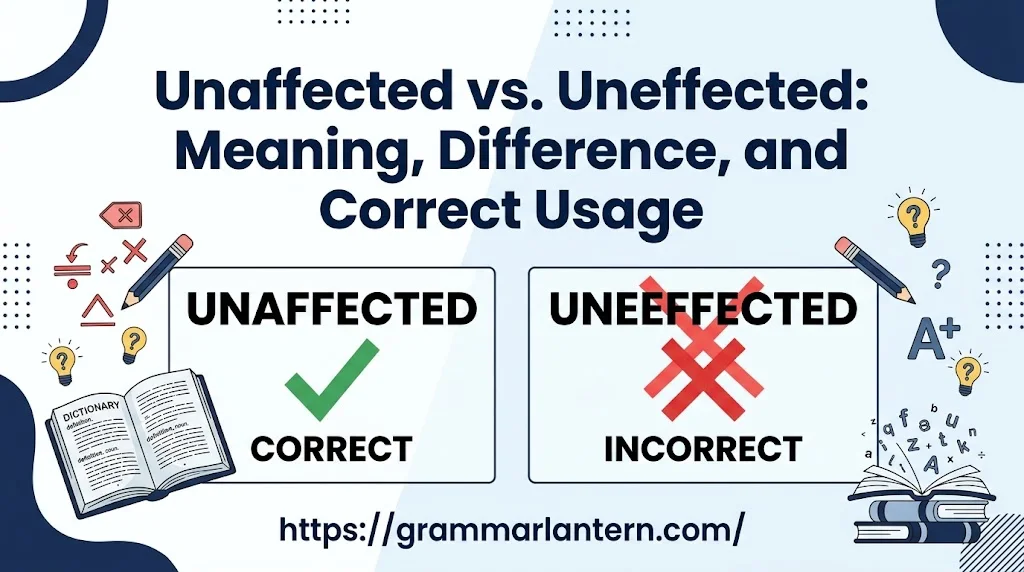
The key is to remember the spelling of affected. Add the prefix un- to that word and you get unaffected, not uneffected.
| Feature | Unaffected | Uneffected |
| Standard spelling | Yes | No, not for the intended meaning |
| Meaning | Not influenced, changed, harmed, or disturbed | Usually an attempted spelling of unaffected |
| Standard usage | Common in everyday and formal English | Generally avoided |
| Example | She seemed unaffected by the criticism. | Use unaffected instead. |
If you’re unsure which word to choose, use unaffected when you mean not affected by something.
What Does Unaffected Mean?
Unaffected is an adjective that describes a person, object, situation, or condition that has not been influenced or changed by something. It can also describe someone who shows little or no emotional reaction to an event.
The word combines the prefix un-, which often expresses negation, with affected. In this case, un- reverses the meaning of affected.
Consider this example:
“The heavy rain damaged several roads, but the nearby school remained unaffected.”
The sentence tells you that the rain did not damage or otherwise change the school’s condition. The school experienced the same weather as the surrounding area, but the reported damage did not extend to it.
However, unaffected has several related meanings. The surrounding sentence usually makes the intended meaning clear.
Unaffected Means Not Influenced or Changed
One common use of unaffected describes something that remains unchanged despite an outside influence.
For example, a new company policy might change everyone’s working hours except those of employees in a particular department. You could say that the department remained unaffected by the policy.
Here are more examples:
- The new regulations left small family businesses unaffected.
- Her opinion remained unaffected by the negative comments.
- The software update left all existing documents unaffected.
- The price increase had little effect on customers who had fixed-rate contracts.
In each example, the word indicates that an event, action, or condition did not produce the expected change.
Unaffected Means Not Emotionally Disturbed
You can also use unaffected to describe someone’s emotional response. It suggests that the person doesn’t appear troubled, upset, excited, or influenced by what happened.
For example:
“Despite receiving harsh criticism, Daniel appeared unaffected.”
This sentence doesn’t necessarily mean Daniel felt nothing. He might have been disappointed privately but chosen not to show it. The word describes his apparent response rather than proving what he felt internally.
Other examples include:
- She remained unaffected by the rumors circulating at work.
- He seemed unaffected by the disappointing results.
- The audience was surprised that the speaker appeared completely unaffected by the interruption.
This meaning is especially useful when discussing someone’s outward behavior.
Read More: MYF Meaning in Text: What Does MYF Stand For?
Unaffected Means Natural or Sincere
Less commonly, unaffected describes a person’s behavior, speech, or writing as natural rather than artificial or pretentious.
For example:
“Her unaffected manner made everyone feel comfortable.”
Here, unaffected doesn’t mean that the woman escaped harm or avoided an influence. Instead, it suggests that she behaved naturally without trying to impress anyone.
You might also encounter these expressions:
- An unaffected speaking style
- An unaffected manner
- An unaffected simplicity
Context matters because the same word can describe either a lack of influence or a lack of artificiality.
What Does Uneffected Mean?
Uneffected is generally not the standard spelling when you mean that something has not been affected. In ordinary modern English, unaffected is the established form for that meaning.
Writers sometimes produce uneffected because they confuse affected with effected. Both words are correct, but they serve different grammatical and semantic purposes.
The distinction becomes clearer when you examine how each word works.
Why People Confuse Uneffected With Unaffected
English spelling doesn’t always follow a simple pattern. The prefix un- can form opposites of many adjectives, but you still need to start with the correct base word.
For example:
- Happy becomes unhappy.
- Clear becomes unclear.
- Fair becomes unfair.
- Affected becomes unaffected.
The last example follows the same pattern. The original adjective affected retains its spelling when you add un-.
By contrast, effected is usually the past tense or past participle of the verb effect, meaning to bring something about or accomplish something. Adding un- to that form does not automatically produce the standard adjective you need.
Is Uneffected Ever a Correct Word?
You may encounter uneffected in unusual, historical, specialized, or nonstandard writing. However, that doesn’t make it an appropriate substitute for unaffected in ordinary contemporary English.
If your goal is to describe something that hasn’t changed, hasn’t been influenced, or hasn’t been harmed, choose unaffected.
For example:
Incorrect for the intended meaning: “The medication left the patient’s appetite uneffected.”
Correct: “The medication left the patient’s appetite unaffected.”
The corrected sentence clearly communicates that the medication did not influence the person’s appetite.
In professional writing, academic assignments, and published articles, the standard spelling is the sensible choice.
Key Differences
The main difference is straightforward: unaffected is the established adjective for describing something that has not been influenced or changed, while uneffected is generally an incorrect spelling for that purpose.
Understanding the difference also means recognizing that spelling and meaning work together. You cannot select a word simply because its letters look similar to those of another word.
| Comparison point | Unaffected | Uneffected |
| Accepted standard form for the intended meaning | Yes | No |
| Common dictionary usage | Established adjective | Generally nonstandard for this meaning |
| Describes a lack of influence | Yes | Use unaffected instead |
| Describes a lack of emotional reaction | Yes | Use unaffected instead |
| Appropriate for formal writing | Yes | Generally avoid |
| Recommended correction | No correction needed | Usually replace with unaffected |
How to Choose the Correct Word
When deciding between these spellings, follow three simple steps.
- Identify your intended meaning. Are you describing something that remained unchanged or someone who showed little reaction?
- Check the base word. If the intended meaning comes from affected, adding un- gives you unaffected.
- Read the sentence again. Make sure the chosen word communicates the intended idea naturally.
For example, suppose you’re writing about a storm that damaged several buildings but spared one house.
“The house was unaffected by the storm” is clear and correct.
Writing “The house was uneffected by the storm” introduces a spelling error without improving the meaning.
When to Use Unaffected
Use unaffected when you want to explain that something has not experienced a particular influence, change, or disturbance. It works in casual conversation, journalism, business communication, academic writing, and many other contexts.
Here are the most useful patterns.
Unaffected by Something
The phrase unaffected by identifies the event, person, or condition that failed to produce a change.
Examples:
- The village remained unaffected by the flooding.
- Her decision was unaffected by public opinion.
- The company continued operating unaffected by the temporary outage.
- His confidence remained unaffected by the setback.
This construction is particularly useful because it identifies both the subject and the outside influence.
Remain Unaffected
Use remain unaffected when something continues in its original condition despite an event or change.
Examples:
- The original files remained unaffected after the update.
- Most residents remained unaffected by the transportation strike.
- Her enthusiasm remained unaffected by the long wait.
The verb remain emphasizes continuity. It suggests that the situation stayed the same throughout the relevant period.
Seem or Appear Unaffected
These expressions describe how someone or something looks from an observer’s perspective.
Examples:
- He appeared unaffected by the rejection.
- The child seemed unaffected by the loud noise.
- She looked unaffected by the unexpected announcement.
Be careful with emotional situations. Appearing unaffected doesn’t necessarily mean a person experienced no feelings. It only describes what others could observe.
Unaffected in Professional and Academic Writing
In formal writing, unaffected often describes results, systems, populations, and conditions that did not experience a particular change.
For example:
“The revised procedure affected the eastern branch, while the western branch remained unaffected.”
This sentence establishes a direct contrast between two locations. It also avoids vague language such as “the western branch was fine,” which might not explain exactly what happened.
Use unaffected when the lack of change is relevant to your point.
When to Avoid Uneffected
In most everyday and professional writing, avoid uneffected when you mean unaffected. The easiest solution is to replace the incorrect spelling with the standard word.
However, a good correction should preserve the intended meaning rather than mechanically changing one word.
Consider these examples:
| Incorrect sentence | Corrected sentence |
| The storm left the building uneffected. | The storm left the building unaffected. |
| Her mood was uneffected by the news. | Her mood was unaffected by the news. |
| The policy left most customers uneffected. | The policy left most customers unaffected. |
| The software change left the database uneffected. | The software change left the database unaffected. |
How to Prevent the Mistake
A few practical habits can help you avoid this spelling error.
- Remember the base word: Start with affected, then add un- to form unaffected.
- Use spell-checking tools: A spell-checker may flag uneffected, although you should still review the suggested correction.
- Read the sentence aloud: Listening to the sentence can help you spot awkward wording, even though it won’t always reveal a spelling mistake.
- Check the meaning: Ask whether you mean that something wasn’t influenced or that someone didn’t bring about a result.
- Proofread carefully: Similar-looking words can slip through when you focus only on the overall meaning.
A spell-checker is useful, but it isn’t a substitute for understanding the word. When two spellings look plausible, checking the underlying meaning is often the fastest way to settle the question.
Unaffected vs. Affected vs. Effected
The distinction between affected and effected explains why writers sometimes produce uneffected.
Although these words look similar, they generally perform different jobs in a sentence.
What Does Affected Mean?
Affected is the past tense and past participle of affect. As a verb, affect usually means to influence, change, or have an impact on something.
Examples:
- The storm affected several neighborhoods.
- Her sleep was affected by the noise.
- Rising costs affected the company’s profits.
- The criticism affected his confidence.
As an adjective, affected can also describe behavior that seems artificial or deliberately exaggerated.
For example, “He spoke in an affected manner” suggests that his speech sounded unnatural or pretentious.
What Does Effected Mean?
Effected is the past tense and past participle of effect when it functions as a verb. In this use, effect means to bring about, accomplish, or make something happen.
Examples:
- The new director effected several important changes.
- The agreement effected a peaceful resolution.
- The administration effected reforms throughout the department.
Notice the difference in meaning. A policy that affected a department influenced it. A policy that effected changes brought those changes about.
Comparison Table: Unaffected, Affected, and Effected
| Word | Meaning | Example |
| Affected | Influenced or changed | The heat affected the crops. |
| Unaffected | Not influenced or changed | The shaded crops remained unaffected. |
| Effected | Brought about or accomplished | The new irrigation system effected major improvements. |
The distinction becomes easier when you remember this useful guide:
Affect usually means influence; effect as a verb usually means bring about.
Therefore, unaffected is the standard choice when you want to express the opposite of being influenced.
Unaffected vs. Unchanged
Unchanged and Unaffected sometimes describe the same situation, but they emphasize different things.
Unaffected focuses on the absence of an influence or impact. Unchanged focuses on the fact that something stayed the same.
For example:
“The building remained unaffected by the storm.”
This sentence suggests that the storm did not damage or otherwise impact the building.
“The building remained unchanged after the renovation.”
This sentence suggests that the building’s condition or appearance stayed the same despite the renovation.
The difference is subtle but useful.
| Word | Main emphasis | Example |
| Unaffected | No meaningful impact from an influence | The schedule remained unaffected by the delay. |
| Unchanged | No difference in condition or state | The schedule remained unchanged after review. |
| Unharmed | No injury or damage | The passengers escaped unharmed. |
| Uninfluenced | No change in opinion, behavior, or decision due to an influence | She remained uninfluenced by the pressure. |
| Unmoved | No emotional response or change of feeling | He seemed unmoved by the speech. |
Choose the word that expresses your exact meaning. Although these terms overlap, they aren’t interchangeable in every sentence.
Common Mistakes
Even confident writers can mix up similar words. Understanding the common mistakes makes it easier to catch them before they appear in your final draft.
Assuming Uneffected Is the Opposite of Effected
It’s tempting to think that adding un- to effected creates a standard opposite meaning. However, English doesn’t form every word’s opposite in a predictable way.
If you mean that something wasn’t influenced, use unaffected. If you mean that a change wasn’t brought about, rewrite the sentence to express that idea clearly.
For example:
“The reform effected no improvement.”
This means the reform brought about no improvement. You don’t need uneffected to communicate the idea.
Confusing Affected With Effected
Writers often choose between these words based on how they sound rather than what they mean.
Compare the following sentences:
- The new rules affected the employees.
- The new rules effected changes in the workplace.
The first sentence describes an influence. The second describes changes brought about by the rules.
When in doubt, replace the verb with a simpler explanation. If you mean “influenced,” affected will usually fit. If you mean “brought about,” effected may be appropriate.
Using Unaffected When Another Word Is More Precise
Although unaffected is correct in many situations, it isn’t always the clearest choice.
For example, if you want to say that someone escaped physical injury, unharmed may communicate the idea more directly.
Likewise, if a person’s opinion didn’t change because of another person’s argument, uninfluenced may be more precise.
The goal isn’t simply to use a correct word. It’s to choose the word that best communicates what happened.
Ignoring the Sentence’s Context
A word can be grammatically correct but still fail to convey your intended meaning.
Consider this sentence:
“She remained unaffected by the performance.”
Depending on the context, this could mean that the performance didn’t influence her or that she showed no emotional response to it.
If you mean that she wasn’t impressed, you could write, “She remained unimpressed by the performance.”
A small adjustment can make your meaning much clearer.
Examples in Sentences
Examples make the difference between correct and incorrect usage easier to remember. The following sentences show how unaffected works across everyday and professional situations.
Everyday Conversation
- My plans remained unaffected by the change in weather.
- She seemed unaffected by the teasing.
- The delay left our travel arrangements unaffected.
- His sense of humor remained unaffected by the difficult day.
Emotional Reactions
- Despite the disappointing news, Maya appeared unaffected.
- He remained unaffected by the negative comments on his post.
- The actor delivered the difficult scene with an unaffected expression.
- Her calm, unaffected manner put the nervous guests at ease.
Weather and Environmental Conditions
- The eastern side of the property remained unaffected by the flood.
- The plants in the greenhouse were unaffected by the cold snap.
- Most roads remained unaffected by the light snowfall.
- The protected habitat was largely unaffected by nearby construction.
Business and Technology
- The price adjustment left existing contracts unaffected.
- The software update left saved documents unaffected.
- The temporary outage affected the payment system, but customer records remained unaffected.
- The new policy left part-time employees unaffected.
Academic and Professional Writing
- The findings remained unaffected by the minor change in testing conditions.
- The revised schedule left the final examination date unaffected.
- The research team reported that the control group remained unaffected by the intervention.
- The editorial changes left the author’s original argument unaffected.
These examples show why unaffected is useful in many types of writing. It expresses the absence of an impact without requiring a lengthy explanation.
A Practical Case Study: Unaffected vs. Uneffected in a Realistic Situation
Imagine a small online business updating its website. The update changes the checkout page and improves the shopping experience, but it doesn’t alter the product database.
The owner writes the following report:
“The website update affected the checkout process, while the product database remained uneffected.”
The meaning is understandable, but the final word contains a spelling mistake.
A corrected version reads:
“The website update affected the checkout process, while the product database remained unaffected.”
Why does this version work?
- Affected explains what the update changed.
- Unaffected explains what the update left unchanged.
- Uneffected doesn’t serve as the standard spelling for the intended meaning.
This example also demonstrates how the two standard forms create a clear contrast. One identifies the area that experienced a change, while the other identifies the area that did not.
The same principle applies to business reports, school assignments, technical documentation, and everyday writing.
How to Remember the Correct Spelling
The simplest way to remember unaffected is to focus on its base word.
Start with affected. Then add the prefix un- to express the opposite meaning.
Affected → Unaffected
The spelling stays consistent. You don’t replace the a with an e.
Here are three practical memory aids:
- Remember the base word: If you know how to spell affected, you already know how to spell unaffected.
- Think about the meaning: If something wasn’t influenced, it was unaffected.
- Use a complete sentence: “The storm did not affect the building, so the building remained unaffected.”
You can also remember this simple rule:
If you mean “not affected,” write unaffected.
This rule covers the most common situations in which people confuse unaffected with uneffected.
Read More: Snowball Kisses Meaning: What Does It Mean in Slang?
FAQs
1. Is it unaffected or uneffected?
Unaffected is the correct spelling in standard modern English. Uneffected is generally considered a misspelling. Use unaffected when describing something that remains unchanged or is not influenced by something else.
2. What does unaffected mean?
Unaffected means not changed, influenced, or harmed by something. It can also describe someone who remains natural and calm rather than showing artificial behavior.
Example: “The heavy rain left the building unaffected.”
3. Is uneffected a real English word?
Uneffected is not a standard spelling in modern English. Writers sometimes use it by mistake because they associate it with the word effect. In most situations, unaffected is the word you should use.
4. What is an example of unaffected in a sentence?
Here is an example: “Despite the negative comments, she remained unaffected.”
This sentence means the comments did not change her feelings or behavior.
5. What is the difference between unaffected and unaffected by something?
Unaffected describes a state of remaining unchanged or uninfluenced. The phrase unaffected by something identifies the specific event, condition, or influence that caused no change.
Example: “The village remained unaffected by the storm.”
6. What are the synonyms of unaffected?
Common synonyms for unaffected include unchanged, untouched, unaltered, unimpressed, and unmoved. However, the best synonym depends on the context. For example, unchanged works well for physical conditions, while unmoved may describe someone’s emotional response.
7. Can unaffected describe a person’s emotions?
Yes. Unaffected can describe someone who does not show a noticeable emotional response to an event or situation.
Example: “He appeared unaffected by the disappointing news.”
This suggests that the news did not visibly upset him.
8. What is the opposite of unaffected?
The opposite depends on the context. Words such as affected, influenced, changed, and altered can express the opposite meaning.
Example: “The first building remained unaffected, but the second was seriously affected by the earthquake.”
9. How can I remember the correct spelling of unaffected?
A simple trick is to remember the word affected. Add the prefix un- to form unaffected. The spelling follows the same pattern, so you do not need to change the letter a to e.
10. How do you use unaffected in professional writing?
In professional writing, use unaffected to explain that a process, result, system, or person remained unchanged by a particular event.
Example: “The software’s performance remained unaffected by the latest update.”
This wording is clear, concise, and appropriate for business reports and technical documents.
Conclusion
Understanding unaffected vs uneffected is simple once you remember the correct spelling. Unaffected is the standard English word used to describe something that remains unchanged, uninfluenced, or emotionally unmoved. In contrast, uneffected is generally considered incorrect in modern English, so you should avoid using it in academic assignments, professional documents, and everyday communication.
To avoid this common spelling mistake, connect unaffected with the familiar word affected and remember that adding the prefix un- gives you the correct form. Practice using it in different sentences to strengthen your spelling and vocabulary. With this simple rule in mind, you can write more accurately, express your ideas clearly, and use unaffected with confidence.

Muhammad Haroon is the voice behind many of the clear, practical grammar guides you’ll find on Grammar Lantern. With a strong background in content writing and a genuine love for the English language, Haroon specializes in breaking down intimidating grammar topics into simple, digestible lessons. His goal is simple: to empower readers to write with confidence and clarity. Whether he’s explaining tricky tenses or demystifying punctuation, Haroon approaches each topic with patience, precision, and a touch of warmth—because he knows that learning grammar is a journey, not a race.