Have you ever received a message containing TM and wondered what the sender meant? You’re not alone. In text messages, social media chats, and everyday online conversations, people use abbreviations to communicate quickly and casually. However, the same two letters can have different meanings depending on the situation. Understanding the TM meaning in text helps you interpret messages correctly and avoid unnecessary confusion.
The abbreviation TM can stand for Text Message, Trust Me, or Trademark, depending on the context. In some informal conversations, people may also use it to mean Too Much. You might encounter TM on Instagram, TikTok, Snapchat, or WhatsApp, where the surrounding words often reveal the intended meaning. Recognizing these differences makes digital communication easier to follow.
In this guide, you’ll discover the most common TM meanings, how people use the abbreviation across different messaging platforms, and what it means in everyday conversations. You’ll also find practical examples and helpful tips for choosing the right interpretation. By the end, you’ll know how to understand TM correctly and respond naturally when it appears in a chat.
Quick Answer
TM has no single universal meaning in text messages. Depending on the context, it may refer to a text message, serve as personal shorthand for tomorrow, or relate to a trademark.
Here are the main interpretations to know:
| TM usage | Possible meaning | Typical context |
| TM | Text message | Conversations about sending or receiving messages |
| TM | Tomorrow | Informal shorthand used by some people |
| ™ | Trademark | Brand names, products, slogans, and social media profiles |
| TM | Community-specific abbreviation | Gaming groups, online communities, or specialized conversations |
One important distinction: “TM” is not a universally recognized abbreviation for tomorrow or text message. The surrounding sentence helps you determine whether either interpretation makes sense.
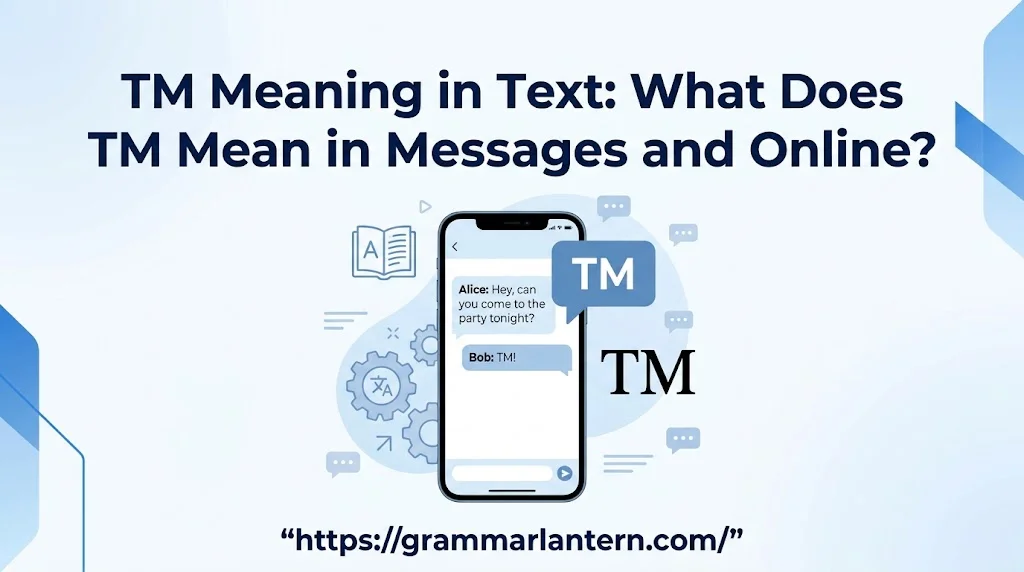
For example, if someone writes, “I’ll send you a TM,” they might mean a text message. If someone writes, “See you TM,” they might be using personal shorthand for tomorrow. Neither interpretation is guaranteed without more context.
When TM appears immediately after a brand name, especially as ™, it usually refers to a trademark.
What Does TM Mean in Text Messages?
The meaning of TM becomes clearer when you consider what the conversation is about. Unlike familiar abbreviations such as LOL (“laughing out loud”) or BRB (“be right back”), TM doesn’t have one widely accepted meaning across all texting situations.
People sometimes create their own shorthand to type faster. Others borrow abbreviations from friends, gaming communities, workplaces, or social media. As a result, two people can use the same letters but intend different things.
Consider these examples:
- “I’ll send you the TM tonight.” The sender might mean a text message, although the wording is unusual and needs context.
- “See you TM!” The sender might intend tomorrow, using personal shorthand.
- “Our TM logo looks great.” Depending on the discussion, TM might refer to a trademark or a brand-related symbol.
These examples illustrate possibilities rather than fixed definitions. You shouldn’t assume that every person uses TM in the same way.
TM as “Text Message”
In some conversations, someone may use TM to refer to a text message. However, TM isn’t a standard abbreviation for text message that everyone will recognize immediately.
People generally write “text,” “text message,” or “DM” when they want to communicate this idea clearly. DM stands for “direct message” and commonly refers to a private message on a social platform.
Here are a few examples of how someone might use TM as personal shorthand:
Example 1
- Alex: “Did you get my TM?”
- Jordan: “Yes, I just read it.”
Alex may be asking whether Jordan received a text message. The context supports that interpretation, but the abbreviation itself doesn’t establish it.
Example 2
- Sam: “I’ll send a TM with the address.”
- Riley: “Okay, I’ll check my phone.”
Here, the discussion suggests that Sam intends to send a message containing an address.
If you want to avoid confusion, it’s better to write “text” or “text message.” A few extra letters can save both people a second round of questions.
TM as “Tomorrow”
Some people use TM as shorthand for tomorrow, especially when they want to type quickly. However, this isn’t a universally recognized texting convention.
The abbreviations “tmr” and “tmrw” are more recognizable alternatives in informal messages. Even those can vary by person and community, but readers are more likely to understand them as references to tomorrow.
For example:
- “See you tmr!”
- “Let’s finish this tmrw.”
- “Can we talk tomorrow instead?”
Someone might write “See you TM” and intend to meet the following day. The context makes that interpretation plausible, but you shouldn’t treat TM as a standard synonym for tomorrow.
If the timing matters, use the full word. That becomes especially important when discussing appointments, travel plans, deadlines, or work meetings.
Read More: Starting a Sentence With “During” – Comma Rules Explained
TM as “Trademark”
When you see the symbol ™, you’re usually looking at a trademark indicator rather than a texting abbreviation.
A trademark identifies a word, phrase, symbol, design, or other feature that distinguishes one business’s goods or services from those of others. Companies often place ™ after a brand name, product name, or slogan to signal that they claim it as a trademark.
For example:
- BrightPath™
- FreshStart™
- “The Original Recipe™”
These are illustrative examples, not claims about existing registered brands.
The ™ symbol does not, by itself, prove that a trademark is registered. It can be used to indicate a claimed trademark even when registration hasn’t been granted.
The symbol ® is different. In the United States, it indicates that a trademark has been registered with the relevant trademark office for the applicable goods or services. People shouldn’t use ® as though it were interchangeable with ™.
This distinction matters because trademark symbols communicate something different from ordinary chat shorthand. If you see ™ beside a product or business name, a branding-related meaning is much more likely than a reference to tomorrow.
What Does ™ Mean on Social Media?
On social media, the trademark symbol can appear in usernames, profile descriptions, captions, hashtags, memes, and comments. Sometimes it identifies a brand. Other times, people use it playfully to make a phrase or habit sound like their personal signature.
The surrounding content usually tells you which interpretation fits.
TM as a Branding Symbol
Businesses may add ™ to a product name, slogan, or brand identity to signal that they claim trademark rights in that name or phrase.
For example, a company might write:
“Introducing our new BrightPath™ planner.”
The symbol suggests that the company treats BrightPath as a trademark. It doesn’t automatically establish registration or guarantee that the business has exclusive rights in every situation.
Creators may also use the symbol when promoting a product, service, course, or other branded offering.
TM as a Joke or Personal Signature
Social media users sometimes add ™ to ordinary expressions for humor. The symbol makes a phrase sound like a registered personal trademark, even when the person is simply joking.
For example:
- “Professional overthinker™”
- “Late-night snack enthusiast™”
- “Making things awkward™”
In these examples, the symbol adds a playful tone. The writer isn’t necessarily making a legal claim or saying that the phrase has been formally registered.
Imagine someone who always arrives at a party with an elaborate snack. Their friend might post, “The snack queen™ has arrived.” The symbol adds personality and turns an ordinary description into a running joke.
This informal usage is common enough to recognize, but it still depends on the post’s tone. A company announcement and a humorous meme can use the same symbol for very different purposes.
TM Meaning in Different Contexts
The platform where you encounter TM can offer useful clues, but it doesn’t determine the meaning on its own. The same letters can appear in a private message, a public caption, or a professional discussion.
TM in Snapchat and Instagram Messages
On Snapchat and Instagram, people often use abbreviations to keep conversations short. However, neither platform gives TM one universal meaning.
In a direct message, TM might be someone’s personal shorthand for a text message or tomorrow. In a profile or caption, ™ may identify a brand or add humor to a phrase.
Consider these examples:
In a private message
- Taylor: “Can you send me the details?”
- Morgan: “I’ll text you tomorrow.”
The word “tomorrow” makes the timing clear. If Morgan instead wrote “TM,” Taylor might need to ask what it meant.
In an Instagram bio
- “Coffee lover™”
- “Founder of BrightPath™”
The first example may be playful. The second looks more like branding, although the wording alone doesn’t confirm formal trademark status.
The key is to read the entire message instead of treating the abbreviation as a standalone definition.
TM in WhatsApp and Regular Text Messages
WhatsApp chats and standard SMS messages rely heavily on context. People often shorten words because they already know what the conversation concerns.
If a friend is discussing a message they sent, TM might refer to that message. If you’re arranging a meeting, the sender might intend tomorrow when using TM as personal shorthand.
For example:
- “Did you receive my text?” clearly refers to a message.
- “Let’s meet tomorrow at 10 a.m.” clearly establishes a time.
- “Let’s meet TM” may be understandable to some readers but confusing to others.
Group chats can make this even trickier. One person might use an abbreviation that everyone in their friend group understands, while a new member has never seen it before.
When clarity matters, write the complete word or phrase. You don’t need to decode every abbreviation if the sender can explain it directly.
TM in Gaming and Online Communities
Gaming communities often develop specialized vocabulary. Abbreviations can refer to game modes, teams, strategies, technical features, or community-specific terms.
In these settings, TM might have a meaning that doesn’t apply to ordinary texting. For instance, in a discussion about a particular game, it could refer to a named mode or mechanic. The exact interpretation depends on that game’s terminology and the community using it.
Don’t assume a gaming meaning without knowing the game or reading the conversation.
If you see TM in a gaming chat, look for clues such as:
- The name of the game being discussed.
- Nearby references to a match, team, mission, or feature.
- Other abbreviations used by the same group.
- Whether the conversation is about gameplay or an ordinary personal message.
If those clues don’t help, asking “What does TM mean here?” is a perfectly reasonable response.
TM in Business and Professional Communication
In business writing, TM frequently appears in branding and trademark discussions. It may be placed after a product name, included in marketing material, or mentioned in conversations about protecting a brand.
For example:
- “Please keep the ™ symbol beside the product name.”
- “We’re reviewing the trademark for our new service.”
- “The company is preparing a new brand identity.”
In a professional context, distinguish the trademark symbol from informal chat shorthand. A message that uses TM in a conversation about brand names probably isn’t referring to tomorrow.
Professional writing also benefits from precision. If you mean a text message, write “text message.” If you mean a trademark, use that word when the distinction matters.
Examples in Text Conversations
Realistic examples can help you understand how the abbreviation might work in different situations. Remember that these examples show possible interpretations, not universal definitions.
| Example message | Possible interpretation | Why it fits |
| “Did you get my TM?” | Text message | The sender asks whether a message arrived. |
| “See you TM!” | Tomorrow | The message concerns a future meeting. |
| “Add the ™ symbol to the logo.” | Trademark | The conversation concerns branding. |
| “That’s my signature move™.” | Playful trademark usage | The symbol adds humor or a sense of ownership. |
| “What does TM mean in this game?” | Community-specific meaning | The game may use specialized terminology. |
A Short Case Study: Understanding TM From Context
Imagine receiving the message, “I’ll send it TM.”
You have three possible clues to consider.
First, think about the conversation. If you’ve been discussing a document that your friend needs to send, TM might be intended to mean tomorrow.
Second, consider the sender’s usual habits. Perhaps this person regularly shortens tomorrow to TM. That makes the intended meaning more plausible, although it doesn’t prove it.
Finally, consider whether another interpretation fits better. If the discussion concerns a text message, the sender might be referring to one.
If you’re still unsure, ask a simple question: “Do you mean tomorrow?”
This approach works because it uses context instead of treating every abbreviation as though it had one fixed definition.
TM vs. TMR vs. TMRW: What’s the Difference?
If you’re trying to understand whether TM means tomorrow, it helps to compare it with other shorthand forms.
| Abbreviation | Common interpretation | Clarity |
| TM | Context-dependent; sometimes used for tomorrow | Ambiguous |
| TMR | Tomorrow | Common informal shorthand |
| TMRW | Tomorrow | Recognizable informal shorthand |
| Tomorrow | The following day | Clear in ordinary contexts |
For example, compare these messages:
- “I’ll call you TM.”
- “I’ll call you tmr.”
- “I’ll call you tomorrow.”
The first message may leave the reader guessing. The second is more recognizable as informal shorthand. The third is the clearest option.
These abbreviations are generally suited to casual conversations rather than formal writing. In professional emails, appointment confirmations, or important scheduling messages, spelling out “tomorrow” reduces the chance of confusion.
Also, remember that TMR and TMRW are not guaranteed to be understood by every reader. When communicating with someone unfamiliar with texting shorthand, plain language is usually best.
TM vs. ™: Are They the Same?
The letters TM and the symbol ™ are closely related visually, but their uses differ.
TM consists of two ordinary letters. Its meaning depends on the conversation, and some people use it as informal shorthand.
™ is a typographic trademark symbol. It commonly appears next to a brand name, slogan, or product name to indicate a claimed trademark.
Here’s a quick comparison:
| Feature | TM | ™ |
| Form | Two letters | Trademark symbol |
| Meaning | Depends on context | Trademark indicator |
| Common setting | Chats and informal writing | Branding and product names |
| Can indicate a trademark? | Yes, when used as shorthand or in context | Yes, its conventional purpose |
| Proves registration? | No | No |
Placement can help you understand the difference.
For instance, “I’ll message you TM” may contain informal shorthand. However, “BrightPath™” uses the trademark symbol after a name.
Capitalization alone doesn’t settle the question. Some people type TM when they mean ™, while others use the actual symbol. Read the whole sentence before deciding what the writer intended.
How to Understand TM When Someone Texts You
You don’t need to memorize every possible meaning of TM. Instead, use a few practical steps to interpret it accurately.
Read the Entire Message
The surrounding words often provide the strongest clue.
If the message discusses sending something, a reference to a text message might make sense. If it concerns a meeting, the sender might intend tomorrow. If it appears beside a product name, a trademark interpretation becomes more likely.
Avoid defining an abbreviation without considering the sentence.
Consider the Conversation Topic
Think about what you and the sender were discussing immediately before the message arrived.
For example, if you’ve been planning a lunch date, a message containing TM might refer to the next day. If you’ve been discussing a new business logo, the trademark interpretation may fit better.
Context narrows the possibilities, but it doesn’t always settle the matter.
Think About the Sender’s Habits
Friends and family members often develop their own shorthand. One person might regularly use an abbreviation that another person has never encountered.
If someone consistently uses TM to mean tomorrow, you may learn that preference through repeated conversations. However, avoid assuming that strangers or new contacts follow the same convention.
Ask for Clarification
When the meaning remains uncertain, ask a direct question.
You could say:
- “What do you mean by TM?”
- “Do you mean tomorrow?”
- “Are you talking about a text message?”
- “Do you mean the trademark symbol?”
A quick question is better than making the wrong assumption, particularly when a message involves plans or deadlines.
Is TM a Common Texting Abbreviation?
TM appears in different online contexts, but it isn’t as universally recognizable as some other texting abbreviations.
For comparison, these abbreviations have widely understood meanings in everyday digital communication:
- LOL: Laughing out loud.
- BRB: Be right back.
- BTW: By the way.
- IDK: I don’t know.
- TMRW: Tomorrow, used as informal shorthand.
TM is less predictable because people may use it differently. Someone familiar with a particular group’s habits may understand it immediately, while another reader may need clarification.
Its meaning also depends on how it’s written. The letters TM in a sentence aren’t necessarily being used in the same way as the symbol ™ after a brand name.
The practical lesson is simple: recognize the possible meanings without assuming that one interpretation always applies.
Read More: TB Meaning in Text: What Does TB Mean in Social Media?
FAQs
1. What does TM mean in text messages?
TM can mean Trust Me, Text Message, or Too Much, depending on the conversation. For example, someone might write “TM, I know what I’m doing” to express confidence or reassure a friend. Check the surrounding words to understand the intended meaning.
2. What does TM mean on Instagram?
On Instagram, TM may refer to Trust Me, Too Much, or Trademark, depending on how someone uses it. If a person writes “TM, this place is amazing,” they may mean “Trust Me.” If it appears beside a brand name, it usually indicates a trademark.
3. What does TM mean on Snapchat?
On Snapchat, TM can have different meanings depending on the message. Someone might use it to mean Trust Me when emphasizing a point or Too Much when reacting to something overwhelming. The conversation usually provides the clearest clue.
4. Does TM mean Trust Me?
Yes, TM can stand for Trust Me in informal online conversations. For example, “TM, you’ll love this movie” means the sender strongly recommends the movie and wants you to trust their judgment. However, this abbreviation is not universally understood, so context matters.
5. Can TM mean Too Much?
Yes, people may use TM to mean Too Much in informal chats, although this meaning is less standardized. For instance, someone reacting to an outrageous story might use TM to express that something is excessive. Other abbreviations, such as 2M, may also appear in casual texting.
6. What does TM mean at the end of a brand name?
When TM appears beside a brand name or logo, it generally stands for trademark. It signals that a name, phrase, or symbol is being claimed as a brand identifier. Its use does not necessarily mean the trademark is officially registered.
7. What does TM mean in business or legal writing?
In business and legal contexts, TM usually stands for trademark. Companies may place the symbol ™ beside a product name, logo, or slogan to identify it as a trademark. Its meaning differs from informal texting abbreviations such as Trust Me.
8. Is TM the same as TMI?
No, TM and TMI have different meanings. TM can mean Trust Me or Trademark, depending on context. TMI stands for Too Much Information, which people use when someone shares unnecessary, embarrassing, or overly personal details.
9. How should I respond when someone texts TM?
Your response depends on what the sender means. If TM means Trust Me, you could reply, “Okay, I’ll take your word for it!” If the conversation suggests Too Much, you might respond, “I know, that’s a lot!” When you’re unsure, asking what they mean is perfectly fine.
10. How can I tell which TM meaning someone intends?
Look at the surrounding words, conversation topic, and platform. A message recommending a movie might use TM to mean Trust Me, while a company logo may use ™ to indicate a trademark. If the abbreviation doesn’t fit the context, ask the sender for clarification rather than assuming.
Conclusion
Understanding the TM meaning in text becomes much easier when you pay attention to the conversation. The abbreviation can mean Trust Me, Text Message, or, in some informal exchanges, Too Much. In business and branding, TM commonly refers to a trademark. Because these meanings differ, the two letters alone aren’t always enough to determine what someone intends.
The next time you see TM on Instagram, Snapchat, TikTok, WhatsApp, or in a regular text message, consider the surrounding words before responding. Think about whether the sender is emphasizing a point, discussing a message, reacting to something excessive, or referring to a brand. If the meaning still isn’t clear, simply ask. Learning common texting abbreviations helps you communicate more confidently, understand online conversations, and avoid misunderstandings in everyday digital communication.

For Shafiq ur Rehman, writing is an art form and grammar is the toolbox that makes it beautiful. As a dedicated content writer at Grammar Lantern, Shafiq approaches every topic like an architect carefully laying down strong foundations of understanding before adding the finer details. He loves diving into the trickiest grammar points and resurfacing with simple, bite-sized takeaways that anyone can grasp. When he’s not crafting articles, you’ll likely find him strategizing over a game of chess, exploring dusty local bookshops, or quietly jotting down poetic observations in his notebook.