
If you’ve ever received a message containing TB and wondered what it means, you’re not alone. Texting abbreviations can be confusing, especially when the same letters have different meanings across social media, messaging apps, and everyday conversations. Understanding the context helps you figure out what someone actually means without guessing.
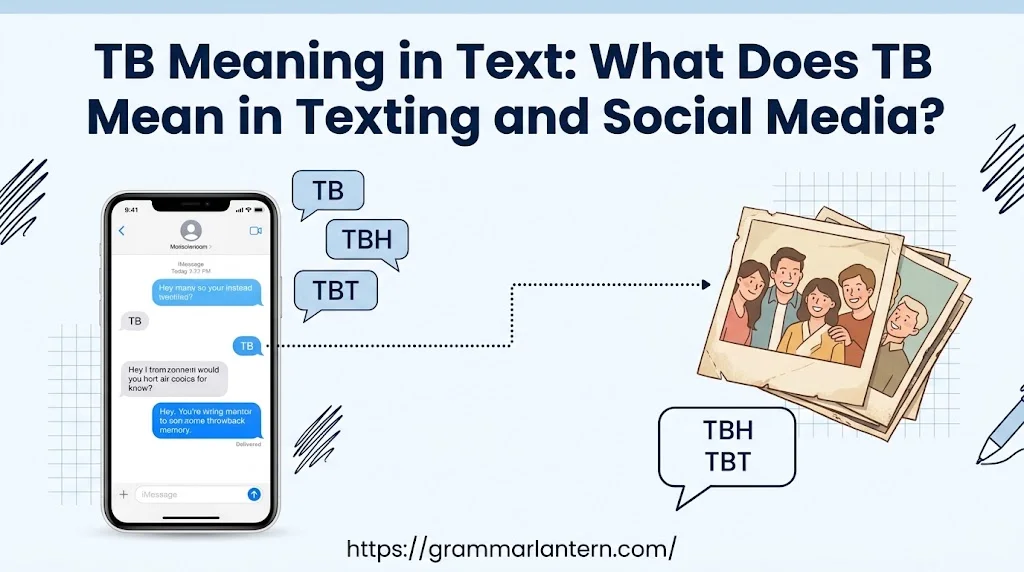
The most common TB meaning in text is throwback, which refers to an old memory, photograph, or past experience. You might see it in an Instagram caption like “TB to that amazing trip!” However, TB can also mean text back in certain conversations, particularly when someone wants you to reply. Its meaning depends on the surrounding words and the situation.
In this guide, you’ll discover how people use TB in text messages, Instagram, TikTok, and Snapchat. You’ll also learn about its alternative meanings, common misunderstandings, and practical examples of real-life usage. By the end, you’ll know how to interpret TB correctly and respond naturally whenever it appears in a conversation.
Quick Answer
TB most commonly refers to “throwback” in nostalgic social media contexts, while some people use it to mean “text back” in private conversations. The intended meaning depends on the message and the situation.
Here are the main interpretations:
- TB = Throwback: A reference to an old photo, past experience, or memorable event.
- TB = Text back: An informal request for someone to reply to a message.
- TB = To be: A possible abbreviation in notes or highly compressed writing, although it isn’t a standard texting meaning.
- TB = Terabyte: A unit of digital storage used in technology.
- TB = Tuberculosis: A medical abbreviation used in health-related contexts.
For example, someone posting an old vacation picture might write, “TB to our beach trip.” In this case, TB refers to a throwback.
However, if someone texts, “TB when you get a chance,” they might mean “text back” in that particular conversation.
The best approach is simple: read the whole message before deciding what TB means.
What Does TB Mean in Texting?
Texting abbreviations often depend on shared habits between friends, family members, and online communities. TB is a good example because it doesn’t have one universal meaning across every platform.
Two interpretations deserve particular attention: throwback and text back.
TB Meaning: Throwback
A throwback is a reference to something from the past. It could be an old photograph, a childhood memory, a previous vacation, or a moment someone wants to remember.
People use TB in captions, comments, and casual messages when they want to revisit an earlier experience.
For example:
- “TB to my high school days.”
- “Here’s a TB from our summer vacation.”
- “Major TB to the best birthday ever.”
- “This picture is such a TB!”
- “TB to when we were kids.”
In these examples, TB points toward a past event or memory.
You might see it when someone shares an old picture with friends. The abbreviation adds a nostalgic feeling without requiring a long explanation.
However, TB isn’t as universally recognizable as TBT, which stands for “Throwback Thursday.” Some people use TB casually, while others prefer writing out the full word.
TB Meaning: Text Back
In some texting conversations, TB means “text back.” People may use it when they want someone to reply or continue a conversation.
For example:
- “TB when you’re free.”
- “Don’t forget to TB later.”
- “TB after your meeting.”
- “I’ll be waiting for you to TB.”
Here, the sender is asking for a response rather than referring to a memory.
The meaning becomes clearer when the message involves a future reply, an unanswered question, or an ongoing conversation.
For example, imagine your friend asks whether you’re coming to dinner. You haven’t decided yet, so they message you later with “TB when you know.”
The likely meaning is “text back when you know.”
Still, TB isn’t a universally standardized abbreviation for this phrase. Some people may not recognize it, and others might interpret it differently. If clarity matters, writing “text back” in full is often the safer choice.
Does TB Mean “To Be”?
TB can represent “to be” in certain personal notes, shorthand systems, or compressed writing. However, this interpretation is not a standard, widely established meaning of TB in everyday texting.
For example, someone taking quick notes might write “TB discussed later” to mean something like “to be discussed later.” Yet this isn’t a conventional format that every reader will understand.
Compare these expressions:
- “To be continued” is commonly abbreviated as TBC.
- “To be honest” is commonly abbreviated as TBH.
- “Text back” may be shortened to TB in some informal conversations.
Notice how the surrounding words affect the interpretation.
If someone sends you just “TB,” you shouldn’t automatically assume they mean “to be.” Look for clues in the sentence and the conversation.
What Does TB Mean on Social Media?
Social media gives abbreviations additional meaning because images, videos, captions, and comments provide visual context.
A two-letter abbreviation under an old photograph can mean something different from the same abbreviation in a private message.
TB Meaning on Instagram
On Instagram, TB may refer to a throwback when someone shares an old photo, video, or memory.
For example, a user might post a picture from a vacation several years ago with the caption:
“TB to the most beautiful beach I’ve ever visited.”
The caption tells readers that the photo comes from an earlier experience.
Other examples include:
- “TB to my graduation day.”
- “A little TB from our road trip.”
- “TB with my favorite people.”
- “Throwback to simpler times.”
People may also use TB in comments when discussing an older post or remembering a shared experience.
However, TB doesn’t always mean throwback on Instagram. In a direct message, someone might use it to request a reply. The format and surrounding words help distinguish these meanings.
TB Meaning on Snapchat
On Snapchat, TB can refer to a past memory or a request to respond, depending on the conversation.
Suppose a friend sends you an old picture from a school trip and writes, “TB 😂.”
The likely meaning is that the picture reminds them of a funny moment from the past.
Now imagine someone sends you a question and follows up with “TB later.” In that situation, they may be asking you to text back later.
Snapchat conversations often move quickly, so people may rely on shorthand that their friends already understand. Nevertheless, not everyone uses the same abbreviations.
If you’re unsure, a quick clarification can prevent an awkward misunderstanding.
Read More: JSP Meaning in Text: What Does JSP Mean in Texting and Chat?
TB Meaning on TikTok
On TikTok, TB may appear in captions, comments, or videos that revisit earlier experiences.
For example, a creator might post a video from a previous trip and write:
“TB to the trip that changed everything.”
The abbreviation signals that the content looks back at an earlier moment.
You might also see TB in comments about childhood memories, old trends, past relationships, or earlier stages of someone’s life.
The video itself often provides the strongest clue. A nostalgic slideshow suggests a throwback, while a private message asking for a reply may suggest “text back.”
Because social media slang changes over time, it’s best not to assume every creator uses TB in exactly the same way.
TB Meaning on WhatsApp and Messenger
On WhatsApp and Messenger, TB may appear in private conversations where the sender expects the recipient to understand the shorthand.
For example:
Person A: “Are we meeting at 6?”
Person B: “Not sure yet.”
Person A: “Okay, TB when you decide.”
In this fictional example, TB most likely means “text back.”
A different conversation could use the same letters differently:
Person A: “Look what I found in my old gallery!”
Person B: “Wow, TB!”
Here, TB likely refers to a throwback or a memory from the past.
The important difference is the purpose of the conversation. One exchange is about receiving a reply, while the other is about remembering something.
TB Meaning in Different Contexts
The easiest way to understand TB is to consider why someone used it. The abbreviation itself provides limited information, but the situation can reveal much more.
TB in Casual Conversations
Friends often shorten familiar expressions because they understand each other’s communication habits.
For instance, a friend might write, “TB after work,” expecting you to understand that they want you to respond later.
Another friend might send an old photograph with “TB” as a quick comment about the memory.
These examples illustrate an important point: the same abbreviation can serve different purposes in different conversations.
If your friends regularly use TB in a particular way, their shared habit may help you understand it. However, someone outside that circle might interpret the abbreviation differently.
TB in Captions and Comments
Captions often provide clues through photographs, dates, locations, and descriptions.
Consider these examples:
| Example | Likely meaning | Why |
| “TB to 2019” under an old picture | Throwback | The caption points to a past year. |
| “TB to our first concert” | Throwback | It recalls a previous experience. |
| “TB when you get home” | Text back | The sender expects a reply. |
| “TB later, please” in a private chat | Text back | The message requests a response. |
These interpretations are contextual rather than universal definitions. A person could use TB differently, especially in a private conversation.
When reading a caption, look at the image and its description together. When reading a message, focus on the conversation’s purpose.
TB Meaning in Flirting and Romantic Texts
TB can appear in conversations between romantic partners or people who are flirting. However, the abbreviation alone doesn’t reveal romantic interest.
For example:
“TB when you get home ❤️”
In this context, the sender may be asking the recipient to text back later. The heart emoji adds affection, but TB itself doesn’t necessarily carry a romantic meaning.
Consider another example:
“TB to our first date.”
Here, TB likely refers to a shared memory. The message may feel romantic because of the subject, not because the abbreviation has a special romantic definition.
If someone sends you TB, consider the complete message, your existing relationship, and the tone of the conversation. Avoid reading too much into two letters.
TB Meaning in Group Chats
Group chats often develop their own shorthand. Friends may use abbreviations that make perfect sense within their group but confuse newcomers.
Imagine a group of friends sharing photographs from a recent reunion. Someone posts an old picture with “TB,” and everyone starts remembering the event.
In that setting, throwback is a reasonable interpretation.
Now imagine the group is planning a weekend trip. Someone asks a friend to “TB with the final numbers.” The intended meaning may be “text back with the final numbers.”
Group conversations can provide extra clues because earlier messages often establish the topic. Reading the previous few messages can help you understand the abbreviation without asking anyone.
TB vs. TBT: What’s the Difference?
TB and TBT are related when people use them to discuss past experiences, but they aren’t interchangeable in every situation.
TB can mean “throwback” in nostalgic contexts, while TBT stands for “Throwback Thursday.” TBT is a recognizable social media expression for sharing memories, especially on Thursdays.
Here’s how they compare:
| Feature | TB | TBT |
| Full meaning in nostalgic contexts | Throwback | Throwback Thursday |
| Typical use | Informal reference to a past memory | Throwback post or caption associated with Thursday |
| Used in private messages | Yes, depending on context | Yes, although it is strongly associated with social posts |
| Can refer to a reply? | Sometimes, as “text back” | Not normally |
| Example | “TB to our vacation” | “TBT: Our vacation in Hawaii” |
The key distinction is that TBT specifically includes Thursday, whereas TB doesn’t.
People sometimes post TBT content on days other than Thursday. Social media habits aren’t strict rules, so the expression can appear outside its traditional day.
For example, “TBT to my college graduation” makes sense even if someone publishes it on a Saturday.
If you want to share an old memory, TB or TBT may work depending on your caption. If you want someone to respond to a message, use clearer wording because readers may interpret TB as a throwback reference.
TB vs. Other Common Texting Abbreviations
TB belongs to a much larger collection of texting abbreviations. Learning a few related terms can help you interpret online conversations more easily.
| Abbreviation | Full meaning | Example |
| TB | Throwback or, in some contexts, text back | “TB to last summer.” |
| TBT | Throwback Thursday | “TBT to graduation day.” |
| TBH | To be honest | “TBH, I loved the movie.” |
| BRB | Be right back | “BRB, someone is at the door.” |
| TTYL | Talk to you later | “I have to go. TTYL!” |
| HMU | Hit me up | “HMU when you’re free.” |
| DM | Direct message | “Send me a DM.” |
| BTW | By the way | “BTW, did you call Sam?” |
| ASAP | As soon as possible | “Please send it ASAP.” |
| LOL | Laughing out loud | “LOL, that was hilarious.” |
These abbreviations serve different purposes. Some communicate emotions, others manage conversations, and a few refer to particular types of content.
One distinction is especially useful: TBH means “to be honest,” not “throwback.” The extra letter changes the meaning entirely.
Similarly, TTYL signals that a conversation will continue later. TB may request a reply in some contexts, but it isn’t as consistently recognized.
When you need to avoid confusion, write the full expression instead of relying on an abbreviation.
Examples of TB Used in Text Messages
The following examples show how context changes the likely meaning of TB.
Example: Asking Someone to Reply
Alex: “Did you find out what time the movie starts?”
Jordan: “Not yet. I’ll check.”
Alex: “Okay, TB when you know.”
Meaning: Alex is asking Jordan to text back when the information becomes available.
The words “when you know” suggest that Alex expects a future response.
Example: Sharing an Old Memory
Mia: “Look at this picture from our camping trip!”
Sam: “TB! I forgot how much it rained 😂”
Meaning: Sam is reacting to a throwback picture and remembering the experience.
The photograph and the reference to a past trip make the meaning clear.
Example: Responding to an Old Photo
Taylor: “Found this picture from my first day at college.”
Riley: “Such a TB!”
Meaning: Riley is calling attention to a memory from the past.
The sentence uses TB as shorthand for throwback, although some readers might prefer the full word.
Example: An Ambiguous Message
Chris: “TB later?”
Morgan: “Do you mean text back later or a throwback?”
Meaning: The original message doesn’t provide enough context to identify the intended meaning confidently.
Morgan asks a direct question instead of guessing. That’s a sensible response when an abbreviation has multiple possible interpretations.
A Simple Case Study: Why Context Matters
Imagine receiving two messages from the same friend on the same day.
In the morning, your friend writes, “TB after class.” Later, they share an old school photograph with the caption “TB!”
The morning message may be a request to reply after class. The photograph caption likely refers to a memory.
Nothing about the two letters changed. The surrounding information did.
This small example demonstrates why memorizing a single definition isn’t enough. To understand slang, you need to consider the sentence, the platform, and the purpose of the communication.
How to Tell What TB Means in a Message
When someone sends you TB without explaining it, use these practical steps to identify the likely meaning.
Read the Entire Sentence
Start by looking at the words around TB.
If the message includes phrases such as “when you can,” “later,” or “when you know,” the sender may be asking you to text back.
If the message mentions an old photograph, a previous vacation, or a memorable event, throwback is a more likely interpretation.
Don’t interpret the abbreviation in isolation when the sentence provides additional clues.
Consider the Platform
The platform can offer useful context, although it doesn’t determine the meaning automatically.
For example:
- An old-photo caption on Instagram may suggest throwback.
- A private message about an unanswered question may suggest text back.
- A nostalgic TikTok video may use TB to refer to a past experience.
- A conversation on WhatsApp may use TB as shorthand understood by the people involved.
These are clues, not fixed rules. People use social platforms in different ways.
Look at the Conversation History
If you’re still unsure, read the previous messages.
A conversation about childhood photographs makes a throwback interpretation more likely. A conversation about scheduling or unanswered questions may point toward text back.
You can also consider the sender’s usual writing habits. If the person frequently uses a particular abbreviation, their past messages may help you understand it.
However, don’t assume every sender follows the same conventions.
Ask for Clarification
Sometimes, the clearest answer is simply to ask.
You could say:
- “What do you mean by TB?”
- “Do you mean throwback?”
- “Are you asking me to text back?”
- “Sorry, just checking what TB means here.”
A short question can resolve the confusion immediately. There’s no need to pretend you understand an abbreviation when you don’t.
How to Reply When Someone Texts TB
Once you identify the intended meaning, responding becomes much easier.
If TB Means Text Back
If someone asks you to text back, reply according to the situation.
If you can respond now:
“I’m here! What’s up?”
If you’re busy:
“I’m tied up right now, but I’ll message you later.”
If you need more time:
“I’ll check and get back to you tonight.”
If you don’t understand the abbreviation:
“Do you mean you want me to text you back?”
These responses are clear and natural. They also prevent misunderstandings that can arise when both people rely on shorthand.
If TB Means Throwback
When someone shares an old photo or memory, respond to the content itself.
Here are some options:
- “I remember that day!”
- “What a great memory.”
- “We need to do that again.”
- “This feels like yesterday.”
- “I completely forgot about this picture!”
Your response can be funny, sentimental, or casual depending on the relationship.
For example, if a friend posts an old photograph from a school trip, you might write, “We had no idea how good those days were.”
A specific reaction often makes the conversation more engaging than a generic “nice pic.”
If You’re Unsure What TB Means
You don’t need to guess. Ask a brief follow-up question.
Try:
- “What’s TB in this context?”
- “Do you mean a throwback?”
- “Just checking, are you asking me to reply?”
- “I might be missing the abbreviation here. What does it mean?”
A friendly clarification keeps the conversation moving without creating unnecessary awkwardness.
Other Meanings of TB Outside Texting
TB can also have established meanings outside casual conversations. Recognizing these meanings helps you avoid confusing texting slang with technical terminology.
TB Meaning in Technology: Terabyte
In computing, TB commonly stands for terabyte, a unit used to measure digital storage capacity.
For example, a laptop advertised with a 1 TB solid-state drive has a nominal storage capacity of one terabyte.
In the decimal system used by storage manufacturers, one terabyte equals 1,000 gigabytes. Computers may also use binary units such as tebibytes, which follow a different conversion system.
You might encounter TB when discussing:
- Laptop and desktop storage.
- External hard drives.
- Cloud storage plans.
- Video archives.
- Large databases.
In a technology discussion, TB usually refers to storage rather than texting slang.
TB Meaning in Medicine: Tuberculosis
In medical contexts, TB stands for tuberculosis, an infectious disease caused by bacteria that most commonly affect the lungs but can also affect other parts of the body.
The meaning is very different from the abbreviation’s casual use in messages.
For example, a health article might discuss TB testing, treatment, or prevention. In that context, the medical meaning is clear.
The surrounding subject determines which definition makes sense. A message about a doctor’s appointment shouldn’t be interpreted using social media slang without considering the medical context.
TB as Other Specialized Shorthand
TB may also appear as an abbreviation in technical notes, workplace documents, or specialized fields.
Its meaning can depend on the organization’s terminology or the subject under discussion. Unlike a well-established term such as terabyte, a locally defined abbreviation may not be recognizable outside that environment.
If you encounter TB in a professional document, look for a glossary or ask the writer what it means.
The main rule is to match the abbreviation to its context. A social media caption, a computer specification, and a medical report may use the same letters for entirely different purposes.
Is TB Still Common in Texting?
TB appears in informal digital communication, particularly where people use abbreviations to shorten captions or messages. However, its popularity and intended meaning vary across communities and platforms.
Throwback references remain easy to recognize when paired with old photographs or memories. The abbreviation TBT is also familiar in nostalgic social media contexts.
By comparison, TB as “text back” is less standardized. Some people use it naturally, while others may not recognize it.
There isn’t one universal texting dictionary that determines how everyone uses every abbreviation. Meaning develops through shared habits, community conventions, and the immediate conversation.
For that reason, it’s useful to understand several possible meanings rather than memorize one definition.
If you’re writing to someone who may not know your shorthand, clarity matters more than saving two or three characters. “Text me back when you’re free” is longer than “TB,” but nobody has to guess what it means.
Read More: Stole or Stolen: Which Is Correct? Helpful Examples
FAQs
1. What does TB mean in text messages?
TB most commonly means throwback when people talk about old photos, memories, or past experiences. In some conversations, it can also mean text back. The intended meaning depends on the message and the relationship between the people chatting.
2. What does TB mean on Instagram?
On Instagram, TB usually stands for throwback. People use it when sharing old pictures, vacation memories, childhood photos, or special moments from the past. For example, “TB to my favorite summer” refers to remembering a previous summer.
3. What does TB mean on Snapchat?
On Snapchat, TB can mean throwback, especially when someone shares an old picture or memory. However, the abbreviation may have a different meaning depending on the conversation. Check the accompanying caption or message to understand what the sender intends.
4. What does TB mean on TikTok?
On TikTok, TB often refers to throwback content, including older videos, nostalgic trends, and memorable experiences. A creator might use TB in a caption to revisit a previous event or share something from the past.
5. Does TB mean text back?
Yes, TB can mean text back in certain informal conversations, although this usage is less universal than throwback. For example, someone might write, “TB when you get a chance,” to encourage another person to reply. Context helps you distinguish this meaning from others.
6. What does TB mean in a conversation between friends?
Between friends, TB often refers to a shared memory or past experience. One friend might send an old photograph and write, “TB to our school days!” This can express nostalgia, affection, or a desire to remember a fun moment together.
7. What does TB mean in a social media caption?
In a social media caption, TB generally means throwback. People use it to highlight older photographs, memorable trips, celebrations, or experiences they want to revisit. For example, “TB to our graduation day” points to a past event.
8. How should I respond when someone sends TB?
Your response depends on the intended meaning. If someone shares an old photo, you could say, “That brings back memories!” or “Those were the good old days!” If they mean text back, simply reply to their message when you can.
9. Is TB the same as TBT?
No, TB and TBT are not exactly the same. TB commonly stands for throwback, while TBT stands for Throwback Thursday, a popular social media tradition of sharing older photos or memories on Thursdays. People sometimes use both abbreviations when posting nostalgic content.
10. Can TB have meanings other than throwback?
Yes, TB has several meanings depending on the context. Besides throwback and the occasional use of text back, TB can refer to tuberculosis in medicine or terabyte in computing. Always consider the topic and surrounding words before deciding what the abbreviation means.
Conclusion
Understanding the TB meaning in text is easier when you consider the context in which someone uses it. In most social media posts and casual conversations, TB means throwback, referring to old photos, cherished memories, and past experiences. In certain informal messages, it may mean text back, while professional or technical discussions can use TB for entirely different terms.
The next time you see TB on Instagram, Snapchat, TikTok, or in a text message, look at the surrounding words before interpreting it. If someone shares an old photograph, they are probably reminiscing. If they ask you to respond, they may be using it to mean text back. When the meaning remains unclear, asking a quick question is the easiest way to avoid confusion and keep your online conversations natural and friendly.

Muhammad Haroon is the voice behind many of the clear, practical grammar guides you’ll find on Grammar Lantern. With a strong background in content writing and a genuine love for the English language, Haroon specializes in breaking down intimidating grammar topics into simple, digestible lessons. His goal is simple: to empower readers to write with confidence and clarity. Whether he’s explaining tricky tenses or demystifying punctuation, Haroon approaches each topic with patience, precision, and a touch of warmth—because he knows that learning grammar is a journey, not a race.