
Have you ever paused while writing and wondered whether “buses,” “bus’s,” or “bus’” is the correct form? This common grammar question can cause confusion, especially in formal writing, professional emails, and academic work. Understanding the difference between plural and possessive nouns helps you write with greater consistency and confidence. Although these forms look similar, each follows a different punctuation rule in everyday English usage.
Choosing the correct form matters in many situations, from discussing a bus company’s scheduling system to updating a calendar, managing online booking details, or preparing project management reports. Proper punctuation also improves clarity in business communication, presentations, and workplace documents. When you understand these distinctions, you can avoid common mistakes and express your ideas more precisely, whether you’re writing meeting notes, organizing schedules, or sharing important information with colleagues.
In this guide, you’ll discover when to use buses, bus’s, and bus’ through simple explanations and practical examples. We’ll explore essential grammar rules, compare common style preferences, and explain how possessive forms work in different contexts. By the end, you’ll know which form to choose, how to apply it correctly, and why this small punctuation difference makes a meaningful impact on clear, professional writing.
Quick Answer
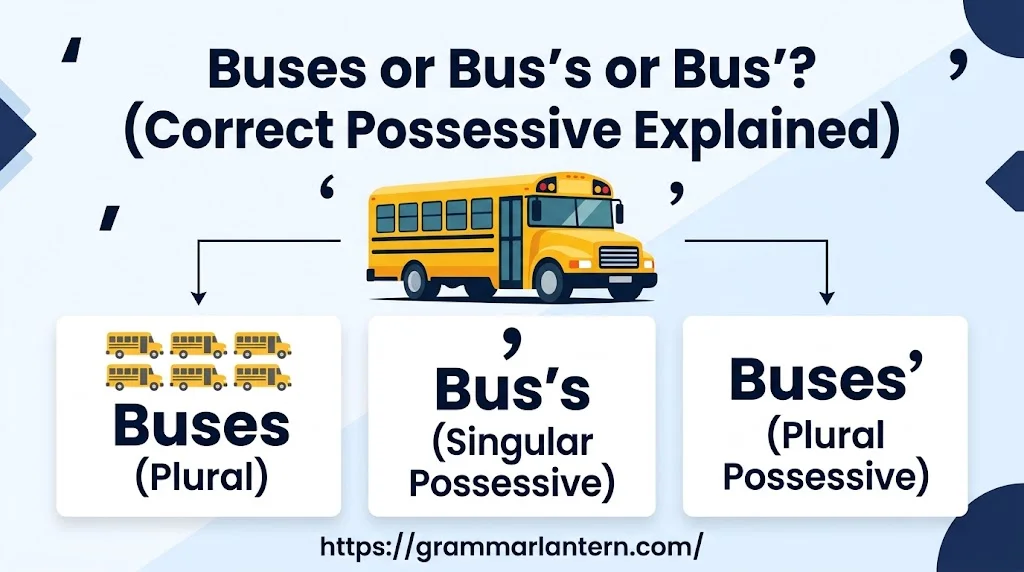
The correct form depends on what you want to express. Buses is the plural of bus, bus’s is the standard singular possessive, and bus’ is an alternative possessive form accepted by some style guides.
Here’s a quick comparison:
| Word | Grammatical function | Meaning | Example |
| Buses | Plural noun | More than one bus | The buses are waiting outside. |
| Bus’s | Singular possessive | Something belonging to one bus | The bus’s engine needs repair. |
| Bus’ | Alternative singular possessive | Something belonging to one bus | The bus’ engine needs repair. |
| Buses’ | Plural possessive | Something belonging to multiple buses | The buses’ engines need repair. |
Remember these simple rules:
- Use buses when referring to two or more buses.
- Use bus’s to show possession by one bus.
- Use bus’ only when your chosen style guide permits or requires it.
- Use buses’ to show possession by multiple buses.
The key is to identify the meaning before choosing the spelling. Once you do that, the correct form becomes much easier to recognize.
What Does Buses Mean?
Buses is the standard plural form of the noun bus. You use it when referring to two or more vehicles designed to carry passengers.
For example, you might talk about school buses, city buses, tour buses, or buses traveling between different towns. Whenever you’re referring to multiple vehicles rather than one, buses is usually the word you need.
Notice that the word doesn’t contain an apostrophe. That’s because ordinary plural nouns don’t need apostrophes to show number.
Definition of Buses
The word bus refers to a motor vehicle that carries multiple passengers, typically along a route or for a particular journey.
Adding -es creates the plural form:
- One bus
- Two buses
- Several buses
- A fleet of buses
For example:
- The buses arrive at the station every morning.
- Three buses transported the students to the museum.
- The company purchased ten new buses this year.
- Several buses were parked outside the stadium.
Each example refers to more than one vehicle. None requires an apostrophe.
Why Is the Plural of Bus Buses Instead of Buss?
English spelling rules explain why bus becomes buses rather than buss or buss’s.
Nouns ending in certain sibilant sounds commonly form their plurals by adding -es. These endings include s, ss, sh, ch, and x.
Consider these examples:
| Singular | Plural |
| Bus | Buses |
| Class | Classes |
| Box | Boxes |
| Dish | Dishes |
| Watch | Watches |
| Brush | Brushes |
The extra vowel helps form a pronounceable plural. In buses, the ending adds another syllable, producing the familiar pronunciation.
A common mistake is writing bus’s when you simply mean several buses. However, that apostrophe changes the grammatical function of the word. It suggests possession rather than plurality.
Incorrect: The bus’s are waiting outside.
Correct: The buses are waiting outside.
The second sentence correctly uses the plural noun without an unnecessary apostrophe.
Examples of Buses in Different Contexts
Understanding how buses works in everyday situations makes the rule easier to remember.
Public transportation: The buses run every fifteen minutes during rush hour.
School transportation: Four buses carried the children to the science museum.
Travel: Several buses departed from the terminal before sunrise.
Business operations: The transportation company operates a fleet of fifty buses.
Road safety: The buses stopped when the traffic light turned red.
In each example, the word identifies multiple vehicles. The number of buses may be two, four, fifty, or an unspecified amount, but the plural form remains the same.
What Does Bus’s Mean?
Bus’s is the standard singular possessive form of bus in general American English. It indicates that something belongs to, comes from, or is associated with one bus.
To form this possessive, start with the singular noun bus and add ’s.
The result is bus’s.
For example, consider this sentence:
The bus’s engine started making a strange noise.
The sentence refers to one bus and its engine. The apostrophe followed by s marks the possessive relationship between the vehicle and its engine.
Possession doesn’t always mean literal ownership. It can also indicate a feature, part, characteristic, or association.
Read More: Payments or Payment: Which One Is Correct?
When Should You Use Bus’s?
Use bus’s when you want to show that something belongs to or relates to a single bus.
Common examples include vehicle parts, physical features, schedules, and other associated details.
Physical parts
- The bus’s tires need replacing.
- The bus’s windshield cracked during the storm.
- The bus’s doors opened at the station.
Features and conditions
- The bus’s interior was unusually clean.
- The bus’s air conditioning stopped working.
- The bus’s headlights illuminated the road.
Schedules and operations
- The bus’s departure time changed unexpectedly.
- The bus’s route includes three stops.
- The bus’s arrival was delayed by traffic.
These examples all refer to one particular vehicle. The apostrophe shows the relationship between that vehicle and the item or detail being discussed.
Is Bus’s Grammatically Correct?
Yes. Bus’s is grammatically correct and is the recommended general-purpose singular possessive form in American English.
The standard rule for most singular nouns is to add an apostrophe followed by s to form the possessive. This rule applies even when the noun already ends in the letter s.
For example:
| Singular noun | Singular possessive |
| Bus | Bus’s |
| Class | Class’s |
| Glass | Glass’s |
| Dress | Dress’s |
| Boss | Boss’s |
Consider the difference between these two sentences:
- The bus stopped near the school.
- The bus’s engine overheated near the school.
In the first sentence, bus identifies the vehicle. In the second, bus’s identifies something associated with that vehicle.
The apostrophe isn’t decorative punctuation. It serves a grammatical purpose.
Some writers avoid bus’s because they think the double s looks awkward. However, appearance alone doesn’t make a form incorrect. In general writing, bus’s is a clear and reliable choice.
What Does Bus’ Mean?
Bus’ can serve as an alternative singular possessive form under certain style conventions. It has the same intended meaning as bus’s when a writer uses it to indicate possession by one bus.
For example:
The bus’ engine needs repair.
This sentence expresses the same basic idea as:
The bus’s engine needs repair.
The difference lies in the punctuation convention, not the intended meaning.
However, there’s an important distinction to remember. Bus’ is not the standard plural of bus. If you’re talking about multiple vehicles without showing possession, use buses.
When Is Bus’ Acceptable?
Some editorial styles permit an apostrophe without an additional s for possessive forms of singular nouns ending in s. Under such a convention, bus’ may be acceptable.
Other style guides prefer adding ’s to singular nouns, including those ending in s. Under those rules, bus’s is the appropriate choice.
The best approach depends on your writing requirements.
- For everyday American English: Prefer bus’s.
- For school assignments: Follow your teacher’s required style guide.
- For professional publications: Use the publication’s editorial rules.
- For business documents: Apply the organization’s established writing style consistently.
The important point is that you shouldn’t switch between bus’s and bus’ randomly. Consistency helps your writing look deliberate and professional.
Bus’ vs. Bus’s in American English
Both forms can express singular possession, but they don’t have equal status in every style guide.
| Feature | Bus’s | Bus’ |
| Meaning | Singular possession | Singular possession under an accepted alternative convention |
| General American English | Recommended default | Style-dependent |
| Example | The bus’s door is open. | The bus’ door is open. |
| Best general-purpose choice | Yes | Only when the applicable style permits it |
For most readers, bus’s is straightforward and easy to recognize. It also follows the common rule for forming singular possessives.
Practical tip: Unless you have a specific reason to use bus’, choose bus’s. That decision avoids unnecessary uncertainty.
Key Differences
The main difference between these forms is their grammatical function. One expresses plurality, while the others express singular possession under different punctuation conventions.
Buses: The Plural Form
Use buses when you mean more than one bus.
Example: The buses are lined up outside the terminal.
This sentence tells readers that multiple vehicles are present. It doesn’t indicate ownership.
Bus’s: The Standard Singular Possessive
Use bus’s when something belongs to or is associated with one bus.
Example: The bus’s windshield needs cleaning.
The possessive form links the windshield to a particular vehicle.
Bus’: An Alternative Singular Possessive
Use bus’ when the style guide you’re following permits this possessive convention.
Example: The bus’ windshield needs cleaning.
The sentence communicates the same basic relationship as the version with bus’s.
Buses’: The Plural Possessive
Use buses’ when something belongs to or is associated with multiple buses.
Example: The buses’ windshields need cleaning.
Here, the plural noun buses already ends in s. To form its possessive, add an apostrophe after the final s.
This creates four distinct forms:
- Buses: Multiple vehicles.
- Bus’s: Something associated with one vehicle.
- Bus’: An alternative form for singular possession.
- Buses’: Something associated with multiple vehicles.
Once you understand these differences, apostrophe placement becomes much less confusing.
How to Form the Possessive of Bus
Forming the possessive correctly requires two steps. First, determine whether the noun is singular or plural. Then apply the appropriate apostrophe rule.
The Singular Possessive Rule
For most singular nouns, add ’s to indicate possession.
Examples include:
- The dog’s collar
- The teacher’s desk
- The company’s office
- The bus’s engine
For bus, the standard singular possessive spelling is bus’s.
Consider this example:
The bus’s brakes failed during the inspection.
The sentence refers to the brakes of one bus. Because the noun is singular, the standard possessive form takes ’s.
A useful way to remember this rule is to begin with the basic noun. If you’re discussing one bus and want to identify something associated with it, use bus’s in general American English.
The Plural Possessive Rule
Plural possessives follow a different pattern when the plural noun already ends in s.
First, form the plural: bus becomes buses. Then add an apostrophe after the final s to show possession.
The result is buses’.
Examples:
- The buses’ engines were inspected.
- The buses’ schedules changed last week.
- The buses’ parking area was full.
- The buses’ tires were replaced before winter.
Each sentence refers to something associated with multiple buses.
Notice that buses’ contains an apostrophe but doesn’t need another s after it. The plural noun already ends in s, so the apostrophe goes after that final letter.
Bus’s vs. Buses’: What’s the Difference?
The difference between these forms is the number of buses involved.
| Sentence | Meaning |
| The bus’s engine needs repair. | One bus has an engine that needs repair. |
| The buses’ engines need repair. | Multiple buses have engines that need repair. |
| The bus’s schedule changed. | One bus has a changed schedule. |
| The buses’ schedules changed. | Multiple buses have changed schedules. |
The distinction matters because the apostrophe helps readers understand the relationship between the noun and what follows it.
Imagine a transportation manager writing a maintenance report. If the report says the bus’s tires, it refers to one vehicle’s tires. If it says the buses’ tires, it refers to the tires belonging to multiple vehicles.
A single apostrophe can clarify the scope of an entire sentence.
Common Mistakes
Even experienced writers occasionally confuse plurals and possessives. The easiest way to avoid these errors is to check what the sentence actually means.
Using Bus’s as the Plural of Bus
Incorrect: Five bus’s arrived at the terminal.
Correct: Five buses arrived at the terminal.
The first sentence uses a possessive-looking form when it needs an ordinary plural noun. The second correctly identifies multiple vehicles.
Remember that adding an apostrophe doesn’t make a noun plural.
Using Bus’ When You Mean Multiple Buses
Incorrect: The bus’ are parked outside.
Correct: The buses are parked outside.
The first sentence incorrectly uses an alternative possessive spelling as a plural. The second uses the standard plural form.
Confusing Bus’s With Buses’
Incorrect for plural possession: The buses’s engines were checked.
Correct: The buses’ engines were checked.
The plural possessive form is buses’, not buses’s. Once you’ve formed the plural noun, place the apostrophe after its final s.
Adding Apostrophes to Ordinary Plurals
Incorrect: The school purchased twelve bus’s.
Correct: The school purchased twelve buses.
Numbers and words such as many, several, and multiple often signal that you need a plural noun. They don’t automatically call for an apostrophe.
Compare these examples:
- Several buses arrived early.
- Several buses’ engines needed attention.
The first sentence uses a plural noun. The second uses a plural possessive because the engines belong to multiple buses.
Switching Between Bus’s and Bus’ Without a Reason
Both forms can be used for singular possession under different conventions. However, switching between them within the same document can make the writing inconsistent.
For example, a report that uses bus’s engine in one paragraph and bus’ door in another may leave readers wondering whether the difference is intentional.
Choose a convention and apply it consistently.
Real-World Case Study: A School Bus Maintenance Report
Imagine a school district preparing a report about its transportation fleet. The report needs to describe several vehicles, their individual parts, and shared maintenance concerns.
Here are four sentences that illustrate the differences.
Example one: The plural noun
The buses arrived at the depot before sunrise.
The report refers to multiple vehicles. Therefore, buses is correct.
Example two: Singular possession
The bus’s engine failed during the morning inspection.
The report discusses one particular vehicle. The standard singular possessive is bus’s.
Example three: Plural possession
The buses’ engines received routine maintenance.
The report refers to engines belonging to multiple buses. The correct form is buses’.
Example four: Alternative singular possession
The bus’ engine failed during the morning inspection.
This sentence can also express singular possession under a style convention that permits bus’. However, bus’s is the recommended default for general American English.
The case study shows why you must consider both number and possession. The apostrophe’s position isn’t arbitrary; it reflects the grammatical relationship you’re describing.
A Simple Trick to Remember the Difference
If you frequently confuse these forms, ask yourself two questions before writing.
First, am I talking about more than one bus?
If the answer is yes, use buses unless you also need to express possession.
Second, does something belong to or relate to the bus or buses?
If the answer is yes, choose the appropriate possessive form.
Use this quick memory guide:
- More than one bus: Buses
- Something associated with one bus: Bus’s
- Alternative singular possessive under an accepted style: Bus’
- Something associated with multiple buses: Buses’
You can also use a simple sentence test.
If you can replace the word with more than one bus, you probably need buses, If you can rewrite the phrase as the engine belonging to one bus, you need the singular possessive. If the engine belongs to multiple buses, use the plural possessive.
For example:
The buses are late.
You mean several vehicles, so there’s no apostrophe.
The bus’s engine is noisy.
You’re describing one vehicle’s engine, so the apostrophe belongs before the final s.
The buses’ engines are noisy.
You’re describing engines associated with multiple vehicles, so the apostrophe follows the plural ending.
This simple test works in many everyday writing situations.
Read More: Holliday or Holiday: Which Spelling Is Correct?
FAQs
1. Is it buses, bus’s, or bus’?
Buses is the plural form of bus, meaning more than one bus. Bus’s usually shows possession by one bus. Bus’ is an alternative possessive form used by some style guides, but bus’s is more common in modern English.
2. What is the plural of bus?
The plural of bus is buses. You add -es because the word ends in s.
Example: Three buses arrived at the station on time.
3. Is bus’s grammatically correct?
Yes, bus’s is grammatically correct when showing that something belongs to or is associated with one bus.
Example: The bus’s engine needs repair.
4. When should I use bus’?
You can use bus’ as a possessive form if your chosen style guide allows it. However, many modern style guides recommend adding ’s to singular nouns ending in s.
Example: The bus’ route changed yesterday.
5. What is the difference between buses and bus’s?
Buses refers to multiple vehicles, while bus’s indicates possession by one bus.
Examples:
- The buses are waiting outside.
- The bus’s door is open.
6. Is buses’ a correct word?
Yes, buses’ is the plural possessive form. It indicates that something belongs to or is associated with multiple buses.
Example: The buses’ schedules were updated.
7. How do I make bus plural possessive?
To make bus plural possessive, first change bus to buses, then add an apostrophe.
Example: The buses’ parking area is closed.
8. Should I use bus’s or buses’ in formal writing?
Use bus’s when referring to one bus and buses’ when referring to multiple buses. These forms are suitable for formal writing and clearly indicate ownership or association.
Examples:
- The bus’s headlights are broken.
- The buses’ headlights are broken.
9. Why does buses have no apostrophe?
Buses is an ordinary plural noun, so it doesn’t need an apostrophe. Apostrophes indicate possession or contractions, not regular plural forms.
Correct: Several buses stopped near the school.
Incorrect: Several bus’s stopped near the school.
10. How can I remember the difference between buses, bus’s, and bus’?
Remember this simple rule: buses means more than one bus, bus’s shows possession by one bus, and buses’ shows possession by multiple buses. Although bus’ is sometimes accepted as a singular possessive, bus’s is generally the safer choice.
Conclusion
Understanding the difference between buses, bus’s, and bus’ makes your writing clearer and more accurate. Use buses when talking about multiple vehicles, bus’s when showing possession by one bus, and buses’ when something belongs to several buses. Although some style guides accept bus’ as a singular possessive, bus’s is widely preferred in modern English writing.
The key is to identify whether you’re discussing a plural noun or showing possession. Once you learn this simple distinction, you’ll avoid common apostrophe mistakes in emails, reports, academic assignments, and everyday communication. Practice with a few examples, and choosing the correct form will soon become second nature.

Muhammad Haroon is the voice behind many of the clear, practical grammar guides you’ll find on Grammar Lantern. With a strong background in content writing and a genuine love for the English language, Haroon specializes in breaking down intimidating grammar topics into simple, digestible lessons. His goal is simple: to empower readers to write with confidence and clarity. Whether he’s explaining tricky tenses or demystifying punctuation, Haroon approaches each topic with patience, precision, and a touch of warmth—because he knows that learning grammar is a journey, not a race.