Have you ever paused while writing and wondered whether you need a comma before or after “now”? You are not alone! This small word can create confusion because its punctuation depends on how it works in a sentence. Learning the correct comma placement helps you avoid common mistakes and improve your English grammar.
In everyday communication, “now” can show when something happens, introduce a new thought, or guide a conversation. Each use may follow a different comma rule. For example, “I need your help now” requires no comma, while “Now, let’s get started” usually needs a comma after “now.” Understanding these differences makes punctuation in English easier for beginners.
This guide explains when to use a comma before “now,” a comma after “now,” or no comma at all. With simple explanations and practical examples, you will learn how to apply these rules in emails, essays, reports, and professional writing. By the end, you will feel more confident using “now” and creating clear, natural, and grammatically correct sentences.
Quick Answer
You can put a comma before or after “now,” but the correct placement depends on the sentence’s structure and meaning. You don’t automatically need a comma every time you use this word.
Here are the basic rules:
| Situation | Comma placement | Example |
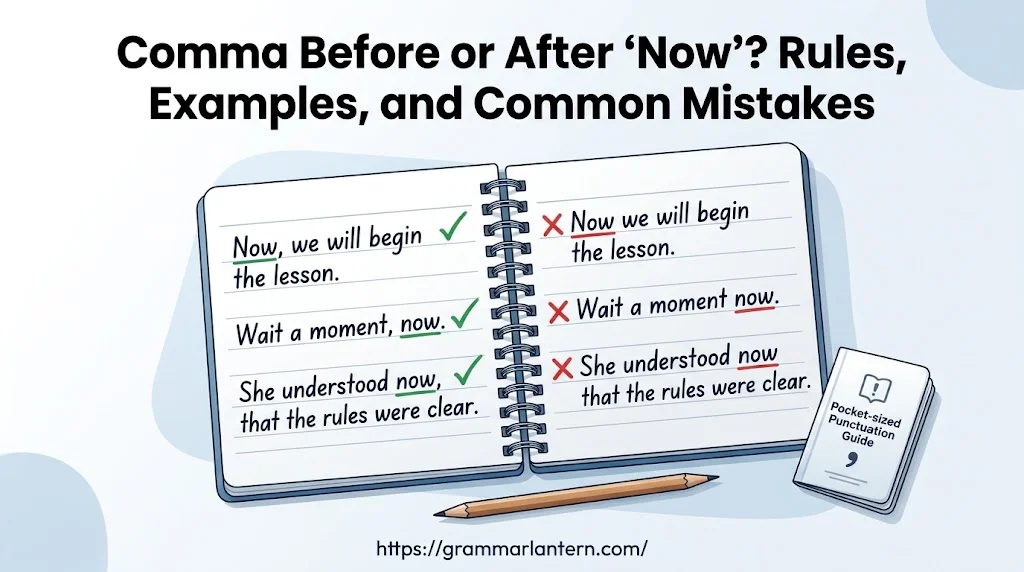
| Now introduces a new thought | Often after now | Now, let’s begin the lesson. |
| Now refers to the present time | Usually no comma | I need the information now. |
| Now follows a conjunction between independent clauses | Often before and or but, not necessarily before now itself | We were waiting, but now we’re ready. |
| Now interrupts a sentence as a parenthetical expression | Commas may appear on both sides | The proposal, now, seems reasonable. |
| Now appears at the end of a sentence | Usually no comma | We can leave now. |
| Now that introduces a dependent clause | Depends on clause order | Now that it’s sunny, let’s go outside. |
Remember one important distinction: a comma doesn’t belong beside now simply because you would pause while speaking. Grammar, sentence structure, and clarity should guide your decision.
When to Put a Comma After “Now”
A comma after now often appears when the word introduces a new point, signals a transition, or sets up a question. However, the comma isn’t mandatory in every sentence that begins with now.
When “Now” Introduces a Sentence
When now introduces a sentence as a transition, a comma often helps separate the opening word from the main statement.
Examples:
- Now, let’s look at another example.
- Now, we can move on to the next step.
- Now, everything makes a little more sense.
- Now, consider what happens when you remove the comma.
In these sentences, now does more than identify the present time. It guides the reader from one thought to another.
You can often hear the difference when you read the sentences aloud. The comma creates a small break between the transition and the main idea.
However, some sentences sound more natural without it:
- Now let’s get started.
- Now we need to make a decision.
Both versions can be acceptable. A comma is more useful when now functions as a distinct introductory transition rather than as part of the sentence’s main meaning.
When “Now” Introduces a New Topic or Point
Writers often use now to shift attention, introduce a new subject, or move to another stage of an explanation.
Examples:
- Now, let’s discuss the second option.
- Now, what happens if the payment arrives late?
- Now, turn your attention to the final paragraph.
- Now, here’s where things get interesting.
The comma helps readers recognize the shift. This technique works especially well in tutorials, presentations, instructions, and conversational writing.
For instance, a teacher might explain one grammar rule and then say, “Now, let’s look at an exception.” The word now signals that the discussion is moving forward.
Writing tip: Use the comma when it makes the transition clearer. Don’t add one mechanically to every sentence that begins with now.
When “Now” Appears in Direct Address
Sometimes, now appears near a person’s name or a word used to address a group. In these sentences, the name or direct address determines where commas belong.
Examples:
- Now, Sarah, let’s review your answer.
- Come on, everyone, now is the time to begin.
- Now, class, open your textbooks.
In the first and third examples, the comma after now separates the introductory transition from the rest of the sentence. The name or form of address is also set off with commas.
Compare these sentences:
- Now, Sarah, read the next paragraph.
- Sarah, read the next paragraph now.
The first uses now as an introductory transition. In the second, now indicates when Sarah should read. It doesn’t need a comma simply because it appears near the end.
When to Put a Comma Before “Now”
A comma can appear before now when the surrounding sentence requires one. The important point is that the comma usually belongs to the sentence structure, not to the word now itself.
When “Now” Follows a Coordinating Conjunction
When two independent clauses are joined by a coordinating conjunction, a comma generally appears before the conjunction.
The seven coordinating conjunctions are for, and, nor, but, or, yet, and so.
Consider these examples:
- We finished the first task, and now we can begin the next one.
- The store was closed, but now it is open.
- She felt nervous at first, yet now she feels confident.
- The instructions were confusing, so now we need clarification.
In each sentence, the comma separates two independent clauses. The word now doesn’t create the comma requirement.
Here’s a useful way to check: Can both parts stand alone as complete sentences?
In “The store was closed, but now it is open,” both “The store was closed” and “now it is open” express complete thoughts. The comma belongs before but because it joins those clauses.
Read More: Buses or Bus’s or Bus’? Correct Possessive Explained
When “Now” Appears in the Middle of a Sentence
You might see commas on both sides of now when a writer treats it as an interruption or parenthetical transition.
For example:
- The proposal, now, seems reasonable.
- The team, now, needs to focus on the deadline.
These sentences are grammatically possible in a context where the writer deliberately separates now for emphasis. However, the commas often feel unnecessary and make the sentences less natural.
More straightforward versions would be:
- The proposal now seems reasonable.
- The team now needs to focus on the deadline.
Use paired commas only when the interruption serves a clear purpose. If removing now doesn’t reveal a meaningful interruption, you probably don’t need to set it off with commas.
When “Now” Appears Near the End of a Sentence
When now appears at the end of a sentence, it usually functions as an adverb of time. In that role, it doesn’t require a comma before it.
Examples:
- We can leave now.
- I understand the instructions now.
- Are you ready now?
- Please send the document now.
Avoid inserting a comma merely because now comes at the end:
- Less suitable: We can leave, now.
- Better: We can leave now.
A comma might appear before now for a separate grammatical reason, such as a clause boundary or a parenthetical interruption. But ordinary end-position now doesn’t need one.
When to Use Commas Both Before and After “Now”
Using two commas around now is possible, but it’s less common than using one comma after an introductory now. It generally occurs when the word interrupts a sentence as a parenthetical element.
When “Now” Interrupts a Sentence
A parenthetical expression adds a side comment or interruption to the main sentence. Writers often place commas around such expressions.
For example:
- The proposal, now, seems reasonable.
- Our next step, now, is to contact the supplier.
These sentences emphasize now as a separate interruption, but most everyday writing doesn’t need that emphasis. The smoother alternatives are:
- The proposal now seems reasonable.
- Our next step is now to contact the supplier.
Another example illustrates how paired commas can be useful when the interruption is longer:
– The manager, now aware of the problem, contacted the customer.
Here, the commas surround the descriptive phrase now aware of the problem, not the word now alone.
This distinction matters. A phrase that contains “now” may need two commas even when “now” by itself doesn’t.
When “Now” Functions as a Transitional Interruption
Sometimes, a writer inserts now into a sentence to signal a change in direction.
For example:
– The situation is, now, more complicated than before.
Although this punctuation is possible for a deliberate stylistic effect, it often interrupts the sentence unnecessarily. A more natural version is:
– The situation is now more complicated than before.
In formal and professional writing, clarity usually matters more than creating a pause around a familiar adverb.
When “Now” Does Not Need a Comma
Many comma mistakes happen because writers assume now always requires punctuation. In reality, the word often works perfectly well without a comma.
When “Now” Refers to the Present Time
When now tells you when an action happens or describes a current situation, it usually functions as an ordinary adverb of time.
Examples:
- I am busy now.
- She lives in Chicago now.
- We need to leave now.
- He understands the problem now.
- The office is closed now.
None of these sentences needs a comma around now. The word fits naturally into the sentence and doesn’t introduce a separate thought.
When “Now” Appears Naturally in the Middle of a Sentence
You can also place now before a main verb or after an auxiliary verb without adding commas.
Examples:
- You can now access your account.
- The results are now available.
- She has now completed the application.
- We now understand the requirements.
- They will now begin the meeting.
In each example, now helps establish timing. It doesn’t interrupt the sentence or introduce a transition.
Adding commas would make the wording feel unnecessarily choppy:
- Less suitable: You can, now, access your account.
- Better: You can now access your account.
When “Now” Connects Ideas Without Replacing Sentence Structure
The word now can appear after a conjunction when the conjunction connects two complete clauses.
Examples:
- I was worried, but now everything is fine.
- She struggled with the task, yet now she feels confident.
- We have the necessary information, so now we can decide.
Notice that the commas appear before but, yet, and so. They separate independent clauses rather than marking now.
This is one of the most useful rules to remember because it prevents a common mistake: adding a comma directly before now when the sentence actually needs a comma before the conjunction.
In Different Sentence Positions
Where now appears can help you choose the right punctuation. However, its grammatical role still matters more than its position alone.
“Now” at the Beginning of a Sentence
At the beginning, now can introduce a transition or refer to the present moment.
| Example | Is the comma needed? | Why? |
| Now, let’s begin the exercise. | Often helpful | Now introduces a transition. |
| Now we need to leave. | Optional in many contexts | The word can flow directly into the statement. |
| Now, what should we do? | Usually helpful | It introduces a question as a transition. |
| Now is the right time to act. | No | Now is the subject of the sentence. |
The last example is particularly important. In “Now is the right time to act,” now means the present moment and functions as the subject. A comma after it would be incorrect.
“Now” in the Middle of a Sentence
When now appears in the middle, ask whether it describes timing or interrupts the main thought.
- No comma: We can now start the meeting.
- No comma: The company now offers free delivery.
- Paired commas around a longer phrase: The company, now based in Denver, serves customers nationwide.
The third example contains a descriptive phrase that adds information about the company. The commas surround that phrase, not now alone.
“Now” at the End of a Sentence
End-position now usually needs no comma, whether the sentence is a statement, question, or command.
- The train is arriving now.
- Do you understand the instructions now?
- Please call me now.
In each case, now tells the reader when something happens. There’s no reason to separate it from the sentence with a comma.
“Now” in Questions and Exclamations
Questions and exclamations follow the same basic principles.
Examples:
- Now, where did I put my keys?
- Now, what happens next?
- What do you want now?
- Now what?
- Now, that’s an interesting idea!
When now introduces a new thought, a comma often helps. When it forms part of a direct question or familiar expression, a comma may be unnecessary.
For example, “Now what?” is a natural, grammatically acceptable question without a comma. It treats the two words as a single conversational expression.
In Common Expressions
Some expressions containing now have their own punctuation patterns. Learning these phrases makes everyday writing easier.
“Now and Then”
The expression now and then means occasionally or from time to time. It usually doesn’t need commas internally.
Examples:
- We visit our old neighbors now and then.
- I listen to that album now and then.
- Now and then, I enjoy a quiet afternoon with a book.
When the expression begins a sentence, a comma may follow the entire introductory phrase. You don’t insert commas between now, and, and then.
“From Now On”
From now on means starting at the present time and continuing into the future.
Examples:
- From now on, submit your assignments before Friday.
- We’ll communicate by email from now on.
- From now on, everyone must follow the updated procedure.
When the phrase begins a sentence, a comma commonly follows it because it introduces the main statement.
When it appears at the end, no comma is normally needed.
“Right Now”
The expression right now emphasizes the present moment. It generally doesn’t need an internal comma.
Examples:
- I need your answer right now.
- Right now, we’re waiting for the results.
- She’s working right now.
- Right now, the best option is to wait.
At the beginning, a comma can separate the introductory time expression from the main clause. In the middle or at the end, the phrase usually fits naturally without punctuation.
“Now That”
The phrase now that introduces a dependent clause that explains a current condition or a change that makes something possible.
Compare these sentences:
- Now that the rain has stopped, we can go outside.
- We can go outside now that the rain has stopped.
In the first sentence, the introductory dependent clause comes before the main clause, so a comma separates the two clauses.
In the second, the dependent clause follows the main clause. A comma is generally unnecessary.
More examples:
- Now that you’ve finished your work, you can relax.
- We can start the meeting now that everyone has arrived.
- Now that the store is open, let’s buy the supplies.
Don’t place a comma between now and that. The words work together to introduce the dependent clause.
Read More: 8 Words for Someone Who Follows the Rules
“But Now,” “And Now,” and “So Now”
These expressions frequently appear in conversations, explanations, and storytelling. Their punctuation depends on how they connect ideas.
But now
- The road was blocked, but now we have another route.
- I didn’t understand the rule before, but now I do.
And now
- And now, let’s welcome our next speaker.
- We finished the introduction, and now we’ll discuss the examples.
So now
- The deadline has changed, so now we have more time.
- So now, let’s review what we’ve learned.
When a coordinating conjunction joins two independent clauses, place the comma before the conjunction. A comma after and now or so now may be appropriate when those words introduce a separate transition, but it isn’t automatically required.
In American English
In American English, commas help readers understand sentence structure, separate introductory elements, and set off parenthetical information.
However, punctuation isn’t always a matter of following one rigid rule. Some introductory words take commas more naturally than others, and sentence rhythm can influence stylistic choices.
Consider these examples:
- Now, let’s review the results.
- Now let’s review the results.
- We have the results now.
All three can work in appropriate contexts. The first emphasizes now as a transition. The second reads more directly. The third uses now to indicate timing.
For formal writing, choose the punctuation that makes the relationship between ideas clear. For casual messages, a lighter approach may sound more natural.
The key principle: Don’t punctuate a word in isolation. Examine the complete sentence and determine what each part does.
Common Mistakes
Even experienced writers sometimes add unnecessary commas or overlook a clause boundary. These are the mistakes worth watching for.
- Adding a comma after every introductory “now.” A comma often works, but a direct time reference may flow naturally without one.
- Placing a comma before “now” just because you hear a pause. Spoken pauses don’t always correspond to grammatical boundaries.
- Using two commas around an ordinary adverb. In “The results are now available,” the word doesn’t interrupt the sentence.
- Confusing a transition with a time reference. “Now, let’s begin” differs from “Let’s begin now.”
- Putting the comma in the wrong place around a conjunction. In “We were tired, but now we’re ready,” the comma belongs before but.
- Separating “now” from “that.” Write “Now that the meeting has ended,” not “Now, that the meeting has ended,” when now that introduces a dependent clause.
- Adding a comma before sentence-final “now.” “I need the report now” doesn’t require one.
- Overusing commas for emphasis. Extra punctuation can make a sentence harder to read instead of clearer.
The easiest way to avoid these errors is to identify the role of now before deciding where the comma belongs.
Examples and Corrections
Use this table as a quick reference when editing your own sentences.
| Incorrect or less suitable | Better version | Explanation |
| Now let’s, begin the lesson. | Now, let’s begin the lesson. | The comma belongs after the introductory transition, not inside the main clause. |
| I need your help, now. | I need your help now. | The final adverb doesn’t need a comma. |
| We finished the work but, now we need to submit it. | We finished the work, but now we need to submit it. | The comma belongs before the coordinating conjunction. |
| Now, that the rain stopped, we can leave. | Now that the rain has stopped, we can leave. | Don’t separate now from that. |
| The results are, now, available. | The results are now available. | The paired commas are unnecessary in a straightforward sentence. |
| We can leave now, that everyone is here. | We can leave now that everyone is here. | The dependent clause follows the main clause, so no comma is generally needed. |
| From now on everyone must arrive early. | From now on, everyone must arrive early. | The introductory phrase benefits from a comma. |
| We visit them, now and then. | We visit them now and then. | The expression doesn’t need an internal or separating comma. |
| Now what, should we do? | Now, what should we do? | The comma separates the introductory transition from the question. |
| She was nervous yet, now she feels confident. | She was nervous, yet now she feels confident. | The comma belongs before yet, which joins independent clauses. |
The first column includes examples that are incorrect or less suitable in their intended meanings. In other contexts, a different sentence structure could justify different punctuation.
Quick Rules for Remembering Comma Placement With “Now”
If you only remember a few rules, make them these:
- Use a comma after introductory “now” when it signals a transition, introduces a new point, or sets up a question.
- Use a comma before “now” only when sentence structure calls for it. For example, a comma often precedes but or and when those conjunctions join independent clauses.
- Use two commas around a parenthetical expression when it genuinely interrupts the sentence. A longer phrase containing now may need paired commas.
- Skip the comma when “now” simply refers to the present time. For example, “I’m ready now.”
- Keep “now that” together. When its dependent clause comes first, place a comma after the entire clause.
- Don’t add a comma before sentence-final “now” automatically. In “Please come now,” no comma is needed.
- Read the whole sentence before deciding. The word’s function matters more than its position alone.
A simple editing trick can help: temporarily remove now. If the sentence still works but loses a sense of timing or transition, you’ve identified what the word contributes. You can then decide whether a comma improves clarity.
FAQs
1. Do you need a comma before or after “now”?
It depends on how you use “now” in a sentence. When it shows the time of an action, you usually do not need a comma. However, when it introduces a new thought, a comma often follows it.
2. Do you put a comma after “now” at the beginning of a sentence?
Yes, you often use a comma after “now” when it introduces a new idea or signals a change in the conversation. For example, “Now, let’s discuss the next topic.” However, the comma is not always necessary when “now” simply refers to the present time.
3. Do you need a comma before “now” at the end of a sentence?
Usually, no. When “now” appears at the end of a sentence to show when something happens, you do not need a comma. For example, “I understand the instructions now.”
4. Is a comma necessary before “now” in the middle of a sentence?
Not always. If “now” naturally fits into the sentence, you can write it without commas. For example, “We now have enough information.” However, commas may be appropriate when “now” acts as an introductory or parenthetical expression.
5. Should you write “But now” with a comma?
It depends on the sentence. For example, “But now we need to make a decision” does not require a comma after “now.” If “now” introduces a separate comment, a comma may improve readability. Always consider the sentence’s meaning and structure.
6. Is “Now,” grammatically correct at the beginning of a sentence?
Yes, “Now,” is grammatically correct when “now” introduces a new thought, gives an instruction, or shifts the discussion. For example, “Now, let’s look at another example.” The comma helps separate the introductory word from the main statement.
7. Do you put a comma before “now” when joining two ideas?
Sometimes. If “now” appears in a sentence with two independent clauses, the comma may depend on the conjunction and sentence structure. For example, “I was confused before, but I understand now.” Here, the comma separates the clauses before “but,” not the word “now.”
8. Can you use commas before and after “now”?
Yes. You can place commas on both sides when “now” interrupts a sentence as a parenthetical expression. For example, “The plan, now that I think about it, needs some changes.” Here, the commas separate the interrupting expression “now that I think about it.”
9. Is a comma after “now” necessary in formal writing?
A comma after “now” is often appropriate when the word introduces a statement or transition. For example, “Now, we can review the final report.” However, if “now” functions as an ordinary adverb, a comma may be unnecessary. Formal writing should prioritize clarity and correct sentence structure rather than adding commas automatically.
10. What is the easiest way to remember comma rules for “now”?
Remember one simple principle: the role of “now” determines its punctuation. If it tells you when something happens, you usually do not need a comma. If it introduces a new thought or interrupts a sentence, a comma may be necessary. Reading your sentence aloud can also help you identify its natural flow.
Conclusion
Understanding comma before or after “now” becomes much easier when you focus on how the word functions in a sentence. You generally do not need a comma when “now” simply tells you when something happens. However, when it introduces a new thought, signals a transition, or interrupts a sentence, a comma may improve clarity and readability.
The key is to avoid adding commas automatically. Instead, consider the sentence’s meaning, structure, and flow before deciding where punctuation belongs. With regular practice and simple examples, you can master comma placement with “now” and improve your everyday communication, academic assignments, emails, and professional writing.