If you’ve ever wondered whether sponser or sponsor is the correct spelling, you’re not alone. This common spelling mistake often appears in emails, school assignments, business proposals, and social media posts. The confusion happens because the word’s pronunciation can make the ending sound like “-ser” instead of “-sor.” However, only one spelling is correct in standard English.
Sponsor is the correct spelling in both American and British English, while sponser is a misspelling. A sponsor is a person, company, or organization that supports an event, project, or individual, often by providing money or other resources. Understanding the sponsor meaning and seeing how the word works in everyday sentences can help you avoid this mistake.
In this guide, you’ll learn the difference between sponser vs sponsor, explore common examples, and discover simple tricks to remember the correct spelling. By the end, you’ll feel more confident using sponsor in academic, professional, and everyday writing.
Quick Answer
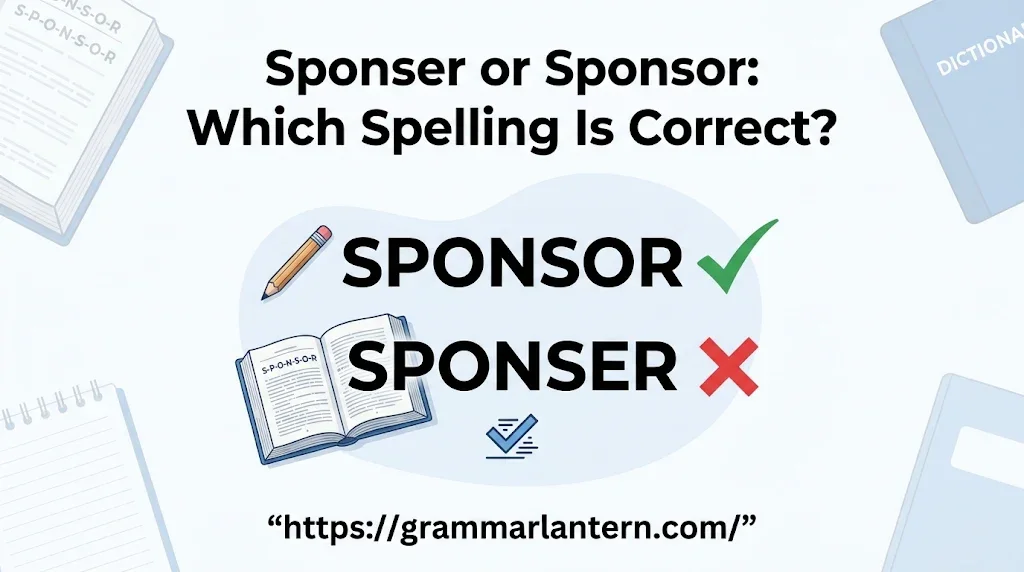
Sponsor is the correct spelling in American English. Sponser is a misspelling and isn’t an accepted alternative in standard written English.
A sponsor can be a person or organization that provides support. The word also works as a verb when someone agrees to support an activity, event, person, or project.
| Word | Correct or Incorrect? | Meaning or Explanation |
| Sponsor | Correct | A person or organization that provides support |
| Sponser | Incorrect | A common misspelling of sponsor |
| Sponsored | Correct | The past tense and past participle of sponsor |
| Sponsoring | Correct | The present participle or gerund form |
| Sponsorship | Correct | The act or arrangement of providing support |
Easy rule to remember: Write sponsor with an o in the final syllable, not an e.
For example:
- Correct: The company will sponsor our school event.
- Incorrect: The company will sponser our school event.
The meaning remains understandable in the incorrect sentence, but the spelling needs correction.
What Does Sponsor Mean?
The word sponsor has two main grammatical uses: it can function as a noun or a verb. In both cases, it relates to providing support, backing, or assistance to someone or something.
The type of support depends on the situation. A business might pay for a sports team’s uniforms, an individual might support a community project, or an organization might help fund an educational program.
Sponsor as a Noun
As a noun, a sponsor is a person, company, organization, or other entity that provides support. That support may involve money, equipment, services, resources, or public backing.
For example, imagine a local business paying for the banners and refreshments at a charity run. The business is a sponsor because it helps make the event possible.
Here are more examples:
- The company became the official sponsor of the annual music festival.
- Each sponsor received a certificate of appreciation.
- A local restaurant served as the team’s main sponsor.
- The event organizers thanked every sponsor during the closing ceremony.
- Our school needs another sponsor for its science fair.
Notice that sponsor identifies the person or organization providing support. It doesn’t describe the support arrangement itself.
Sponsor as a Verb
As a verb, sponsor means to support, fund, or back an activity, person, event, or initiative.
For example, when a company agrees to pay for a neighborhood football tournament, you can say that the company will sponsor the tournament.
Consider these additional sentences:
- A technology company will sponsor the student coding competition.
- Several businesses sponsor local youth sports teams.
- The nonprofit organization plans to sponsor a community education program.
- Our employer agreed to sponsor the conference.
- The university may sponsor a research project next year.
The grammatical role depends on how you use the word in a sentence. However, the spelling never changes to sponser.
Why Is Sponsor the Correct Spelling?
The correct spelling is sponsor, written S-P-O-N-S-O-R. The final syllable contains the letter o, which is the part that writers often confuse with e.
English spelling can be tricky because pronunciation doesn’t always tell you which letters to write. Some vowels sound similar in unstressed syllables, particularly when people speak quickly or casually. That can make a familiar word harder to spell than expected.
However, the standard spelling remains consistent in formal and informal English.
Sponsor Ends With O-R, Not E-R
The easiest way to recognize the error is to compare the final letters.
- Sponsor: The correct spelling ends in -sor.
- Sponser: The incorrect spelling uses -ser instead.
The difference is only one letter, but that small change makes the second form incorrect.
You can remember the distinction by connecting sponsor with its related words, including sponsored and sponsorship. All three preserve the correct spelling of the base word.
For instance:
- Correct: The brand sponsored the concert.
- Correct: The brand announced a new sponsorship agreement.
- Incorrect: The brand announced a new sponser agreement.
A quick spelling check can prevent this mistake from appearing in a document that otherwise looks polished.
Is Sponser an Alternative Spelling?
No. Sponser is a misspelling of sponsor, not a recognized alternative spelling in standard American English.
You might encounter sponser on social media, in informal messages, or in user-generated content. Seeing a spelling repeatedly doesn’t make it correct.
For schoolwork, professional writing, business communication, and published articles, use sponsor. The same spelling is standard in British English as well, so this isn’t a case where American and British English use different forms.
Why Do People Write Sponser Instead of Sponsor?
The mistake usually comes from uncertainty about spelling rather than a difference in meaning. Several habits can make the incorrect form seem plausible.
Confusion About the Final Vowel
English has many words whose pronunciation doesn’t make their spelling immediately obvious. When a vowel appears in an unstressed syllable, writers may struggle to remember which letter belongs there.
Someone who knows the meaning of sponsor but rarely writes it may accidentally substitute e for o. The result looks reasonable at first glance, even though it isn’t correct.
The solution is simple: learn the written form rather than relying on sound alone.
Read More: Sang or Sung: Which Is Correct? Helpful Examples
Typing Too Quickly
Typing errors happen when people focus on the message instead of the individual letters. Because sponser differs from sponsor by only one vowel, a writer might overlook the error during a quick review.
This is especially common in short messages, captions, and online posts. Spell-checking tools can help, but they don’t replace careful proofreading.
Repeated Exposure to Incorrect Spelling
A spelling mistake can spread when people copy text from unreliable websites, social media posts, or old documents. After seeing the same incorrect form several times, a reader may begin to recognize it as familiar.
Familiarity, however, isn’t the same as correctness.
If you aren’t sure about a word, check a reliable dictionary or spelling reference instead of using the most familiar-looking version.
Confusing Related Words
Writers sometimes assume that words with similar meanings follow the same spelling pattern. English doesn’t always work that way.
For example, sponsor, sponsorship, and supporter all relate to assistance, but their endings differ. The correct form depends on the particular word you’re using.
Learning a word together with its common grammatical forms can make these distinctions easier to remember.
Key Differences
The main difference between these two forms is spelling. They aren’t two separate words with different meanings.
| Feature | Sponsor | Sponser |
| Standard spelling | Yes | No |
| Accepted in standard English | Yes | No |
| Used as a noun | Yes | No |
| Used as a verb | Yes | No |
| Suitable for professional writing | Yes | No |
| Correct final vowel | O | E |
If you see sponser in a sentence, the intended word is usually sponsor. You can correct the mistake without changing the sentence’s meaning.
For example:
Incorrect: The school is looking for a sponser for its annual sports day.
Correct: The school is looking for a sponsor for its annual sports day.
The correction changes only the spelling. The sentence still describes a school seeking support for an event.
When Should You Use Sponsor?
Use sponsor whenever you refer to someone who provides support or to the act of providing that support.
Common contexts include:
- Sports: A company sponsors a football team.
- Education: A business sponsors a scholarship program.
- Entertainment: A brand sponsors a music festival.
- Community projects: A local organization sponsors a neighborhood cleanup.
- Business: A company sponsors an industry conference.
- Charity: An individual sponsors a fundraising activity.
In all these situations, sponsor is the correct spelling.
Correct Examples in Sentences
Examples make spelling rules easier to apply because they show how a word works in real contexts. The following sentences illustrate common uses of sponsor in everyday and professional writing.
Sponsor in Business and Marketing
Businesses often sponsor events to build brand awareness, reach an audience, or support a community. The sponsorship might include financial assistance, products, equipment, or promotional services.
Examples:
- The clothing company became the main sponsor of the fashion show.
- Our business plans to sponsor a local entrepreneurship workshop.
- The event’s sponsor provided refreshments for all attendees.
- Several brands sponsor the annual trade exhibition.
In marketing, a sponsor may receive advertising space, a logo placement, or public acknowledgment in return for its contribution. The exact arrangement depends on the agreement between the sponsor and the event organizer.
Sponsor in Sports
Sports sponsorship is another familiar use of the word. Companies may support individual athletes, professional teams, tournaments, or community leagues.
Examples:
- A local company agreed to sponsor the junior cricket team.
- The team’s sponsor paid for its new uniforms.
- Two businesses became sponsors of the regional basketball tournament.
- The club is searching for a new sponsor before the next season.
These examples show how sponsor works as both a noun and a verb.
Sponsor in Education and Community Projects
Schools, colleges, and community groups may seek sponsors to cover expenses or provide resources. A sponsor can help fund educational materials, competitions, workshops, and public programs.
Examples:
- The foundation will sponsor three students at the science competition.
- Our school thanked its sponsors for supporting the annual exhibition.
- A local business offered to sponsor the reading program.
- The community center needs a sponsor for its free training sessions.
A sponsor doesn’t always provide cash. Equipment, supplies, professional services, and other useful resources can also count as support.
Incorrect Examples Using Sponser
The following examples demonstrate how to identify and correct the misspelling.
| Incorrect Sentence | Correct Sentence |
| We need a sponser for the event. | We need a sponsor for the event. |
| The company will sponser our team. | The company will sponsor our team. |
| Our main sponser donated equipment. | Our main sponsor donated equipment. |
| Several sponsers attended the ceremony. | Several sponsors attended the ceremony. |
| The school found a new sponser. | The school found a new sponsor. |
The key is to correct the spelling wherever it appears, including plural forms and related expressions. Changing sponser to sponsors without correcting the vowel would leave the original mistake unresolved.
Sponsor as a Noun vs. a Verb
Although the spelling stays the same, the meaning of sponsor depends on its grammatical role. Recognizing that role helps you build clearer sentences and choose the right word form.
| Example | Part of Speech | Explanation |
| The sponsor donated new computers. | Noun | Identifies the organization providing support |
| The company will sponsor the competition. | Verb | Describes the act of providing support |
| Three sponsors attended the meeting. | Plural noun | Refers to multiple supporting individuals or organizations |
| The company sponsors local events. | Verb | Describes a regular or repeated action |
Consider this example: “The sponsor agreed to sponsor the event.”
The first sponsor is a noun because it identifies the person or organization. The second is a verb because it describes what that person or organization agreed to do.
Although the same word appears twice, each use serves a different grammatical purpose.
Related Words and Correct Spellings
Learning the related forms of sponsor helps you avoid mistakes beyond the original spelling question. These forms appear frequently in business documents, news articles, school assignments, and everyday conversations.
| Word | Part of Speech | Meaning | Example |
| Sponsor | Noun or verb | A supporter or the act of supporting | The company will sponsor the event. |
| Sponsors | Plural noun or verb | Multiple supporters or an action performed by a singular subject | She sponsors local programs. |
| Sponsored | Past tense or past participle | Supported by a sponsor | The company sponsored the tournament. |
| Sponsoring | Present participle or gerund | Providing support | They are sponsoring a school project. |
| Sponsorship | Noun | The act, arrangement, or relationship involving a sponsor | The sponsorship covered the equipment costs. |
Sponsor and Sponsors
Use sponsor for one supporting person or organization. Use sponsors when referring to more than one.
- Singular: The sponsor attended the ceremony.
- Plural: The sponsors attended the ceremony.
- Verb: The organization sponsors educational programs.
Notice the difference in the third example. When the subject is a singular third-person noun, the present-tense verb takes an s.
Sponsored
Sponsored is the simple past tense and past participle of sponsor.
Use it when describing an action that happened previously or an activity that received support.
Examples:
- The company sponsored the event last year.
- The sponsored program provided free training.
- The school has sponsored several competitions.
The spelling retains the original o. It doesn’t become sponsered.
Sponsoring
Sponsoring describes an ongoing action or can function as a noun-like gerund.
Examples:
- The business is sponsoring a community festival.
- Sponsoring young athletes can help expand access to sports.
- The company announced that it was sponsoring the conference.
Remember that the correct form is sponsoring, not sponsering.
Sponsorship
Sponsorship refers to the support arrangement or the act of sponsoring. It’s a noun rather than a verb.
For example, a company might sign a sponsorship agreement with a sports club. The agreement explains what each party will provide and what the arrangement includes.
Other examples include:
- The school secured a sponsorship for its annual science fair.
- The festival depends on corporate sponsorship.
- The organization announced a new sponsorship agreement.
A simple distinction helps: a sponsor provides support, while sponsorship describes the supporting arrangement or relationship.
How to Remember the Correct Spelling
Spelling becomes easier when you use a simple memory aid instead of trying to recall every letter separately.
Remember the O in Sponsor
The most direct trick is to memorize this phrase:
Sponsor has an O, not an E.
Whenever you hesitate between sponser and sponsor, recall the correct final syllable. This small reminder can prevent the most common mistake.
Learn the Word Family Together
Don’t memorize sponsor in isolation. Practice it alongside sponsored, sponsoring, and sponsorship.
These related forms reinforce the same spelling pattern. Once you recognize the shared base, you’re less likely to substitute the wrong vowel when writing a longer word.
For example:
- Sponsor a project.
- Sponsored a project.
- Sponsoring a project.
- Sponsorship of a project.
The wording changes, but the original spelling pattern remains recognizable.
Use a Quick Proofreading Check
If you write the word regularly, make it part of your proofreading routine.
Before submitting an assignment, publishing an article, or sending a business proposal, check for these common errors:
- Sponser instead of sponsor.
- Sponsers instead of sponsors.
- Sponsered instead of sponsored.
- Sponsering instead of sponsoring.
A spell-checking tool may flag these errors, depending on the software and context. However, reading your writing carefully remains useful because automated tools don’t catch every mistake.
A Practical Example: Correcting Sponsor in a Business Proposal
Imagine that a school is preparing a proposal asking local businesses to support its annual science fair. The proposal includes this sentence:
“Our school is looking for a reliable sponser to help provide laboratory materials and prizes for students.”
The intended meaning is clear, but the spelling error makes the proposal look less polished.
A corrected version reads:
“Our school is looking for a reliable sponsor to help provide laboratory materials and prizes for students.”
Now consider the related wording:
“We welcome businesses interested in sponsoring the event. Each sponsor will receive recognition in the event program.”
Both sponsoring and sponsor are spelled correctly. The revised wording also communicates the request more professionally.
This example illustrates an important point: a single spelling error doesn’t change the underlying meaning, but it can distract readers from the message. Correct spelling helps your writing appear careful and credible.
Read More: 20 Best Replies to “Grow Up” Funny Comebacks
FAQs
1. Is it sponser or sponsor?
Sponsor is the correct spelling in standard English. Sponser is a misspelling and should not be used in formal or informal writing. For example, “The company will sponsor the local football tournament.”
2. What does sponsor mean?
A sponsor is a person, company, or organization that supports someone or something, often by providing money, resources, or assistance. For example, a business might sponsor a school event or a sports team.
3. Why do people spell sponsor as sponser?
People often write sponser because the final vowel in sponsor can sound similar to the letter e in quick conversation. This pronunciation confusion leads to spelling mistakes, especially when typing without checking.
4. Is sponsor correct in American and British English?
Yes, sponsor is the correct spelling in both American and British English. Unlike some words that have different regional spellings, this word does not change between the two varieties.
5. What is the plural of sponsor?
The plural of sponsor is sponsors. Add an s to refer to more than one sponsor. For example, “Several sponsors contributed money to the charity event.”
6. What is the past tense of sponsor?
The past tense of sponsor is sponsored. For example, “The company sponsored a community fundraiser last year.” The present participle is sponsoring.
7. Is sponsor a noun or a verb?
Sponsor can function as both a noun and a verb. As a noun, it refers to someone who provides support. As a verb, it describes the act of providing that support. For example, “The sponsor agreed to sponsor the event.”
8. How can I remember the correct spelling of sponsor?
A simple trick is to remember the word sponsor as it appears in familiar phrases such as “official sponsor” or “event sponsor.” Practice writing these phrases a few times to reinforce the correct spelling.
9. Can I use sponser in professional writing?
No. Sponser is not the standard spelling, so avoid using it in resumes, business emails, marketing materials, and professional proposals. Always write sponsor to keep your communication clear and polished.
10. What are some synonyms for sponsor?
Depending on the context, synonyms for sponsor include supporter, backer, patron, financier, and funding provider. These words have slightly different meanings, so choose the one that best describes the type of support being offered.
Conclusion
When choosing between sponser vs sponsor, remember that sponsor is the only correct standard spelling. Although sponser may seem reasonable because of how the word sounds, it is still a spelling mistake. Using the correct form helps you communicate clearly and maintain a professional writing style.
Whether you’re writing a business email, preparing a school assignment, or discussing a sponsored event, take a moment to check your spelling. Remember the word sponsor, practice using it in sentences, and you’ll be less likely to make this common mistake.