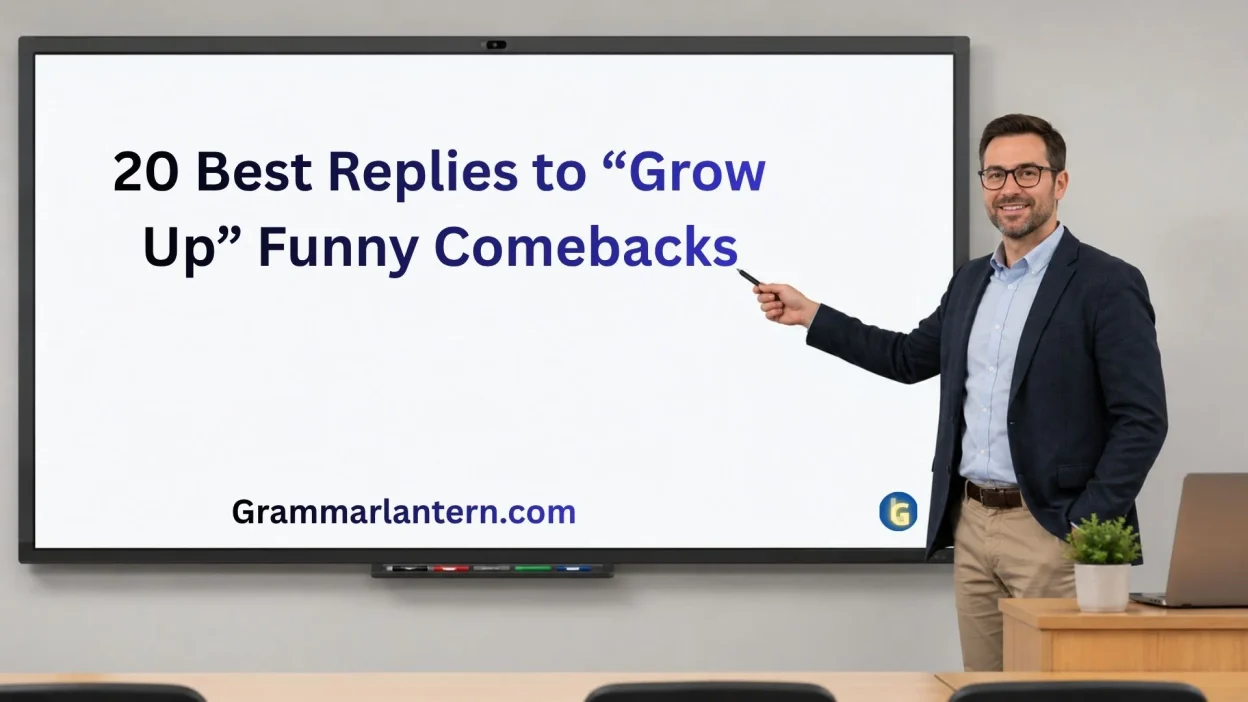
Being told to “grow up” can feel annoying, especially when someone uses it to criticize your behavior or dismiss your opinion. The right comeback can turn an awkward moment into a laugh or help you stand your ground without starting an argument.
The 20 best replies to “grow up” give you plenty of ways to respond with humor, confidence, and maturity. Whether you’re chatting with friends, dealing with coworkers, or responding to strangers online, your words can make a difference. A witty line like “Growing up doesn’t mean losing my personality!” keeps things light while showing that you’re comfortable being yourself.
However, not every situation calls for a joke. Sometimes, a calm and respectful response works better, especially during disagreements or professional conversations. True maturity means knowing when to laugh, when to speak up, and when to walk away. With the right words, you can protect your boundaries, express your feelings, and remind others that being an adult doesn’t mean taking life too seriously.
Quick Answer
The best replies to “grow up” are short, clever, and suited to the situation. If someone says it jokingly, respond with humor. If they’re trying to insult you, choose a confident answer that doesn’t invite more drama.
Here are five excellent options:
- “I’m growing up, not growing boring.”
- “I’ll consider it when you start making sense.”
- “Being an adult doesn’t mean losing your sense of humor.”
- “Thanks for the advice. Do you offer wisdom, too?”
- “Maturity means knowing when not to argue.”
For friendly teasing, use a playful comeback. For a rude comment, stay composed and set a boundary. You don’t have to turn every remark into a battle.
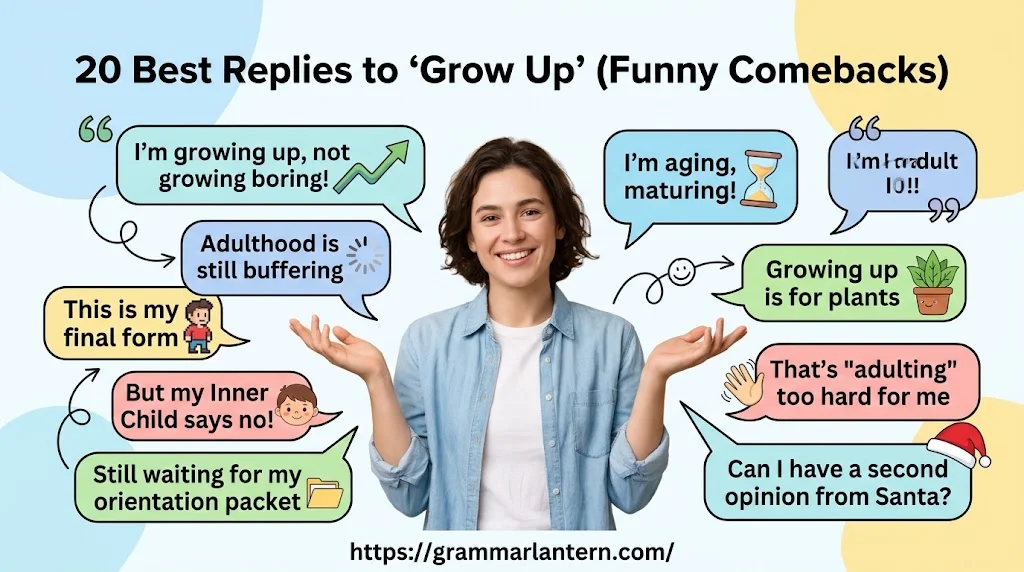
20 Best Replies to “Grow Up” (Funny Comebacks)
These 20 replies cover different situations, from joking with friends to handling someone who’s being unnecessarily rude. Choose one that fits your personality and the conversation.
Funny Replies
Humor is often the easiest way to handle this comment. A funny answer changes the mood without making the conversation feel like a serious confrontation.
1. “I’m growing up, not growing boring.”
This reply works when someone thinks being mature means giving up fun. It reminds them that responsibility and humor can exist together.
2. “I’m still waiting for the instruction manual.”
This comeback makes growing up sound like a complicated project. It’s especially effective with friends who enjoy playful conversations.
3. “Sorry, my inner child is having a great day.”
Use this response when you’re being silly, laughing loudly, or enjoying something others consider childish. It shows that you don’t feel embarrassed about having fun.
4. “I tried, but adulthood had terrible reviews.”
This line turns the pressure to act mature into a joke about adult life. It’s a good choice when everyone understands the humor.
5. “I’ll grow up when they release the next update.”
Comparing maturity to a software update makes the reply sound playful and modern. It works well in text messages and casual online conversations.
Sarcastic Comebacks
Sarcasm adds a sharper edge to your response. Use it when someone sounds condescending or acts as though their opinion is the only reasonable one.
6. “Thanks. I’ll add that to my list of unsolicited advice.”
This response points out that the other person offered advice you didn’t request. It sounds confident without becoming openly insulting.
7. “I’ll take that under advisement.”
This short reply sounds formal enough to be funny. Its humor comes from treating a casual remark as if it were an official recommendation.
8. “And here I thought we were having a conversation.”
Choose this response when someone dismisses your point instead of discussing it. It redirects attention to how they’re communicating.
9. “That’s a bold opinion from someone giving unsolicited life lessons.”
This comeback works when someone repeatedly lectures you about maturity. It highlights the irony without attacking their appearance, background, or personal life.
10. “I’ll work on that right after you work on your manners.”
Use this line when the comment itself is disrespectful. It reminds the other person that maturity includes treating people well.
Short and Savage Replies
Sometimes, one sentence is enough. These replies are direct and memorable, making them useful when you don’t want to explain yourself.
11. “You first.”
This classic comeback is brief and pointed. It works best when the other person is behaving immaturely while criticizing you.
12. “Define mature.”
This question challenges the assumption behind the comment. Someone who uses “grow up” to dismiss harmless behavior may struggle to explain what they actually mean.
13. “I’m good, thanks.”
Not every comeback needs sarcasm. This response shows that you heard the remark without accepting the judgment.
14. “Maturity isn’t a competition.”
Use this when someone seems determined to prove they’re better than you. It shifts the focus from superiority to personal growth.
15. “I don’t need your permission to be myself.”
This confident reply works when someone criticizes your personality, hobbies, or harmless sense of humor. It establishes independence without inviting a personal attack.
Read More: Plaque vs. Plack: Meaning, Spelling, and Examples
Smart and Classy Responses
A classy comeback lets you defend yourself without lowering the tone of the conversation. These responses are especially useful at work, around family, or with people you don’t know well.
16. “Being mature doesn’t mean taking everything seriously.”
This response challenges a common misunderstanding about adulthood. You can take your responsibilities seriously while still enjoying jokes, games, and silly moments.
17. “I believe maturity includes respecting different personalities.”
People express themselves in different ways. This answer reminds the other person that being mature doesn’t require everyone to behave identically.
18. “I can be responsible and still have fun.”
This is a straightforward response when someone mistakes playfulness for irresponsibility. It separates your personality from your ability to handle important tasks.
Playful and Flirty Replies
When someone you like teases you, a lighthearted answer can keep the conversation fun. These replies work best when both people are comfortable with the flirting.
19. “Only if you promise to make adulthood interesting.”
This playful response invites the other person to continue the banter. It adds a little flirtation without putting too much pressure on the conversation.
20. “Why? Are you volunteering to teach me?”
This comeback turns the comment into a teasing question. Use it when you already share a playful connection with the other person.
Remember that delivery matters. A line that makes a close friend laugh might sound rude to a coworker or stranger. Choose your words based on the relationship, the setting, and the other person’s tone.
Replies to “Grow Up” in Text Messages
Text messages remove facial expressions and vocal cues. As a result, a joke can sometimes sound harsher than you intended.
If someone tells you to grow up over text, keep your response short and easy to understand. Avoid sending a long paragraph when one sentence can do the job.
Here are a few options:
- Funny: “Adulthood is still buffering.”
- Playful: “I’m keeping life interesting.”
- Sarcastic: “Thanks for your very official recommendation.”
- Confident: “I know how to have fun and handle my responsibilities.”
- Calm: “What exactly do you mean by that?”
Emojis can help clarify your tone when you’re joking with someone who knows you well. However, you don’t need to add one to every message.
For example, “You first 😂” may feel playful between friends. The same words without an emoji could sound more confrontational in an unfamiliar conversation.
A useful rule: If your message could easily be misunderstood, choose clearer wording instead of relying on the reader to guess your tone.
Replies on Social Media
Social media comments often reward quick reactions. Someone might leave “grow up” under a joke, video, opinion, or personal post simply because they disagree with you.
You can respond without turning the comment section into an argument.
Consider these options:
- “Thanks for stopping by with that opinion.”
- “Different personalities exist. It’s okay.”
- “It’s a joke, not a maturity test.”
- “You can disagree without making it personal.”
- “Not every post needs to be serious.”
Before replying, consider what you want to achieve. If you’re exchanging jokes with a friend, a witty comeback may add to the conversation. If a stranger is trying to provoke you, responding may only give them more attention.
You also don’t have to answer every comment. Muting, blocking, or ignoring someone can be more useful than trading insults, especially when the discussion becomes repetitive.
Mature Responses That End the Conversation
Sometimes, the smartest response is one that closes the discussion. This approach is useful when someone keeps criticizing you, refuses to listen, or turns every disagreement into a personal attack.
Try these replies:
- “You’re entitled to your opinion.”
- “We clearly see this differently.”
- “I’m comfortable with who I am.”
- “Let’s leave it there.”
- “I don’t think this conversation is going anywhere.”
These statements don’t require the other person to agree with you. They simply establish that you’re not interested in continuing an unproductive exchange.
For example, imagine a coworker tells you to grow up because you make a harmless joke during a break. You could respond, “I can be professional when it matters and still enjoy a joke.” If the coworker continues arguing, you can end the discussion rather than defending your personality all afternoon.
That response demonstrates a practical form of maturity: knowing when a conversation deserves your time and when it doesn’t.
What Does “Grow Up” Really Mean?
The phrase “grow up” usually means that someone should behave more maturely, responsibly, or sensibly. However, its meaning depends heavily on the situation.
A parent might use it to encourage a teenager to take responsibility. A friend might say it jokingly after a silly prank. During an argument, someone might use the same words to dismiss another person’s feelings or opinion.
Consider these examples:
| Situation | What “Grow Up” May Mean |
| A friend laughs at your silly joke | Stop being so playful |
| A parent discusses responsibilities | Act more responsibly |
| Someone dismisses your opinion | Stop behaving in a way I dislike |
| A partner argues about a disagreement | Handle the conflict more constructively |
| A stranger comments online | An attempt to criticize or provoke you |
The phrase isn’t automatically an insult. Sometimes it expresses genuine frustration or concern. In other situations, it can sound patronizing because it judges your behavior without explaining what needs to change.
The important distinction is between constructive feedback and personal criticism. Someone who wants to help will usually explain the problem. Someone who simply wants to put you down may rely on vague remarks instead.
How to Choose the Right Comeback
The best response depends on more than the words themselves. Your relationship with the speaker, their tone, and the setting all influence which comeback will work.
Consider Who Said It
A close friend gives you more room for playful sarcasm than a supervisor or unfamiliar person.
- Friends: Use jokes, silly comparisons, and playful teasing.
- Family members: Respond calmly if the comment reflects a genuine disagreement.
- Partners: Keep the conversation respectful and explain what bothered you when necessary.
- Coworkers: Prefer professional, composed responses.
- Strangers online: Keep it brief or disengage if they seem determined to provoke you.
Match Your Response to Their Tone
If someone laughs while saying “grow up,” they may be inviting playful banter. A sharp response could turn a harmless moment into an argument.
However, if the person sounds angry or repeatedly belittles you, a sarcastic comeback may make the situation worse. A direct boundary is often more effective.
Don’t Confuse Confidence With Insults
A strong comeback doesn’t need to attack someone’s intelligence, appearance, or personal circumstances.
Compare these responses:
| Less helpful response | Better alternative |
| “You’re an idiot.” | “You don’t have to agree with me.” |
| “Look who’s talking.” | “Let’s focus on the actual issue.” |
| “Nobody asked you.” | “I didn’t ask for advice, but thanks.” |
| “You’re the immature one.” | “Maturity means respecting different perspectives.” |
The better alternatives let you defend yourself without turning the conversation into a contest over who can be more insulting.
What Does Maturity Actually Look Like?
Maturity isn’t about eliminating humor, avoiding games, or acting serious every minute. It involves handling responsibilities, managing emotions, respecting boundaries, and recognizing how your behavior affects others.
A person can love cartoons, make silly jokes, enjoy video games, and still be dependable. Likewise, someone can speak formally and appear serious while treating others poorly.
The difference becomes clearer in everyday situations.
Imagine two people receive criticism. One immediately responds with insults and tries to win the argument. The other asks what the criticism means, considers whether it has merit, and responds calmly.
The second person demonstrates a more constructive approach because they can manage their reaction without surrendering their own point of view.
That doesn’t mean you should accept every criticism. You can disagree, defend yourself, and set boundaries. The goal is to respond thoughtfully rather than letting someone else’s remark control your behavior.
Read More: Check-In or Check In? Meaning, Differences, and Examples
FAQs
1. What is the best reply to “grow up”?
A good reply is, “Growing up doesn’t mean losing my personality!” It sounds confident, keeps the conversation light, and reminds the other person that maturity doesn’t require you to stop having fun.
2. What is a funny comeback to “grow up”?
Try saying, “I would, but adulting looks expensive!” This playful response can make people laugh without turning a casual conversation into an argument.
3. How do you respond to “grow up” sarcastically?
You could say, “Thanks for the advice, Professor Maturity!” It adds a little sarcasm while keeping the exchange humorous. Use it with people who understand your sense of humor.
4. How do you reply to “grow up” without being rude?
Keep your response calm and straightforward. For example, say, “I think I can be mature and still enjoy myself.” This communicates your point without insulting the other person.
5. What should you say when a friend tells you to grow up?
If your friend is joking, respond with something playful, such as, “Only after I finish having fun!” If they genuinely criticize you, ask what behavior bothers them instead of assuming their intentions.
6. How do you respond when a coworker tells you to grow up?
Stay professional and avoid trading insults. You might say, “Let’s focus on the issue rather than making personal comments.” This response sets a boundary and keeps the conversation productive.
7. What is a confident response to “grow up”?
Try, “Being mature doesn’t mean I have to be someone I’m not.” It shows self-confidence without suggesting that you refuse to take responsibility for your actions.
8. How do you respond to “grow up” in a text message?
Short replies work best in text conversations. You could send, “Still growing, still glowing!” or “Maturity loading… please wait.” Both options add humor without requiring a lengthy explanation.
9. Is it better to ignore someone who tells you to grow up?
Sometimes, yes. If someone is trying to provoke you, ignoring the comment can prevent unnecessary drama. However, if the remark is disrespectful or affects your relationship, a calm response may help resolve the issue.
10. How can you tell someone to grow up politely?
Focus on the behavior rather than attacking the person’s character. For example, say, “I think we should handle this more responsibly.” This wording encourages maturity without sounding unnecessarily judgmental.
Conclusion
Knowing how to respond to “grow up” can help you handle criticism without losing your cool. A funny comeback can lighten the mood, while a confident or respectful reply can help you establish boundaries. The best response depends on who’s speaking, what they mean, and how the conversation unfolds.
Remember, growing up doesn’t mean abandoning your personality, sense of humor, or love of fun. Real maturity comes from taking responsibility, respecting others, and knowing when a conversation deserves your attention. Choose a reply that fits the moment, stay true to yourself, and don’t feel pressured to prove your maturity to everyone.