
Have you ever wondered whether steers or stear is the correct spelling? These two words look similar, so it’s easy to mix them up when writing. However, only steers is the correct spelling in standard English, while stear is generally considered a misspelling. Understanding this difference helps you avoid mistakes in everyday writing, school assignments, emails, and professional communication.
The word steers has several meanings depending on the context. It can describe guiding a vehicle, directing someone toward a particular decision, or referring to male cattle. For example, you might steer a car down a narrow road or steer a conversation toward an important topic. Each meaning follows the same standard spelling.
In this guide, you’ll learn the difference between steers and stear, their meanings, grammatical uses, and practical examples. You’ll also discover common spelling mistakes, easy memory tricks, and helpful tips to remember the correct word. By the end, you’ll feel confident using steers correctly in your writing.
Quick Answer
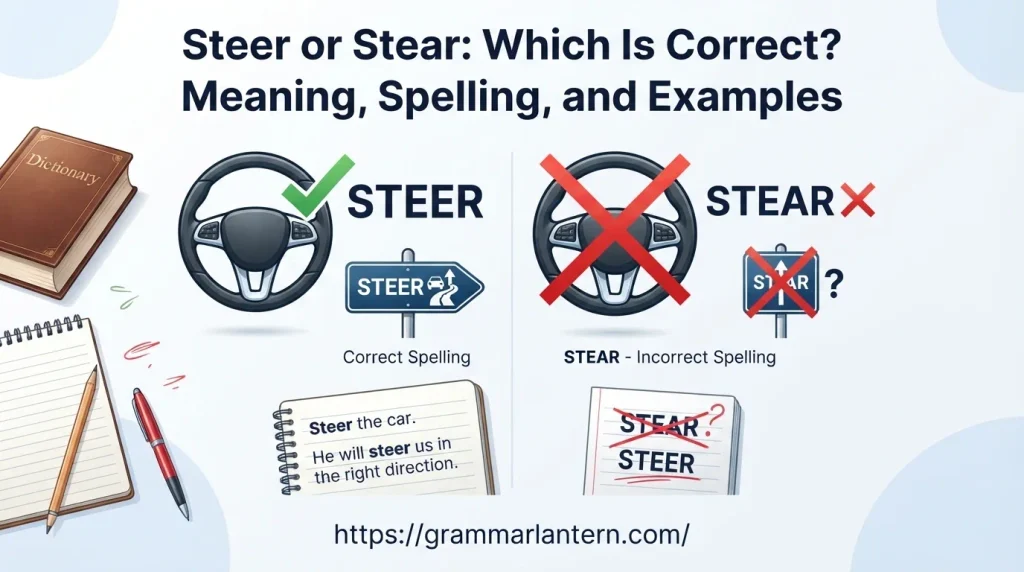
Steer is correct, while stear is generally incorrect in standard modern English.
The word steer works as both a verb and a noun. As a verb, it means to guide, direct, or control the movement or course of something. As a noun, it refers to a male bovine that has been castrated, commonly raised for beef.
| Word | Correctness | Meaning | Example |
| Steer | Correct | Guide, direct, or control something; also a type of cattle | She learned to steer the boat. |
| Stear | Incorrect for ordinary usage | Common misspelling of steer | She learned to stear the boat. (Incorrect) |
If you’re writing about driving, navigation, leadership, decision-making, or cattle, use steer. The spelling stear doesn’t replace it in standard everyday English.
What Does Steer Mean?
The word steer has several meanings depending on how you use it. It can describe controlling movement, guiding someone toward a decision, or referring to a type of cattle. Understanding the context makes the meaning easy to recognize.
Steer as a Verb
As a verb, steer means to guide, direct, or control the movement or course of something. You often use it when operating a vehicle or helping something move in a particular direction.
For example, a driver steers a car by turning the steering wheel. A boat operator steers a vessel by controlling its rudder or steering system. The word also applies to bicycles, motorcycles, aircraft, and other vehicles.
Here are some examples:
- The driver steered the car around the fallen tree.
- She steers her bicycle carefully through crowded streets.
- The captain steered the boat toward the harbor.
- He steered the truck away from the damaged bridge.
- The pilot steered the aircraft toward the runway.
In each sentence, steer describes controlling direction or movement. The word doesn’t necessarily mean moving something forward. It specifically emphasizes choosing or controlling the direction.
Steer as a Noun
The word steer also functions as a noun. It refers to a male bovine animal that has been castrated, often raised for beef production.
In farming and ranching, the word appears in conversations about livestock, animal care, meat production, cattle auctions, and pasture management. A steer is different from a bull because a bull remains an intact male.
For example:
- The rancher raised several steers for beef production.
- A steer grazed quietly near the fence.
- The farmer purchased two steers at the livestock auction.
- The cattle handler moved the steers into another pasture.
The plural form is steers. You don’t need to change the spelling when referring to more than one animal.
| Singular | Plural | Example |
| Steer | Steers | The ranch has twelve steers. |
The noun and verb share the same spelling. Their meanings become clear from the surrounding words.
Steer in Figurative Language
You don’t always need a vehicle or an animal to use steer. English speakers frequently use it figuratively to describe guiding decisions, influencing behavior, or directing the progress of something.
For example, a manager might steer a team toward a solution. A teacher might steer students toward reliable information. A friend might steer someone away from a poor decision.
Consider these sentences:
- The manager steered the meeting toward the main issue.
- Her advice helped steer me toward a better career.
- The coach steered the team through a difficult season.
- We need to steer the conversation away from personal arguments.
- The company steered its strategy toward sustainable growth.
These examples describe influence rather than physical movement. Someone helps determine the direction of an action, discussion, decision, or situation.
This figurative meaning makes steer particularly useful in professional and academic writing. It sounds natural when discussing leadership, planning, communication, decision-making, and problem-solving.
What Does Stear Mean?
Stear isn’t the standard modern spelling of the everyday word steer. If you write stear when you mean guide, direct, or control, your sentence contains a spelling error.
For example:
- Incorrect: She tried to stear the conversation toward business.
- Correct: She tried to steer the conversation toward business.
The mistake often happens because writers remember the sound but not the spelling. Since English contains many words with ea, such as fear, near, and clear, someone might mistakenly choose those letters.
However, modern standard English uses steer for the ordinary verb and cattle-related noun.
Read More: Sneek or Sneak: Which Spelling Is Correct?
Is Stear Ever a Real Word?
There is an important historical detail worth knowing. Stear has appeared as an obsolete spelling of steer in older English texts. Historical spellings weren’t always consistent with today’s standards.
You may find older documents, literary works, or historical dictionaries that record forms such as stear or steare. Their presence in historical writing doesn’t make them acceptable replacements in contemporary everyday English.
The letter sequence stear- also appears in scientific vocabulary connected with stearic acid and related substances. For instance, stearate is a scientific term used in chemistry.
These specialized forms are different from the ordinary verb steer.
| Context | Correct usage |
| Modern everyday English | Steer |
| Historical or obsolete spelling | Stear may appear in old records |
| Scientific vocabulary | Stear- appears in words such as stearate |
| Modern sentence about guidance | Use steer |
Therefore, the safest choice for emails, school assignments, blog posts, reports, business writing, and everyday messages is steer.
Key Differences
The primary difference between steer and stear is their status in modern English. Steer is the standard spelling, while stear is generally an obsolete form or an incorrect spelling in ordinary sentences.
| Feature | Steer | Stear |
| Standard modern spelling | Yes | No, not for ordinary usage |
| Common part of speech | Verb and noun | Historical obsolete form |
| Verb meaning | Guide, direct, or control | No standard modern everyday meaning |
| Noun meaning | A castrated male bovine | Not the standard cattle spelling |
| Modern usage | Common | Rare in ordinary writing |
| Professional writing | Correct | Incorrect when intended as steer |
| Example | Steer the car carefully. | Stear the car carefully. (Incorrect) |
Why the Difference Matters
Spelling mistakes can distract readers even when they understand your intended meaning. In professional communication, academic work, articles, and public content, standard spelling helps your writing appear polished.
Imagine reading this instruction in a driving manual:
“Always stear away from obstacles when driving.”
The meaning is clear, but the spelling looks incorrect. Readers may notice the mistake before they focus on the safety advice.
The corrected sentence is:
“Always steer away from obstacles when driving.”
The correct spelling helps the sentence look reliable and professional.
When to Use Steer
You can use steer in several everyday situations. Its meaning changes slightly depending on whether you’re describing physical movement, guidance, leadership, or livestock.
When Driving or Controlling a Vehicle
Use steer when directing a vehicle’s movement. It works with cars, bicycles, motorcycles, boats, trucks, and other forms of transportation.
Examples:
- Steer the car slowly around the corner.
- He steered the motorcycle through heavy traffic.
- The driver steered away from the pothole.
- She steered the boat toward the dock.
- The cyclist steered around a group of pedestrians.
The word emphasizes control over direction. You might accelerate to increase speed or brake to slow down, but you steer to determine where the vehicle goes.
When Guiding Someone
You can also use steer when helping someone choose a direction or make a decision. This meaning often appears in conversations about education, careers, personal choices, and advice.
Examples:
- My teacher steered me toward a useful writing course.
- Her parents steered her toward a career in medicine.
- The counselor steered students toward scholarship opportunities.
- His mentor steered him away from unnecessary risks.
In these examples, nobody physically moves another person. Instead, they provide guidance or influence a choice.
When Managing a Project or Conversation
The figurative meaning of steer is especially common in workplaces. Leaders often steer teams, projects, meetings, discussions, and business plans toward particular goals.
Examples:
- The director steered the project toward completion.
- She steered the discussion back to the main topic.
- Our manager steered the team through a challenging deadline.
- The CEO steered the company toward a new market.
- He steered the negotiations toward a practical agreement.
This usage suggests leadership without necessarily implying complete control. A person may guide a situation while other people still contribute ideas and make decisions.
Example Sentences
The following examples show common spelling mistakes and their correct versions. Pay attention to how steer appears in different sentence structures.
| Incorrect Sentence | Correct Sentence |
| Please stear the car to the left. | Please steer the car to the left. |
| She tried to stear the boat away from the rocks. | She tried to steer the boat away from the rocks. |
| We need to stear the discussion back to the topic. | We need to steer the discussion back to the topic. |
| The farmer bought five stears. | The farmer bought five steers. |
| He stears the team toward better results. | He steers the team toward better results. |
| They steared the vehicle through the narrow road. | They steered the vehicle through the narrow road. |
| I am stearing the project in a new direction. | I am steering the project in a new direction. |
The correct form doesn’t change based on the sentence’s meaning. Whether you’re talking about driving, leadership, or livestock, use the standard spelling steer and its correct grammatical forms.
Common Mistakes
Writers sometimes confuse steer with other words or use incorrect forms of its verb. Learning these common mistakes can help you catch them before publishing.
Using Stear Instead of Steer
This is the most common mistake when comparing steer or stear. People sometimes replace the double E with EA because both combinations appear in English words.
However, the correct spelling remains steer.
- Incorrect: Can you stear me toward the nearest exit?
- Correct: Can you steer me toward the nearest exit?
- Incorrect: He tried to stear clear of the argument.
- Correct: He tried to steer clear of the argument.
Remember that steer is the standard modern spelling for these expressions.
Writing Steared Instead of Steered
Another mistake involves the past tense. Since some writers mistakenly use stear, they may also write steared instead of steered.
The correct past tense and past participle are both steered.
| Incorrect Form | Correct Form |
| Steared | Steered |
| Stearing | Steering |
| Stears | Steers |
Examples:
- Incorrect: She steared the car into the parking space.
- Correct: She steered the car into the parking space.
- Incorrect: They are stearing the company through a difficult period.
- Correct: They are steering the company through a difficult period.
The standard forms always retain the double E.
Confusing Steer With Stir
Steer and stir look similar but have different meanings. They also describe different actions.
Steer means guide, direct, or control a course. Stir means mix something by moving it around or cause activity or emotion.
| Word | Meaning | Example |
| Steer | Guide or direct | He steered the boat toward the shore. |
| Stir | Mix or agitate | She stirred the soup with a spoon. |
More examples help make the distinction clear:
- Steer the car into the driveway.
- Stir the sugar into the coffee.
- The manager steered the discussion toward the budget.
- The announcement stirred excitement among employees.
If you are directing something toward a destination or outcome, use steer. If you’re mixing ingredients or creating movement within something, use stir.
Confusing Steer With Stare or Stair
These words share some letters but have different meanings and uses.
| Word | Meaning | Example |
| Steer | Guide or direct | He steered the vehicle carefully. |
| Stare | Look at something for a long time | Don’t stare at strangers. |
| Stair | One step in a staircase | She climbed the last stair. |
A quick spelling check can prevent these words from slipping into the wrong sentence. Their meanings are unrelated, so context usually makes the correct choice obvious.
Steer Word Forms and Grammar
The verb steer follows regular English verb patterns. You can change its form to match the tense, subject, or sentence structure.
| Word Form | Grammatical Use | Example |
| Steer | Base form | I steer the boat. |
| Steers | Third-person singular present | She steers the car. |
| Steered | Simple past | He steered us home. |
| Steered | Past participle | They have steered the project well. |
| Steering | Present participle or gerund | Steering requires concentration. |
| Steer | Singular noun | The steer grazed in the field. |
| Steers | Plural noun | The ranch raises several steers. |
Present Tense
Use steer with I, you, we, and they. Use steers with he, she, or it.
- I steer the vehicle carefully.
- They steer the boat together.
- She steers the car through traffic.
- He steers the team toward success.
Past Tense
The simple past form is steered.
- The driver steered around the obstacle.
- She steered the conversation toward a solution.
- They steered the boat into the harbor.
Present Participle
The present participle is steering. You can use it in continuous tenses or as a noun.
- He is steering the truck.
- They are steering the project toward completion.
- Steering through heavy traffic requires patience.
Past Participle
The past participle is also steered. It appears in perfect tenses and passive constructions.
- She has steered the company through several changes.
- They had steered the boat safely before sunset.
- The vehicle was steered away from the danger zone.
Notice that the spelling doesn’t become stear, steared, or stearing. The correct forms are steer, steers, steered, and steering.
Synonyms and Antonyms
The best synonym for steer depends on the context. Some words describe physical navigation while others express guidance or influence.
Synonyms of Steer
When steer means guiding or directing movement, you can use:
- Guide: Help something or someone follow a direction.
- Direct: Control or point toward a particular course.
- Navigate: Find or follow a route.
- Pilot: Operate or guide a vehicle.
- Maneuver: Move or control something skillfully.
- Lead: Show the way or take charge.
- Control: Manage movement or behavior.
Examples:
- She guided the visitors through the building.
- The captain navigated the ship through rough water.
- He directed the vehicle toward the entrance.
- The pilot maneuvered the aircraft around the storm.
When steer means influencing a decision or outcome, consider these synonyms:
- Influence
- Advise
- Shape
- Encourage
- Channel
- Guide
For example, “The mentor steered him toward a better career” could become “The mentor guided him toward a better career.”
However, these synonyms aren’t interchangeable in every sentence. You can navigate a ship but wouldn’t normally navigate a conversation in the same way you’d steer it.
Antonyms of Steer
The antonyms of steer mainly apply to its verb meaning.
| Antonym | Meaning | Example |
| Misguide | Lead someone in the wrong direction | False information misguided the travelers. |
| Misdirect | Direct something incorrectly | The sign misdirected visitors. |
| Disorient | Make someone confused about direction | The sudden turn disoriented him. |
There isn’t a natural direct antonym for steer when it refers to cattle. These opposites relate to the action of guiding or directing.
Common Expressions
Several everyday expressions use steer. These phrases are especially useful in conversation, workplace communication, and informal writing.
Steer Clear Of
The expression steer clear of means avoid someone, something, or a situation. It can refer to physical danger, unwanted behavior, arguments, trouble, or uncomfortable circumstances.
Examples:
- Steer clear of that damaged road.
- I try to steer clear of office gossip.
- You should steer clear of unnecessary arguments.
- She steered clear of unhealthy habits.
- They decided to steer clear of the crowded area.
The expression suggests deliberately choosing a safer or more suitable path.
Steer in the Right Direction
This phrase means helping someone make a good decision or find a suitable path.
Examples:
- My teacher steered me in the right direction.
- The career counselor steered her toward useful training.
- His advice helped steer us in the right direction.
- A good mentor can steer young professionals toward better opportunities.
You don’t need to make a decision for someone to use this expression. You can simply offer information, advice, or support that helps them choose wisely.
Steer Someone Toward Something
Use this expression when someone guides another person toward an option, opportunity, choice, or idea.
Examples:
- The librarian steered me toward useful research books.
- Her friend steered her toward a reliable mechanic.
- The counselor steered students toward scholarship programs.
- The manager steered the team toward a practical solution.
The phrase often describes gentle influence rather than force. Someone offers direction while the other person remains free to choose.
Steer Away From
This expression means guide or move something away from a particular direction, topic, or situation.
Examples:
- The driver steered away from the pothole.
- She steered the conversation away from politics.
- We steered the project away from unnecessary expenses.
- He steered his children away from dangerous activities.
It works in both literal and figurative contexts.
How to Remember the Correct Spelling
Spelling becomes easier when you connect a word with a simple memory trick. For steer, the easiest method is remembering its two E’s.
Use the Double-E Rule
The word steer contains two E’s. Think of them as two eyes looking toward the correct direction.
Whenever you guide something, remember:
Keep both E’s when you steer.
This small reminder can help you avoid writing stear by mistake.
Connect the Word With a Steering Wheel
Think about a car’s steering wheel. You turn the wheel to direct the vehicle where you want it to go.
The word steer has the same double-E spelling. Connecting the word with a familiar object makes the spelling easier to remember.
Remember the Correct Verb Forms
Memorize this short sequence:
Steer → Steers → Steered → Steering
All four forms use the correct E spelling. When you’re unsure about a sentence, check this pattern before writing.
Is Stear Ever Correct?
Yes, but only in limited contexts. Saying stear never appears anywhere in English would be too broad.
Historical records contain stear as an obsolete spelling of steer. Older English writing sometimes used spellings that differ from modern standards. These forms may appear in old books, manuscripts, historical dictionaries, or quotations.
The scientific combining form stear- also appears in words related to stearic acid, a fatty acid. Examples include stearate and other chemistry-related terms.
However, these exceptions don’t make stear a standard alternative for the everyday verb or cattle noun.
| Situation | Appropriate Form |
| Modern driving instructions | Steer |
| Business writing about guiding a project | Steer |
| Modern writing about cattle | Steer |
| Historical quotation using an older spelling | Stear may appear |
| Scientific terminology related to stearic acid | Stear- may appear |
If you’re writing a modern sentence, don’t use stear simply because it looks reasonable or sounds similar. Choose steer.
In American and British English
American and British English both use steer as the standard spelling for the verb meaning guide or direct. The noun referring to cattle also uses steer in both varieties.
Unlike words such as color and colour or center and centre, this isn’t a regional spelling difference.
| Meaning | American English | British English |
| Guide a vehicle | Steer | Steer |
| Direct a conversation | Steer | Steer |
| Guide a decision | Steer | Steer |
| Male bovine raised for beef | Steer | Steer |
| Incorrect everyday spelling | Stear | Stear |
For example, an American might write, “She steered the car into the driveway.” A British writer would use the same spelling.
Likewise, both writers would use steer clear of to mean avoid something.
Examples in American and British English
American English:
- The driver steered around the obstacle.
- She steered the discussion toward the main issue.
- The rancher raised several steers.
British English:
- The driver steered around the obstacle.
- She steered the discussion toward the main issue.
- The farmer raised several steers.
The spelling remains the same. Differences in vocabulary or pronunciation don’t change the correct written form.
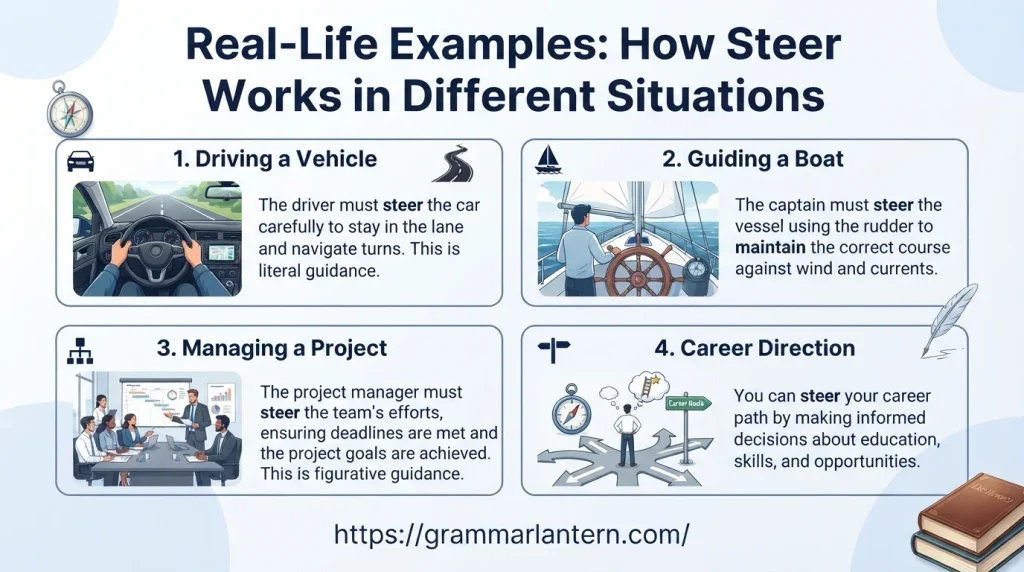
Real-Life Examples: How Steer Works in Different Situations
Understanding a word becomes easier when you see how people use it in real situations. The following examples illustrate the difference between physical steering and figurative guidance.
Driving Situation
A driver approaches a narrow road with parked vehicles on both sides. To avoid hitting anything, the driver carefully steers the car through the available space.
Here, steer describes physically controlling the vehicle’s direction.
Example: The driver steered the car through the narrow street without touching the parked vehicles.
Workplace Situation
A team begins discussing several unrelated problems during a meeting. The manager brings everyone back to the main topic so they can finish the planned work.
The manager doesn’t control the participants physically. Instead, the manager steers the conversation toward its original purpose.
Example: The manager steered the discussion back to the project deadline.
Career Guidance Situation
A student feels uncertain about choosing a career. A counselor explains several options and recommends exploring a field that matches the student’s interests.
The counselor helps influence the student’s direction without making the final decision.
Example: Her counselor steered her toward a career that matched her strengths.
Illustrative Case Study: Steering a Project Toward Success
Imagine a small company developing a new website. The team spends several weeks discussing colors, animations, and minor design details. However, the project deadline approaches and the essential pages remain unfinished.
The project manager redirects the conversation toward the most important tasks. The team prioritizes the homepage, product information, checkout process, and mobile usability. Everyone agrees to postpone optional features.
The manager has successfully steered the project toward completion.
This example shows how steer describes leadership and direction. The manager doesn’t perform every task but helps the team focus on the right path.
Read More: Families or Family’s or Families’? Correct Possessive Explained
FAQs
1. Is steers or stear the correct spelling?
Steers is the correct spelling in standard English. Stear is generally a misspelling and should be avoided in formal writing, emails, school assignments, and professional documents.
2. What does steers mean?
Steers can mean guides, directs, or controls the movement of something. It can also refer to plural male cattle, usually castrated males raised for beef.
3. Is stear a real English word?
Stear is not a standard spelling in modern English. People sometimes use it accidentally when they mean steer or steers.
4. What is the difference between steer and steers?
Steer is the singular form when referring to a male bovine animal. It is also a verb meaning to guide or direct. Steers is the plural noun or the third-person singular form of the verb.
5. How do you use steers in a sentence?
You can use steers as a verb or a plural noun. For example, “She steers the boat carefully through the river” uses it as a verb, while “The ranch raises several steers” uses it as a noun.
6. Why do people misspell steers as stear?
People often confuse steers with stear because the words look similar and may sound alike in casual speech. The unfamiliar spelling pattern can also lead to typing mistakes.
7. Is steers a noun or a verb?
Steers can function as both. As a noun, it refers to more than one steer. As a verb, it describes someone or something guiding or directing, such as “He steers the truck.”
8. What is the past tense of steer?
The past tense of steer is steered. For example, “She steered the car away from the obstacle.” The spelling changes by adding -ed to the base verb.
9. What is the plural of steer?
The plural of steer is steers. For example, “The farmer bought five steers for the ranch.” You simply add -s to the singular noun.
10. How can I remember the correct spelling of steers?
Remember the word steer contains the same eer spelling as words like deer and peer. Whenever you mean guiding, directing, or male cattle, use steer or steers, depending on the sentence.
Conclusion
Choosing between steers and stear becomes easy once you understand the correct spelling. Steers is the standard English spelling, whether you’re describing someone guiding a vehicle, directing a conversation, or referring to multiple male cattle. Meanwhile, stear is generally a spelling mistake that you should avoid in everyday and formal writing.
Learning the correct spelling helps you communicate more clearly and confidently. Whenever you feel unsure, remember the eer pattern in steer and double-check your sentence. With regular practice and attention to spelling, you’ll avoid this common confusion and use steers correctly every time.