Have you ever paused while writing because you weren’t sure whether to use wise or wize? You’re not alone! These words sound exactly alike, making it easy to mix them up. However, only one is the standard spelling in modern English, and knowing the difference can help you write with confidence.
The word wise describes someone who has knowledge, good judgment, and experience. You can use it to describe a person who makes sensible decisions or offers helpful advice. For example, “My grandmother is a wise woman who always gives me good advice.” On the other hand, wize is generally considered a misspelling in standard English, although it sometimes appears in brand names, business names, or creative spellings.
Understanding wise vs. wize can improve your English vocabulary, grammar, and spelling accuracy. Whether you’re writing an email, completing a school assignment, or posting on social media, choosing the correct spelling makes your message clearer and more professional. Let’s explore their meanings, examples, and common mistakes so you’ll always know which spelling to use.
Quick Answer
Wise is the correct standard spelling in modern English when describing someone who shows good judgment or makes sensible decisions. Wize is an obsolete historical spelling and is not a standard modern alternative.
For example:
- Correct: It was wise to save some money for emergencies.
- Incorrect in standard modern English: It was wize to save some money for emergencies.
The word wise can describe a person, decision, action, or piece of advice. You can also use it in expressions such as wise up, older and wiser, and none the wiser.
Although you might encounter Wize in a business name, username, or creative title, that doesn’t make it the standard spelling of the adjective.
The simple rule: Use wise in ordinary writing. Preserve Wize when a specific name, historical text, or deliberate creative choice requires that exact spelling.
What Does Wise Mean?
The word wise is an adjective that describes good judgment, sound thinking, and the ability to make sensible choices. A wise person often uses knowledge and experience to understand a situation before acting.
Wisdom doesn’t necessarily come from age or formal education. A young person can make a wise decision, while an experienced adult can make a poor one. The key is how someone evaluates information, considers consequences, and chooses what to do.
For example, imagine that two people receive unexpected money. One spends everything immediately, while the other pays an overdue bill and saves the remainder. Depending on their circumstances, the second person may have made the wiser choice because they considered their future needs.
Read More: Auxiliary vs. Auxillary: Which Spelling Is Correct?
Wise as an Adjective
As an adjective, wise modifies a noun or follows a linking verb to describe someone or something.
Consider these examples:
- A wise teacher helps students understand their mistakes rather than simply criticizing them.
- A wise decision takes both immediate benefits and future consequences into account.
- Wise advice offers practical guidance based on sound judgment.
- A wise investment reflects careful research and an understanding of potential risks.
- A wise response addresses a difficult situation without making it worse.
Notice that wise doesn’t mean someone always makes the perfect choice. It describes good judgment, not guaranteed success.
For instance, you might make a carefully researched investment that loses money because market conditions change. Your decision could still have been reasonable based on the information available at the time.
Wise in Different Contexts
The meaning of wise stays closely connected to good judgment, but its application changes with the situation.
In personal decisions: A wise choice considers your needs, responsibilities, and long-term goals.
Example: It was wise to discuss the problem before it became a bigger argument.
In education: A wise approach helps you learn effectively rather than simply working harder without a plan.
Example: Taking short breaks during a long study session can be a wise strategy.
In relationships: Wise behavior involves listening, thinking carefully, and responding with respect.
Example: She made a wise decision to hear both sides before judging the disagreement.
In business: Wise planning considers costs, risks, resources, and future opportunities.
Example: The company made a wise decision to test the product before launching it nationwide.
In each case, the word describes judgment that fits the circumstances.
Common Expressions With Wise
English uses wise in several expressions that have meanings beyond the word’s basic definition.
| Expression | Meaning | Example |
| Wise up | Become more aware or recognize the truth | You should wise up and read the contract carefully. |
| None the wiser | Not knowing any more than before | I read the instructions twice but was none the wiser. |
| Older and wiser | Having gained experience and better judgment over time | After several mistakes, he became older and wiser. |
| Wise to someone | Aware of someone’s actions, plans, or tricks | The manager was wise to the attempted scam. |
| In no wise | In no way; a formal or archaic expression | The statement was in no wise intended as an insult. |
These expressions demonstrate why learning a word in context can be more useful than memorizing its definition alone.
For example, wise up usually suggests that someone needs to recognize something they have overlooked. It doesn’t simply mean becoming more intelligent.
What Does Wize Mean?
Wize is an obsolete spelling historically associated with wise. In modern standard English, however, it isn’t an accepted substitute when you want to describe good judgment or sensible behavior.
You may still encounter the spelling in older texts, stylized names, online usernames, or creative writing. Its appearance in these settings doesn’t mean it has the same status as the standard modern word.
For everyday communication, the distinction is straightforward: write wise when you mean sensible, experienced, or knowledgeable.
Wize as a Historical Spelling
English spelling has changed over centuries. Words sometimes appeared in older documents with forms that differ from those used today. As spelling conventions became more standardized, some historical forms fell out of ordinary use.
Wize belongs to this category when used as an alternative spelling of wise. Its historical appearance doesn’t make it appropriate for a modern essay or business email.
Imagine reading an old manuscript that contains a sentence using wize. If you’re transcribing the document exactly, you may preserve the original spelling. If you’re writing a new sentence with the same meaning, use wise.
This distinction matters whenever you encounter older spellings. Historical authenticity and modern correctness serve different purposes.
Wize in Brand Names and Usernames
Sometimes, a company or individual deliberately uses Wize instead of Wise. This may be a branding choice designed to create a distinctive name or make a username available.
For example, a fictional business might call itself Wize Solutions. The unusual spelling could be part of its official identity.
In that context, preserve the name as its owner writes it. Don’t automatically change a registered or established name to Wise Solutions.
However, a proper name follows its own naming conventions. Its spelling doesn’t change the rules for ordinary English words.
Compare these examples:
- Standard adjective: She offered wise advice.
- Fictional business name: Wize Solutions provides consulting services.
- Creative username: @WizeWriter shares writing tips.
The second and third examples use Wize as a chosen name. They don’t establish wize as the correct spelling of the adjective.
Wize in Creative Writing
Writers sometimes bend spelling rules to create a particular effect. A fictional character might use wize in dialogue to reflect a distinctive voice, or a fantasy story might feature a place with that spelling.
Such choices can work when they’re intentional and consistent. However, creative spelling shouldn’t be confused with standard spelling.
If a character says, “That was a wize move,” the writer might be signaling a particular voice or style. Outside that deliberate context, the standard sentence is “That was a wise move.”
The important question is whether the spelling serves a clear purpose. If it doesn’t, choose wise.
What Is the Difference Between Wise and Wize?
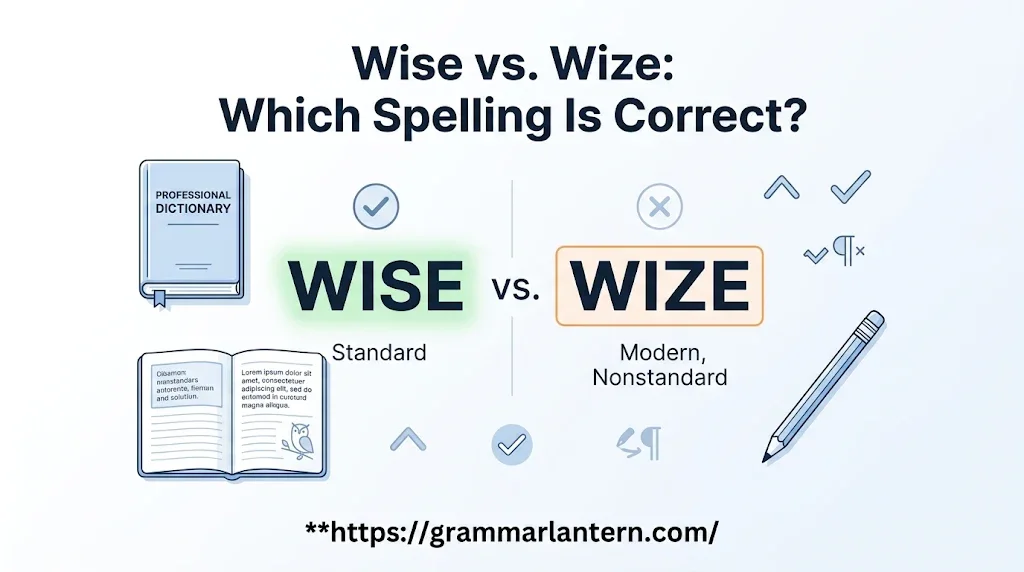
The main difference between wise and wize is their status in modern English. Wise is the standard spelling; wize is an obsolete alternative when used as the ordinary word.
Their appearance and pronunciation can cause confusion, but they aren’t interchangeable in formal or standard writing.
| Feature | Wise | Wize |
| Standard modern spelling | Yes | No |
| Meaning good judgment | Yes | Not as a standard modern form |
| Suitable for formal writing | Yes | Generally avoid |
| Historical use | Established | Recorded as obsolete |
| Use in brand names | Possible | Possible |
| Use in creative writing | Yes | Yes, when intentional |
| Standard pronunciation of the adjective | /waɪz/ | Not a standard modern alternative |
The pronunciation shown for wise is an IPA transcription. It represents a sound similar to the word size, not the sound of the letter name W followed by eyes.
One useful detail is that the final S in wise represents a voiced /z/ sound. That sound explains why some writers mistakenly choose Z when spelling the word.
Nevertheless, pronunciation doesn’t override the established spelling. English contains many words whose written letters don’t correspond neatly to the sounds people expect.
Examples in Context
The following examples show how the distinction works in everyday sentences.
| Incorrect in ordinary modern writing | Correct version |
| She made a wize decision. | She made a wise decision. |
| My grandfather gave me wize advice. | My grandfather gave me wise advice. |
| It is wize to plan ahead. | It is wise to plan ahead. |
| He became wizer with experience. | He became wiser with experience. |
| That was the wizeest choice. | That was the wisest choice. |
The corrected forms also demonstrate an important spelling pattern: related forms retain the S in wise, wiser, wisest, and wisely.
If you remember the base word, you can usually spell its common forms correctly, too.
Example Sentences
Seeing the word in realistic situations helps you recognize when to use it. The following examples cover personal decisions, work, education, and everyday conversation.
Correct Examples Using Wise
Use wise when describing good judgment or a sensible approach.
- Personal choices: It was wise to think carefully before accepting the offer.
- Money: Saving a portion of your income is a wise habit.
- Education: A wise student asks questions when a lesson isn’t clear.
- Work: The manager made a wise decision to review the proposal first.
- Relationships: She thought it was wise to listen before responding.
- Health and safety: Wearing appropriate protective equipment is a wise precaution.
- Planning: Booking your accommodation early can be wise when traveling during a busy season.
- Experience: My uncle shared a wise lesson he learned from his first business.
Each sentence uses wise as an adjective. The word describes a decision, habit, person, precaution, or lesson that reflects sound judgment.
Keep in mind that whether a decision is truly wise depends on its circumstances. For example, booking early might make sense for a popular destination, while waiting could be reasonable if your travel dates remain uncertain.
Incorrect Examples Using Wize
These examples show mistakes that can appear when writers rely on pronunciation instead of standard spelling.
– Incorrect: That was a wize suggestion.
Correct: That was a wise suggestion.
– Incorrect: It is always wize to check your work.
Correct: It is always wise to check your work.
– Incorrect: She made the wizer choice.
Correct: She made the wiser choice.
– Incorrect: He spoke wize words.
Correct: He spoke wise words.
– Incorrect: They were none the wizer.
Correct: They were none the wiser.
The mistake isn’t a difference in meaning. It’s a spelling error in standard modern English.
Wise vs. Wize in Everyday Writing
The same rule applies across different types of communication.
In school assignments: Write wise decision, wise character, or wise advice. Teachers generally expect standard spelling unless the assignment involves historical language or creative experimentation.
In professional emails: Use wise when discussing plans, recommendations, or choices. For example, “It may be wise to review the figures before approving the budget.”
In text messages: Informal communication allows abbreviations and playful spelling, but wise remains the standard form. Writing wize may look intentional or simply mistaken.
In website content: Use wise in articles, product descriptions, and educational material when you mean sensible or knowledgeable. Consistent spelling improves clarity and helps readers trust the content.
In creative projects: You can use Wize when it belongs to a specific name or serves a deliberate stylistic purpose. Make sure the unusual spelling doesn’t confuse readers about the intended meaning.
Why Do People Confuse?
The confusion between wise and wize largely comes from the way English represents speech through spelling. In wise, the letter S makes a /z/ sound rather than the /s/ sound found in words such as sun.
When people hear a word rather than see it written, they sometimes choose letters based on the sound alone. That approach can lead to errors because English spelling reflects established conventions, word histories, and patterns that aren’t always obvious from pronunciation.
The Final S in Wise Sounds Like Z
Say wise aloud, then compare it with rise, size, and prize. In these words, the final S represents the same voiced consonant sound.
That doesn’t mean the words should end in Z. Their standard spellings use S.
Consider these examples:
- Wise: She gave me wise advice.
- Rise: Prices may rise next year.
- Size: Choose the right size.
- Prize: He won the first prize.
All four words end with the letter S in writing, although that letter represents a /z/ sound in each word.
This is a useful reminder that spelling follows conventional patterns rather than a simple rule of matching every sound to one letter.
English Spelling Doesn’t Always Match Pronunciation
English has many words that sound different from what their spellings might suggest. Silent letters, borrowed words, and historical spelling patterns all contribute to this complexity.
For example, the letter combination ph represents an /f/ sound in phone. The word sign contains a silent G in its usual pronunciation. Likewise, the final S in wise represents a /z/ sound.
These patterns aren’t random mistakes. They’re part of the spelling system that readers learn through exposure, instruction, and practice.
When you’re unsure about a word, check its established spelling instead of relying entirely on what you hear.
Is Wise Spelled the Same in American and British English?
Yes. Wise is the standard spelling in both American and British English.
Unlike words such as color and colour, which have accepted regional spelling differences, wise doesn’t have a standard American-versus-British spelling distinction.
The following examples are correct in both varieties:
- She made a wise decision.
- It would be wise to prepare in advance.
- He became wiser with experience.
- They offered some wise advice.
Writing wize doesn’t make a sentence British, American, or more informal in any established spelling sense. It remains nonstandard when used as an ordinary alternative to wise.
If you’re writing for an international audience, you can confidently use wise without worrying about regional spelling preferences.
Common Mistakes to Avoid
Even a simple spelling difference can create confusion when you encounter it repeatedly. These common mistakes are easy to prevent once you understand the standard form.
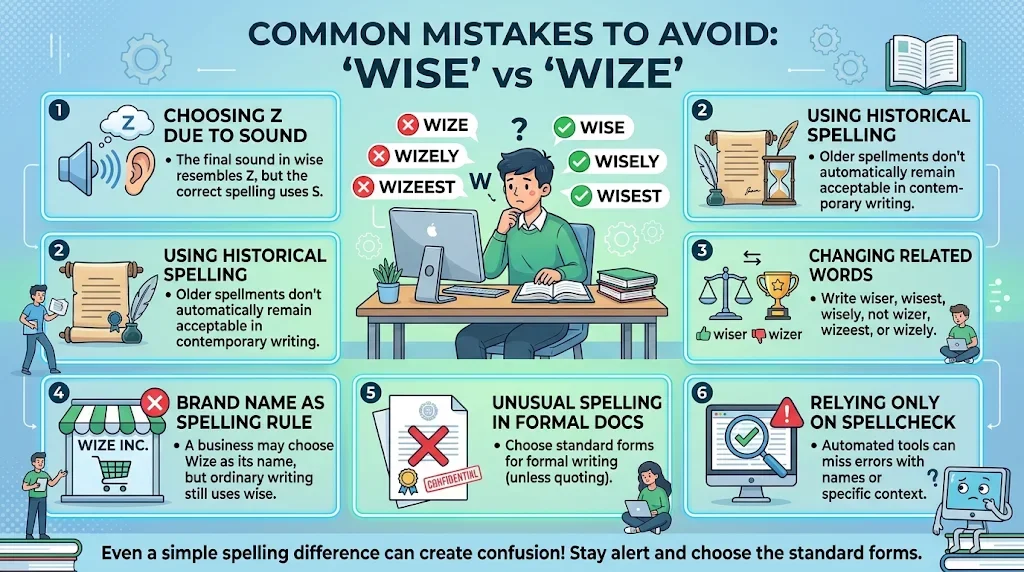
- Choosing Z because of pronunciation: The final sound in wise resembles Z, but the correct spelling uses S.
- Treating historical spelling as modern usage: An older spelling doesn’t automatically remain acceptable in contemporary writing.
- Changing related words incorrectly: Write wiser, wisest, and wisely, not wizer, wizeest, or wizely when using the standard forms.
- Assuming a brand name establishes a spelling rule: A business may choose Wize as its name, but ordinary writing still uses wise.
- Using unusual spelling in formal documents: Unless you’re quoting a source or reproducing a specific name, choose the standard form.
- Relying only on spellcheck: Automated tools can miss errors when an unusual spelling appears in a proper name or other accepted context.
Incorrect vs. Correct Word Forms
| Nonstandard form | Standard form |
| Wize | Wise |
| Wizer | Wiser |
| Wizeest | Wisest |
| Wizely | Wisely |
| Wizedom | Wisdom |
The last example deserves special attention. The noun related to wise is wisdom, not wizedom. Although the words share a meaning, English doesn’t form every related word by simply adding letters to the base form.
Learning a small group of related words can help you avoid several mistakes at once.
How to Remember the Correct Spelling
The easiest way to remember the correct spelling is to connect it with familiar words and phrases.
Remember: Wise ends in S, even though its final sound resembles Z.
Try these techniques to make the spelling stick.
- Memorize common combinations: Practice wise choice, wise advice, wise decision, and wise person.
- Learn related forms: Remember wise, wiser, wisest, wisely, and wisdom.
- Use the word in a sentence: Write one sentence each day using wise in a different context.
- Read carefully: Notice the spelling when you encounter the word in books, articles, or professional writing.
- Check unfamiliar forms: If wize appears in a document, determine whether it’s a proper name, historical spelling, or ordinary spelling mistake.
A useful memory sentence is: “A wise person chooses the right spelling.”
It reinforces the standard form without requiring you to memorize a complicated rule.
You can also practice with a quick exercise:
| Sentence | Correct choice |
| It was a (wise/wize) decision. | Wise |
| She offered (wise/wize) advice. | Wise |
| He became (wiser/wizer) over time. | Wiser |
| Knowledge and experience can develop (wisdom/wizedom). | Wisdom |
If you answered all four correctly, you’ve learned the main spelling pattern.
FAQs
1. Is it wise or wize?
Wise is the correct spelling in standard English. It describes someone who has good judgment, knowledge, or experience. Wize is generally considered a misspelling unless it appears in a brand name or another proper name.
2. What does wise mean?
Wise means having good judgment and the ability to make sensible decisions. For example, “It was wise to save money for emergencies.”
3. Is wize a real word?
Wize is not a standard English spelling of the word wise. However, businesses, brands, and individuals sometimes use it as a creative name or spelling.
4. Do wise and wize sound the same?
Yes, wise and wize are pronounced the same way in English. This similarity can cause confusion, but their spelling and usage are different.
5. How do you use wise in a sentence?
You can use wise to describe a person, decision, or action that shows good judgment. For example, “She made a wise choice by checking the details before signing the contract.”
6. Is wise correct in American and British English?
Yes, wise is the standard spelling in both American and British English. You should use it in school assignments, professional emails, and everyday writing.
7. Why do people spell wise as wize?
People may write wize because it sounds like wise. Others use it intentionally in usernames, business names, or marketing because they want a distinctive spelling.
8. What is the difference between wise and wisdom?
Wise is an adjective that describes someone who shows good judgment. Wisdom is a noun that refers to the knowledge and experience behind that judgment. For example, “My father is wise, and his wisdom helps our family make better decisions.”
9. Can I use wize in formal writing?
You should avoid wize in formal writing when you mean the standard English word wise. Use the alternative spelling only when it is part of an official name, brand, or title.
10. What is an easy way to remember the correct spelling?
Remember that wise is the standard spelling associated with good judgment and knowledge. If you’re describing a sensible person or decision, choose wise, not wize.
Conclusion
When comparing wise vs. wize, the difference is simple: wise is the correct spelling in standard English, while wize is generally considered a misspelling. The word wise describes someone who uses knowledge, experience, and good judgment to make sensible decisions. You’ll find it in everyday conversations, professional writing, books, and educational materials.
To avoid this common spelling mistake, remember to use wise whenever you mean sensible, knowledgeable, or experienced. Although wize may appear in business names or creative branding, it isn’t the standard spelling. Keeping this simple distinction in mind will help you improve your spelling, communicate clearly, and write with greater confidence.

For Shafiq ur Rehman, writing is an art form and grammar is the toolbox that makes it beautiful. As a dedicated content writer at Grammar Lantern, Shafiq approaches every topic like an architect carefully laying down strong foundations of understanding before adding the finer details. He loves diving into the trickiest grammar points and resurfacing with simple, bite-sized takeaways that anyone can grasp. When he’s not crafting articles, you’ll likely find him strategizing over a game of chess, exploring dusty local bookshops, or quietly jotting down poetic observations in his notebook.