Hampster vs. Hamster: Which Spelling Is Correct? is a common question for people who want to improve their English spelling and avoid mistakes. Although both words may sound alike when spoken out loud, only hamster is the correct spelling. A hampster is an incorrect and misspelled version of the word, usually caused by adding an extra “p” while writing.
Understanding this word distinction can improve your vocabulary, word recognition, and spelling accuracy. A hamster is a small animal often kept as a pet. Although the two forms have a similar pronunciation, they are not technically homophones because the incorrect spelling does not represent a separate English word with a different meaning. Paying attention to context and word usage helps you choose the right spelling in everyday communication.
In written English, using the correct spelling makes your message clearer and more professional. I recommend remembering the standard form without the extra letter. Practicing standard English and its language rules can help you avoid this common spelling mistake in schoolwork, emails, and other writing.
Quick Answer
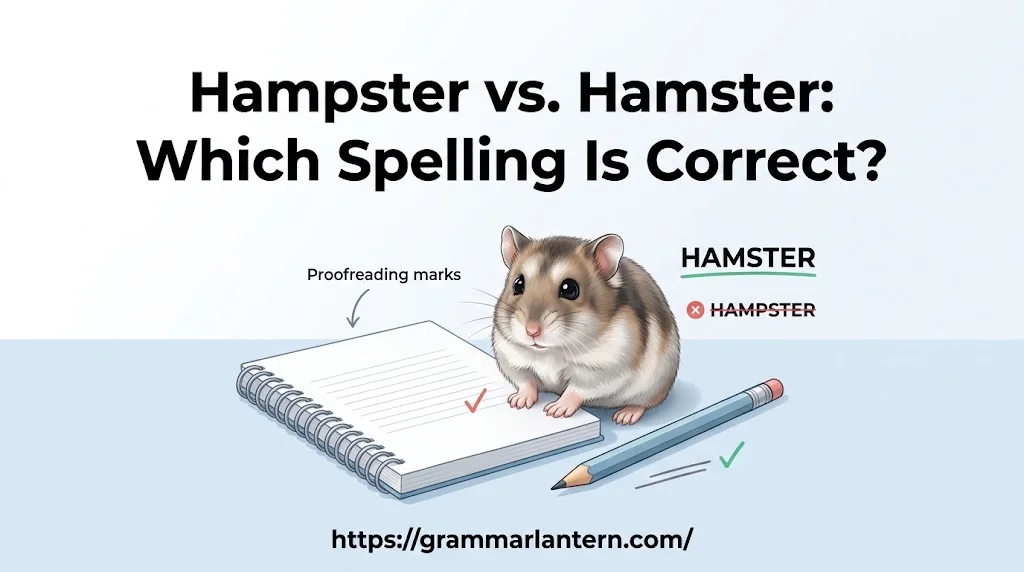
Hamster is the correct spelling. Hampster is a common misspelling and isn’t an accepted alternative spelling of the animal’s name in standard English.
| Word | Is It Correct? | Meaning |
| Hamster | Yes | A small rodent often kept as a pet |
| Hampster | No, not for the animal’s standard name | A misspelling of hamster |
| Hamsters | Yes | The plural form of hamster |
| Hampsters | No, not as the standard plural | A misspelled version of hamsters |
For example:
- Correct: My hamster likes to run on its exercise wheel.
- Incorrect: My hampster likes to run on its exercise wheel.
The easiest way to remember the difference is to look at the middle of the word. Hamster contains no letter P. Write it as ham + ster, and you’ll have the correct spelling every time.
What Is the Difference Between Hampster and Hamster?
The difference between hampster and hamster comes down to one extra letter. Although the two forms may look similar, only hamster is the standard spelling of the animal’s name.
Let’s examine both words more closely.
Hamster: The Correct Spelling
A hamster is a small rodent belonging to the subfamily Cricetinae. These animals are known for their compact bodies, short tails, cheek pouches, and habit of gathering food.
Many people keep hamsters as pets because they’re relatively small and fascinating to observe. They come in different species, including Syrian hamsters and several dwarf hamster species.
Hamsters have expandable cheek pouches that help them carry food. In the wild, this behavior supports their food-gathering habits. They also tend to be most active during the evening and night, although their activity patterns vary by species and individual animal.
The word hamster functions as a noun. It identifies the animal rather than describing an action or quality.
Here are some examples:
- My hamster hides sunflower seeds in its bedding.
- The children watched the hamster explore its enclosure.
- A hamster needs suitable bedding, fresh water, and a balanced diet.
- Our family adopted two hamsters from a local rescue.
Notice that the spelling remains hamster whether you’re discussing the animal’s appearance, behavior, or care.
Hampster: The Incorrect Spelling
Hampster is a common misspelling of hamster. Writers sometimes insert the letter P because they perceive an extra consonant when saying the word.
That mistake doesn’t create a separate standard English word for the animal. In ordinary writing, hampster should be corrected to hamster.
Consider these examples:
- Incorrect: I bought a new cage for my hampster.
- Correct: I bought a new cage for my hamster.
- Incorrect: The hampster is sleeping in its nest.
- Correct: The hamster is sleeping in its nest.
- Incorrect: My two hampsters enjoy exploring tunnels.
- Correct: My two hamsters enjoy exploring tunnels.
The correction is simple: remove the unnecessary P. You don’t need to change the sentence’s meaning or structure.
There is one exception worth understanding. Someone might deliberately use Hampster as a username, fictional name, joke, or creative label. In that situation, the spelling may be intentional. However, it doesn’t become the standard spelling of the animal’s name.
Read More: 6 More Formal Ways to Say “Please Provide…” at Work
Why Do People Spell Hamster as Hampster?
The extra P isn’t entirely random. Several factors can contribute to this mistake, including pronunciation, familiar spelling patterns, and repeated exposure to incorrect forms.
The Influence of Pronunciation
One reason people write hampster is that the consonants in hamster occur close together. When someone says the word quickly, the transition between the sounds can seem to include a brief P-like sound.
This is an example of how speech perception can influence spelling. Your brain doesn’t always process every sound as a separate, clearly defined unit. Instead, it uses familiar patterns and expectations to interpret what you hear.
For example, if you’ve repeatedly heard a word but rarely seen it written, you might spell it according to your impression of its pronunciation. That strategy works for many familiar words, but it can lead to mistakes when the perceived sounds don’t match the conventional spelling.
The important distinction is that hearing an extra sound doesn’t mean the word contains an extra letter.
The standard spelling remains hamster, regardless of how quickly someone speaks or how the word sounds in a particular accent.
Confusion With Similar Words
English contains many words whose spellings are difficult to predict from pronunciation alone. This makes it tempting to rely on familiar letter combinations when writing an unfamiliar word.
A person who hears hamster may mentally connect it with a spelling pattern that includes P. Once that incorrect form seems familiar, it can become harder to notice the mistake.
Compare these examples:
| Correct Word | Common Mistake | Explanation |
| Hamster | Hampster | An unnecessary P is added |
| February | Febuary | The first R is omitted |
| Library | Libary | The first R is omitted |
| Definitely | Definately | The vowel sequence is confused |
| Separate | Seperate | The wrong vowel is used |
These mistakes don’t all happen for the same reason. However, they share one important feature: the writer relies on an imperfect memory of the word’s spelling.
The solution is to learn the conventional written form rather than inventing a spelling based only on sound.
Typing Errors, Autocorrect, and Online Searches
Fast typing can turn a small spelling uncertainty into a repeated mistake. If you type hampster several times without correcting it, the form may begin to look familiar.
Autocorrect and spell-check tools can help, but they aren’t perfect. A tool might flag an unfamiliar spelling, suggest a correction, or overlook a term used as a proper name.
Search engines can also recognize what someone probably intended when they enter a misspelled word. That makes it possible to find information about hamsters even when the search query contains hampster.
Still, search results aren’t proof that a spelling is correct. Search engines are designed to help users find relevant information, not to establish every word’s standard spelling.
For published content, schoolwork, and professional communication, use hamster.
Hamster Meaning, Definition, and Usage
Understanding the meaning of hamster helps you remember not only how to spell it but also how to use it correctly in a sentence.
What Does Hamster Mean?
A hamster is a small mammal in the rodent family. Hamsters belong to the subfamily Cricetinae and have several distinctive features, including cheek pouches, strong front teeth, and a tendency to collect food.
Some hamsters live in dry, open habitats in the wild. Others are bred and kept as companion animals. Syrian hamsters and dwarf hamsters are among the types commonly encountered in pet care.
Hamsters also have several interesting biological traits:
- Cheek pouches: They can carry food in expandable pouches inside their cheeks.
- Incisors: Like other rodents, they have continuously growing front teeth.
- Food storage: Many hamsters gather food and store it for later consumption.
- Activity patterns: Many are most active around dusk and during the night.
- Burrowing behavior: They often dig or use tunnels to create sheltered sleeping spaces.
These characteristics explain why hamsters frequently appear in discussions about pets, animal behavior, and small-mammal care.
Here are three examples of the word in context:
- A hamster uses its cheek pouches to carry food.
- Our hamster spends much of the evening exploring its enclosure.
- The veterinarian explained how to maintain the hamster’s dental health.
In each sentence, hamster names an animal, so it functions as a noun.
Hamster as a Noun
The word hamster is a countable noun. You can refer to one hamster or several hamsters.
It can appear in different parts of a sentence, depending on what you want to communicate.
As the subject:
- The hamster sleeps inside its wooden hideout.
- A hamster needs a suitable enclosure.
As the object:
- We adopted a hamster from a rescue center.
- The children watched the hamster eat a small piece of vegetable.
After a preposition:
- The food bowl is beside the hamster.
- We bought a safe exercise wheel for the hamster.
The word’s grammatical role may change, but its spelling doesn’t. You still write hamster, not hampster.
What Is the Plural of Hamster?
The plural of hamster is hamsters. English forms the plural of most regular nouns by adding -s.
| Form | Example |
| Singular | The hamster is eating. |
| Plural | The hamsters are eating. |
| Singular with a possessive | The hamster’s food bowl is empty. |
| Plural with a possessive | The hamsters’ enclosures need cleaning. |
Pay attention to the apostrophe in possessive forms. Hamster’s indicates possession by one hamster, while hamsters’ indicates possession by multiple hamsters.
The misspelled form hampster follows the same basic pattern incorrectly. Adding -s gives hampsters, but the extra P remains a spelling mistake.
Remember this simple rule: hamster, hamsters, hamster’s, and hamsters’ are the standard forms for the singular, plural, singular possessive, and plural possessive.
How to Pronounce Hamster Correctly
Pronunciation can help explain the confusion between hamster and hampster. However, you shouldn’t rely on pronunciation alone when spelling a word.
Hamster Pronunciation in American English
In American English, hamster is commonly pronounced /ˈhæm.stɚ/.
The pronunciation has two syllables:
- Ham: The first syllable has the short vowel sound found in ham.
- Ster: The second syllable contains an unstressed vowel followed by an R sound in typical American pronunciation.
The stress falls on the first syllable: HAM-ster.
When you say the word, the M sound moves directly into the S sound. You don’t need to insert a P between them.
Try saying the word slowly, then repeat it at a natural conversational pace. Pay attention to the transition from M to S.
This small exercise helps separate the word’s actual pronunciation from the spelling your ears might suggest.
Why Hamster May Sound Like Hampster
Speech doesn’t always sound as carefully separated as written language looks on a page. When people speak quickly, consonants can blend together or create brief transitions that listeners interpret differently.
This can make hamster seem as though it contains a P. However, the standard spelling doesn’t include that letter.
A useful comparison is the difference between hearing a word and identifying its spelling. You might recognize a word immediately in conversation but hesitate when writing it down. The meaning is clear, yet the spelling requires a separate mental check.
For hamster, use these reminders:
- The first part is ham.
- The second part is ster.
- There is no P between the M and S.
- The standard written form contains seven letters: H-A-M-S-T-E-R.
Once you associate the word with its seven-letter structure, the extra P becomes easier to spot.
Examples of Correct and Incorrect Usage
Examples are one of the quickest ways to make a spelling rule stick. Instead of memorizing an explanation alone, look at how the word appears in ordinary sentences.
Correct Sentences With Hamster
Here are several examples of hamster used correctly in everyday English.
- My hamster hides its favorite treats under the bedding.
- The hamster explored the cardboard tunnel.
- We prepared a larger enclosure for our hamster.
- A hamster needs fresh water every day.
- My sister adopted a hamster last weekend.
- The veterinarian examined the hamster carefully.
- Our two hamsters have separate enclosures.
- The children learned about hamster behavior in science class.
These sentences cover different contexts, including pet ownership, animal care, plural usage, and education. The spelling remains consistent throughout.
Incorrect Sentences With Hampster
Now compare the incorrect spelling with its corrected form.
| Incorrect Sentence | Correct Sentence |
| My hampster is sleeping. | My hamster is sleeping. |
| The hampster needs fresh water. | The hamster needs fresh water. |
| I bought food for my hampster. | I bought food for my hamster. |
| The hampsters are playing. | The hamsters are exploring. |
| My hampster’s cage is clean. | My hamster’s enclosure is clean. |
Each correction removes the unnecessary P while preserving the intended meaning.
Notice that the plural and possessive forms require the same correction. You can’t make hampster correct simply by adding an ending.
Common Spelling Mistakes to Avoid
The hampster mistake becomes easier to catch when you know what to look for.
Watch for these common errors:
- Adding an unnecessary P: Write hamster, not hampster.
- Misspelling the plural: Write hamsters, not hampsters.
- Adding a possessive ending to the wrong spelling: Write hamster’s, not hampster’s.
- Assuming frequent use makes a spelling correct: Repeated exposure doesn’t turn a misspelling into the standard form.
- Trusting search results without checking: A search engine may understand an incorrect query without endorsing its spelling.
A quick proofreading trick is to scan for the letter P in the middle of the word. If you find one in the animal’s name, check whether you’ve accidentally typed hampster.
In Different Contexts
The correct spelling doesn’t change depending on where you use the word. However, the consequences of a spelling mistake may vary with the situation.
Formal and Academic Writing
In formal writing, standard spelling helps readers focus on your ideas rather than errors.
If you’re writing an essay about animal behavior, a biology report, or a pet care guide, use hamster throughout the text. The same rule applies to presentations, educational materials, newsletters, and professional documents.
For example:
Incorrect: The hampster is a nocturnal animal that stores food in its cheeks.
Correct: The hamster is a small rodent that stores food in its cheek pouches.
The corrected sentence also uses more precise biological language. A hamster is not strictly nocturnal in every circumstance, and its activity patterns can vary by species and environment. Accurate terminology matters just as much as accurate spelling.
Everyday Conversations and Text Messages
Informal writing often includes typos, abbreviations, and playful spellings. If someone sends a message about their hampster, you’ll probably understand what they mean.
That doesn’t make the spelling standard.
For example:
- Casual message: “My hampster keeps hiding its food.”
- Corrected message: “My hamster keeps hiding its food.”
In a private conversation, a minor typo may not cause any confusion. Still, learning the correct form helps you avoid carrying the mistake into school assignments, work emails, or public posts.
Online Searches and Social Media
People search for both hamster and hampster because they may be unsure about the spelling. Others use the incorrect form in memes, jokes, usernames, or deliberately silly captions.
Search engines often interpret misspelled queries and display results related to the intended word. That feature makes information easier to find, but it can also hide a spelling mistake from the person searching.
For example, someone might search for “how to care for a hampster” and still find useful hamster care advice.
The search works. The spelling doesn’t.
When publishing online content, use the standard spelling in titles, headings, body text, image descriptions, and other relevant fields. You can explain the misspelling when it’s the topic of the article, but there’s no need to repeat it unnecessarily.
Is Hampster Ever Correct?
This question deserves a little nuance. Although hampster isn’t the standard spelling of the animal’s name, a writer might use the same letters intentionally in another context.
Standard English Usage
When referring to the small rodent, hamster is the accepted standard spelling.
The spelling hampster isn’t an established alternative in standard English dictionaries for that animal. In ordinary writing, editing software and proofreading should treat it as an error unless the surrounding context indicates a deliberate name or creative use.
For example:
- Standard: The hamster ate a piece of carrot.
- Nonstandard: The hampster ate a piece of carrot.
The second sentence communicates the intended meaning, but its spelling remains incorrect.
Names, Usernames, and Creative Uses
People sometimes invent spellings to make usernames, fictional characters, or jokes more distinctive. A person might call a cartoon character “Hampster” or choose that spelling for an online nickname.
In such cases, the term functions as an intentional label rather than an ordinary reference to the animal’s name.
Consider this example:
“Hampster” is the name of the cartoon character in my story.
Here, the spelling may be correct as the chosen name of a fictional character. It doesn’t establish hampster as a standard alternative spelling for the animal itself.
The distinction is straightforward: a deliberate name can have its own spelling, but the common noun remains hamster.
Hamster Spelling Rules and Memory Tricks
If you frequently confuse hamster with hampster, a simple memory technique can help. You don’t need to memorize a complicated grammar rule. You just need to remember the word’s correct letter sequence.
An Easy Way to Remember Hamster
Break the word into two parts: ham + ster.
The first part is ham, and the second part is ster. Put them together, and you get hamster.
Try this short reminder:
“My hamster has no P in its spelling.”
It’s simple, memorable, and easy to recall when you’re writing quickly.
You can also use the following checklist:
- Start with H-A-M.
- Follow with S-T-E-R.
- Check that the word contains no P.
- Add -s for the regular plural: hamsters.
- Add an apostrophe only when you need a possessive form.
These steps work well for students, English learners, bloggers, and anyone who wants to improve spelling accuracy.
How to Check the Spelling Quickly
When you’re unsure about a word, use a reliable dictionary or a spell-check tool. Both can help you confirm the standard form.
For the word in question, remember these three points:
- Dictionary form: Hamster.
- Plural form: Hamsters.
- Common error: Hampster.
If you’re proofreading a long article, use your word processor’s search function to locate every occurrence of hampster. Replace accidental misspellings with hamster, while checking any intentional names separately.
This approach is especially helpful for website owners. A single spelling error repeated across headings, paragraphs, and image descriptions can make an otherwise polished article look careless.
A Practical Case Study: Correcting Hampster in a Blog Article
Imagine you’re preparing a blog post about caring for a small pet rodent. You write the first draft quickly and use hampster throughout the article because that’s how the word sounds to you.
Your draft includes the following sentences:
- “A hampster needs a safe place to sleep.”
- “Choose a suitable exercise wheel for your hampster.”
- “Some hampsters enjoy exploring tunnels.”
A proofreading check reveals that all three sentences contain the same spelling mistake.
You correct them as follows:
- “A hamster needs a safe place to sleep.”
- “Choose a suitable exercise wheel for your hamster.”
- “Some hamsters enjoy exploring tunnels.”
The correction takes only a moment, but it improves the article’s accuracy and consistency.
This example illustrates a useful editing principle: when you find one recurring spelling error, search the entire document rather than fixing only the first occurrence.
For website content, you should also check the page title, headings, image alt text, captions, and meta description. Consistent spelling helps readers understand your content and keeps your presentation professional.
Read More: Wore or Worn: Which Is Correct? Helpful Examples
FAQs
1. Is it Hampster or Hamster?
Hamster is the correct spelling. Hampster is a common misspelling.
2. Why do people spell hamster as hampster?
People often add an extra “p” because they associate the spelling with how they hear or pronounce the word.
3. What does the word hamster mean?
A hamster is a small rodent that people often keep as a pet.
4. Is hampster a real English word?
No. Hampster is not the standard English spelling of the animal’s name.
5. Are hampster and hamster homophones?
No. They are spelling variations of the same intended word, not two separate words with identical pronunciation.
6. How do you spell hamster correctly?
The correct spelling is H-A-M-S-T-E-R, without an extra “p.”
7. Why is hamster commonly misspelled?
The mistake usually happens because people add an unnecessary letter when spelling the word from memory.
8. Does hampster have a different meaning from hamster?
No. Hampster is generally an incorrect spelling intended to refer to a hamster.
9. How can I remember the correct spelling of hamster?
Remember that hamster begins with “ham,” not “hamp.” Practicing the correct spelling can help you avoid the mistake.
10. Should I use hamster in formal writing?
Yes. Use hamster in school assignments, emails, articles, and other forms of formal or informal writing.
Conclusion
Choosing between hampster and hamster is simple once you learn the correct spelling. Although the two forms may look similar, hamster is the standard English word for the small animal commonly kept as a pet. Hampster is an incorrect spelling that adds an unnecessary “p.”
To improve your spelling accuracy, practice writing the correct form and check unfamiliar words when necessary. Using hamster consistently will make your writing clearer and help you avoid this common spelling mistake.

Muhammad Haroon is the voice behind many of the clear, practical grammar guides you’ll find on Grammar Lantern. With a strong background in content writing and a genuine love for the English language, Haroon specializes in breaking down intimidating grammar topics into simple, digestible lessons. His goal is simple: to empower readers to write with confidence and clarity. Whether he’s explaining tricky tenses or demystifying punctuation, Haroon approaches each topic with patience, precision, and a touch of warmth—because he knows that learning grammar is a journey, not a race.