Have you ever wondered whether sneek or sneak is the correct spelling? These two words look similar, which makes the confusion understandable. Many English learners and native speakers mistakenly write sneek because words like peek, seek, and week follow the same vowel pattern. However, English spelling has exceptions that can easily trip you up. The correct spelling is sneak, while sneek is generally considered a misspelling of the word.
Understanding the difference helps you improve your spelling, vocabulary, and everyday writing skills. The word sneak describes moving quietly, doing something secretly, or avoiding attention. You might sneak into a room, sneak a snack, or sneak away from a crowded gathering. Although sneek may appear in informal messages or online searches, it isn’t the standard spelling of this verb.
In this guide, you’ll learn the meaning, correct spelling, and usage of sneak, along with practical examples to make it easier to remember. We’ll also explore common spelling mistakes, helpful tips, and the difference between sneek and sneak. By the end, you’ll know which spelling to use and how to avoid this mistake with confidence.
Quick Answer
Sneak is the correct spelling of the English word. Sneek is generally a spelling mistake when someone intends to use the word sneak.
The word sneak means to move quietly, act secretly, or do something without attracting attention. It can function as a verb, noun, and adjective in different contexts.
| Spelling | Correct or Incorrect? | Meaning |
| Sneak | Correct | To move or act secretly |
| Sneek | Incorrect in ordinary English usage | Common misspelling of sneak |
| Sneek | Correct as a proper noun | Name of a city in the Netherlands |
Examples:
- Correct: The children tried to sneak downstairs without waking their parents.
- Incorrect: The children tried to sneek downstairs without waking their parents.
- Correct: We watched a documentary about Sneek, a city in the Netherlands.
Remember the spelling s-n-e-a-k. The letters ea make the long E sound in this word.
Which Spelling Is Correct?
When choosing between sneek and sneak, always use sneak for the English vocabulary word. Dictionaries recognize sneak as the standard spelling. The alternative sneek doesn’t belong to standard English spelling for this meaning.
The confusion usually starts with pronunciation. Both spellings may look like reasonable ways to represent the same sound. However, English spelling doesn’t always follow pronunciation in a predictable way. You need to remember the established spelling rather than create one based on sound.
Sneak Is the Correct English Spelling
Sneak is a standard English word that describes secretive movement or behavior. It often suggests that someone wants to avoid being seen, heard, or noticed.
You can use it in everyday conversations, academic writing, professional emails, stories, news reports, and social media posts.
Examples:
- The cat tried to sneak into the kitchen.
- He wanted to sneak a quick look at the invitation.
- We decided to sneak out before the meeting ended.
- She managed to sneak an extra cookie from the jar.
Notice how the meaning stays connected to secrecy or quiet action. Someone may sneak into a place, sneak something somewhere, or sneak a quick look at an object.
Sneek Is Usually a Misspelling
The spelling sneek is incorrect when you intend to write the English word sneak. It may appear in messages, search queries, captions, comments, and informal writing because people often spell words according to their sounds.
However, informal communication doesn’t make the spelling standard.
For example:
- Incorrect: I had to sneek into the kitchen.
- Correct: I had to sneak into the kitchen.
- Incorrect: She tried to sneek a peek at the gift.
- Correct: She tried to sneak a peek at the gift.
If you’re writing an essay, article, school assignment, business email, or application, use sneak. Spell-checking tools may catch the error, but knowing the correct spelling helps you avoid it in the first place.
When Is Sneek Correct?
Although sneek is not the standard spelling of the English verb, Sneek is a legitimate proper noun. It refers to a city in Friesland, a province in the Netherlands.
Proper nouns follow their own spelling conventions. A city name, person’s name, company name, or brand can use a spelling that differs from ordinary English vocabulary.
For example:
- We visited Sneek during our trip to the Netherlands.
- Sneek is known for its waterways and maritime connections.
- The event took place near the city of Sneek.
In these sentences, Sneek is correct because it refers to a specific geographical place. It isn’t being used as the English verb meaning to move secretly.
Quick Comparison
The following table summarizes the difference between the two spellings.
| Feature | Sneak | Sneek |
| Standard English word | Yes | No |
| Correct spelling of the verb | Yes | No |
| Means moving secretly | Yes | No |
| Can function as a noun | Yes | Not as the ordinary English word |
| Proper place name | No, not normally | Yes, the Dutch city |
| Suitable for standard English writing | Yes | Only when used as a proper name or other specific name |
The easiest way to remember the difference is to associate sneak with secret movement and Sneek with the Dutch city.
What Does Sneak Mean?
The word sneak has several meanings depending on how you use it. Its most common meaning involves moving quietly or doing something secretly to avoid being noticed.
However, it can also describe a person, an unexpected action, or something performed without warning.
Sneak as a Verb
As a verb, sneak means to move quietly, go somewhere secretly, or take something somewhere without attracting attention.
The word often describes an action that someone wants to keep hidden. That action may be harmless, mischievous, or dishonest depending on the situation.
Examples:
- The dog sneaked into the bedroom while everyone was sleeping.
- I tried to sneak past the security guard.
- They sneaked some snacks into the movie theater.
- She sneaked a note into his backpack.
The word doesn’t always suggest wrongdoing. Someone might sneak away to surprise a friend or sneak into the kitchen for a midnight snack. Context determines whether the action seems playful, harmless, or suspicious.
Sneak as a Noun
As a noun, sneak can describe a person who behaves secretly or someone who reports another person’s wrongdoing in a disapproving sense.
For example:
- Nobody likes a sneak who tells every little secret.
- He called his brother a sneak after discovering the hidden note.
- Don’t be such a sneak; tell us what happened.
In British informal usage, sneak can refer to a person who secretly reports someone to an authority figure. This meaning often carries a negative tone similar to snitch or tattletale.
The noun can also refer informally to a sneaker or athletic shoe in some American usage. Its meaning depends on the context.
Sneak as an Adjective
The word sneak can also appear in adjective-like expressions that describe something secretive or unexpected.
Examples include:
- Sneak attack: An attack that happens unexpectedly.
- Sneak preview: An early showing or preview of something.
- Sneak thief: A thief who steals quietly or secretly.
These expressions often appear in newspapers, entertainment, sports, gaming, and everyday conversation.
Why Do People Spell Sneak as Sneek?
The spelling confusion isn’t unusual. English contains several spelling patterns for the same vowel sound, so people sometimes choose the wrong combination of letters.
The Long E Sound Causes Confusion
The word sneak has a long E sound, represented by /iː/ in the International Phonetic Alphabet.
That sound also appears in words containing ee, such as:
- Peek
- Week
- Seek
- Green
- Sleep
When someone hears sneak, they may naturally think of ee because it appears in many words with the same vowel sound. As a result, they type sneek instead of the established spelling sneak.
The pronunciation doesn’t change the spelling rule. You still need to use ea in sneak.
English Spelling Doesn’t Always Match Pronunciation
English has several ways to represent the same vowel sound. For example, the long E sound appears in words with ee, ea, and occasionally other spelling patterns.
| Word | Vowel Pattern | Example |
| Sneak | ea | He tried to sneak away. |
| Peek | ee | Take a peek inside. |
| Speak | ea | Please speak clearly. |
| Green | ee | The grass looks green. |
| Team | ea | Our team won. |
| Key | ey | She lost her key. |
These examples show why spelling by sound alone can lead to mistakes. English spelling has patterns, but it also has exceptions and historical quirks.
Sneak and Peek Create a Common Spelling Trap
People often encounter sneak in the expression sneak peek. Since sneak and peek have similar vowel sounds, writers sometimes mistakenly spell both words with ee.
However, the expression contains two different spelling patterns:
- Sneak uses ea.
- Peek uses ee.
Correct: We received a sneak peek of the new movie.
Incorrect: We received a sneek peek of the new movie.
The phrase becomes easier to remember when you learn the spelling of both words separately.
How to Use Sneak in a Sentence
Understanding the meaning is only half the battle. You also need to know which words naturally go with sneak. English speakers commonly use it with prepositions and short expressions that describe entering, leaving, approaching, or doing something secretly.
Sneak Into a Place
Use sneak into when someone enters a place quietly or secretly, often without permission or without being noticed.
Examples:
- The boys tried to sneak into the concert.
- She sneaked into the office after everyone left.
- Someone sneaked into our backyard last night.
- He wanted to sneak into the room without disturbing his sister.
The word into emphasizes movement from outside to inside. It works with rooms, buildings, events, places, and even situations.
Sneak Out of a Place
Use sneak out when someone secretly leaves a place. The expression often appears in stories about children, teenagers, parties, or people trying to avoid attention.
Examples:
- He sneaked out of the house after midnight.
- The students tried to sneak out of class early.
- She sneaked out through the back door.
- We sneaked out before the guests arrived.
You can also use sneak out without mentioning a specific location when the context makes it clear.
Sneak Something Into Somewhere
This structure describes secretly carrying, bringing, or introducing something into a place.
Examples:
- He tried to sneak a phone into the examination room.
- She sneaked candy into the movie theater.
- They sneaked a puppy into the apartment.
- I managed to sneak an extra sandwich into my bag.
This construction can also describe adding something subtly to an activity or situation.
For example, a parent might say, “I sneak vegetables into the pasta sauce.” The vegetables aren’t necessarily hidden from someone physically. The expression means adding them without making the addition obvious.
Read More: Flake vs. Hake: What’s the Difference? Taste, Nutrition, and Uses
Sneak a Look or Peek
The expression sneak a look means to look at something quickly or secretly.
Examples:
- She sneaked a look at the clock.
- I sneaked a glance at his notes.
- He tried to sneak a look at the answer sheet.
- They sneaked a peek at the birthday presents.
These expressions often describe curiosity. Someone wants to see something without openly revealing their interest.
Sneak Up on Someone
The phrasal verb sneak up on means to approach someone quietly without being noticed.
Examples:
- The cat sneaked up on the bird.
- I tried to sneak up on my brother.
- The little girl sneaked up on her father and shouted, “Surprise!”
- He sneaked up on me while I was reading.
The expression can also describe something that happens gradually or unexpectedly.
For example:
- The deadline sneaked up on us.
- Winter sneaked up on the town.
- The realization sneaked up on her.
In these sentences, the subject doesn’t literally move quietly. The phrase suggests that something arrived or became noticeable before someone expected it.
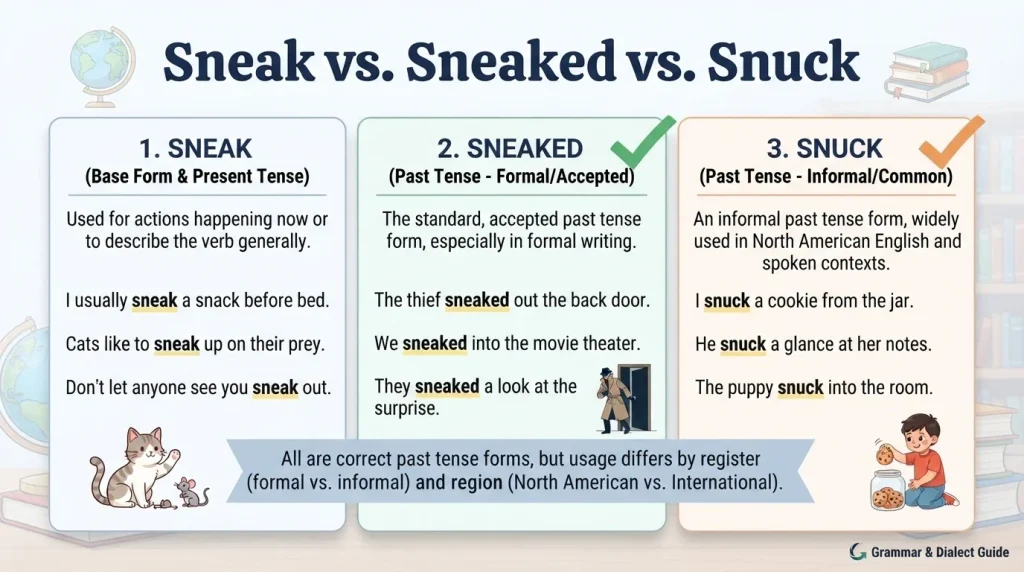
Sneak vs. Sneaked vs. Snuck
The word sneak has several grammatical forms. Understanding these forms helps you use the correct word in different tenses.
Sneak Is the Present-Tense Form
Use sneak for the base form and with plural subjects or the pronouns I, you, we, and they in the present tense.
Examples:
- I sneak downstairs for a snack.
- They sneak into the garden.
- We sneak away during the break.
- You sneak around too quietly.
With he, she, or it, add -s to form sneaks.
- He sneaks out every Friday.
- She sneaks a look at the menu.
- The cat sneaks into the kitchen.
Sneaked Is the Traditional Past-Tense Form
Sneaked is the regular past-tense form of sneak. You create it by adding -ed to the base word.
Examples:
- He sneaked out of the house.
- She sneaked a cookie from the jar.
- They sneaked into the theater.
- We sneaked past the guard.
The form sneaked is correct in standard English. You can use it in formal writing, casual conversation, and storytelling.
Snuck Is Also an Accepted Past-Tense Form
Snuck is another accepted past-tense and past-participle form of sneak. It became especially common in North American English and is widely used in modern conversation and writing.
Examples:
- He snuck out of the meeting.
- She snuck a snack into her room.
- They snuck past the sleeping dog.
- I snuck into the kitchen for coffee.
Both sneaked and snuck are correct. The choice often depends on your preferred style, the tone of your writing, and regional usage.
| Form | Example |
| Sneak | I sneak out quietly. |
| Sneaks | She sneaks into the room. |
| Sneaked | He sneaked past the guard. |
| Snuck | He snuck past the guard. |
| Sneaking | They are sneaking around. |
| Have sneaked | We have sneaked inside. |
| Have snuck | We have snuck inside. |
For formal writing, sneaked may feel more traditional. However, snuck is also widely accepted. You don’t need to avoid it simply because it looks irregular.
Sneaking Is the -Ing Form
The word sneaking is the present participle and gerund form of sneak. You use it with helping verbs to describe ongoing actions or as a noun-like form.
Examples:
- He is sneaking into the building.
- They were sneaking around the backyard.
- Sneaking into the room was a bad idea.
- She caught him sneaking out.
The spelling changes slightly when you add -ing. You keep the original word and add the suffix without changing ea.
Common Expressions
The word sneak appears in several everyday expressions. Learning these phrases can help you recognize the word in different contexts and improve your vocabulary.
Sneak Peek
A sneak peek means an early or brief look at something before its official release or full presentation.
People commonly use this expression in entertainment, marketing, social media, and product announcements.
Examples:
- The company shared a sneak peek of its new smartphone.
- We received a sneak peek of the upcoming movie.
- The designer gave us a sneak peek at the collection.
- Here’s a sneak peek of tomorrow’s announcement.
Remember that peek means a quick look. It isn’t peak, which refers to the highest point, or peeke, which isn’t the correct spelling in this expression.
Sneak Attack
A sneak attack is an unexpected attack or assault intended to catch someone off guard.
Examples:
- The army launched a sneak attack at dawn.
- The opponent used a sneak attack during the game.
- The surprise announcement felt like a sneak attack on the employees.
The expression can be literal or figurative. In everyday speech, someone might call an unexpected criticism or sudden challenge a “sneak attack.”
Sneak Out
Sneak out describes leaving a place quietly or secretly.
Examples:
- She sneaked out before the party ended.
- He snuck out to meet his friends.
- They tried to sneak out without saying goodbye.
The expression often appears in casual conversation and fictional stories. It can describe a playful escape or an attempt to avoid responsibility.
Sneak In
Sneak in means entering secretly or adding something without making it obvious.
Examples:
- He sneaked in through the back entrance.
- We managed to sneak in an extra question.
- She sneaked a few minutes of rest into her busy schedule.
The expression can refer to physical movement or figurative inclusion.
Sneak Up On
Sneak up on describes approaching quietly or something arriving unexpectedly.
Examples:
- The dog sneaked up on the sleeping man.
- The exam date sneaked up on me.
- The cost of repairs sneaked up on the family.
The expression is useful when you want to describe something that catches a person by surprise.
Sneak a Look
Sneak a look means taking a quick or secret look at something.
Examples:
- He sneaked a look at the scoreboard.
- I sneaked a look at her phone.
- She sneaked a glance at the clock during the meeting.
The expression often suggests curiosity or an attempt to look without being noticed.
Sneak vs. Similar Words
Although sneak has a clear meaning, several related words can create confusion. Knowing the differences helps you choose the right word for each sentence.
Sneak vs. Creep
Both sneak and creep can describe quiet movement. However, creep often emphasizes slow movement or an unsettling manner.
| Sneak | Creep |
| Move or act secretly | Move slowly, quietly, or cautiously |
| Often involves avoiding attention | Can describe movement without a secrecy goal |
| He sneaked out of the house. | The spider crept across the wall. |
You can use either word in certain situations. However, creep may sound more natural when describing slow physical movement.
Sneak vs. Steal
Sneak describes secretive movement or behavior. Steal means taking something that belongs to someone else without permission.
These words aren’t interchangeable.
- He sneaked into the room. — Describes secret entry.
- He stole the money. — Describes taking money unlawfully.
- She sneaked a cookie from the kitchen. — Describes secretly taking a cookie.
- Someone stole her wallet. — Describes theft.
Sneaking can involve stealing, but not every sneaky action is theft.
Sneak vs. Snuck
Sneak is the base form of the verb. Snuck is an accepted past-tense and past-participle form.
- Present: I sneak into the room.
- Past: I snuck into the room.
- Present perfect: I have snuck into the room.
You shouldn’t use snuck as the present-tense form. The sentence “I snuck into the room every day” may be grammatically possible in a past-time context, but “I snuck into the room tomorrow” is incorrect because the tense doesn’t match.
Sneak vs. Peek
Sneak describes secretive movement or behavior. Peek means looking quickly or briefly.
- She sneaked into the office.
- She peeked through the window.
- He sneaked a peek at the gift.
The expression sneak a peek combines both words. It means taking a quick or secret look at something.
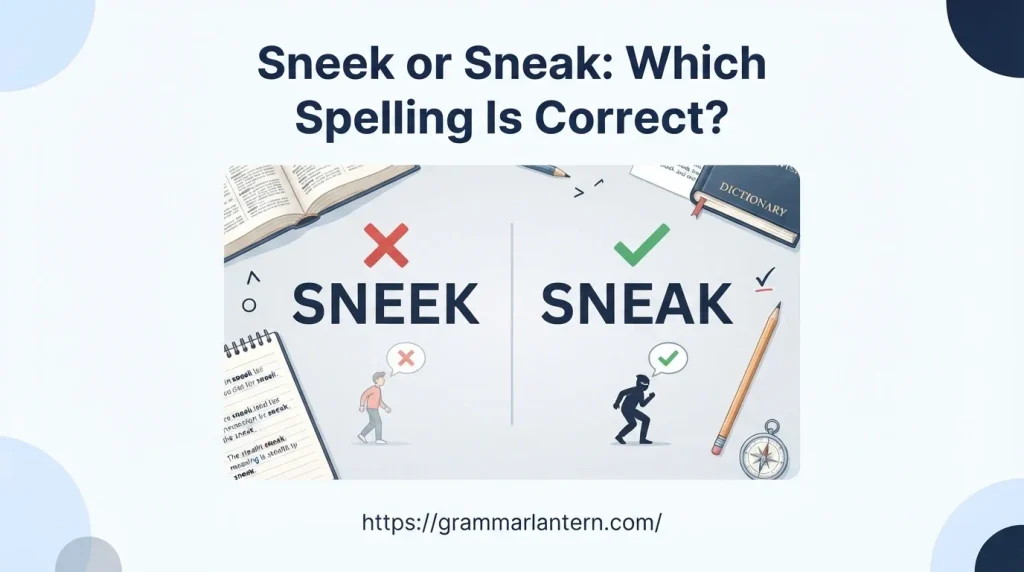
Common Mistakes to Avoid
Even a familiar word can cause spelling and grammar mistakes. The following errors are common among English learners and people typing quickly.
- Writing sneek instead of sneak: The correct spelling is sneak.
- Writing sneek peek: The correct expression is sneak peek.
- Confusing sneak with steal: Sneaking describes secrecy while stealing involves taking something without permission.
- Using snuck as the present tense: Snuck is a past-tense or past-participle form.
- Using sneak and sneaked incorrectly: Sneak is the base form while sneaked is the regular past tense.
- Assuming sneaked is wrong: Both sneaked and snuck are accepted past forms.
- Forgetting the third-person S: Write she sneaks rather than she sneak in the simple present.
- Confusing sneak peek with peak: A peek is a quick look while a peak is the top of something.
Sneak or Sneek: Incorrect and Correct Examples
| Incorrect Sentence | Correct Sentence |
| He tried to sneek out. | He tried to sneak out. |
| I wanted to sneek a look. | I wanted to sneak a look. |
| We got a sneek peek. | We got a sneak peek. |
| She will sneek into the room. | She will sneak into the room. |
| They sneeked past the guard. | They sneaked past the guard. |
| He sneak into the kitchen every night. | He sneaks into the kitchen every night. |
| I snuck yesterday and I will sneek tomorrow. | I snuck yesterday and I will sneak tomorrow. |
The biggest lesson is simple: use sneak for the present and base form. Use sneaked or snuck when talking about the past.
How to Remember the Correct Spelling
Spelling tricks can help you remember words that sound different from how they’re written. Fortunately, sneak has a few simple memory aids.
Remember the EA in Sneak
The word sneak contains ea, not ee. Try connecting it with other words that contain the same letter combination.
- Sneak
- Speak
- Break
- Clean
- Dream
These words don’t all share identical pronunciation patterns. However, seeing the letter combination can help reinforce the spelling of sneak.
Remember the Phrase Sneak Peek
The expression sneak peek is one of the easiest ways to remember the correct spelling.
Think about a movie trailer, product announcement, or preview video. Someone gives you a sneak peek before the complete release.
Whenever you remember the phrase, you’ll also remember that sneak contains ea while peek contains ee.
Use a Simple Sentence
A short memory sentence can help you remember the spelling when you’re writing quickly.
I sneak, but I never sneek.
The sentence is playful but useful. You can also practice by writing a few short examples:
- I sneak out quietly.
- She sneaks into the room.
- We sneaked past the door.
- They snuck away early.
Practice the correct spelling in complete sentences rather than memorizing isolated letters. Repeated exposure makes the word easier to recognize.
In American and British English
Spelling differences between American and British English can confuse writers. Words such as color and colour or organize and organise have accepted regional variations.
However, sneak doesn’t have a standard American or British spelling variation that changes it to sneek.
Is Sneak or Sneek Used in American English?
American English uses sneak as the standard spelling.
Examples:
- He sneaked out of the house.
- She snuck into the meeting.
- They sneaked a look at the scoreboard.
Both sneaked and snuck are used in American English. The first follows the regular past-tense pattern while the second is an accepted irregular form.
Is Sneak or Sneek Used in British English?
British English also uses sneak as the standard spelling.
Examples:
- He sneaked into the garden.
- She sneaked out of the classroom.
- The children were sneaking around the house.
British English also uses sneak in expressions such as sneak on someone, meaning to report someone’s wrongdoing, especially to an authority figure. The expression can sound disapproving or informal.
The spelling remains sneak in both American and British English. You don’t need to switch to sneek when writing for a British audience.
A Practical Proofreading Example
Imagine a student writing a short paragraph about a surprise birthday party. The original draft contains the following sentences:
We tried to sneek into the house before my sister arrived. Dad gave us a sneek peek at the decorations. Then we sneeked out through the back door.
The paragraph contains three spelling or usage mistakes. Here’s how to correct them:
| Original | Correction | Explanation |
| Sneek into the house | Sneak into the house | Sneak is the standard spelling. |
| Sneek peek | Sneak peek | The expression uses sneak and peek. |
| Sneeked out | Sneaked out | The past-tense form is sneaked or snuck. |
The corrected paragraph reads:
We tried to sneak into the house before my sister arrived. Dad gave us a sneak peek at the decorations. Then we sneaked out through the back door.
This example shows why proofreading matters. A single spelling mistake can appear several times in a paragraph when a writer doesn’t recognize the correct form.
The same principle applies to professional communication, school assignments, blogs, social media captions, and creative writing. Once you learn the spelling pattern, you can spot and correct the mistake quickly.
Read More: Witnesses or Witness’s or Witness’? Correct Possessive Explained
FAQs
1. Is sneek or sneak the correct spelling?
Sneak is the correct spelling of the English verb. Sneek is a common misspelling that may appear in informal writing, but it isn’t standard English.
2. What does sneak mean?
Sneak means to move quietly, act secretly, or do something without attracting attention. For example, someone might sneak out of a room to avoid waking others.
3. Why do people spell sneak as sneek?
People often write sneek because words like peek, seek, and week use “ee” to represent a similar vowel sound. However, the correct spelling follows the “ea” pattern in sneak.
4. Is sneek a real word?
Sneek isn’t a standard English spelling of the verb sneak. However, Sneek is a proper name for a city in the Netherlands, so it can be correct in that context.
5. How do you use sneak in a sentence?
You can use sneak when someone moves quietly or does something secretly. For example, “The children tried to sneak cookies before dinner.”
6. What is the past tense of sneak?
The past tense of sneak is sneaked. For example, “He sneaked into the kitchen to grab a snack.” Snuck is also widely used, especially in American English.
7. Is sneak a noun or a verb?
Sneak is commonly used as a verb, but it can also function as a noun. As a noun, it may describe a person who acts secretly or a quick, hidden look at something.
8. What are synonyms for sneak?
Common synonyms for sneak include creep, slip, steal, tiptoe, skulk, and lurk. The best synonym depends on the context and the type of secretive action involved.
9. Is sneak informal or formal?
Sneak is a standard English word used in both casual and formal contexts. However, expressions such as “sneak a peek” or “sneak out” are more conversational.
10. How can I remember the spelling of sneak?
Remember that sneak contains “ea,” just like words such as speak and freak. You can also practice writing sentences with sneak to reinforce the correct spelling.
Conclusion
The difference between sneek vs sneak is simple once you remember the correct spelling. Sneak is the standard English word that means moving quietly, acting secretly, or doing something without being noticed. Meanwhile, sneek is generally a spelling mistake, even though it may look reasonable because of words like peek, seek, and week.
To avoid this mistake, remember the “ea” in sneak and practice using it in everyday sentences. Whether you’re writing an email, completing schoolwork, chatting with friends, or improving your English vocabulary, choosing the correct spelling makes your writing clearer and more professional. Keep practicing, and soon sneak will feel natural to spell without second-guessing yourself.

Muhammad Haroon is the voice behind many of the clear, practical grammar guides you’ll find on Grammar Lantern. With a strong background in content writing and a genuine love for the English language, Haroon specializes in breaking down intimidating grammar topics into simple, digestible lessons. His goal is simple: to empower readers to write with confidence and clarity. Whether he’s explaining tricky tenses or demystifying punctuation, Haroon approaches each topic with patience, precision, and a touch of warmth—because he knows that learning grammar is a journey, not a race.