Choosing the correct spelling matters when you want your writing to look clear, polished, and professional. The confusion between Attornies or Attorneys often arises because English plural rules can be tricky. Many words ending in -y change to -ies when pluralized, so attornies may look correct at first glance. However, the word attorney follows a different spelling rule, and using the wrong form can create unnecessary mistakes in your writing.
Whether you’re writing legal documents, professional emails, academic assignments, or everyday messages, knowing the correct plural spelling helps you communicate confidently. Understanding how words ending in a vowel followed by y form their plurals makes this spelling easier to remember. Once you learn the rule, you can avoid similar mistakes with other words and improve your overall English grammar and spelling.
In this article, you’ll learn whether Attornies or Attorneys is correct, understand the meaning of attorney, and discover the correct pluralization rule. You’ll also see simple examples, common spelling mistakes, and practical tips for using the word in formal, professional, and informal writing. By the end, you’ll know exactly which spelling to use whenever you write about lawyers or legal professionals.
Quick Answer
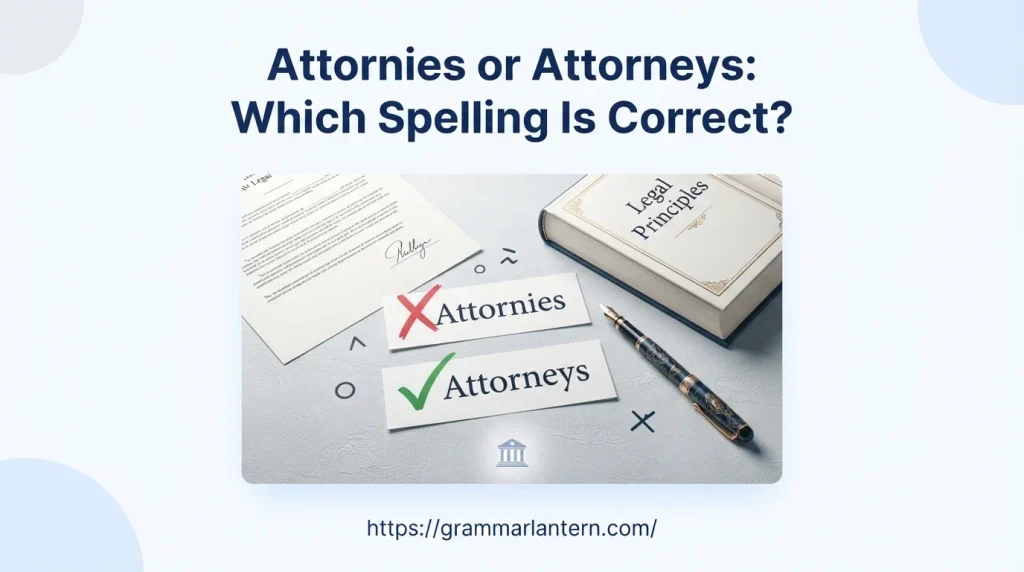
Attorneys is the correct plural spelling of attorney. Attornies is a misspelling in modern standard English and should not be used in professional or everyday writing.
The word attorney ends in -ey, so you simply add s to form its plural. You don’t change the y to ies.
| Word | Correct or Incorrect | Explanation |
| Attorney | Correct | Singular form of the noun |
| Attorneys | Correct | Standard plural form |
| Attornies | Incorrect | Applies the wrong pluralization rule |
Examples:
- Correct: Several attorneys attended the meeting.
- Incorrect: Several attornies attended the meeting.
- Correct: The company hired two experienced attorneys.
Remember this simple rule: Attorney + s = Attorneys.
Why Is Attorneys the Correct Spelling?
The spelling attorneys follows a straightforward pluralization rule. When a noun ends in a vowel followed by y, you usually add s to form the plural. The word attorney ends with the letters e and y. Since the letter before y is a vowel, the spelling stays the same.
This rule applies to many English words. You don’t need to remove the final y or replace it with ies. Just add an s at the end.
The Vowel + Y Rule
When a noun ends in a vowel + y, add s to make it plural. The final y remains unchanged.
Here are some common examples:
| Singular | Plural |
| Attorney | Attorneys |
| Boy | Boys |
| Day | Days |
| Key | Keys |
| Toy | Toys |
| Monkey | Monkeys |
| Journey | Journeys |
| Valley | Valleys |
| Donkey | Donkeys |
| Essay | Essays |
Notice how each word keeps its original spelling before adding s. The same pattern applies to attorney. You don’t need to change anything except adding the plural ending.
For example:
- One attorney handles the case.
- Two attorneys handle the case.
- Several attorneys work for the firm.
- The attorneys prepared their arguments.
The word remains attorney in its base form. Only the plural marker changes.
The Consonant + Y Rule
The confusion often comes from another pluralization rule. When a noun ends in a consonant followed by y, you usually change the y to ies.
For example:
| Singular | Plural |
| City | Cities |
| Baby | Babies |
| Party | Parties |
| Country | Countries |
| Company | Companies |
| Family | Families |
| Story | Stories |
| Lady | Ladies |
| Cherry | Cherries |
| Puppy | Puppies |
In these words, a consonant comes directly before the final y. That’s why the plural form changes.
Compare the two patterns:
- Attorney → Attorneys (vowel + y)
- City → Cities (consonant + y)
- Key → Keys (vowel + y)
- Baby → Babies (consonant + y)
The letter before the final y determines the rule. This simple detail explains why attorneys is correct and attornies is not.
Why Do People Write Attornies Instead of Attorneys?
The misspelling attornies usually comes from applying the consonant + y rule incorrectly. Many writers remember that words ending in y often change to ies. However, they forget that the rule only applies when a consonant appears before the final y.
Because attorney ends in y, writers may assume the plural should become attornies. The word looks familiar in that form because English contains many plurals with the same ending.
For example:
- Cities
- Companies
- Families
- Parties
- Stories
These examples can create a misleading pattern. A writer may apply it to attorney without checking the preceding letter.
Why This Spelling Mistake Is Common
Several factors make attornies an easy mistake:
- Overgeneralization: Writers apply the consonant + y rule to every word ending in y.
- Visual familiarity: The ending -ies appears in many common English plurals.
- Fast typing: People may write the word quickly without checking its spelling.
- Limited proofreading: A misspelling can remain unnoticed in emails, articles, and documents.
- Uncertainty about legal vocabulary: Readers may encounter attorney less often than everyday words such as city or family.
The mistake isn’t difficult to fix. Once you recognize the vowel before the final y, the correct spelling becomes easier to remember.
Read More: Midday or Mid-Day: Which Spelling Is Correct?
What Does Attorney Mean?
An attorney is generally a legal professional who provides legal services, advises clients, or represents people and organizations in legal matters. In American English, attorney and lawyer are often used interchangeably.
However, the word attorney can also have a broader meaning. It may refer to someone who has legal authority to act on behalf of another person. The meaning depends on the context.
For example, an attorney may help someone understand a contract, represent a client in court, negotiate a settlement, or prepare legal paperwork.
Attorney as a Lawyer
In everyday American English, an attorney commonly refers to a lawyer who practices law and provides legal assistance.
Attorneys may work in different areas of law, including:
- Criminal law
- Family law
- Corporate law
- Immigration law
- Real estate law
- Employment law
- Civil litigation
- Estate planning
- Intellectual property law
Their responsibilities depend on their specialization, qualifications, jurisdiction, and the needs of their clients.
For instance, a criminal defense attorney represents someone accused of a crime. A family law attorney may handle divorce, custody, or adoption matters. Meanwhile, a corporate attorney may help businesses prepare contracts and manage legal risks.
Attorney as an Authorized Representative
The word attorney can also describe someone authorized to act for another person in a legal or financial matter.
A common example is an attorney-in-fact, who receives authority through a power of attorney document. This person may handle certain financial, property, or personal matters on behalf of another individual.
An attorney-in-fact doesn’t necessarily have to be a licensed lawyer. The person’s authority comes from the legal document that appoints them and the powers it grants.
This distinction matters because the word attorney doesn’t always mean someone who practices law professionally.
Attorneys or Attornies in Sentences
The best way to remember a spelling rule is to see it in action. The following examples show how to use attorneys correctly in different situations.
Examples Using Attorneys
- The attorneys reviewed the contract before the company signed it.
- Three attorneys represented the defendant during the hearing.
- Both attorneys agreed to discuss a possible settlement.
- Several attorneys attended the legal conference.
- The firm hired two experienced attorneys last month.
- Our attorneys prepared the documents for the upcoming transaction.
- The company’s attorneys examined the agreement carefully.
- Many attorneys specialize in employment law.
- The attorneys presented their arguments before the judge.
- Four attorneys worked together on the complex case.
In each sentence, attorneys refers to more than one legal professional or authorized representative.
Incorrect Examples Using Attornies
Here are some sentences that contain the incorrect spelling:
- The attornies prepared the legal documents.
- Several attornies attended the hearing.
- The company contacted three attornies.
- Two attornies reviewed the contract.
- The attornies represented the client.
Each sentence should use attorneys instead of attornies.
| Incorrect sentence | Correct sentence |
| The attornies reviewed the case. | The attorneys reviewed the case. |
| Three attornies attended court. | Three attorneys attended court. |
| Several attornies contacted the client. | Several attorneys contacted the client. |
The sentence structure doesn’t change. You only need to correct the spelling of the plural noun.
Singular and Plural
The difference between attorney and attorneys is simply the number of people being discussed. Use the singular form when referring to one attorney. Use the plural form when referring to two or more.
| Singular | Plural | Example |
| Attorney | Attorneys | One attorney reviewed the document. |
| Attorney | Attorneys | Two attorneys reviewed the document. |
| Attorney | Attorneys | Several attorneys represented the clients. |
When to Use Attorney
Use attorney when referring to one person. The singular form usually appears with a, an, the, or another singular determiner.
Examples:
- She hired an attorney to review her lease.
- The attorney explained the legal options.
- I spoke with a criminal defense attorney yesterday.
- Every attorney must follow applicable professional rules.
- That attorney specializes in business disputes.
When to Use Attorneys
Use attorneys when referring to multiple people. It commonly appears with numbers, plural determiners, and expressions of quantity.
Examples:
- The company hired two attorneys.
- Several attorneys attended the seminar.
- Both attorneys agreed with the proposal.
- Many attorneys work in private practice.
- The firm employs experienced attorneys across several practice areas.
How Quantity Changes the Sentence
Changing attorney to attorneys may also change the verb. Singular nouns usually take singular verbs in the present tense, while plural nouns take plural verbs.
| Singular sentence | Plural sentence |
| The attorney works late. | The attorneys work late. |
| An attorney handles the matter. | Attorneys handle the matters. |
| The attorney is available. | The attorneys are available. |
| The attorney has reviewed the contract. | The attorneys have reviewed the contract. |
Pay attention to both the noun and the verb. Correct spelling is important, but grammatical agreement makes the entire sentence sound natural.
Attorneys, Attorney’s, and Attorneys’: What’s the Difference?
These three forms look similar, yet they serve different grammatical purposes. The difference involves number and possession.
| Word | Meaning | Example |
| Attorney | One legal professional or representative | The attorney called today. |
| Attorneys | More than one attorney | The attorneys called today. |
| Attorney’s | Singular possessive or contraction | The attorney’s office is open. |
| Attorneys’ | Plural possessive | The attorneys’ offices are open. |
Understanding these forms will help you avoid mistakes in emails, legal articles, business documents, and everyday writing.
When to Use Attorney’s
Attorney’s usually indicates possession by one attorney. The apostrophe comes before the s because the noun is singular.
Examples:
- The attorney’s office is on the second floor.
- I reviewed the attorney’s advice.
- The attorney’s client requested additional information.
- We followed the attorney’s instructions.
- The attorney’s decision surprised everyone.
In each example, something belongs to or relates to one attorney.
However, attorney’s can also represent a contraction of attorney is or attorney has in certain sentences.
For example:
- The attorney’s available this afternoon. (Attorney is)
- The attorney’s already reviewed the agreement. (Attorney has)
In formal legal writing, contractions are generally avoided. In conversational writing, they may be acceptable depending on the tone.
When to Use Attorneys’
Attorneys’ is the plural possessive form. It indicates that something belongs to, relates to, or is associated with multiple attorneys.
Examples:
- The attorneys’ offices are located downtown.
- We discussed the attorneys’ recommendations.
- The attorneys’ schedules were difficult to coordinate.
- The attorneys’ clients attended the meeting.
- The attorneys’ arguments differed considerably.
The apostrophe comes after the plural s because the noun already has its plural ending.
Common Apostrophe Mistakes
Writers often confuse plural and possessive forms. Here’s how to avoid the most common errors.
| Incorrect | Correct | Reason |
| The attorney’s attended court. | The attorneys attended court. | No possession is involved. |
| The attorneys office is closed. | The attorney’s office is closed. | One attorney owns or uses the office. |
| The attorney’s offices are closed. | The attorneys’ offices are closed. | Multiple attorneys’ offices are being discussed. |
| The attorneys’ attended court. | The attorneys attended court. | The apostrophe is unnecessary. |
A useful trick is to ask yourself whether something belongs to someone. If not, you probably don’t need an apostrophe.
Attorneys vs. Lawyers: Are They the Same?
In American English, attorney and lawyer generally refer to legal professionals. People commonly use both terms when discussing someone who practices law, offers legal advice, or represents clients.
For example:
- She is an experienced attorney.
- She is an experienced lawyer.
Both sentences communicate essentially the same idea in ordinary American conversation.
However, the terms can have slightly different meanings depending on the legal system and context. Attorney can refer to someone authorized to act on another person’s behalf. Lawyer generally refers to someone trained in law, though qualifications and professional titles vary internationally.
Key Differences Between Attorney and Lawyer
| Attorney | Lawyer |
| Commonly used in American English for legal practitioners | Also commonly used for legal practitioners |
| Can refer to someone authorized to represent another person | Usually refers to someone trained in or professionally connected with law |
| Appears in terms such as attorney-in-fact | Used broadly in everyday conversation |
| May have a specific meaning in legal documents | Meaning can vary across jurisdictions |
These terms often overlap. Still, you should consider the relevant legal jurisdiction before treating them as identical in every formal context.
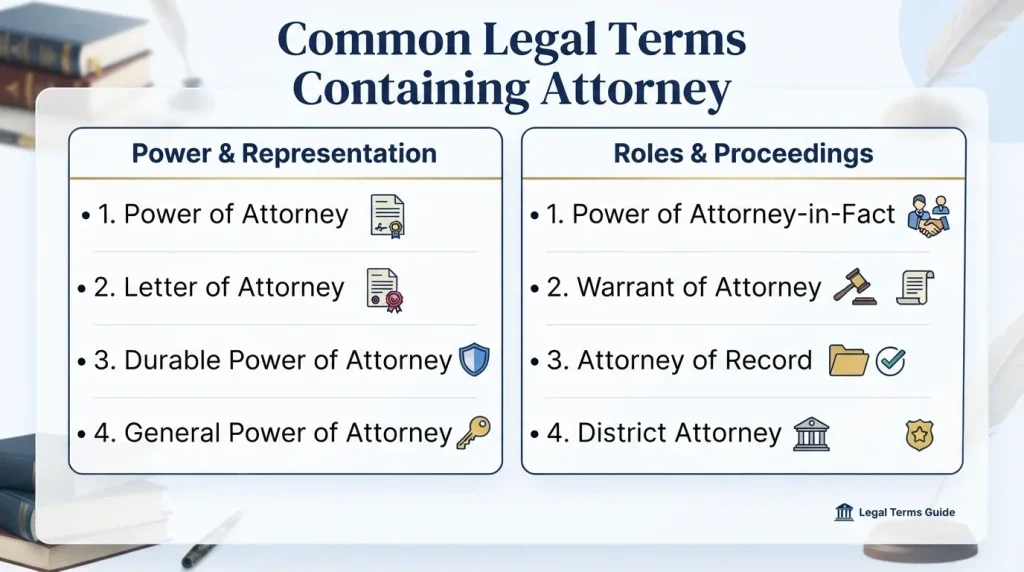
Common Legal Terms Containing Attorney
The word attorney appears in several legal expressions. Some follow ordinary plural rules while others have special forms that can surprise English learners.
Attorney-at-Law
An attorney-at-law generally refers to a lawyer who is qualified to practice law in a particular jurisdiction.
The term often appears in formal legal documents, professional titles, and law firm descriptions.
Examples:
- She is an attorney-at-law licensed in her state.
- The attorney-at-law prepared the court filing.
- Several attorneys-at-law attended the professional conference.
The standard plural is attorneys-at-law.
Notice that the plural ending appears on attorneys, not on every word in the compound expression.
Attorney-in-Fact
An attorney-in-fact is someone appointed to act on behalf of another person under a power of attorney.
The person may receive authority to manage financial matters, sign documents, handle transactions, or perform other duties specified in the document. The exact authority depends on the legal arrangement and applicable law.
An attorney-in-fact does not necessarily have to be a licensed lawyer.
The plural form is attorneys-in-fact.
For example:
- The document named two attorneys-in-fact.
- Her brother served as her attorney-in-fact.
- The attorneys-in-fact handled the authorized financial transactions.
Attorney General
An attorney general is a senior legal official who serves as the chief legal adviser or law enforcement authority for a government, depending on the jurisdiction.
The plural form is unusual because it becomes attorneys general, not attorney generals in traditional standard usage.
Examples:
- The attorney general issued a public statement.
- Several attorneys general signed the agreement.
- The attorneys general discussed the proposed legislation.
This expression follows a different pattern because attorney general is a compound title. The word attorney becomes plural while general remains unchanged.
Power of Attorney
A power of attorney is a legal document that authorizes one person to act for another within specified limits.
Depending on the document and local law, the appointed representative may be able to:
- Manage financial accounts.
- Pay bills.
- Handle certain property matters.
- Sign authorized documents.
- Make specified administrative decisions.
A power of attorney doesn’t automatically grant unlimited authority. The document defines the powers, and applicable laws govern how those powers may be used.
Examples:
- She granted her brother power of attorney.
- The attorney reviewed the power of attorney document.
- The attorneys helped prepare the necessary paperwork.
This expression is especially useful to understand because it connects the word attorney with its broader meaning of legal authorization.
Is Attornies Ever Correct?
The spelling attornies may occasionally appear in older texts, historical records, or outdated publications. However, it isn’t the standard plural spelling in modern English.
Today’s dictionaries and contemporary writing use attorneys. If you’re writing an article, email, legal document, academic assignment, or business communication, use attorneys.
Historical or Outdated Usage
English spelling has changed over centuries. Older documents sometimes contain spellings that differ from modern conventions. A historical spelling may appear in archived legal documents or older books.
That doesn’t mean you should use it in current writing. Modern spelling conventions favor attorneys, and readers expect that form.
| Context | Recommended spelling |
| Modern blog articles | Attorneys |
| Business emails | Attorneys |
| Legal correspondence | Attorneys |
| Academic writing | Attorneys |
| Contemporary books | Attorneys |
| Historical quotation containing the original spelling | Preserve the spelling when quoting accurately |
If you’re transcribing a historical document, keep the original spelling when accuracy requires it. Otherwise, use the modern standard form.
How to Remember
Spelling rules can feel confusing when several patterns compete for your attention. Fortunately, you can remember attorneys with a few simple tricks.
Keep the EY and Add S
Look at the ending of attorney. It contains ey, so you don’t change the y.
- Attorney + s = Attorneys
- Boy + s = Boys
- Key + s = Keys
- Day + s = Days
Think of the word as having a fixed ending. The y stays right where it is.
Check the Letter Before Y
When you’re unsure about a plural ending, check the letter immediately before y.
- If a vowel comes before y, usually add s.
- If a consonant comes before y, usually change y to ies.
For example:
| Vowel + Y | Consonant + Y |
| Attorney → Attorneys | City → Cities |
| Key → Keys | Baby → Babies |
| Toy → Toys | Party → Parties |
| Day → Days | Country → Countries |
This quick check works for many everyday nouns and prevents the common attornies mistake.
Remember the Legal Team
Imagine one attorney standing in a courtroom. Add another attorney and you have a team of attorneys.
The spelling doesn’t need to change dramatically. Simply add s to the singular noun.
One attorney, two attorneys, several attorneys.
That’s the whole rule.
Read More: Witnesses or Witness’s or Witness’? Correct Possessive Explained
Common Mistakes to Avoid
Even though attorneys is a simple plural, writers sometimes make related grammar mistakes. Understanding these errors will help you use the word confidently.
Changing Y to IES Incorrectly
Incorrect: The firm hired several attornies.
Correct: The firm hired several attorneys.
The final y follows a vowel, so it stays unchanged.
Using an Apostrophe for a Simple Plural
Incorrect: The firm’s attorneys’ attended the meeting.
Correct: The firm’s attorneys attended the meeting.
A simple plural doesn’t need an apostrophe. Use one only when possession or a contraction requires it.
Confusing Attorneys With Attorney’s
Incorrect: Two attorney’s reviewed the agreement.
Correct: Two attorneys reviewed the agreement.
The sentence refers to two people. It doesn’t express possession.
Using Attorneys’ for a Singular Possessive
Incorrect: The attorneys’ office was closed. (When referring to one attorney’s office.)
Correct: The attorney’s office was closed.
The singular possessive requires an apostrophe before s.
Forgetting the Special Plural Attorney General
Incorrect: Three attorney generals attended the event.
Traditional standard plural: Three attorneys general attended the event.
This expression follows the pluralization pattern of the compound title rather than the ordinary plural rule.
Quick Comparison
Here’s a quick reference table you can revisit whenever you need to check the spelling.
| Feature | Attorneys | Attornies |
| Correct modern spelling | Yes | No |
| Standard plural of attorney | Yes | No |
| Used in professional writing | Yes | No |
| Accepted in contemporary standard English | Yes | No |
| Plural formation | Attorney + s | Incorrect y-to-ies change |
| Recommended for articles and documents | Yes | No |
The correct spelling is always attorneys in modern standard English.
A Practical Proofreading Example: Correcting Attornies
Imagine you’re preparing a business article about legal services. Your first draft contains the sentence:
The company contacted three attornies to review its new contract.
The sentence communicates the right idea, but the plural spelling is incorrect. Applying the vowel + y rule fixes the problem.
Edited sentence:
The company contacted three attorneys to review its new contract.
Here’s what changed:
| Original | Correction | Reason |
| Attornies | Attorneys | The word ends in vowel + y, so add s. |
| Three attornies | Three attorneys | The plural form needs no apostrophe. |
| Attornies to review | Attorneys to review | The spelling correction preserves the meaning. |
This small edit makes the sentence more polished and professional. The same rule applies whether you’re writing a legal article, a business email, a school assignment, or a casual message.
FAQs
1. Is attornies or attorneys the correct spelling?
Attorneys is the correct standard plural spelling of attorney. The word attornies is a common misspelling and should be avoided in formal, academic, and professional writing.
2. Why is attorneys correct instead of attornies?
The word attorney ends with a vowel followed by y. According to the English pluralization rule, words ending in a vowel + y usually add -s rather than changing y to -ies. Therefore, attorney becomes attorneys.
3. What is the singular form of attorneys?
The singular form is attorney. You use it when referring to one lawyer or legal representative. For example, “My attorney reviewed the contract before I signed it.”
4. What does the word attorney mean?
An attorney is a legal professional authorized to represent clients, provide legal advice, or perform certain legal duties. The exact responsibilities and qualifications may vary depending on the jurisdiction.
5. Is attornies ever considered correct?
No, attornies is not the standard spelling in modern English. Although people sometimes use it because of the common -y to -ies plural rule, the correct spelling is attorneys.
6. How do you pronounce attorneys?
Attorneys is pronounced approximately as uh-TUR-neez. The final syllable sounds like “knees,” making the plural ending easy to recognize when spoken.
7. Can I use attorneys in professional or legal documents?
Yes, attorneys is the correct spelling for professional emails, legal documents, contracts, academic papers, business communication, and other formal writing when referring to more than one attorney.
8. What is the plural rule for words ending in vowel + y?
Words ending in a vowel followed by y generally form their plurals by adding -s. For example, boy becomes boys, key becomes keys, day becomes days, and attorney becomes attorneys.
9. What is the difference between attorney and attorneys?
Attorney refers to one legal professional, while attorneys refers to two or more legal professionals. The difference is simply the plural form, which adds -s to the singular word.
10. How can I remember the correct spelling of attorneys?
Remember that attorney ends in -ey, not a consonant followed by y. When the word ends in a vowel + y, simply add s. Think of key → keys and attorney → attorneys to remember the pattern.
Conclusion
Choosing between attornies or attorneys becomes simple once you understand the pluralization rule. Attorneys is the correct spelling because attorney ends in a vowel followed by y. In this case, you simply add s to form the plural instead of changing y to -ies. Although attornies may look reasonable at first, it is not the standard spelling and should be avoided.
Whenever you write about lawyers, legal professionals, or court-related matters, use attorneys in your sentences, emails, academic assignments, and official documents. Remember the simple pattern attorney → attorneys, just like boy → boys and key → keys. Keeping this rule in mind will help you avoid spelling mistakes and make your writing more accurate, confident, and professional.

For Shafiq ur Rehman, writing is an art form and grammar is the toolbox that makes it beautiful. As a dedicated content writer at Grammar Lantern, Shafiq approaches every topic like an architect carefully laying down strong foundations of understanding before adding the finer details. He loves diving into the trickiest grammar points and resurfacing with simple, bite-sized takeaways that anyone can grasp. When he’s not crafting articles, you’ll likely find him strategizing over a game of chess, exploring dusty local bookshops, or quietly jotting down poetic observations in his notebook.