Have you ever stopped while writing because you weren’t sure whether to use Bosses, Boss’s, or Bosses’? These forms look similar, but each serves a different purpose in English grammar. Bosses is the regular plural noun for more than one boss. Boss’s is the singular possessive form, showing that something belongs to one boss. Meanwhile, Bosses’ is the plural possessive form, indicating ownership by multiple bosses.
The easiest way to remember these grammar rules is to check the apostrophe placement. The word Bosses needs no apostrophe because it simply refers to several people. Boss’s adds an apostrophe + s to show ownership, as in the boss’s office or my boss’s desk. However, Bosses’ uses only an apostrophe after the final s, as in the bosses’ offices. Some traditional guides, including AP style, accept Boss’, while Chicago generally prefers Boss’s.
Understanding these differences makes everyday writing easier and improves your punctuation. For example, the bosses arrived at a meeting, but the boss’s office belongs to one person. Similarly, our bosses’ conference refers to something involving multiple bosses. Always consider the intended meaning before choosing a form. Once you understand singular ownership, plural meaning, and possessive usage, selecting the correct spelling becomes much simpler.
Quick Answer
The correct choice depends on whether you’re talking about multiple supervisors or showing possession. Here’s a quick breakdown:
| Word | Grammatical function | Meaning | Example |
| Bosses | Plural noun | More than one boss | The bosses attended the meeting. |
| Boss’s | Singular possessive | Something belonging to one boss | My boss’s office is upstairs. |
| Boss’ | Alternative singular possessive | Something belonging to one boss | My boss’ office is upstairs. |
| Bosses’ | Plural possessive | Something belonging to multiple bosses | The bosses’ offices are upstairs. |
Remember these simple rules:
- Use bosses when referring to two or more bosses.
- Use boss’s when something belongs to one boss. This is the standard form in most modern American English writing.
- Use boss’ when following a style convention that forms certain singular possessives with an apostrophe alone.
- Use bosses’ when something belongs to multiple bosses.
The apostrophe matters because it shows possession. Without it, the word generally indicates a plural noun rather than ownership.
What Does Bosses Mean?
Bosses is the plural form of the noun boss. It refers to two or more people who supervise employees, manage teams, or hold positions of authority.
The word boss becomes bosses by adding -es to the end. This spelling follows a common English pluralization rule for nouns ending in certain sibilant sounds, including s, sh, ch, x, and z.
For example:
- Boss → Bosses
- Class → Classes
- Dish → Dishes
- Church → Churches
- Box → Boxes
Notice that bosses doesn’t contain an apostrophe. That’s because you’re simply making the noun plural rather than showing ownership.
When to Use Bosses
Use bosses whenever you’re discussing multiple supervisors or managers.
Here are some common situations:
- Talking about multiple managers: Several bosses attended the company conference.
- Discussing workplace relationships: Some employees have supportive bosses.
- Describing management decisions: The bosses agreed to change the working schedule.
- Referring to different supervisors: Both bosses approved the new project.
- Discussing workplace experiences: Many people appreciate bosses who communicate clearly.
In each example, the word identifies more than one person. It doesn’t indicate that anything belongs to them.
Bosses in Example Sentences
Consider these additional examples:
- The bosses discussed the company’s upcoming expansion.
- Both bosses approved my request for annual leave.
- Our bosses expect everyone to arrive on time.
- The new employees met their bosses during orientation.
- Several bosses attended the leadership development program.
- Their bosses encouraged them to share fresh ideas.
Why are these sentences correct?
Each sentence refers to multiple supervisors. No apostrophe is necessary because the noun simply identifies more than one boss.
A useful trick is to replace bosses with managers. If the sentence still makes sense, you’re probably using the plural form correctly.
What Does Boss’s Mean?
Boss’s is the singular possessive form of boss. It shows that something belongs to, relates to, or is associated with one supervisor.
To create this form, start with the singular noun boss. Then add an apostrophe followed by another s.
The structure looks like this:
Boss + ‘s = Boss’s
This follows the standard rule for forming the possessive of most singular nouns, including those that already end in the letter s.
For example:
- The teacher’s desk.
- The manager’s decision.
- The employee’s responsibility.
- The boss’s office.
The additional s doesn’t create another boss. It marks the possessive relationship.
Read More: Others or Other’s or Others’? Correct Possessive Explained
When to Use Boss’s
Use boss’s when you’re talking about something connected to one particular boss.
The connection doesn’t always mean physical ownership. It can also describe responsibilities, decisions, opinions, instructions, or relationships.
Here are some common examples:
- Possession: My boss’s laptop is on the desk.
- Workplace authority: The boss’s decision surprised everyone.
- Personal belongings: I borrowed my boss’s notebook.
- Responsibilities: The boss’s duties include managing the department.
- Communication: I followed my boss’s instructions.
- Workplace location: My boss’s office is near the reception area.
In each situation, the word refers to one boss.
Boss’s in Example Sentences
Let’s look at several examples to understand how this possessive form works naturally.
- My boss’s office has a large conference table.
- The boss’s instructions were clear and easy to follow.
- Everyone respected the boss’s decision.
- I received my boss’s approval before submitting the report.
- The boss’s schedule changed because of an unexpected meeting.
- Her boss’s feedback helped her improve the presentation.
- The boss’s assistant organized the appointments.
- We discussed the boss’s expectations during orientation.
Each sentence connects something to one supervisor.
For example, in my boss’s office, the office belongs to or is associated with one boss. The apostrophe appears before the final s because the word uses the singular possessive structure.
Does Boss’s Have Two S’s?
Yes. The spelling boss’s contains two consecutive letter s’s around the apostrophe.
One s belongs to the original word boss. The second s forms the possessive ending.
Although this spelling might look unusual at first, it’s grammatically standard.
Other examples follow the same pattern:
- James’s car.
- Class’s schedule.
- Business’s success.
- Dress’s color.
- Boss’s responsibility.
When writing in American English, boss’s is generally the preferred singular possessive form.
What Does Boss’ Mean?
Boss’ is an alternative singular possessive spelling of boss. It expresses the same basic meaning as boss’s: something belongs to or relates to one boss.
The difference comes from the punctuation convention used by a particular style guide or publication.
Some writing conventions form certain singular possessives ending in s by adding only an apostrophe. Under this approach, the spelling becomes boss’ rather than boss’s.
For example:
- The boss’ office is upstairs.
- I followed my boss’ instructions.
- The boss’ decision surprised everyone.
These sentences use the apostrophe-only convention.
However, writers should understand an important distinction: boss’s is the more widely recommended form in standard American English, while boss’ is a style-dependent alternative.
When to Use Boss’
Use boss’ when your organization’s writing rules, publication requirements, or chosen style guide specifically prefer the apostrophe-only convention.
You might encounter this spelling in:
- Company documents following a particular house style.
- Publications that omit an additional s in selected possessives.
- Edited material that follows an established punctuation convention.
- Older or traditional writing that uses apostrophe-only possessives.
Consistency matters more than switching between forms whenever one looks better.
For instance, if a company requires boss’, follow that spelling throughout the document. Don’t use boss’s in one paragraph and boss’ in another without a clear reason.
Boss’ in Example Sentences
Here are examples using the apostrophe-only convention:
- My boss’ office is located on the third floor.
- The boss’ instructions helped the team finish early.
- Everyone agreed with the boss’ decision.
- I attended my boss’ retirement celebration.
- The boss’ schedule changed unexpectedly.
The meaning remains the same as the corresponding sentences with boss’s.
The difference is purely a matter of possessive style rather than meaning.
Key Differences
Although these spellings look similar, they perform different grammatical jobs. Understanding their functions makes it easier to choose the right one.
| Feature | Bosses | Boss’s | Boss’ |
| Word type | Plural noun | Singular possessive | Alternative singular possessive |
| Refers to | Multiple bosses | One boss | One boss |
| Shows possession | No | Yes | Yes |
| Contains an apostrophe | No | Yes | Yes |
| Standard usage | Yes | Yes | Style-dependent |
| Example | The bosses arrived. | The boss’s car arrived. | The boss’ car arrived. |
The easiest way to remember the distinction is to identify what your sentence communicates.
Bosses answers the question, “How many bosses?”
Boss’s and boss’ answer the question, “What belongs to one boss?”
However, there’s another form worth learning: bosses’. It expresses possession by multiple bosses.
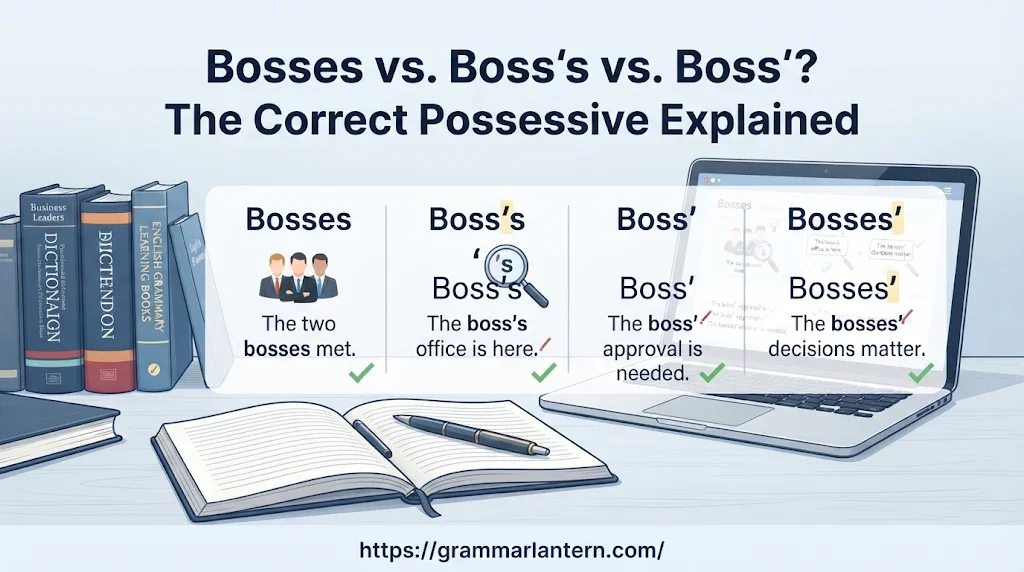
What Is the Difference Between Boss’s and Bosses’?
This distinction causes considerable confusion because both forms indicate ownership. The difference lies in the number of people involved.
Boss’s indicates possession by one boss. Meanwhile, bosses’ indicates possession by two or more bosses.
Let’s compare them.
Boss’s: Singular Possessive
Use boss’s when one supervisor owns something or has a particular connection to it.
Examples:
- My boss’s office is spacious.
- The boss’s car is parked outside.
- Sarah followed her boss’s advice.
- The boss’s presentation impressed the clients.
Each example refers to one supervisor.
Bosses’: Plural Possessive
Use bosses’ when multiple supervisors share ownership or have a connection to something.
To form this spelling, first make the noun plural:
Boss → Bosses
Then place the apostrophe after the final s:
Bosses + ‘ = Bosses’
Examples:
- The bosses’ meeting starts at noon.
- The bosses’ offices are on the fourth floor.
- We discussed the bosses’ expectations.
- The bosses’ decisions affected the entire department.
The apostrophe comes after the final s because the noun is already plural.
Boss’s vs. Bosses’ Example Sentences
Consider these sentence pairs:
| Singular possession | Plural possession |
| The boss’s office is locked. | The bosses’ offices are locked. |
| My boss’s decision was final. | My bosses’ decisions were final. |
| The boss’s meeting starts at nine. | The bosses’ meeting starts at nine. |
| The boss’s responsibilities increased. | The bosses’ responsibilities increased. |
Notice that the surrounding sentence often provides clues about whether you’re discussing one person or several.
For example:
- The boss’s meeting: A meeting associated with one boss.
- The bosses’ meeting: A meeting associated with multiple bosses.
The noun following the possessive doesn’t have to be plural. Multiple bosses can share one meeting, office, or project.
What Is the Plural Possessive Form of Boss?
The plural possessive form of boss is bosses’.
This spelling indicates that something belongs to, involves, or relates to multiple supervisors.
The formation requires two simple steps:
Step One: Make the noun plural.
Change boss to bosses.
Step Two: Add an apostrophe after the final s.
Change bosses to bosses’.
Here are some practical examples:
- The bosses’ conference room was recently renovated.
- The bosses’ decisions changed the company’s direction.
- The bosses’ responsibilities include employee development.
- The bosses’ schedules overlap on Fridays.
- The bosses’ signatures appear on the agreement.
Shared Ownership vs. Separate Ownership
Sometimes, the context determines whether multiple people share something or have separate possessions.
Compare these examples:
Shared ownership:
The bosses’ office is being renovated.
This sentence suggests that multiple bosses use or share one office.
Separate ownership:
The bosses’ offices are being renovated.
Here, each boss has an office, and multiple offices are involved.
The apostrophe stays in the same position. The following noun provides additional information about the ownership arrangement.
How to Make Words Ending in S Possessive
English possessive rules can feel tricky when a noun already ends in s. However, the process becomes straightforward once you distinguish singular and plural nouns.
The key is to determine whether the original noun identifies one person or multiple people.
Singular Nouns Ending in S
For most singular nouns, add ‘s to form the possessive.
This rule applies even when the noun already ends in s.
Examples:
| Singular noun | Singular possessive |
| Boss | Boss’s |
| James | James’s |
| Class | Class’s |
| Dress | Dress’s |
| Business | Business’s |
| Witness | Witness’s |
For example:
- James’s car needs new tires.
- The class’s schedule changed.
- The business’s profits increased.
- The witness’s statement provided useful details.
The same basic principle applies to boss’s.
Some style guides use different conventions for particular names or words ending in s. Therefore, check the required style guide when writing for a specific publication.
Plural Nouns Ending in S
Regular plural nouns that already end in s generally take only an apostrophe to form the possessive.
Examples:
| Plural noun | Plural possessive |
| Bosses | Bosses’ |
| Teachers | Teachers’ |
| Managers | Managers’ |
| Employees | Employees’ |
| Students | Students’ |
| Writers | Writers’ |
For example:
- The teachers’ lounge is downstairs.
- The managers’ meeting lasted two hours.
- The employees’ requests were reviewed.
- The students’ projects received positive feedback.
Notice the difference between the singular and plural forms:
- One boss → boss’s
- Multiple bosses → bosses’
This distinction applies to many other regular English nouns.
Why Different Style Guides Use Different Rules
English punctuation conventions aren’t always identical across every style guide.
Some guides recommend adding ‘s to singular nouns ending in s. Others permit or prefer an apostrophe alone in certain situations.
For example, Chicago-style guidance generally favors boss’s for a singular possessive. Certain house styles and traditional conventions may use boss’ instead.
The main difference concerns how writers form singular possessives. Both conventions aim to show the same grammatical relationship.
When writing professionally, consider these points:
- Follow the style guide required by your employer or publisher.
- Use one possessive convention consistently.
- Prefer boss’s when no special style requirement applies in standard American English.
- Don’t confuse singular possessives with regular plural possessives.
A consistent document looks more polished and prevents unnecessary punctuation confusion.
Common Mistakes
Even experienced writers sometimes mix up these forms. The problem usually occurs when someone focuses on the spelling instead of the sentence’s meaning.
Here are several mistakes worth avoiding.
Using Bosses’ for One Boss
Incorrect: My bosses’ office is on the second floor.
Correct: My boss’s office is on the second floor.
If you’re referring to one supervisor, use the singular possessive form.
The plural possessive bosses’ suggests that multiple bosses are involved.
Writing Boss’s for Multiple Bosses
Incorrect: The boss’s attended the meeting.
Correct: The bosses attended the meeting.
The incorrect version adds an apostrophe even though the sentence simply needs a plural noun.
Remember that pluralization alone doesn’t require an apostrophe.
Adding an Apostrophe to Bosses Without Showing Possession
Incorrect: Several boss’s attended the conference.
Correct: Several bosses attended the conference.
The sentence identifies multiple supervisors rather than something belonging to them.
Therefore, the apostrophe has no grammatical purpose.
Confusing Boss’ With Bosses’
Incorrect: The bosses’ office is reserved for one supervisor.
Correct: The boss’s office is reserved for one supervisor.
If the sentence refers to one boss, use boss’s in standard American English. The alternative boss’ may also follow an accepted house style.
Don’t confuse that singular form with bosses’, which indicates plural possession.
Switching Between Possessive Styles
Incorrect: My boss’s instructions were clear, but my other boss’ expectations were different.
This example mixes two singular possessive conventions.
A consistent version would be:
My boss’s instructions were clear, but my other boss’s expectations were different.
Alternatively, a publication following the apostrophe-only convention might use boss’ in both places.
Consistency makes your writing easier to edit and understand.
How to Choose the Correct Form
You don’t need to memorize dozens of complicated grammar rules. A simple decision-making process can help you select the correct spelling.
A Simple Decision-Making Method
Ask yourself these questions before writing:
Are you talking about more than one boss?
If yes, use bosses.
Example: The bosses attended the annual conference.
Does something belong to one boss?
If yes, use boss’s in standard American English.
Example: My boss’s computer needs an update.
Does your required style guide prefer an apostrophe-only singular possessive?
If yes, use boss’.
Example: My boss’ computer needs an update.
Does something belong to multiple bosses?
If yes, use bosses’.
Example: The bosses’ computers need updates.
This method works because it separates two important grammatical questions: number and possession.
Quick Memory Tricks
Use these simple reminders:
- Bosses: More than one boss.
- Boss’s: One boss owns or is associated with something.
- Boss’: Alternative singular possessive spelling.
- Bosses’: Multiple bosses own or are associated with something.
Here’s another helpful trick:
1.If you can replace the word with managers without changing the meaning, you’re probably using bosses correctly.
2.If you can replace it with the manager’s, you probably need a singular possessive.
3.If you can replace it with the managers’, you probably need a plural possessive.
Bosses, Boss’s, Boss’, and Bosses’ in Professional Writing
Workplace communication requires clear language. A misplaced apostrophe might not change an entire message, but it can make a sentence confusing or distracting.
Understanding these forms helps you write more confidently in emails, reports, presentations, and business documents.
Workplace Emails and Messages
Professional emails often mention supervisors, instructions, decisions, and responsibilities.
Here are some examples:
Correct:
- My boss’s approval is required before submitting the proposal.
- The bosses will review the project tomorrow.
- The bosses’ feedback helped improve the final report.
- I followed my boss’s instructions during the presentation.
Each sentence uses the appropriate form for its grammatical purpose.
Business Reports and Documents
Business writing often discusses management responsibilities and organizational decisions.
For example:
“The bosses’ recommendations helped the company improve its hiring process.”
This sentence uses bosses’ because multiple supervisors contributed recommendations.
Compare it with:
“The boss’s recommendation helped the company improve its hiring process.”
Here, one supervisor provided the recommendation.
That small punctuation difference changes the number of people involved.
Academic and Formal Writing
Academic writing requires consistent punctuation and careful word selection.
If you’re preparing an assignment, research paper, or professional report, follow the institution’s required style guide.
For standard American English writing, boss’s is generally the safest singular possessive choice. Use bosses’ for plural possession.
If a publication specifically requires boss’, follow that convention consistently.
Good grammar doesn’t mean adding punctuation wherever a word looks like it needs it. It means using punctuation to communicate the intended meaning.
Read More: Ones or One’s or Ones’? Correct Possessive Explained
FAQs
1. Is Bosses or Boss’s correct?
Both are correct, but they have different meanings. Bosses refers to more than one boss, while Boss’s shows ownership by one boss.
2. What is the plural of boss?
The plural of boss is bosses. You simply add -es without an apostrophe.
3. What does Boss’s mean?
Boss’s is the singular possessive form. It shows that something belongs to one boss, such as the boss’s office or the boss’s car.
4. Is Boss’ grammatically correct?
Yes. Some traditional style guides, including AP style, accept Boss’ as a singular possessive form. However, Chicago style generally prefers Boss’s.
5. What is the plural possessive form of boss?
The plural possessive form is bosses’. It indicates that something belongs to multiple bosses, such as the bosses’ offices.
6. Should I write Bosses’ or Boss’s?
It depends on what you mean. Use Boss’s for something belonging to one boss and Bosses’ for something belonging to multiple bosses.
7. Does Bosses need an apostrophe?
No. Bosses is a regular plural noun, so it doesn’t need an apostrophe. Adding one would change its grammatical meaning.
8. What is the difference between Bosses and Bosses’?
Bosses refers to multiple people, while Bosses’ shows ownership by those people. For example, bosses arrived and bosses’ offices.
9. Is Boss’s singular or plural?
Boss’s is singular possessive. It refers to something owned by one boss, not several bosses.
10. How can I remember the difference between Bosses, Boss’s, and Bosses’?
Remember three simple rules: Bosses means multiple bosses, Boss’s means something belongs to one boss, and Bosses’ means something belongs to multiple bosses.
Conclusion
Choosing between Bosses, Boss’s, and Bosses’ becomes easier once you understand their meanings. The main difference is whether you’re referring to multiple people or showing ownership. Bosses is the regular plural, Boss’s indicates singular possession, and Bosses’ indicates plural possession.
Before using an apostrophe, take a moment to check who owns what. This small habit can improve your everyday writing, prevent punctuation mistakes, and make your sentences easier to understand.

For Shafiq ur Rehman, writing is an art form and grammar is the toolbox that makes it beautiful. As a dedicated content writer at Grammar Lantern, Shafiq approaches every topic like an architect carefully laying down strong foundations of understanding before adding the finer details. He loves diving into the trickiest grammar points and resurfacing with simple, bite-sized takeaways that anyone can grasp. When he’s not crafting articles, you’ll likely find him strategizing over a game of chess, exploring dusty local bookshops, or quietly jotting down poetic observations in his notebook.