
Safety is the standard and preferred word in everyday English. In Safeness vs. Safetyness: Which Word Is Correct?, safety is the most natural choice when discussing protection from danger, risk, or harm. For example, “Check the safety of the equipment before using it.” This sentence shows how safety describes protection and risk reduction in a clear, familiar way.
Safeness is also a real, dictionary-approved word, but people use it less often. It describes the state or quality of being safe. For example, “The study tested the safeness of the new material.” You may find this word in formal writing or psychological contexts when discussing trust, comfort, or an inner sense of calm. However, safety usually sounds more natural in everyday conversations.
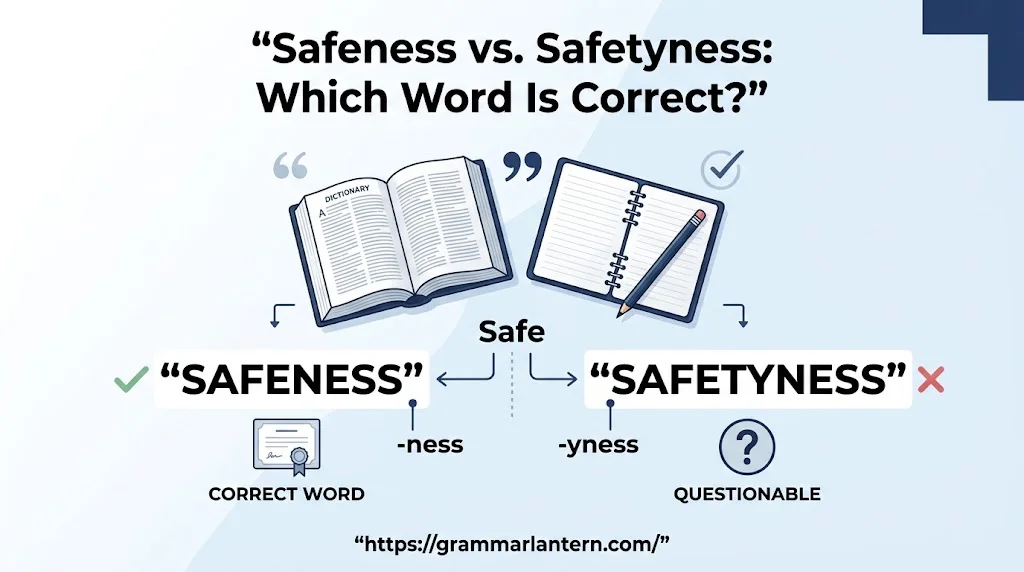
Safetyness is not a standard English word, so avoid using it in formal or casual writing. Although adding the suffix -ness to an adjective can create a noun, safety remains the preferred term for most situations.
Quick Answer
Safeness is an established English noun that describes the quality or condition of being safe. Safetyness is generally considered nonstandard and isn’t recommended in formal or everyday writing. In most situations, safety is the most natural and widely used noun.
Here’s a quick comparison:
| Word | Status | Meaning | Recommended use |
| Safeness | Established but less common | The quality or condition of being safe | Use when the wording fits the context |
| Safetyness | Generally nonstandard | An attempted noun form referring to being safe | Avoid in standard English |
| Safety | Standard and widely used | Protection from danger, injury, or harm | Preferred in most contexts |
| Safe | Standard adjective | Free from unacceptable danger or risk | Describe a person, place, or situation |
| Safely | Standard adverb | In a way that avoids harm or danger | Describe how an action is performed |
For example:
- Correct: The safety of the children is our priority.
- Acceptable in a suitable context: The perceived safeness of the environment influenced their decision.
- Not recommended: The safetyness of the environment influenced their decision.
The key is simple: choose safety for most everyday situations. Use safeness when you specifically need that less common noun, and avoid safetyness in standard English.
What Does Safeness Mean?
Safeness is a noun that refers to the quality, condition, or perceived state of being safe. It describes how free something seems to be from danger, risk, or harm.
The word comes from the adjective safe, which describes something protected from danger or unlikely to cause harm. Adding the noun-forming suffix -ness creates safeness, following a familiar pattern in English.
Consider these examples:
- The safeness of the playground influenced the parents’ decision.
- Researchers examined people’s perceptions of the safeness of public spaces.
- The safeness of the route mattered to travelers unfamiliar with the area.
Each sentence uses safeness to describe a condition or quality associated with being safe. However, the word can sound less natural than safety, depending on the sentence.
How Is Safeness Used in English?
Although safeness is a legitimate word, English speakers generally prefer safety in everyday conversation and professional writing.
For instance, you would normally say, “We need to improve workplace safety,” rather than “We need to improve workplace safeness.”
Both expressions communicate a similar general idea, but the first follows conventional English usage more naturally.
Safeness can be useful when a writer wants to emphasize the quality of being safe rather than a broader system of protection or precautions. It may also appear in discussions of perception, feelings, or the qualities of a particular environment.
Here are some examples:
| Example sentence | Explanation |
| The perceived safeness of the neighborhood affected visitors’ comfort. | Emphasizes how safe the neighborhood appeared to people |
| The safeness of the proposed route remained a concern. | Refers to the route’s condition or perceived risk |
| The study explored the perceived safeness of different public spaces. | Focuses on people’s judgments about safety |
Notice that these examples use safeness in contexts where the writer wants to describe a quality or perception. Even then, alternatives such as perceived safety may sound more natural.
Is Safeness Suitable for Formal Writing?
Yes, safeness can appear in formal writing when it expresses the intended meaning clearly. However, being a valid word doesn’t mean it’s always the best choice.
In academic papers, workplace policies, technical documents, and news articles, safety is usually the more familiar and direct option.
For example:
- Less natural: The report evaluated the safeness of the equipment.
- More natural: The report evaluated the safety of the equipment.
The second sentence uses a conventional expression that readers can understand immediately.
Before choosing safeness, consider whether safety, security, lack of risk, or perceived safety would communicate your meaning more precisely.
What Does Safetyness Mean?
Safetyness is a nonstandard formation that some writers may create by adding -ness to safety. The intended meaning is usually the quality or state of being safe.
At first glance, the word might seem logical. English regularly forms nouns by adding -ness to adjectives. For example, kind becomes kindness, and dark becomes darkness.
However, English doesn’t form every noun by attaching -ness to an existing word. Established vocabulary and conventional usage also determine which forms readers recognize as standard.
Because safety already functions as a noun, adding -ness to create safetyness is unnecessary in most contexts. Standard English generally favors safety or, in suitable contexts, safeness.
Why Do People Write Safetyness?
The spelling often results from a reasonable but incorrect assumption about word formation.
Someone who knows that happiness comes from happy might assume that every adjective or noun related to a quality can take the same ending. That assumption overlooks an important distinction: safe is an adjective, while safety is already an established noun.
Compare these examples:
- Kind → kindness
- Dark → darkness
- Happy → happiness
- Safe → safety
- Safe → safeness
The final two examples show that English has established safety as its conventional noun and also recognizes safeness as a less common noun.
Adding another suffix to safety doesn’t automatically create a standard word. That’s why safetyness should generally be avoided.
Read More: MYF Meaning in Text: What Does MYF Stand For?
Is Safetyness Ever Used?
A writer might use safetyness informally, experimentally, or mistakenly. Its appearance in a sentence, online discussion, or unpublished document doesn’t establish it as standard English.
It’s useful to distinguish three things:
- Understandable: Readers may guess what the writer intends.
- Possible to construct: The spelling follows a pattern that resembles other English words.
- Standard and idiomatic: The word follows accepted usage and sounds natural to fluent readers.
Safetyness may be understandable, but that doesn’t make it a suitable substitute for safety.
For example:
- Nonstandard: The company reviewed the safetyness of its procedures.
- Standard: The company reviewed the safety of its procedures.
The corrected sentence is shorter, clearer, and more natural.
Key Differences
The main difference between safeness and safetyness is their status in standard English. Although both may communicate the idea of being safe, they aren’t equally accepted.
Safeness is an established noun; safetyness is generally nonstandard. Understanding this distinction helps you avoid unnecessary word formation and choose language that suits your audience.
| Feature | Safeness | Safetyness |
| Word formation | Safe + -ness | Safety + -ness |
| Grammatical role | Noun | Intended as a noun |
| Standard status | Established English word | Generally nonstandard |
| Intended meaning | Quality or condition of being safe | Usually the quality of being safe |
| Frequency in ordinary writing | Relatively uncommon | Not recommended |
| Better alternative in most contexts | Safety | Safety |
| Suitable for formal writing? | Sometimes, depending on context | Generally avoid |
Examples That Show the Difference
Consider these sentences:
1.Example: Describing a workplace
- Nonstandard: The safetyness of the factory needs improvement.
- Better: The safety of the factory needs improvement.
2.Example: Describing a public space
- Acceptable but less common: Visitors commented on the safeness of the park.
- More natural: Visitors commented on the safety of the park.
3.Example: Describing a travel route
- Nonstandard: We checked the safetyness of the road before leaving.
- Better: We checked the safety of the road before leaving.
The examples reveal an important point: correcting safetyness usually requires only a small change. Replacing it with safety preserves the intended meaning while improving the sentence.
Safeness vs. Safety: Which Word Should You Use?
Although safeness is a valid word, safety is usually the better choice. Both relate to the condition of being safe, but they differ in how naturally they fit common expressions.
Safety appears frequently in discussions about preventing injuries, reducing risks, protecting people, and following precautions. It’s also the conventional term in established phrases such as road safety, workplace safety, and food safety.
When Should You Use Safety?
Use safety when discussing protection from danger, risk prevention, or measures designed to prevent harm.
Examples include:
- The school introduced new safety rules.
- Road safety depends on responsible driving.
- The company provides safety training for new employees.
- Parents should check the safety instructions before using the product.
- Food safety requires proper storage and handling.
In each example, safety is the familiar noun that communicates the intended meaning directly.
When Should You Use Safeness?
Use safeness when you specifically want to describe the quality or condition of being safe and the less common wording fits your sentence.
For example:
- The perceived safeness of the area influenced the tourists’ choices.
- The researchers discussed the safeness people associated with familiar surroundings.
Even in these examples, perceived safety may be more idiomatic, particularly in formal writing.
The choice depends on context, not simply on whether a word is technically valid. A good writer considers how readers will interpret the sentence and which expression communicates the idea most naturally.
Safety vs. Safeness in Everyday Expressions
| Context | Recommended expression | Why it works |
| Workplace rules | Workplace safety | Established expression |
| Traffic regulations | Road safety | Standard terminology |
| Handling food | Food safety | Common professional term |
| Product design | Product safety | Clear and conventional |
| People’s impressions | Perceived safety | Natural wording for subjective judgments |
| Describing a quality | Safeness | Possible when the context specifically suits it |
The practical rule is straightforward: if safety expresses your meaning clearly, you probably don’t need safeness.
Why Is Safetyness Considered Nonstandard?
The issue with safetyness comes down to how English builds words and how speakers establish conventional usage.
The suffix -ness commonly turns adjectives into nouns that describe qualities or states. For example, weak becomes weakness, and polite becomes politeness. These patterns help you understand unfamiliar words.
However, a familiar word-building pattern doesn’t make every possible formation standard English.
How the Suffix -ness Works
The suffix -ness usually attaches to adjectives to create nouns.
| Adjective | Noun | Example |
| Kind | Kindness | Her kindness impressed everyone. |
| Dark | Darkness | Darkness covered the road. |
| Happy | Happiness | Their happiness was obvious. |
| Weak | Weakness | The test revealed a weakness. |
| Safe | Safeness | The word describes the quality of being safe. |
English also has established nouns that don’t need this suffix. Safety is one of them.
Although you can understand why someone might invent safetyness, standard writing favors established words over unnecessary formations. The problem isn’t that -ness can never form a noun from a word related to another noun. Rather, safetyness has no established role that makes it preferable to safety or safeness.
Does Every Word Ending in -Ness Make Sense?
No. A word can look plausible without being an accepted or natural choice.
For example, you wouldn’t normally replace kindness with kindnessness. Likewise, you wouldn’t replace safety with safetyness.
When you’re unsure about a word, consider its meaning, grammatical role, and established usage. A dictionary can help confirm whether a form is recognized, while examples from ordinary writing can show how naturally it fits a sentence.
Common Mistakes
Writers often make word-choice mistakes because two forms look similar or follow a familiar spelling pattern. Fortunately, these errors are easy to correct once you understand the distinction.
Using Safetyness Instead of Safety
This is the main mistake to avoid. Since safety already expresses the intended meaning, safetyness adds an unnecessary ending.
Incorrect: The manager discussed the safetyness of the building.
Correct: The manager discussed the safety of the building.
The corrected sentence uses the standard noun and sounds more natural.
Assuming Every -Ness Formation Is Correct
The suffix -ness is productive, which means English speakers can use it to form many nouns. However, that flexibility doesn’t mean every new formation belongs in standard writing.
For example, darkness and kindness are established words. Safetyness, by contrast, isn’t a standard substitute for safety.
Remember: word formation provides useful patterns, but established usage determines which forms readers generally accept.
Using Safeness Where Safety Sounds Better
Even when safeness is valid, it may not suit the sentence.
Less natural: The government announced new safeness regulations.
Better: The government announced new safety regulations.
The second sentence uses the conventional expression. You don’t need a rare synonym when an established term already communicates your meaning.
Confusing Safety With Security
Another mistake involves treating safety and security as interchangeable in every situation.
Although their meanings overlap, they often emphasize different things.
- Safety usually concerns preventing injury, accidents, or exposure to danger.
- Security often concerns protection against threats, theft, unauthorized access, or deliberate harm.
For example, workplace safety procedures may cover accident prevention, while workplace security measures may address unauthorized entry.
Choosing the precise noun improves clarity more than choosing an unusual alternative.
Examples of Safeness, Safety, and Safetyness in Sentences
Seeing these words in context makes their differences easier to remember. The following examples show how to use standard English forms naturally.
Example Sentences With Safeness
Safeness is an established noun, although it’s less common than safety.
- The perceived safeness of the neighborhood influenced the family’s decision.
- The discussion focused on the safeness of the environment.
- Participants rated the perceived safeness of several public spaces.
- The writer explored the feeling of safeness people associated with familiar places.
- The article questioned whether the apparent safeness of the route reflected its actual risks.
These sentences illustrate possible uses. In many formal contexts, however, perceived safety or the feeling of being safe may sound clearer.
Example Sentences With Safety
Safety is the usual choice in everyday, academic, and professional writing.
- The school prioritizes student safety.
- Always follow the manufacturer’s safety instructions.
- The driver checked the vehicle’s safety features.
- Workplace safety training helps employees recognize hazards.
- Parents should discuss online safety with their children.
- The restaurant follows established food safety procedures.
- Road safety campaigns encourage responsible driving.
- The organization reviewed its safety policies after the incident.
Each example uses safety in a familiar expression. These are the kinds of sentences in which replacing safety with safeness would usually make the wording less natural.
Examples of Safetyness and Their Corrections
| Nonstandard sentence | Corrected sentence |
| We evaluated the safetyness of the playground. | We evaluated the safety of the playground. |
| The report examined the safetyness of the equipment. | The report examined the safety of the equipment. |
| Safetyness should be everyone’s concern. | Safety should be everyone’s concern. |
| The school introduced new safetyness guidelines. | The school introduced new safety guidelines. |
| They questioned the safetyness of the route. | They questioned the safety of the route. |
The corrections are simple. Replace safetyness with safety unless you have a specific reason to express the idea differently.
A Practical Case Study: Choosing the Right Word
Imagine that a school administrator is preparing a report about playground conditions. The report needs to explain whether children can use the equipment without unreasonable risk.
The administrator drafts this sentence:
“The committee assessed the safetyness of the playground before reopening it.”
The intended meaning is clear, but safetyness isn’t the appropriate standard form.
The administrator could revise the sentence to say:
“The committee assessed the safety of the playground before reopening it.”
This version is more natural and professional. It also uses familiar terminology that readers can understand immediately.
Now consider a different sentence:
“The researchers examined children’s perceived safeness in unfamiliar environments.”
The word safeness is an established noun, but the sentence could be clearer:
“The researchers examined how safe children felt in unfamiliar environments.”
Alternatively, if the researchers are measuring perceptions of safety, they could write:
“The researchers examined children’s perceptions of safety in unfamiliar environments.”
These revisions show that choosing the correct word involves more than spelling. You should also consider the sentence’s purpose, audience, and intended meaning.
Related Words: Safe, Safely, Safety, and Safeness
Understanding the word family helps you avoid mistakes when describing protection, risk, or the condition of being safe.
| Word | Part of speech | Meaning | Example |
| Safe | Adjective | Protected from danger or unlikely to cause harm | The building is safe. |
| Safely | Adverb | In a way that avoids harm or danger | They arrived safely. |
| Safety | Noun | Protection from danger, injury, or harm | Safety comes first. |
| Safeness | Noun | The quality or condition of being safe | The perceived safeness of the area mattered. |
| Safetyness | Nonstandard formation | An attempted noun referring to being safe | Use safety instead. |
Safe: The Adjective
Use safe to describe a person, place, object, or situation.
For example: “The children are safe inside the building.”
Here, safe describes the children’s condition.
Safely: The Adverb
Use safely to explain how someone performs an action.
For example: “The driver safely crossed the bridge.”
The word describes how the driver crossed.
Read More: Snowball Kisses Meaning: What Does It Mean in Slang?
Safety: The Noun
Use safety when referring to protection, precautions, or freedom from unacceptable danger.
For example: “The company introduced new safety measures.”
The noun identifies the area the measures address.
Safeness: The Less Common Noun
Use safeness when its particular meaning and wording suit the sentence.
For example: “The perceived safeness of the room helped visitors feel comfortable.”
In many situations, the room’s perceived safety or how safe visitors felt in the room would sound more natural.
How to Choose the Correct Word
When deciding between safeness, safetyness, and safety, follow a few practical steps.
- Choose safety when discussing protection, precautions, rules, risks, or injury prevention.
- Consider safeness when you specifically want to describe the quality or perceived condition of being safe and the wording fits naturally.
- Avoid safetyness in standard English writing.
- Use safe when describing a person, place, object, or situation.
- Use safely when describing how an action happens.
Here’s a simple decision guide:
| If you want to describe… | Choose… |
| Protection from injury or danger | Safety |
| A place that isn’t dangerous | Safe |
| An action performed without harm | Safely |
| The quality or perceived condition of being safe | Safeness, where appropriate |
| The supposed noun safetyness | Safety instead |
If you’re still uncertain, rewrite the sentence using safety. If it expresses your meaning clearly, you probably don’t need another form.
FAQs
1. Is safeness or safetyness correct?
Safeness is a real English word, while safetyness is not standard English. However, safety is the most common and preferred word.
2. What does safety mean?
Safety means freedom from danger, risk, or harm. It refers to protection and being secure from possible threats.
3. Is safeness a real word?
Yes, safeness is a valid English noun. It describes the state or quality of being safe, although people use it less often than safety.
4. Why is safetyness incorrect?
Safetyness is not an established standard English word. The accepted noun for general protection from danger is safety.
5. Can I use safeness in formal writing?
Yes, you can use safeness when it fits your meaning. However, safety is usually clearer and more natural in professional and academic writing.
6. What is an example of safety in a sentence?
“Please check the safety of the equipment before operating the machine.” Here, safety refers to protection from possible harm.
7. What is an example of safeness in a sentence?
“The study examined the safeness of the new material.” This sentence uses safeness to describe the quality of being safe.
8. Is safeness commonly used in everyday English?
No, safeness is relatively uncommon. Most English speakers prefer safety when talking about protection, security, or freedom from danger.
9. What is the difference between safe and safety?
Safe is an adjective that describes something protected from danger. Safety is a noun that refers to the condition of being protected from danger.
10. How can I remember the correct spelling?
Remember that safety is the standard noun used in everyday English. Avoid safetyness, and use safeness only when it suits the context.
Conclusion
Understanding safeness vs. safetyness helps you make better word choices and improve your English writing. Safety is the most widely accepted and natural term for describing protection from danger, risk, or harm. Safeness is also a valid word, but it appears less frequently in everyday communication.
On the other hand, safetyness is not standard English and should generally be avoided. When writing emails, essays, reports, or professional documents, choose safety for clear and familiar communication. Knowing the difference will help you write more accurately and confidently.

Muhammad Haroon is the voice behind many of the clear, practical grammar guides you’ll find on Grammar Lantern. With a strong background in content writing and a genuine love for the English language, Haroon specializes in breaking down intimidating grammar topics into simple, digestible lessons. His goal is simple: to empower readers to write with confidence and clarity. Whether he’s explaining tricky tenses or demystifying punctuation, Haroon approaches each topic with patience, precision, and a touch of warmth—because he knows that learning grammar is a journey, not a race.