
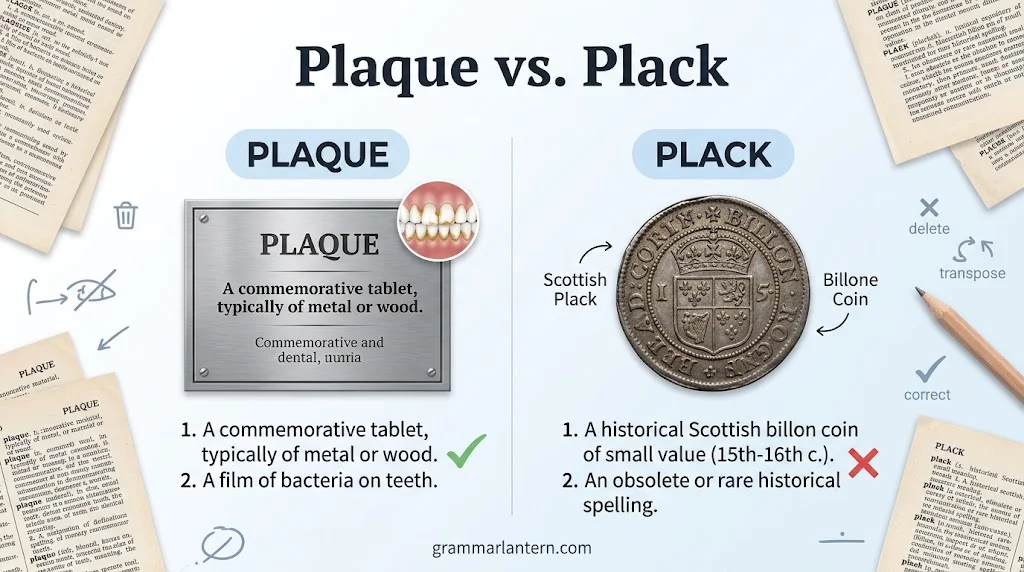
Plaque vs. Plack can be confusing because these words look similar but have different meanings. A plaque is an inscribed tablet made from metal or wood and attached to a wall. It may be a commemorative plaque, an ornamental plaque, or a decorative tablet displaying a historical inscription.
The word plaque also describes dental plaque, a sticky substance containing bacteria that builds up on the teeth. It can also refer to an abnormal skin patch, including a psoriasis patch associated with a skin condition. The word comes from the Dutch word plakken, meaning to stick. Its meaning depends on the context in which you use it.
In contrast, plack refers to a small copper coin used in Scotland during the 1400s and 1500s. Its origin is the Flemish word placke, meaning a small coin. Although the words look alike, using one instead of the other creates a spelling error. Remember the correct usage: plaque describes a tablet, dental deposit, or skin patch, while plack refers to a historical Scottish coin.
Quick Answer
Plaque is the correct word when referring to a flat plate that displays an inscription or a buildup of material, such as dental plaque. Plack is a historical word for a small Scottish coin used centuries ago. It can also appear in older Scottish writing with broader meanings related to money or something of little value.
Here’s the difference at a glance:
| Word | Meaning | Example |
| Plaque | A plate used for a sign, award, or memorial | The school displayed a plaque honoring its founder. |
| Plaque | A buildup of material, especially on teeth or artery walls | The dentist explained how plaque forms on teeth. |
| Plack | A historical Scottish coin | The museum displayed a plack from an old Scottish collection. |
If you’re writing about a dental problem, an award, or a memorial, use plaque. If you’re discussing historical Scottish money, plack may be the word you need.
What Does Plaque Mean?
The word plaque is a noun with several meanings. Its intended meaning depends on the context, but it generally refers to a plate-like object or a layer of material that collects on a surface.
Plaque as an Award or Commemorative Plate
A plaque is often a flat plate made from materials such as metal, wood, stone, or plastic. It may display a name, inscription, date, image, or message.
People use plaques to recognize achievements, remember important events, and honor individuals. You might see one hanging in a school, office, museum, hospital, or public building.
For example:
- The company presented Maya with a plaque for her outstanding service.
- A bronze plaque marks the location of the historic building.
- The university installed a plaque to honor its first president.
- The coach received a plaque after leading the team to victory.
In each sentence, plaque refers to a physical object that communicates information or recognition.
A plaque can also commemorate someone who has died. Families, communities, and organizations may place one near a memorial, on a building, or in a public garden.
Plaque in Dentistry
In dentistry, plaque refers to a sticky film of bacteria that forms on teeth. It develops as bacteria combine with substances in your mouth and collect on tooth surfaces.
Plaque can contribute to tooth decay and gum disease if you don’t remove it regularly. Brushing twice a day, cleaning between your teeth, and visiting a dentist can help manage its buildup.
Consider these examples:
- The dentist found plaque along the gumline.
- Brushing regularly helps remove dental plaque.
- Plaque buildup can irritate the gums.
- The hygienist explained how to prevent plaque from accumulating.
Notice that plaque refers to the substance on the teeth, not the hardened material that may develop when plaque remains in place. That hardened deposit is commonly called tartar or dental calculus.
Plaque in Medicine
The word also appears in medical discussions, especially when describing deposits inside blood vessels.
For example, arterial plaque refers to a buildup of substances, including cholesterol, fats, and other materials, in the walls of arteries. This buildup can narrow the arteries and affect blood flow.
You may encounter sentences such as:
- The scan showed plaque in the patient’s arteries.
- The doctor discussed the risks associated with arterial plaque.
- Researchers are studying how plaque develops in blood vessels.
Medical uses of plaque are different from the commemorative and dental meanings, but the spelling remains the same.
How to Use Plaque in a Sentence
Use plaque when the context involves an award, memorial, sign, or buildup of material.
Here are a few more examples:
- A small plaque beside the entrance identifies the architect.
- The athlete proudly displayed her championship plaque.
- The dentist recommended better brushing to reduce plaque.
- The historical plaque explains the building’s original purpose.
- Scientists examined plaque deposits in the artery.
In each case, plaque fits because the sentence describes a recognized meaning of the word.
What Does Plack Mean?
Plack is a real word, but it’s uncommon in modern everyday English. Its best-known meaning is a small coin used in Scotland centuries ago.
The word appears mainly in historical writing, Scottish language references, and discussions of old currency. Most modern readers won’t need it in ordinary conversation.
Plack as a Historical Scottish Coin
A plack was a small Scottish coin first issued during the reign of James III in the 15th century. Placks continued to appear under later Scottish monarchs, with coinage associated with the period extending into the reign of James VI.
The coin’s value and composition varied across its history. It is commonly described as being worth four Scottish pennies, although historical currency systems and valuations can be complicated.
Today, the word is useful when reading about Scottish history, old financial records, coin collections, or historical fiction.
For example:
- The museum displayed a Scottish plack alongside other historic coins.
- The collector studied the markings on the old plack.
- The historical novel mentioned a merchant paying with a plack.
- The researcher found references to placks in an old Scottish document.
These examples use plack in its historical sense. It would be unusual to use the word when discussing modern money.
Plack in Older Scottish Writing
In older Scottish usage, plack could refer to a small amount of money. It also appeared figuratively in expressions suggesting that something had little or no value.
A reader might encounter plack in historical documents, poetry, or older Scottish literature. In those settings, the word may carry a meaning that goes beyond a particular coin.
For example, an old text might use the word to suggest that a person had very little money or that something was worth almost nothing.
When you encounter plack in an older text, examine the surrounding sentence. The writer may be referring to an actual coin, money in general, or a figurative idea of worthlessness.
Read More: Buses or Bus’s or Bus’? Correct Possessive Explained
Is Plack a Misspelling of Plaque?
Sometimes, yes. If someone writes plack while describing a dental deposit or an award on a wall, they probably intended to write plaque.
However, you shouldn’t assume that every use of plack is an error. The word has a genuine historical meaning, especially in Scottish contexts.
Compare these sentences:
- Incorrect for a dental context: The dentist removed the plack from my teeth.
- Correct: The dentist removed the plaque from my teeth.
- Correct in a historical context: The exhibit included a Scottish plack.
The surrounding meaning determines whether plack is appropriate. A spelling checker may flag an unfamiliar historical word, so context matters when editing older or specialized writing.
Key Differences
Although the words differ by only one letter, their meanings and typical uses are quite different.
Meaning
The most important difference is what each word describes.
Plaque commonly refers to a commemorative plate, an award, or a buildup of material on teeth or inside arteries.
Plack usually refers to an old Scottish coin. In older Scottish usage, it can also describe a small amount of money or something of little value.
For example, a plaque may honor a historical figure, while a plack may appear in a record describing a historical purchase.
Usage
Plaque remains common in modern English. You’ll encounter it in dentistry, medicine, schools, workplaces, museums, and everyday conversation.
Plack is rare in contemporary general English. It mainly appears in historical or regional contexts, including discussions of Scottish currency and older Scottish writing.
If you’re writing for a general audience, plaque will probably be the word you need. Use plack when the historical meaning is relevant.
Spelling
The difference is easy to overlook:
- Plaque: P-L-A-Q-U-E
- Plack: P-L-A-C-K
The word plaque contains -que at the end. The word plack ends in -ck.
Because their first three letters are similar, a hurried writer might type the wrong word. Reading the sentence again can help you catch the mistake.
Pronunciation
Both words are commonly pronounced with a short a sound, similar to the vowel in black. Their pronunciations are therefore very similar in many varieties of English.
That similarity can make the distinction harder to hear in conversation. Spelling and context usually provide the clearest clues.
Plaque vs. Plack Comparison Table
| Feature | Plaque | Plack |
| Part of speech | Noun | Noun |
| Main meaning | A commemorative plate or buildup of material | A historical Scottish coin |
| Modern usage | Common | Rare |
| Typical context | Dentistry, medicine, awards, memorials | Scottish history, old currency, historical writing |
| Example | She received a plaque for her work. | The collector examined a plack. |
| Appropriate for dental buildup? | Yes | No |
| Appropriate for a historical Scottish coin? | No | Yes |
The simplest rule is to match the word to the meaning. If you’re talking about teeth, an award, or a memorial, choose plaque. If you’re discussing a Scottish coin from centuries ago, choose plack.
Examples in Sentences
Looking at complete sentences makes the distinction easier to remember. The examples below show how each word works in context.
Examples Using Plaque
- The school placed a plaque near the main entrance.
- The dentist explained why plaque collects along the gumline.
- A memorial plaque honors the firefighters who served the community.
- The museum installed a plaque describing the building’s history.
- The doctor discussed plaque buildup in the patient’s arteries.
- The employee received a plaque after 25 years of service.
- Regular brushing helps remove plaque from tooth surfaces.
- A small plaque identifies the artist who created the sculpture.
- The historical society donated a plaque to the local library.
- The dentist showed us how to clean areas where plaque often accumulates.
Each sentence uses plaque to describe a plate, recognition item, or buildup of material.
Examples Using Plack
- The museum’s collection included a Scottish plack from the 15th century.
- The historian explained how the plack was used in Scotland.
- The collector compared the plack with other coins from the same period.
- An old financial record mentioned the payment of a plack.
- The student found the word plack while reading a historical document.
- The exhibit described the coinage used under Scottish monarchs.
- The researcher examined a reference to a plack in an old text.
- The historical novel included a merchant who carried a plack.
- The coin collector learned about the plack’s place in Scottish currency.
- The dictionary explained the older Scottish uses of plack.
These sentences use plack in historical settings. In modern writing, explain the word if your readers may not recognize it.
Common Mistakes to Avoid
The most frequent mistake is using plack when you mean plaque.
Incorrect: The dentist removed the plack from my teeth.
Correct: The dentist removed the plaque from my teeth.
Incorrect: The school presented him with a plack for his achievement.
Correct: The school presented him with a plaque for his achievement.
However, this sentence is correct:
The museum displayed a historical plack from Scotland.
Here, plack refers to a coin rather than an award or dental deposit. The spelling isn’t wrong simply because the word is uncommon.
Why Do People Confuse?
Several factors make these words easy to mix up.
They Look Similar
Both words begin with pla- and have similar overall lengths. When you’re typing quickly, the different endings can be easy to overlook.
The spelling plack may also look like a simplified version of plaque. That resemblance can lead people to assume that the two words are interchangeable.
They Sound Similar
In many accents, plaque and plack have nearly identical pronunciations. If you hear one word without seeing it written down, you may not immediately know which spelling the speaker intended.
This is particularly relevant when someone is dictating a sentence or using speech-to-text software.
Plack Is Unfamiliar
Most people regularly encounter plaque in everyday life. Dental appointments, awards, memorials, and medical discussions keep the word familiar.
By contrast, many people rarely encounter plack unless they read Scottish history or study historical currency. When an unfamiliar word appears, writers may mistake it for a spelling error or substitute a more familiar word.
Spell-Checking Tools Can Miss the Intended Meaning
A spelling checker may accept both words because both exist. However, the fact that a word is spelled correctly doesn’t mean it fits the sentence.
For example, a program might accept plack in the sentence “The dentist removed the plack.” A careful reader should still recognize that plaque is the appropriate word.
Always review the meaning, not just the spelling suggestions.
Easy Ways to Remember the Difference
You don’t need to memorize a complicated rule. A simple association can help you choose the correct word.
Connect Plaque With a Plate
Think of a commemorative plaque as a plate attached to a wall. Both words begin with similar sounds, making the association easy to recall.
You can also connect plaque with dental care. When you think about the sticky film that builds up on your teeth, remember the spelling plaque.
For example:
- A plaque honors a person.
- Dental plaque collects on teeth.
- Arterial plaque can build up in blood vessels.
These common uses all take the spelling plaque.
Connect Plack With the Past
Think of plack as a word from the past. Its best-known meaning relates to historical Scottish money.
If you’re reading about old coins, Scottish monarchs, or medieval and early modern currency, plack may be the correct choice.
This memory aid isn’t a formal spelling rule. It’s simply a convenient way to connect the uncommon word with its historical meaning.
Check the Context Before You Choose
When you’re unsure, ask yourself what the sentence describes.
If it involves an award, memorial, dental deposit, or arterial buildup, use plaque. If it refers to an old Scottish coin, use plack.
For example:
“The dentist pointed to the ___ on my teeth.”
The correct answer is plaque because the sentence describes dental buildup.
“The historical exhibit displayed a Scottish ___.”
The correct answer is plack because the sentence refers to a coin.
Context usually resolves the confusion immediately.
When Should You Use Plaque or Plack?
The right choice depends on your audience and the subject you’re discussing.
Everyday Writing
Use plaque in ordinary writing about awards, memorials, dental health, and medical conditions.
For example, if you’re writing an email about an employee recognition ceremony, you might say, “We’ll present a plaque to the outstanding employee.”
If you’re describing a dental appointment, you could write, “The dentist recommended brushing more carefully to remove plaque.”
You generally won’t need plack in these situations.
Academic and Historical Writing
Use plack when writing about historical Scottish currency or interpreting an older Scottish text.
Because the word is unfamiliar to many readers, provide a brief explanation the first time you use it.
For example:
“The merchant accepted a plack, a small Scottish coin used centuries ago.”
That sentence introduces the term without forcing readers to look up its meaning. In a longer historical article, you can then use plack without repeating the explanation every time.
Medical and Dental Writing
In healthcare-related writing, plaque is the appropriate term for dental plaque and arterial plaque.
Using plack in these contexts would generally be a spelling error unless you’re quoting an original text that uses the word differently.
For instance:
Correct: The patient received advice about reducing plaque buildup.
Incorrect: The patient received advice about reducing plack buildup.
Accurate terminology matters in medical writing because readers rely on clear language to understand health information.
Related Words That Are Easy to Confuse
Understanding a few related terms can help you avoid other common mistakes.
Plaque vs. Plague
These words look similar, but their meanings are very different.
Plaque refers to a plate or a buildup of material. Plague can refer to a serious infectious disease or, more broadly, something that causes widespread trouble.
Examples:
- The dentist explained how plaque affects teeth.
- The plague devastated communities during historical outbreaks.
The ending changes both the spelling and the meaning.
Plaque vs. Plate
A plate is a flat object, such as a dish used for serving food. A plaque is usually a plate designed to display an inscription, commemorate an event, or recognize an achievement.
For example, you eat dinner from a plate, but you may see a plaque honoring the person who founded the restaurant.
Although the objects can have similar shapes, their purposes differ.
Plaque vs. Tartar
In dentistry, plaque and tartar are related but not identical.
Plaque is a sticky film of bacteria that forms on teeth. Tartar, also called dental calculus, is hardened plaque that attaches to tooth surfaces.
Regular brushing and cleaning between teeth help remove plaque. Once tartar forms, a dental professional usually needs to remove it with appropriate instruments.
The terms shouldn’t be treated as interchangeable in dental writing.
Read More: Wore or Worn: Which Is Correct? Helpful Examples
FAQs
1. What is the difference between plaque and plack?
Plaque refers to an inscribed tablet, a sticky substance on teeth, or an abnormal skin patch. Plack refers to a small copper coin used in Scotland centuries ago.
2. Is plack a correct English word?
Yes, plack is a real word. It refers to a historical Scottish coin, not a plaque or a substance found on teeth.
3. What does plaque mean?
Plaque can mean a commemorative tablet, dental buildup caused by bacteria, or an abnormal patch on the skin.
4. What does plack mean in history?
A plack was a small copper coin used in Scotland during the 1400s and 1500s.
5. Is plack a misspelling of plaque?
Not always. Plack is a valid historical word, but using it when you mean plaque is a spelling mistake.
6. Where does the word plaque come from?
The word plaque comes from the Dutch word plakken, meaning “to stick.”
7. Where does the word plack come from?
Plack comes from the Flemish word placke, which means a small coin.
8. What is dental plaque?
Dental plaque is a sticky film of bacteria that forms on teeth. Regular brushing and flossing help remove it.
9. How can I remember plaque vs. plack?
Remember that plaque is associated with a tablet, teeth, or skin, while plack refers to an old Scottish coin.
10. Which spelling should I use in everyday writing?
Use plaque when discussing a commemorative tablet, dental buildup, or a skin patch. Use plack only when referring to the historical coin.
Conclusion
Understanding plaque vs. plack is easier when you focus on their meanings. Although the words look and sound similar, they refer to different things. A plaque can be a decorative tablet, dental buildup, or an abnormal skin patch, while a plack was a historical Scottish coin.
When writing, choose the word that fits your meaning. If you are talking about a wall decoration or dental hygiene, use plaque. If you are discussing old Scottish currency, plack is the correct choice. Knowing this difference helps you avoid spelling mistakes and communicate clearly.

For Shafiq ur Rehman, writing is an art form and grammar is the toolbox that makes it beautiful. As a dedicated content writer at Grammar Lantern, Shafiq approaches every topic like an architect carefully laying down strong foundations of understanding before adding the finer details. He loves diving into the trickiest grammar points and resurfacing with simple, bite-sized takeaways that anyone can grasp. When he’s not crafting articles, you’ll likely find him strategizing over a game of chess, exploring dusty local bookshops, or quietly jotting down poetic observations in his notebook.