Many people find Choosing between Distress and Duress surprisingly confusing because the words have similar spellings, pronunciations, and sound alike. Although they look and sound related, they have different meanings and are used in different contexts.
This article will explore the differences with simple examples so you can understand each term and use it correctly in everyday communication and formal writing.
From my editing experience, I have noticed that many people assume these words mean the same thing, but using the wrong word can change the meaning of a sentence. This mistake is especially common in legal, academic, and professional writing, where precise language matters.
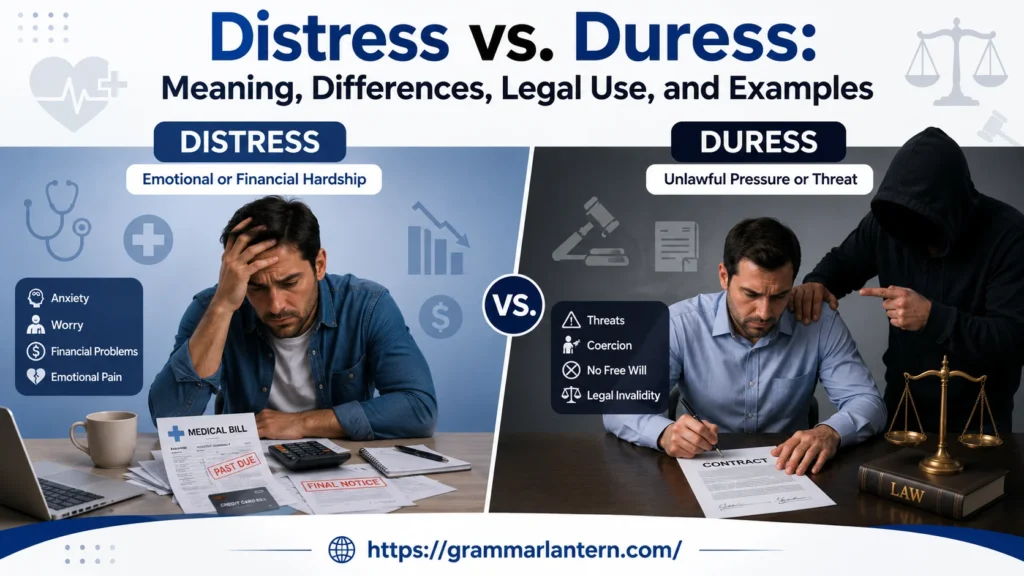
The simplest way to remember the difference is that Distress is a noun that refers to a state of emotional, mental, or physical pain, suffering, discomfort, or harm. It is often caused by a difficult or challenging situation, such as a lost job, financial problems, or a car accident.
Duress, by contrast, describes pressure, threats, or force placed on someone against their will. This cause removes a person’s freedom to choose, which is why the distinction between the two terms is so important.
You will often see Duress used in legal documents, formal papers, and common phrases such as under duress, where a person’s actions are not considered completely voluntary.
This guide explains everything in plain English to help you learn the origins, pronunciation, grammar, and usage of both terms. It also shows you how to write clearly, avoid common mistakes, and build confidence through real life examples.
By the end, you will know exactly when to use each word correctly and recognize the difference without hesitation.
Quick Answer
The main difference between distress and duress is simple.
Distress refers to severe emotional, physical, or financial suffering. It describes a condition or feeling caused by hardship, pain, danger, or loss.
Duress means being forced to do something through threats, intimidation, or unlawful pressure. It is primarily a legal term that describes a lack of free choice because someone has been coerced.
Here is the easiest way to remember them:
- Distress = suffering
- Duress = coercion
Although both words describe difficult situations, they are not interchangeable.
| Feature | Distress | Duress |
| Meaning | Serious suffering or hardship | Force or threats used to make someone act |
| Common Context | Daily life, medicine, psychology, finance | Law, contracts, criminal cases |
| Emotional Component | Usually present | May or may not be present |
| Legal Meaning | Limited | Very specific legal doctrine |
| Example | She experienced emotional distress. | He signed the agreement under duress. |
What Does Distress Mean?
Distress is a noun that describes a state of great pain, anxiety, suffering, or hardship. The suffering may be emotional, physical, financial, or even environmental. Unlike duress, distress does not require another person to force or threaten someone.
People experience distress for many reasons, including:
- Losing a loved one
- Financial hardship
- Serious illness
- Natural disasters
- Relationship problems
- Workplace burnout
- Personal failure
The word comes from the Old French destrece, meaning pressure, trouble, or hardship. Over time, English speakers expanded its meaning to include nearly every form of severe suffering.
Emotional Distress
Emotional distress refers to psychological pain caused by traumatic or upsetting experiences.
Common symptoms include:
- Anxiety
- Depression
- Fear
- Panic attacks
- Persistent sadness
- Emotional exhaustion
- Difficulty concentrating
For example:
- The accident caused severe emotional distress.
- Losing her job left her in deep emotional distress.
Financial Distress
Financial distress occurs when individuals or businesses struggle to meet their financial obligations.
Signs of financial distress include:
- Missed loan payments
- Growing debt
- Cash flow shortages
- Bankruptcy risk
- Falling revenue
Businesses often monitor financial distress through debt ratios, cash reserves, and profitability because prolonged distress may lead to insolvency.
Examples include:
- The company entered financial distress after several poor quarters.
- Rising expenses pushed many families into financial distress.
Physical Distress
Physical distress refers to bodily suffering or medical emergencies.
Doctors frequently use the word when describing patients experiencing breathing problems, severe pain, or life-threatening conditions.
Examples include:
- The patient arrived in respiratory distress.
- The injured climber showed signs of physical distress.
Distress in Emergencies
Emergency organizations also use the word in situations involving danger.
Examples include:
- Distress signal
- Distress call
- Distress beacon
- Distress flare
These signals communicate that immediate assistance is needed.
Related Topics: Manuel vs Manual: Actual Meaning, and Difference
What Does Duress Mean?
Duress refers to pressure created through threats, force, intimidation, or unlawful coercion that causes someone to act against their own free will.
Unlike distress, duress almost always involves another person or organization applying pressure.
The word comes from the Old French duresse, meaning harshness or compulsion. Today, it remains one of the most important legal concepts in contract and criminal law.
Duress in Law
The legal definition of duress focuses on the loss of free choice.
A person acts under duress when they reasonably believe refusing to comply would result in serious harm.
Courts may declare contracts invalid if one party proves they signed because of unlawful threats.
Examples include:
- Threatening physical violence
- Blackmail
- Serious intimidation
- Illegal economic pressure
- Threats against family members
Example:
- She signed the agreement under duress after receiving repeated threats.
Duress in Everyday Language
Outside legal settings, people sometimes use under duress informally.
For example:
- I attended the meeting under duress.
In this sentence, the speaker usually means they felt pressured or strongly reluctant. However, this informal usage does not carry the same legal significance.
Distress vs. Duress: Key Differences Explained
Although both words involve difficult situations, they describe completely different experiences.
Meaning
Distress describes suffering.
Duress describes coercion.
Cause
Distress can result from illness, grief, financial loss, accidents, or emotional trauma.
Duress results from threats, force, intimidation, or unlawful pressure imposed by another person.
Free Choice
Someone experiencing distress usually retains the ability to make decisions, although those decisions may be difficult.
Someone acting under duress does not have genuine freedom because threats influence their choices.
Emotional Impact
Distress almost always involves emotional or physical suffering.
Duress may produce emotional suffering, but emotional pain is not part of its definition. The defining feature is coercion.
Legal Importance
Distress occasionally appears in legal discussions, especially in personal injury claims involving emotional distress.
Duress is a formal legal doctrine that can invalidate contracts or serve as a criminal defense under certain circumstances.
Everyday Use
Distress appears frequently in everyday conversation.
Duress appears mostly in legal, governmental, or professional settings.
Distress vs. Duress Comparison Table
| Category | Distress | Duress |
| Primary Meaning | Suffering | Coercion |
| Cause | Hardship, pain, loss | Threats or force |
| Requires Another Person | No | Usually yes |
| Emotional Pain | Usually | Sometimes |
| Legal Importance | Limited | Major legal principle |
| Common Phrase | In distress | Under duress |
| Used Daily | Very often | Less often |
Can Someone Experience Both Distress and Duress?
Yes. A person may experience both at the same time, but they remain separate concepts.
Imagine an employee whose supervisor threatens to fire them unless they falsify financial records.
The threats represent duress because the employee faces unlawful pressure.
The anxiety, fear, and sleepless nights that follow represent distress because the employee is suffering emotionally.
The two concepts often appear together in legal disputes, workplace investigations, and domestic abuse cases.
Case Study: A Business Contract
A small business owner receives threats that competitors will spread false information unless a contract is signed immediately.
Feeling frightened, the owner signs the agreement.
Later, the owner develops severe anxiety and depression.
In this situation:
- The threats created duress.
- The anxiety and depression became emotional distress.
Understanding this distinction helps lawyers, judges, insurers, and businesses evaluate each issue separately.
Distress in Everyday English
Most English speakers encounter the word distress far more often than duress.
It appears in healthcare, finance, emergency services, psychology, education, and daily conversations.
Emotional Distress
Examples include:
- The unexpected news caused emotional distress.
- Children may experience distress after a natural disaster.
- Therapy helped reduce her emotional distress.
Financial Distress
Examples include:
- Several retailers entered financial distress during the recession.
- Rising costs placed many homeowners in financial distress.
- Investors watch for signs of corporate financial distress before buying shares.
Distress Signal
A distress signal communicates immediate danger.
Common examples include:
- SOS messages
- Emergency radio transmissions
- Marine distress signals
- Aviation distress codes
International law recognizes several standardized distress signals to help rescuers respond quickly.
Distress Call
Police, firefighters, coast guards, and emergency operators respond to distress calls every day.
Examples include:
- A sailor issued a distress call after the engine failed.
- Emergency crews responded within minutes of receiving the distress call.
Distress Sale
A distress sale occurs when property or assets must be sold quickly because of financial hardship.
Examples include:
- The family held a distress sale before relocating.
- The company sold equipment in a distress sale to raise cash.
Distress Tolerance
In psychology, distress tolerance describes a person’s ability to manage emotional pain without reacting impulsively.
Mental health professionals often teach distress tolerance skills through therapies such as Dialectical Behavior Therapy (DBT).
These skills include:
- Deep breathing
- Mindfulness
- Grounding exercises
- Emotional regulation
- Healthy distraction techniques
Duress in Legal English
The word duress appears most often in legal writing because it directly affects whether a person’s actions were truly voluntary. Courts generally recognize that agreements, statements, or actions made under unlawful pressure may not reflect a person’s genuine intent.
Although laws vary by country and jurisdiction, the basic principle remains the same. If someone uses threats, violence, or other forms of illegal pressure to force another person into making a decision, that decision may not be legally valid.
Signing a Contract Under Duress
One of the most common legal examples involves contracts.
For a contract to be enforceable, both parties must usually agree willingly. If one party signs because they fear serious harm or unlawful consequences, the contract may be challenged in court.
Examples include:
- Threatening physical violence unless someone signs.
- Threatening to reveal private information through blackmail.
- Using intimidation to force a business agreement.
- Coercing someone into transferring property.
Example:
A landlord threatens to physically harm a tenant unless the tenant signs a lease extension. The tenant signs out of fear. A court may later determine that the agreement was signed under duress, making it unenforceable.
Criminal Law
Duress may also serve as a legal defense in certain criminal cases.
A defendant may argue they committed an unlawful act because another person threatened immediate death or serious bodily harm.
However, this defense has limits.
Courts generally examine several factors, including:
- Whether the threat was immediate.
- Whether the defendant reasonably believed the threat.
- Whether there was a safe opportunity to escape.
- Whether committing the offense was the only realistic option.
Not every criminal charge allows a duress defense. Serious crimes, particularly those involving intentional violence, often have stricter legal standards.
Employment Situations
Duress can also arise in the workplace.
Examples include:
- An employer forcing an employee to sign resignation papers through threats.
- Pressuring workers to waive legal rights.
- Threatening termination unless an employee agrees to unlawful demands.
Employees who experience unlawful coercion may have legal remedies depending on employment laws in their jurisdiction.
Family and Domestic Abuse Cases
Duress frequently appears in domestic abuse situations.
Victims may feel compelled to make financial decisions, sign legal documents, or perform certain actions because they fear retaliation from an abusive partner.
In these cases, courts often examine evidence showing:
- Threats of violence.
- Financial control.
- Psychological intimidation.
- Isolation from family and friends.
- Repeated patterns of coercive behavior.
Economic Duress
Economic duress occurs when one party uses wrongful financial pressure to force another into accepting unfavorable terms.
For example, imagine a supplier refuses to deliver essential materials unless a customer immediately agrees to pay twice the agreed price. If the customer has no reasonable alternative and faces severe business losses, a court may consider whether economic duress occurred.
Unlike ordinary business negotiations, economic duress involves improper or unlawful pressure, not simply tough bargaining.
Read also: Kinesthesiology vs. Kinesiology: Careers, and Which Is Correct?
Common Expressions with Distress
The word distress appears in many everyday phrases. Learning these expressions helps you recognize how native English speakers naturally use the word.
In Distress
This phrase describes someone experiencing suffering or danger.
Examples:
- The hikers were clearly in distress after getting lost.
- Emergency crews rescued several people in distress.
- The animal appeared to be in distress.
Emotional Distress
This phrase refers to severe emotional suffering.
Examples:
- The incident caused lasting emotional distress.
- She sought counseling to recover from emotional distress.
- Emotional distress can affect physical health over time.
Financial Distress
This expression describes serious financial difficulties.
Examples:
- Several startups entered financial distress after losing investors.
- Families facing financial distress often reduce unnecessary expenses.
- Financial distress may lead businesses to restructure debt.
Distress Signal
A distress signal alerts others that immediate assistance is needed.
Common examples include:
- SOS messages.
- Emergency Position-Indicating Radio Beacons (EPIRBs).
- Mayday radio calls.
- Red distress flares.
Distress Call
A distress call is an emergency request for help.
Examples:
- The coast guard responded to the vessel’s distress call.
- Pilots follow strict procedures after making a distress call.
- Rescue teams located the hikers shortly after receiving the distress call.
Distress Beacon
A distress beacon is an emergency device that sends location information to rescue authorities.
It is commonly used by:
- Sailors
- Pilots
- Mountaineers
- Remote expedition teams
Distress Sale
A distress sale occurs when someone must sell assets quickly because of financial hardship.
Examples:
- The family held a distress sale before moving overseas.
- Investors purchased several properties during the company’s distress sale.
Distress Warrant
In some legal systems, a distress warrant allows authorities to seize property to recover unpaid debts or taxes.
Although less common today, the term still appears in certain legal contexts.
Common Expressions with Duress
Unlike distress, duress appears in relatively few common expressions because its meaning remains closely tied to legal concepts.
Under Duress
This is by far the most common expression.
It means someone acted because they were threatened or coerced.
Examples:
- He confessed under duress.
- She claimed the contract was signed under duress.
- The witness later admitted the statement was made under duress.
Economic Duress
This expression refers to unlawful financial pressure.
Examples:
- The company argued it accepted the deal under economic duress.
- Economic duress differs from ordinary commercial negotiation.
Duress Defense
Lawyers may use this phrase when arguing that a defendant committed an offense because of serious threats.
Example:
- The defense attorney raised a duress defense during trial.
Acting Under Duress
This phrase emphasizes that someone’s actions were not completely voluntary.
Examples:
- The employee claimed he acted under duress.
- Investigators examined whether officials were acting under duress.
Signed Under Duress
This phrase frequently appears in contract disputes.
Examples:
- The buyer insisted the paperwork was signed under duress.
- Evidence suggested the agreement had been signed under duress.
Example Sentences
Seeing both words in context is one of the easiest ways to remember the difference.
Distress Examples
- The family experienced emotional distress after the accident.
- The company entered financial distress during the recession.
- Firefighters rescued several hikers in distress.
- The child showed obvious signs of psychological distress.
- Doctors treated the patient for respiratory distress.
- The ship transmitted a distress signal before losing power.
- Rising debt placed the business in severe financial distress.
- The loud explosion caused widespread panic and distress.
- She managed her emotional distress through therapy.
- Volunteers responded immediately after hearing the distress call.
Duress Examples
- He admitted signing the agreement under duress.
- The suspect claimed he acted under duress.
- The witness later withdrew testimony given under duress.
- She argued that threats forced her to sign the contract.
- Investigators looked for evidence of economic duress.
- The court reviewed whether unlawful coercion existed.
- The employee claimed his resignation resulted from duress.
- No one should make legal decisions under duress.
- The confession was ruled unreliable because it was obtained under duress.
- Lawyers gathered evidence to prove the contract resulted from duress.
Distress vs. Duress in Law
Although distress and duress both appear in legal writing, they serve very different purposes. Understanding the distinction is important because legal professionals use these terms with precise meanings.
Legal Meaning of Distress
In modern law, distress usually refers to harm or suffering rather than coercion. It often appears in civil cases involving emotional or psychological injuries.
For example, a person may seek compensation for emotional distress after experiencing:
- Medical negligence
- Defamation
- Workplace harassment
- Wrongful termination
- Serious accidents
- Intentional emotional abuse
Courts generally require evidence showing that the emotional suffering was genuine and directly connected to the defendant’s actions.
Evidence may include:
- Medical records
- Therapy notes
- Psychological evaluations
- Witness testimony
- Expert opinions
Simply feeling upset is usually not enough. The emotional harm must typically be significant.
Legal Meaning of Duress
Duress has a much narrower legal meaning.
It refers to situations where unlawful threats or coercion leave someone with no reasonable choice except to comply.
Courts commonly examine whether:
- A serious threat existed.
- The threat was unlawful.
- The victim reasonably believed the threat.
- The victim had no practical alternative.
- The pressure directly caused the decision.
If these elements are proven, a contract or agreement may be declared void or voidable depending on the applicable law.
Why Courts Treat Them Differently
The law views distress and duress differently because they involve different legal questions.
With distress, the court asks:
Did someone suffer significant harm?
With duress, the court asks:
Was someone’s free will overcome through unlawful pressure?
One focuses on injury.
The other focuses on consent.
Burden of Proof
The person making the legal claim generally has the responsibility to provide evidence.
For emotional distress claims, evidence often demonstrates:
- Emotional suffering
- Medical treatment
- Psychological impact
- Financial losses resulting from the injury
For duress claims, evidence often includes:
- Threatening messages
- Recorded conversations
- Witness statements
- Police reports
- Financial records
- Contract documents
Strong evidence makes a significant difference in both types of cases.
Simple Legal Example
Imagine someone receives repeated threats that their family will be harmed unless they sign a business agreement.
The threats themselves create duress because the person’s freedom to choose has been taken away.
If those threats later cause anxiety, insomnia, or depression, those conditions represent emotional distress.
The same event can therefore involve both concepts, but each addresses a different legal issue.
Distress vs. Duress in Psychology
Psychology focuses heavily on distress, while duress is discussed mainly when outside pressure contributes to emotional harm.
Emotional Distress Explained
Emotional distress refers to intense psychological discomfort that interferes with daily life.
It may develop after:
- Trauma
- Grief
- Divorce
- Serious illness
- Financial hardship
- Job loss
- Bullying
- Natural disasters
Common symptoms include:
- Persistent sadness
- Anxiety
- Irritability
- Panic attacks
- Difficulty sleeping
- Poor concentration
- Loss of motivation
- Emotional exhaustion
Mental health professionals assess both the severity and duration of these symptoms before recommending treatment.
Can Duress Cause Distress?
Yes.
In fact, it often does.
Someone who experiences threats, intimidation, or coercion frequently develops emotional distress afterward.
For example, an employee threatened with dismissal unless they commit fraud may later experience:
- Anxiety
- Depression
- Chronic stress
- Fear of authority
- Loss of confidence
The duress causes the situation.
The resulting emotional suffering becomes distress.
Stress vs. Distress vs. Duress
Many learners confuse these three words because they all involve pressure.
However, each has a distinct meaning.
| Word | Meaning | Common Context |
| Stress | Mental or physical pressure caused by everyday demands | Work, school, relationships |
| Distress | Severe emotional, physical, or financial suffering | Psychology, medicine, finance |
| Duress | Coercion through threats or unlawful pressure | Law, contracts, criminal cases |
Think of them like this:
- Stress is normal pressure.
- Distress is serious suffering.
- Duress is forced action through threats.
Common Mistakes to Avoid
Many English learners misuse these words because they sound alike. Avoiding a few common mistakes will help you sound more natural and precise.
Using Duress When You Mean Distress
This is the most frequent error.
❌ She felt duress after hearing the bad news.
✅ She felt distress after hearing the bad news.
Bad news creates emotional suffering, not coercion.
Assuming Both Words Mean Stress
Although they relate to difficult situations, neither word is simply another way to say stress.
Stress can be mild or temporary.
Distress describes much more serious suffering.
Duress describes pressure created by threats.
Confusing Emotional Suffering with Coercion
If someone feels sad, anxious, or frightened because of a personal tragedy, they are experiencing distress.
If someone acts because another person threatens them, they are acting under duress.
Always ask yourself one question:
Was the person suffering, or were they being forced?
The answer usually tells you which word to choose.
Saying “Under Distress”
Native speakers rarely say under distress.
Instead, they usually say:
- In distress
- Emotional distress
- Financial distress
- Physical distress
The phrase under duress is the standard expression.
Memory Tricks to Never Confuse Them Again
A simple memory device can prevent mistakes.
Distress = Difficulty
Both words begin with D.
Think:
Distress = Difficulty, Damage, Despair
Whenever someone experiences hardship or suffering, distress is usually the correct choice.
Duress = Driven by Threats
Think of the letter U in duress as standing for Unwilling.
Someone acting under duress is making a decision unwillingly because another person has applied unlawful pressure.
One-Sentence Rule
If someone feels pain, use distress.
If someone faces threats, use duress.
That simple rule works in nearly every situation.
Which Word Should You Use?
When choosing between distress and duress, focus on what actually happened.
Use distress if you’re talking about:
- Emotional suffering
- Mental health
- Financial hardship
- Physical pain
- Emergencies
- Personal loss
Use duress if you’re talking about:
- Threats
- Coercion
- Forced decisions
- Contract disputes
- Criminal defenses
- Intimidation
Quick Decision Checklist
Ask yourself these questions:
- Is someone suffering emotionally or physically? → Distress
- Is someone being threatened or forced? → Duress
- Is this a legal issue involving consent? → Duress
- Is this about hardship or pain? → Distress
Remember this simple comparison:
Distress describes how someone feels. Duress describes why someone had no real choice.
FAQs
1. What is the main difference between distress and duress?
Distress refers to emotional, mental, physical, or financial suffering, while duress means being forced or pressured to do something against your will. Distress describes the condition, whereas duress describes the pressure causing someone to act.
2. Is duress only used in legal situations?
No. Although duress is most common in legal writing, it can also describe any situation where someone is pressured, threatened, or forced to make a decision against their wishes.
3. Can distress refer to physical pain?
Yes. Distress can describe emotional, mental, or physical pain and discomfort. For example, a person injured in an accident may experience physical distress.
4. What does the phrase under duress mean?
The phrase under duress means a person acted because of threats, force, or intense pressure rather than by free choice.
5. Is distress a noun or a verb?
Distress can be both a noun and a verb. As a noun, it means suffering or hardship. As a verb, it means to cause someone pain, anxiety, or sorrow.
6. Why do people confuse distress and duress?
People often confuse them because they have similar spellings and pronunciations. However, their meanings are different, and each word is used in a specific context.
7. Can a person experience both distress and duress at the same time?
Yes. Someone may be under duress because of threats and also experience emotional distress as a result of that situation.
8. Which word should I use in everyday writing?
Use distress when talking about suffering or hardship. Use duress when describing pressure, coercion, or force that limits a person’s freedom to choose.
9. Are distress and duress synonyms?
No. They are related because both involve difficult situations, but they are not synonyms. Distress is the result or condition, while duress is the force or pressure that causes someone to act.
10. How can I easily remember the difference?
A simple memory trick is that distress deals with suffering or discomfort, while duress deals with pressure or threats. Think of distress as the feeling and duress as the force behind an action.
Conclusion
Understanding Distress vs. Duress becomes much easier once you focus on what each word describes. Distress refers to emotional, mental, physical, or financial suffering, while duress refers to pressure, threats, or force that removes a person’s freedom to choose. Although they sound similar, they belong in different contexts and should never be used interchangeably.
Learning this distinction will improve your grammar, strengthen your vocabulary, and help you communicate more accurately in everyday conversations, academic work, and legal writing. The more you practice these words with real-life examples, the more confidently you will recognize and use the correct term every time.




[…] Read More: Distress vs. Duress: Meaning, and Differences […]