Many people confuse Manuel vs Manual in English writing because Manuel is a Spanish name, while manual is an English word with a different meaning. A Manuel is a person name and a proper noun, but a manual describes hand-operated devices, manual work, manual tasks, instruction books, instruction guides, a guidebook, handbooks, and instructions.
This article explains manual vs manuel with simple examples so learners, students, writers, and professionals can learn the difference, understand the definition, and use each term correctly. From my experience, this spelling question often appears when you type emails, reports, posts, or documents because both words look almost identical, and one sneaky letter changes the context.
The comparison becomes crystal clear when you focus on usage, grammar, and sentence placement. A manual is the correct term for something done by hand or an instruction manual, while Manuel refers to a guy or person connected with the Spanish language or another language such as French naming style.
Many writers make a spelling error by choosing the incorrect usage because the word appears like a real word, and Spellcheck tools or automated correction may not always catch these mistakes. Strong writing skills, language skills, and proofreading improve accuracy, clarity, communication, and word choice.
Understanding capitalization, capitalization rules, grammar rules, sentence structure, nouns, adjectives, vocabulary, and language learning helps you avoid common mistakes, stop second-guessing, and write confidently.
Quick Answer
Manuel and manual are not the same word.
| Word | Meaning | Example |
| Manuel | A personal name, usually for a man | Manuel joined the meeting. |
| Manual | Something done by hand or an instruction guide | Read the user manual before use. |
The easiest way to remember:
- Manuel = a person’s name
- Manual = hands-on work or a guidebook
Manuel vs Manual Meaning: Understanding the Real Difference
The confusion between Manuel vs manual happens because both words have similar spelling and pronunciation. However, they come from different origins and serve different purposes in English.
Manuel is mainly a proper noun. It identifies a person.
Manual is a common English word that describes an action, process, or document.
Think of it this way:
“Manuel writes a manual about manual work.”
Here, each word has a separate role:
- Manuel → the person
- manual → the book
- manual work → work done by hand
The context tells you which word fits.
“Manuel” Meaning: What Does Manuel Actually Mean?
The Word “Manuel” as a Personal Name
Manuel is most commonly used as a male first name. It is especially popular in Spanish-speaking and Portuguese-speaking countries.
The name comes from Emmanuel or Immanuel, which has Hebrew origins. The meaning is often translated as:
“God is with us.”
The name has been used for centuries and appears in many cultures, including Spanish, Portuguese, German, and Greek-speaking communities.
Examples:
- Manuel is my new neighbor.
- I emailed Manuel about the project.
- Manuel won the competition last year.
In each example, Manuel refers to a specific person.
Manuel in Different Languages and Cultures
Although Manuel appears in many countries, its pronunciation can change depending on the language.
| Language | Common Pronunciation |
| Spanish | mah-NWEL |
| Portuguese | mah-noo-EL |
| English | man-WELL |
The spelling usually remains the same, but cultural pronunciation differences may exist.
For example, a Spanish speaker may pronounce Manuel differently from an English speaker. However, the meaning remains the same: it is a person’s name.
Common Mistakes With Manuel
Many people accidentally write manuel when they mean manual.
Incorrect:
- I downloaded the product manuel.
- The car manuel explains maintenance.
- Follow the installation manuel.
Correct:
- I downloaded the product manual.
- The car manual explains maintenance.
- Follow the installation manual.
The reason is simple: a document that provides instructions is a manual, not a Manuel.
Manual Meaning: What Does Manual Actually Mean?
The word manual has multiple meanings. It can describe something done by hand, or it can refer to a document containing instructions.
The word comes from the Latin word manus, which means hand.
This connection explains why many meanings of manual relate to human hands or physical effort.
Manual as an Adjective: Something Done by Hand
When manual works as an adjective, it describes an activity performed by humans rather than machines.
Examples:
- manual labor
- manual control
- manual process
- manual operation
A manual task requires direct human involvement.
For example:
Imagine a factory that uses robots to package products. If workers package items themselves instead, that process becomes manual packaging.
Another example:
A computer system may automatically organize files. If someone sorts those files personally, they perform manual sorting.
Examples of Manual Work
Common manual activities include:
- Writing notes by hand
- Moving materials physically
- Entering data without automation
- Repairing equipment using tools
- Operating machines by hand
Manual work does not always mean difficult physical labor. It simply means a person performs the task directly.
Manual as a Noun: An Instruction Guide
The second major meaning of manual is a book or document that explains how to use, operate, or repair something.
Examples:
- user manual
- employee manual
- instruction manual
- repair manual
- training manual
A manual helps users understand a product, system, or process.
For example, when you buy a smartphone, the company usually provides a user manual. It explains:
- how to set up the device
- how to use features
- how to troubleshoot problems
- how to maintain the product
Without manuals, users often have to figure things out through trial and error.
Manual in Technology and Machines
The word manual frequently appears in technology because it contrasts with automation.
| Manual | Automatic |
| Requires human action | Works independently |
| Controlled by a person | Controlled by a system |
| Takes direct effort | Uses automation |
Examples:
Manual Updates vs Automatic Updates
A manual update requires you to download and install changes yourself.
An automatic update happens without direct action.
Manual Data Entry vs Automated Data Entry
A worker typing information into a system performs manual data entry.
Software transferring information automatically performs automated data entry.
Manual Transmission vs Automatic Transmission
A vehicle with a manual transmission requires the driver to change gears using a clutch and gear stick.
An automatic transmission changes gears without the driver controlling each shift.
Visit Us: Stich vs. Stitch: Meaning, and Correct Usage Explained
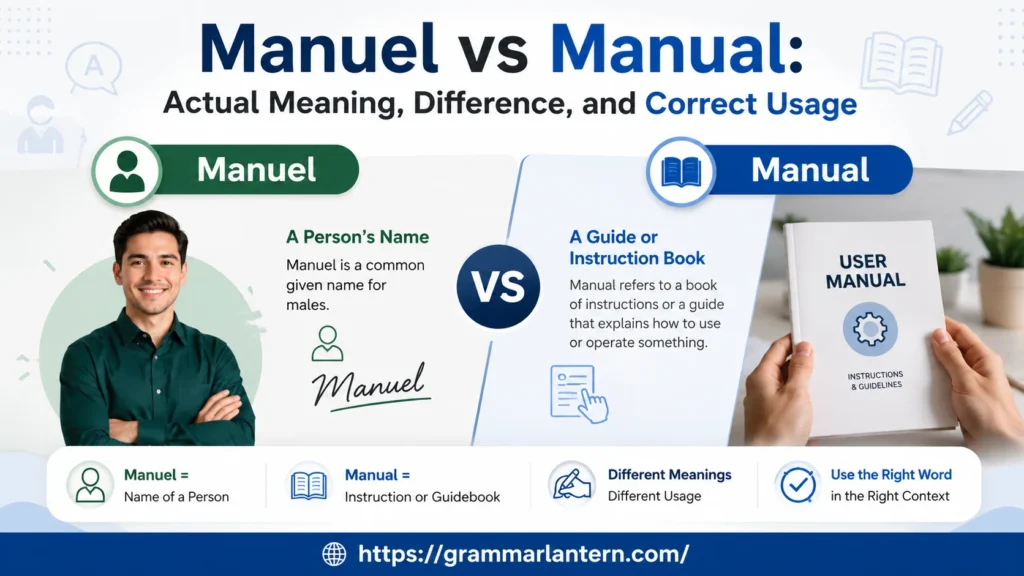
Manuel vs Manual: Key Differences Table
| Feature | Manuel | Manual |
| Word type | Proper noun | Noun and adjective |
| Main meaning | A person’s name | Done by hand or an instruction guide |
| Origin | From Emmanuel/Immanuel | Latin word meaning hand |
| Capitalization | Always capitalized when a name | Usually lowercase |
| Example | Manuel lives nearby. | Read the instruction manual. |
Manuel vs Manual Pronunciation Difference
Pronunciation can also help you identify the correct word.
Manuel
Usually pronounced:
man-WELL
Example:
- Manuel is coming tomorrow.
Manual
Usually pronounced:
MAN-yoo-uhl
Example:
- The manual contains safety instructions.
Although pronunciation differences are small, they can help in conversations.
Real-Life Examples of Manuel and Manual
Workplace Example
Incorrect:
The employee manuel explains company policies.
Correct:
The employee manual explains company policies.
Why?
Because the document containing workplace rules is a manual.
If an employee named Manuel works there, you could say:
Manuel follows the employee manual.
Both words can appear together, but they have different meanings.
Technology Example
Incorrect:
Check the software manuel before installation.
Correct:
Check the software manual before installation.
A software guide is always a manual.
Transportation Example
Incorrect:
I bought a manuel transmission car.
Correct:
I bought a manual transmission car.
A vehicle operated by changing gears yourself has a manual transmission.
It has nothing to do with a person named Manuel.
Common Manuel vs Manual Mistakes
| Incorrect Sentence | Correct Sentence | Explanation |
| Read the user manuel. | Read the user manual. | A guide is a manual. |
| Manuel labor requires strength. | Manual labor requires strength. | Work done by hand is manual. |
| The manual arrived at the office. | Manuel arrived at the office. | A person’s name is Manuel. |
Manual Synonyms and Related Words
The meaning of manual determines which synonyms work.
Manual Meaning: Done by Hand
Related words include:
- handmade
- physical
- hand-operated
- non-automated
Example:
“Manual control” can also mean “hand-operated control.”
Manual Meaning: Instruction Guide
Related words include:
- handbook
- guide
- instructions
- reference book
- booklet
Example:
“The user manual” can also be called “the user guide.”
Manuel Synonyms
Because Manuel is a personal name, it does not have synonyms.
You cannot replace Manuel with another word unless you are using another name.
How to Remember the Difference Between Manuel and Manual
A simple memory trick can prevent mistakes.
Remember: Manuel Has a Name
Manuel = Man + name
It refers to a person.
Example:
- Manuel is my friend.
Remember: Manual Connects to Hands
The word manual comes from Latin manus, meaning hand.
Think:
Manual = made by hands or a handbook
Examples:
- manual labor
- instruction manual
A quick sentence can lock the difference in your memory:
Manuel uses a manual to learn how to perform manual tasks.
FAQs
1. Is Manuel and Manual the same word?
No, Manuel and manual have different meanings. Manuel is usually a Spanish name used for a person, while manual is an English word related to something done by hand or a book containing instructions.
2. When should I use Manuel in a sentence?
Use Manuel when you are referring to a person’s name. Since it is a proper noun, it should always begin with a capital letter. For example, “Manuel sent me the report yesterday.”
3. When should I use manual in writing?
Use manual when talking about an instruction book, handbook, or something performed by hand. For example, “Please read the user manual before operating the machine.”
4. Why do people confuse Manuel and manual?
People often confuse these words because they look almost identical. The only noticeable difference is one letter, but that small spelling change creates a completely different meaning.
5. Is manual always related to machines?
No. While manual is commonly used for machine instructions, it can also describe tasks done by hand, such as manual work, manual labor, or manual processes.
6. Can Spellcheck tools detect Manuel vs Manual mistakes?
Not always. Spellcheck tools usually check spelling, but they may not understand the context or meaning of a sentence. A correctly spelled word can still be the wrong choice.
7. Is manual a noun or an adjective?
Manual can work as both a noun and an adjective. As a noun, it means an instruction book. As an adjective, it describes something done by hand, such as manual work.
8. Is Manuel a common noun or proper noun?
Manuel is a proper noun because it refers to a specific person’s name. Proper nouns are capitalized, while common nouns like “manual” are usually written in lowercase.
9. How can I remember the difference between Manuel and Manual?
A simple trick is to remember that Manuel has a capital “M” because it is a name, while manual usually refers to instructions, handbooks, or hand-operated tasks.
10. Does using the wrong word affect writing quality?
Yes. Choosing the wrong word can create confusion and reduce clarity in emails, reports, articles, and other forms of communication. Correct usage improves accuracy and professionalism.
Conclusion
Understanding the difference between Manuel and manual helps you avoid common spelling mistakes and improve your writing clarity. Although these words look similar, their meanings are completely different. Manuel refers to a person’s name, while manual relates to instructions, hand-operated devices, or tasks completed by hand.
Paying attention to context, capitalization, and sentence meaning allows you to choose the correct word confidently in every situation.

Muhammad Haroon is the voice behind many of the clear, practical grammar guides you’ll find on Grammar Lantern. With a strong background in content writing and a genuine love for the English language, Haroon specializes in breaking down intimidating grammar topics into simple, digestible lessons. His goal is simple: to empower readers to write with confidence and clarity. Whether he’s explaining tricky tenses or demystifying punctuation, Haroon approaches each topic with patience, precision, and a touch of warmth—because he knows that learning grammar is a journey, not a race.



[…] Read More: Manuel vs Manual: Actual Meaning, and Difference […]
[…] Read More: Manuel vs Manual: Actual Meaning, and Difference […]