
Is it headcount or head count? Both spellings are correct in English, and they refer to the total number of people in a group or the process of counting them. However, you may wonder which version works best in professional writing, business reports, or everyday communication. The answer depends mainly on your writing preference and context.
You’ll often see headcount in business documents, employee records, and workforce planning because the combined spelling looks concise and modern. Meanwhile, head count remains an accepted alternative in general writing, classroom instructions, and everyday situations. Both forms communicate the same basic idea, so neither is automatically wrong.
Understanding when to use headcount or head count can help you avoid unnecessary spelling confusion. Whether you’re writing an email, preparing a company report, managing employees, or counting students before a school trip, choosing one form consistently makes your writing clearer and more professional.
Quick Answer
Headcount is the recommended one-word spelling in most modern general and business writing. It refers to the total number of people in a particular group or organization.
Head count is also used as an open-compound variant in some publications and editorial styles. Both forms can communicate the same basic idea, but the closed spelling is a practical default when no specific style guide says otherwise.
| Spelling | Usage | Recommendation |
| Headcount | Closed compound noun meaning the number of people | Preferred default |
| Head count | Open-compound variant with the same general meaning | Acceptable in some styles |
| Head-count | Hyphenated form | Usually unnecessary |
Examples:
- The company’s headcount increased by 15 employees this year.
- The manager checked the head count before the meeting began.
- Our department needs an updated headcount for next month’s budget.
Remember: Choose one spelling and use it consistently throughout your document. If your organization follows a particular dictionary or style guide, follow its preference.
What Does Headcount Mean?
Definition of Headcount
Headcount is a noun that describes the total number of people in a particular group. It helps individuals and organizations understand how many people belong to a team, attend an event, work for a company, or participate in an activity.
The word combines two familiar terms:
- Head: An informal way to refer to a person.
- Count: The process or result of calculating a number.
Together, they describe the number of individuals in a group.
For example, imagine a company with 75 employees. Its employee headcount is 75, regardless of whether those employees work full-time or part-time.
The term doesn’t necessarily describe how many hours people work. Instead, it focuses on the number of individual people.
Headcount in Business and Human Resources
In business, headcount plays an important role in workforce management. Human resources departments use it to track employees, plan recruitment, manage staffing levels, and prepare organizational reports.
Companies also monitor headcount when making financial decisions. Hiring additional employees affects payroll, benefits, equipment requirements, office space, and other operating expenses.
Consider a company with the following workforce:
| Department | Number of Employees |
| Human Resources | 8 |
| Marketing | 12 |
| Sales | 20 |
| Information Technology | 15 |
| Customer Support | 25 |
| Total Headcount | 80 |
The company has 80 employees across five departments. Management can use these figures to identify staffing needs and distribute resources.
For example, if customer support receives more inquiries than usual, managers might consider hiring additional representatives.
However, headcount doesn’t automatically reveal whether a department has enough working hours available. That’s where another workforce measurement, called full-time equivalent (FTE), becomes useful.
Headcount in Everyday Situations
Although businesses frequently use the word, headcount isn’t limited to corporate environments. You can use it whenever you need to describe the number of people in a group.
Common situations include:
- Schools: Teachers count students before organizing a field trip.
- Meetings: Organizers check how many participants have arrived.
- Events: Coordinators estimate attendance before arranging seating.
- Sports teams: Coaches count available players before a match.
- Families: Someone checks the group size before making a restaurant reservation.
- Conferences: Event planners calculate registrations and actual attendance.
For instance, a teacher might say, “I need the final headcount before booking the buses.”
The sentence communicates a simple request: the teacher needs to know how many students will participate.
Read More: Others or Other’s or Others’? Correct Possessive Explained
What Does Head Count Mean?
Definition and Open-Compound Usage
Head count is an open-compound spelling of the same expression. It uses two separate words rather than combining them into one.
Some writers, publications, and editorial conventions retain this spelling. Its meaning generally remains unchanged.
For example:
- We need an accurate head count before ordering lunch.
- The supervisor requested a head count of all employees.
- Please confirm the head count before reserving the conference room.
In these examples, the two-word expression refers to the number of people.
The difference is mainly one of spelling preference rather than meaning. Therefore, readers can usually understand either form without confusion.
Head Count as a Counting Activity
The expression can also describe the act of counting people rather than simply reporting the final number.
Imagine organizing a school trip. You ask teachers to check their groups before the buses leave. Each teacher counts the students to make sure nobody is missing.
That process is a head count.
Consider these examples:
- The teacher performed a head count before leaving the classroom.
- Security staff conducted a head count after the evacuation.
- The event coordinator completed a head count before opening the doors.
These sentences emphasize the counting activity.
However, the closed spelling also appears in modern writing for the resulting number and related counting contexts. Don’t assume that the open form must always describe an action.
When to Use the Two-Word Form
You may encounter head count in older publications, organizational documents, and style guides that prefer open compounds.
Consider using it when:
- Your employer’s writing guidelines require that spelling.
- A publication consistently uses open compounds.
- You’re editing a document that already follows this convention.
- A particular dictionary or editorial reference recommends it.
The most important rule is consistency. A report shouldn’t randomly alternate between headcount and head count without a reason.
Key Differences
The difference between headcount and head count is mainly their written form. Both expressions refer to counting people or identifying the number of individuals in a group.
However, understanding their usage helps you make better spelling decisions.
| Comparison | Headcount | Head Count |
| Word structure | One word | Two words |
| Grammatical function | Noun | Noun |
| General meaning | Number of people or counting activity | Number of people or counting activity |
| Business usage | Common | Also used |
| Attendance usage | Common | Also used |
| Spelling preference | Closed compound | Open compound |
| Example | The headcount reached 100. | The head count reached 100. |
Do Headcount and Head Count Have Different Meanings?
No significant difference in meaning separates these two spellings. Both can describe the total number of people or the process of counting them.
For example:
- The school reported a student headcount of 500.
- The school reported a student head count of 500.
Both sentences communicate the same information.
The choice usually depends on the dictionary, publication, or organizational style you follow.
Which Form Should You Use in Professional Writing?
For most professional documents, headcount is a practical choice. It appears as a recognized closed compound in major English dictionaries, including Oxford and Cambridge.
Nevertheless, the open form also appears in established business writing. If your company’s editorial guidelines specify head count, there’s no reason to change it unnecessarily.
The goal isn’t to force one spelling into every situation. It’s to write accurately and consistently.
Headcount as a Noun
The word headcount functions primarily as a noun. It identifies either the number of people in a group or the act of counting those people.
Its meaning depends on the surrounding sentence.
Headcount in Workforce Planning
Businesses regularly track employee headcount to understand their staffing levels. Human resources teams use these figures when preparing recruitment plans and reviewing organizational growth.
For example, a company might have 120 employees at the beginning of January. After hiring 15 people and losing five employees, its headcount becomes 130.
The calculation looks like this:
| Workforce Activity | Employees |
| Starting headcount | 120 |
| New hires | +15 |
| Employees who left | -5 |
| Ending headcount | 130 |
This simple calculation helps managers understand workforce changes.
However, companies must define which workers they include. Some reports count only active employees, while others include employees on approved leave or temporary arrangements.
A reliable report should explain its counting rules.
Headcount in Attendance and Event Management
Event organizers use headcount to estimate attendance and prepare suitable facilities.
Imagine planning a business conference for 200 registered participants. If only 175 people confirm their attendance, the organizer may adjust seating, refreshments, printed materials, and staff requirements.
An accurate count prevents unnecessary spending and helps avoid overcrowding.
Common examples include:
- The conference headcount reached 175.
- We need the final headcount before ordering meals.
- The organizer requested an updated headcount from each department.
- Security completed a headcount after the evacuation drill.
In safety situations, counting people is especially important. Supervisors can use attendance lists and physical checks to confirm that everyone has reached a designated safe location.
Headcount in Schools and Educational Institutions
Schools and universities also use headcount to measure enrollment and attendance.
However, these measurements aren’t always identical.
Enrollment headcount refers to the number of students registered with an institution. Attendance headcount refers to the students physically present at a particular time.
For example, a school might have 800 enrolled students but only 760 attending on a specific day.
| Measurement | Number |
| Total enrolled students | 800 |
| Students present | 760 |
| Students absent | 40 |
The difference matters when schools prepare attendance reports, arrange transportation, or calculate classroom capacity.
Is Headcount One Word or Two?
Headcount is one word and serves as a standard spelling in modern English. However, head count is also an established alternative.
English contains many compound expressions that appear in different forms. Some remain separate, some use hyphens, and others combine into one word.
For example:
| Open Compound | Closed Compound |
| Ice cream | Not commonly written as one word |
| Data base | Database |
| Web site | Website |
| Head count | Headcount |
These examples show why compound-word spelling can confuse writers. Language changes over time, and dictionaries sometimes recognize multiple forms.
Why Do Compound Words Become One Word?
Compound words often develop gradually.
Writers initially use two separate words because each part has an independent meaning. As an expression becomes familiar, people may begin treating it as a single vocabulary item.
The spelling can eventually become closed.
The word headcount follows this familiar pattern. Its two elements combine to form a single noun with a specific meaning.
Still, the open spelling hasn’t disappeared. Both forms remain recognizable in contemporary English.
Should You Use Headcount or Head Count in an Article?
For a general article, use headcount as your default spelling.
It creates a consistent appearance and matches the closed form listed by major dictionaries. However, if you’re writing for an organization that prefers head count, follow its established convention.
Avoid changing the spelling simply to make different paragraphs look varied. Spelling consistency matters more than stylistic variation.
Is Headcount Hyphenated?
No. In ordinary contemporary writing, headcount is generally written as one word without a hyphen.
The hyphenated form head-count is usually unnecessary.
To understand the distinction, consider these three forms:
- Headcount: Closed compound.
- Head count: Open compound.
- Head-count: Hyphenated compound.
The closed and open forms are established alternatives. The hyphenated form isn’t normally needed for this expression.
Examples of Correct and Less-Preferred Usage
| Sentence | Assessment |
| Our headcount increased this month. | Preferred closed form |
| Our head count increased this month. | Established open variant |
| Our head-count increased this month. | Usually unnecessary hyphen |
For everyday business writing, choose the first form unless your style guide recommends otherwise.
Headcount vs. FTE: Are They the Same?
Although businesses often discuss headcount and FTE together, these terms measure different things.
Headcount measures the number of individual employees. FTE measures their combined working hours relative to a standard full-time schedule.
Understanding this difference helps managers prepare accurate workforce reports.
What Is Employee Headcount?
Employee headcount counts individual workers.
Each employee represents one person, regardless of whether they work full-time or part-time.
For example, a company employs:
- 10 full-time employees.
- 5 part-time employees.
- 3 temporary employees.
If all 18 workers fall within the company’s reporting definition, its headcount is 18.
The calculation doesn’t reduce the number because some employees work fewer hours.
What Is Full-Time Equivalent (FTE)?
Full-time equivalent (FTE) converts working hours into full-time workload units.
One FTE represents the working hours of one full-time employee during a defined period.
The standard schedule depends on the organization and its applicable employment rules. For a simple example, assume full-time work means 40 hours per week.
The calculation is:
FTE=TotalWeeklyWorkingHoursStandardFull-TimeWeeklyHours
Suppose two part-time employees each work 20 hours weekly.
Their combined workload is:
20+2040=1FTE
Although the company employs two people, their combined workload equals one full-time position.
Practical Difference Between Headcount and FTE
Consider a company with the following workforce:
| Employee Category | People | Weekly Hours Each | Total Hours |
| Full-time | 10 | 40 | 400 |
| Part-time | 4 | 20 | 80 |
| Total | 14 | — | 480 |
Assuming a 40-hour full-time schedule:
FTE=48040=12
The company has:
- Headcount: 14 employees.
- FTE: 12 full-time equivalents.
This distinction is useful when evaluating staffing capacity, payroll budgets, and labor requirements.
A company can have a growing headcount without experiencing the same increase in available working hours.
Common Spelling and Usage Mistakes
Even though the word looks simple, writers sometimes misuse it in business reports and everyday communication.
Here are several mistakes worth avoiding.
Writing Head Count and Headcount Inconsistently
Switching between both spellings within one document can make your writing look unedited.
Inconsistent:
- The company reported a headcount of 100.
- The head count increased to 120.
- Management reviewed the headcount again.
Consistent:
- The company reported a headcount of 100.
- The headcount increased to 120.
- Management reviewed the headcount again.
The second version follows one spelling throughout.
Using Headcount and FTE Interchangeably
Headcount measures people, while FTE measures equivalent full-time workloads.
A business with 20 employees doesn’t necessarily have 20 FTEs.
Confusing these measurements can create misleading staffing reports and budget calculations.
Confusing Employee Headcount With Approved Positions
Another common mistake involves treating employees and authorized positions as the same thing.
Imagine a company has approval to hire 50 employees but currently employs only 42.
Its figures are:
- Approved positions: 50.
- Filled positions: 42.
- Vacant positions: 8.
- Current employee headcount: 42.
The company doesn’t have a headcount of 50 simply because it has permission to fill 50 positions.
Using an Unnecessary Hyphen
Writing head-count usually adds punctuation without improving clarity.
Use headcount as the default closed form.
Forgetting to Define Who Gets Counted
Workforce reports can become confusing when companies don’t explain their counting methods.
For example, one department might include contractors while another counts only direct employees.
Both figures may be useful, but they aren’t directly comparable unless their definitions match.
Always identify the population included in a headcount report.
In Different Contexts
The word appears in several professional settings. Its basic meaning stays consistent, but the information it represents changes with the situation.
Corporate and HR Communication
Human resources departments use headcount when discussing recruitment, workforce changes, and employee distribution.
Common expressions include:
- Current employee headcount.
- Department headcount.
- Global workforce headcount.
- Monthly headcount report.
- Headcount reduction.
- Headcount growth.
- Approved headcount.
Example: The HR department will review the company’s headcount before approving additional recruitment.
Finance and Budgeting
Headcount also influences financial planning.
Every additional employee may increase payroll expenses, insurance costs, benefits, equipment requirements, and other operating expenses.
For example, a business planning to hire 10 employees should estimate the total financial impact before approving the recruitment budget.
A headcount forecast helps finance teams prepare for these expenses.
Events and Education
Event organizers and educational institutions use headcount to estimate the number of people they need to accommodate.
For example:
- A university calculates student headcount for enrollment reporting.
- A wedding planner requests a guest headcount before ordering meals.
- A conference organizer checks the participant headcount before arranging seating.
- A teacher performs a headcount before leaving a museum.
In these situations, accurate counting helps people make practical decisions.
Synonyms and Related Terms
Several expressions can replace headcount, depending on the situation. However, not every alternative has exactly the same meaning.
| Synonym or Related Term | Meaning | Best Context |
| Employee count | Number of employees | HR reports |
| Workforce size | Total size of an organization’s workforce | Business planning |
| Staff count | Number of staff members | Workplace communication |
| Personnel count | Number of personnel | Formal reports |
| Attendance count | Number of people present | Events and schools |
| Enrollment | Number of registered students or participants | Education |
| Group size | Number of people in a group | Everyday situations |
| Employee total | Total number of employees | Business reports |
Employee Count
Employee count is a straightforward alternative when discussing the number of people employed by an organization.
Example: The employee count increased from 75 to 90 during the year.
Workforce Size
Workforce size describes the overall size of a company’s workforce.
It works particularly well in business discussions about recruitment, organizational growth, and staffing capacity.
Example: Management wants to review the company’s workforce size before opening another office.
Attendance Count
Attendance count focuses on people who are physically present or recorded as attending an event.
Example: The attendance count reached 350 during the afternoon session.
Enrollment
Enrollment refers to people registered for a school, university, program, or course.
It doesn’t necessarily represent the number of people attending on a particular day.
Example: Student enrollment increased by 8% this academic year.
Examples in Sentences
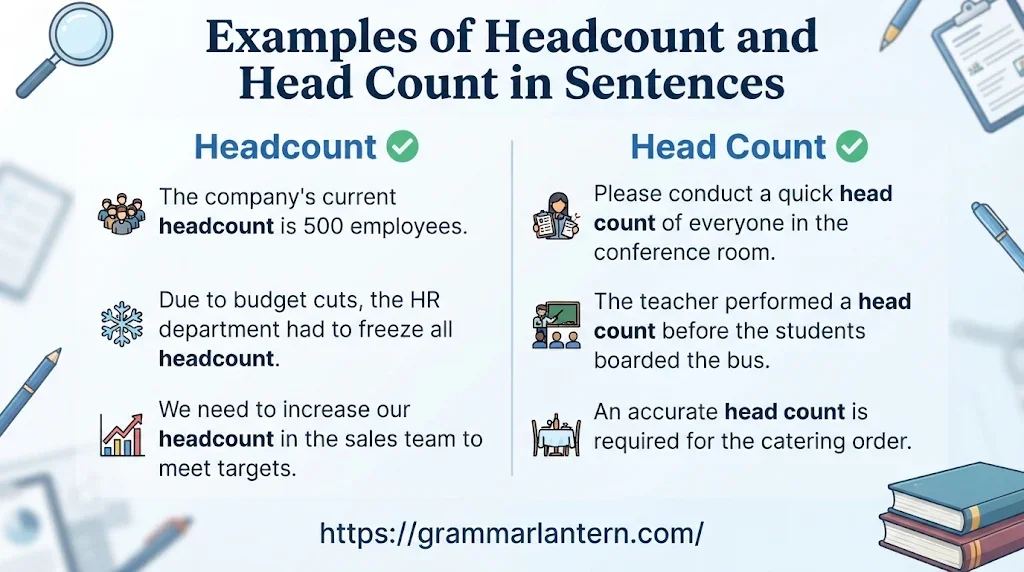
Practical examples make spelling rules easier to understand. The following sentences show how both established forms appear in everyday and professional writing.
1.Examples Using Headcount
- The company reported a headcount of 250 employees.
- Our department’s headcount increased after the recruitment campaign.
- The manager requested an updated headcount for the monthly report.
- The school calculated its student headcount before the new semester.
- We need an accurate headcount before arranging transportation.
- The HR team monitors employee headcount every quarter.
- Management approved a higher headcount for the customer service department.
- The event organizer recorded a final headcount of 180 guests.
- Our current headcount includes both full-time and part-time employees.
- The company expects its workforce headcount to remain stable next year.
2.Examples Using Head Count
- The teacher completed a head count before leaving the classroom.
- We need the final head count before ordering refreshments.
- The supervisor requested a head count after the emergency drill.
- The conference team checked the head count before opening the doors.
- The company reported a total head count of 95 workers.
- Please provide your department’s head count by Friday.
- The school conducted a head count during the morning assembly.
- The organizer requested a guest head count before confirming the venue.
- Security staff performed a head count after the evacuation.
- The department’s head count changed following the restructuring.
Examples Showing the Difference Between Headcount and Counting People
These examples demonstrate how the word works in different grammatical contexts.
| Context | Example |
| Reporting a total | Our headcount is 45 employees. |
| Performing an activity | The manager conducted a headcount. |
| Business planning | Management reviewed the headcount forecast. |
| School attendance | The teacher completed a headcount. |
| Event organization | We need the final headcount today. |
Notice that the closed spelling works naturally in all these examples. The open spelling can also appear where an editorial style prefers it.
How to Remember the Correct Spelling
Remembering headcount is straightforward once you understand its structure and meaning.
Think of it as one combined word that represents the number of people in a group.
Use these simple reminders:
- Headcount: The preferred closed spelling for most modern writing.
- Head count: An accepted open variant.
- Head-count: Usually unnecessary.
- Consistency: Follow one spelling throughout your document.
- Context: Make sure you’re counting people rather than positions or working hours.
A helpful trick is to connect the word with familiar business expressions such as employee headcount and workforce headcount.
These combinations make the closed spelling easier to recognize.
Read More: Which vs. Wich vs. Witch: Meaning, Differences, and Examples
FAQs
1. Is headcount or head count correct?
Both headcount and head count are correct English spellings. They refer to the total number of people in a group or the act of counting them. You can use either form depending on your writing style and context. However, headcount is especially common in modern business and workplace writing.
2. What does headcount mean?
Headcount means the total number of people in a particular group, organization, or location. It can also describe the process of counting those people. For example, a company might review its employee headcount before hiring additional staff.
3. Is headcount one word or two words?
Headcount is commonly written as one word. However, head count is also an accepted spelling. Both forms have the same basic meaning, so you don’t need to worry about changing the meaning when choosing between them.
4. Should I use headcount in professional writing?
Yes. Headcount is a practical choice for professional writing, especially in business reports, HR documents, financial records, and workforce planning. Its compact spelling also fits naturally into workplace vocabulary. Remember to follow your organization’s preferred style.
5. What is the plural of headcount?
The plural of headcount is generally headcounts when referring to multiple counts or separate groups. For example, a company might compare the headcounts of three departments. When referring to the number of people, writers often use the singular form with a specific figure.
6. Is headcount the same as employee count?
They often mean the same thing in business settings. Headcount usually refers to the number of employees working for an organization or department. However, employee count makes the meaning more specific because headcount can also describe students, visitors, attendees, or other groups.
7. Can I write head count in a sentence?
Absolutely! Head count is an accepted alternative and works naturally in sentences. For example, “The teacher completed a head count before the students boarded the bus.” The two-word spelling communicates the same basic meaning as headcount.
8. Is headcount a noun or a verb?
Headcount is primarily used as a noun. It describes the total number of people or the process of counting them. In everyday English, people may also use the expression “take a head count” to describe counting everyone in a group.
9. How do you use headcount in a business sentence?
You can use headcount when discussing staffing levels, hiring plans, or employee numbers. For example, “The manager reviewed the department’s headcount before approving two new positions.” It is particularly useful in human resources, budgeting, and workforce management.
10. Which spelling should I remember: headcount or head count?
Remember that both spellings are acceptable. However, headcount is a convenient choice for modern business and professional writing. Use head count when it matches your preferred writing style or the style guide you’re following. Most importantly, stay consistent throughout your document.
Conclusion
Both headcount and head count are correct spellings, and neither changes the basic meaning of the term. They describe the number of people in a group or the process of counting them. You may encounter either form in business documents, school instructions, workplace conversations, and everyday writing.
For professional communication, headcount is a practical choice because it’s concise and widely used in modern business contexts. However, head count remains perfectly acceptable. Choose the spelling that suits your audience and writing style, and use it consistently. Once you understand this simple difference, you’ll have one less English spelling question to worry about.

For Shafiq ur Rehman, writing is an art form and grammar is the toolbox that makes it beautiful. As a dedicated content writer at Grammar Lantern, Shafiq approaches every topic like an architect carefully laying down strong foundations of understanding before adding the finer details. He loves diving into the trickiest grammar points and resurfacing with simple, bite-sized takeaways that anyone can grasp. When he’s not crafting articles, you’ll likely find him strategizing over a game of chess, exploring dusty local bookshops, or quietly jotting down poetic observations in his notebook.