
Have you ever wondered whether to use came or come in a sentence? Both similar words describe movement, but they fit different situations depending on verb tense and word usage. Understanding their difference helps you communicate clearly and avoid common grammar mistakes.
Come is the base form of an irregular verb, used for present actions, daily habits, and general actions. For example, “I come here every day” describes a routine. In contrast, came is the simple past tense of the verb come. It describes completed actions and past events, as in “I came here yesterday.” These easy examples highlight their grammatical distinction.
Learning when to use came and come improves your grammar understanding, writing skills, and natural speech. In everyday English, spoken English, and daily conversations, the correct choice depends on sentence structure and time expressions. Remember that come also works as a past participle with helping verbs, as in “I have come home.” Understanding verb forms, verb conjugation, and contextual usage helps English learners and native speakers communicate with confidence.
Quick Answer
Came is the simple past tense of come. Use it when describing an action that happened and finished in the past.
Come is the base form and past participle of come. Use it in present-tense sentences, commands, infinitives, future constructions, and perfect tenses with helping verbs.
| Word | Verb Form | When to Use It | Example |
| Came | Simple past | Completed past actions | She came yesterday. |
| Come | Base form | Present sentences, commands, infinitives, and after certain helping verbs | They come here every week. |
| Come | Past participle | Perfect tenses with have, has, or had | They have come already. |
Remember this simple rule:
- Use came for completed past actions without a helping verb in affirmative simple past sentences.
- Use come after did, didn’t, will, can, and other modal verbs.
- Use come after have, has, and had in perfect-tense constructions.
- Use come for commands and infinitives.
For example, “He came home yesterday” is correct. “He has come home” is also correct. However, “He has came home” is incorrect in standard English.
What Does Came Mean?
Came is the simple past tense of the verb come. It describes movement, arrival, appearance, or an event that happened in the past.
When someone came somewhere, they arrived at a place or moved toward a person, destination, or location. The action occurred before the present moment.
Unlike regular verbs that form their past tense by adding -ed, come changes its spelling. This makes it an irregular verb.
For example:
- I come to work every day. (Present)
- I came to work yesterday. (Past)
The second sentence describes an action that already happened. The word came tells readers that the arrival occurred in the past.
Examples of Came in Sentences
Here are several examples showing how came works in everyday English.
- She came to my house yesterday.
- My brother came home late last night.
- The guests came before dinner.
- He came to help me with my homework.
- The train came ten minutes late.
- A good idea came to her during the meeting.
- The news came as a surprise.
- They came to visit us last summer.
In these examples, came describes past movement, arrival, appearance, or an event. The surrounding context helps readers understand when it happened.
Read More: Flake vs. Hake: What’s the Difference? Taste, Nutrition, and Uses
When to Use Came
Use came when your sentence describes a completed action in the simple past tense.
Completed Past Actions
When someone arrived, visited, or moved somewhere in the past, use came.
- She came to the office early.
- He came to my birthday party.
- The children came home after school.
Past Actions With Specific Time Expressions
Time expressions often make the simple past tense easier to recognize. Words such as yesterday, last week, last month, and two days ago usually indicate a completed past action.
- We came here last weekend.
- He came to see me two days ago.
- They came to the city last year.
Past Narratives and Stories
Writers use came to describe events in stories, personal experiences, and historical accounts.
For example:
The stranger came through the door and asked for directions.
The word came helps establish the sequence of events in the narrative.
What Does Come Mean?
Come is the base form of the verb and its past participle. It describes movement toward a person, place, or destination. However, its grammatical function changes depending on the sentence.
You can use come in present-tense sentences, commands, infinitives, future constructions, and perfect tenses.
For example:
- Please come inside.
- I come here every Sunday.
- They have come a long way.
- She will come tomorrow.
- We want to come with you.
Notice that come appears in different sentence structures. The helping verb or surrounding words determine its grammatical role.
Examples of Come in Sentences
Here are common examples of come in everyday English.
- Come here for a moment.
- I come to this restaurant regularly.
- They have come to an agreement.
- We will come tomorrow morning.
- She wants to come with us.
- Did he come to the meeting?
- You can come whenever you want.
- The flowers come in different colors.
Each sentence uses come for a different grammatical reason. Understanding those structures helps you choose the correct verb form without guessing.
When to Use Come
Present Simple With I, You, We, and They
Use come in the present simple when the subject is I, you, we, or they.
- I come here every morning.
- You come to work early.
- We come from different backgrounds.
- They come to visit us regularly.
However, third-person singular subjects require comes in the present simple.
- He comes here every Friday.
- She comes to work by bus.
- My friend comes over after school.
Commands and Requests
Use come when telling someone to arrive, move toward you, or join a group.
- Come here, please.
- Come inside and sit down.
- Come with us to the park.
- Come back when you’re ready.
Commands normally use the base form of a verb. That’s why come works in these sentences.
Infinitives With To
Use come after to when forming an infinitive.
- I want to come with you.
- She plans to come tomorrow.
- They decided to come early.
- He needs to come back soon.
In these sentences, to come expresses an intended action, plan, decision, or need.
Perfect Tenses
Use come after have, has, and had to form perfect tenses.
- I have come to understand the problem.
- She has come home.
- They had come before we arrived.
These helping verbs change the sentence’s tense or relationship to another event. The main verb remains come.
Future Sentences
Use come after will when describing future arrivals or visits.
- I will come tomorrow.
- She will come to your birthday party.
- They will come after work.
The modal verb will takes the base form of the main verb. Therefore, will come is correct while will came is incorrect.
Key Differences
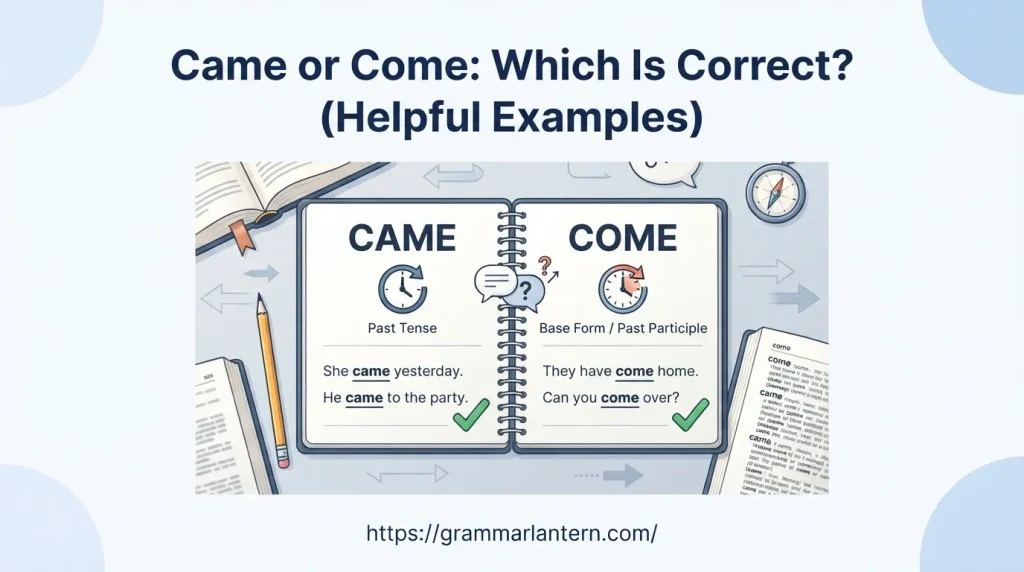
The easiest way to distinguish came and come is to examine their verb forms. Although both words describe movement or arrival, they appear in different grammatical structures.
Came expresses the simple past. Come functions as the base form and past participle. The helping verbs and time expressions surrounding them often tell you which form belongs in a sentence.
Came vs. Come Comparison Table
| Grammar Feature | Came | Come |
| Verb form | Simple past | Base form and past participle |
| Simple past affirmative | He came yesterday. | Not used in this structure |
| Present simple | Not used | I come here regularly. |
| Present perfect | Not used | He has come home. |
| Past perfect | Not used | He had come earlier. |
| Future | Not used after will | He will come tomorrow. |
| Infinitive | Not used | She wants to come. |
| Command | Not used | Come inside. |
| After did | Not used in the main verb | Did you come? |
How Tense Changes the Verb Form
Tense determines whether the sentence refers to the past, present, or future. However, the verb form also depends on whether the sentence contains a helping verb.
Compare these sentences:
- Simple past: He came to work yesterday.
- Present perfect: He has come to work.
- Past perfect: He had come to work before I arrived.
- Future: He will come to work tomorrow.
All four sentences describe arrival. Nevertheless, each uses a different grammatical construction.
The simple past uses came directly. Perfect tenses use come after their helping verbs. The future construction uses come after will.
Came or Come in Different Tenses
Understanding tense is one of the most reliable ways to choose between came and come. Let’s examine how these words work in common English tenses.
Simple Past Tense: Came
The simple past describes an action that happened and finished before the present moment.
Use came when someone arrived, visited, moved, or appeared in the past.
Examples:
- She came to my house yesterday.
- We came back from vacation last Monday.
- He came to the office before everyone else.
- My cousins came for dinner last night.
Time expressions such as yesterday, last night, and last Monday often indicate the simple past. They help establish when the action occurred.
Present Perfect Tense: Have or Has Come
The present perfect connects a past action or experience with the present. It can describe an experience, a recent arrival, or a situation that matters now.
Use have come with I, you, we, and they. Use has come with he, she, and it.
Examples:
- I have come to discuss the project.
- She has come back from vacation.
- They have come to visit their grandparents.
- The time has come to make a decision.
The present perfect doesn’t usually work with finished time expressions such as yesterday or last year.
Incorrect: She has come yesterday.
Correct: She came yesterday.
The simple past works because yesterday identifies a finished time.
Past Perfect Tense: Had Come
The past perfect describes an action completed before another past action or moment.
Use had come regardless of the subject.
Examples:
- She had come home before I called.
- They had come to the party when we arrived.
- He had come prepared for the interview.
- We had come to the wrong address.
The past perfect helps readers understand the order of events. For instance, “She had come home before I called” tells us that her arrival happened first.
Future Tense: Will Come
Use come after will when describing a future action.
Examples:
- I will come to your office tomorrow.
- She will come with us next week.
- They will come after lunch.
- He will come back soon.
The modal will already signals the future. The main verb therefore stays in its base form.
Incorrect: She will came tomorrow.
Correct: She will come tomorrow.
Present Simple Tense: Come
The present simple describes habits, routines, facts, and repeated actions.
Use come with I, you, we, and they.
Examples:
- I come here every morning.
- We come to this park on weekends.
- They come from different countries.
- You come to class on time.
With he, she, and it, the verb changes to comes.
- He comes here every afternoon.
- She comes to work by train.
- My brother comes home late.
Remember that comes is another form of the same verb. It isn’t the simple past form.
Came or Come After Have, Has, and Had?
This is one of the most common mistakes English learners make. When a sentence contains have, has, or had as a perfect-tense helping verb, the main verb must use its past participle form.
For come, the past participle is come, not came.
| Helping Verb | Correct Construction | Example |
| Have | Have come | I have come to help. |
| Has | Has come | She has come home. |
| Had | Had come | They had come earlier. |
Correct Examples
- I have come to see you.
- She has come to an important decision.
- They had come before the rain started.
- We have come a long way.
- He has come back from his trip.
Incorrect Examples and Corrections
| Incorrect | Correct |
| She has came home. | She has come home. |
| They had came early. | They had come early. |
| I have came to help. | I have come to help. |
| He has came back. | He has come back. |
Why do these mistakes happen? Many English verbs use the same form for the simple past and past participle. For example, played works in both “I played yesterday” and “I have played before.”
However, come is an irregular verb. Its simple past and past participle forms are different:
- Simple past: came
- Past participle: come
That’s why you need to remember this particular verb pattern.
After Did and Didn’t?
When you use did or didn’t in a simple past sentence, the main verb stays in its base form.
Use come, not came, after did and didn’t.
The helping verb did already carries the past-tense meaning. Adding another past-tense form to the main verb would create an incorrect construction in standard English.
Examples With Did
- Did you come to the party?
- Did she come to work yesterday?
- Did they come by car?
- Did he come home on time?
Examples With Didn’t
- He didn’t come yesterday.
- We didn’t come to the office.
- She didn’t come to the meeting.
- They didn’t come because it was raining.
Emphatic Statements With Did
Sometimes speakers use did in affirmative sentences to emphasize that an action really happened.
- I did come to your party.
- She did come to see you.
- They did come early.
In these sentences, did adds emphasis. The main verb still uses come.
| Incorrect | Correct |
| Did you came home? | Did you come home? |
| She didn’t came yesterday. | She didn’t come yesterday. |
| Did he came to work? | Did he come to work? |
| I did came earlier. | I did come earlier. |
In Questions?
Questions often use helping verbs to establish tense. Once you identify the helping verb, choosing the correct form becomes much easier.
Simple Past Questions
Use did followed by come.
- Did he come yesterday?
- Did you come by yourself?
- Did they come to the event?
- Did she come home late?
Present Perfect Questions
Use have or has followed by come.
- Have you come here before?
- Has she come back?
- Have they come to an agreement?
- Has he come home yet?
Future Questions
Use will followed by come.
- Will you come tomorrow?
- Will they come to the wedding?
- Will she come with us?
- Will he come back soon?
The main verb remains come in all these questions. The helping verb determines the grammatical structure.
In Negative Sentences?
Negative sentences use helping verbs such as didn’t, haven’t, hasn’t, hadn’t, and won’t. The correct verb form depends on the helping verb.
| Negative Construction | Correct Example |
| Didn’t + come | She didn’t come yesterday. |
| Haven’t + come | They haven’t come yet. |
| Hasn’t + come | He hasn’t come home. |
| Hadn’t + come | We hadn’t come before noon. |
| Won’t + come | I won’t come tonight. |
Negative Simple Past
Use didn’t come to describe something that didn’t happen in the past.
- He didn’t come to school.
- They didn’t come to the party.
- I didn’t come yesterday.
Negative Present Perfect
Use haven’t come or hasn’t come when an action hasn’t happened by the present moment.
- She hasn’t come yet.
- They haven’t come back.
- We haven’t come to a decision.
Negative Past Perfect
Use hadn’t come when an action hadn’t happened before another past event.
- He hadn’t come home when I went to bed.
- They hadn’t come before the meeting started.
Common Mistakes
Even experienced English speakers sometimes mix up irregular verbs while speaking quickly. However, a few simple rules can prevent most mistakes.
Using Came After Have or Has
This mistake occurs when writers confuse the simple past with the past participle.
Incorrect: I have came home.
Correct: I have come home.
Incorrect: She has came to visit.
Correct: She has come to visit.
Rule: Use come after have and has in present perfect constructions.
Read More: Jesus’ or Jesus’s? Here’s the Correct Possessive Form
Using Came After Did
The helping verb did already expresses the past. Therefore, the main verb must stay in its base form.
Incorrect: Did he came yesterday?
Correct: Did he come yesterday?
Incorrect: They didn’t came early.
Correct: They didn’t come early.
Rule: After did or didn’t, use come.
Using Come Instead of Came in Simple Past
When a sentence uses the simple past without a helping verb, came is usually the correct form.
Incorrect: He come here last night.
Correct: He came here last night.
Incorrect: We come to the party yesterday.
Correct: We came to the party yesterday.
Rule: Use came for affirmative simple past statements.
Confusing the Past Tense With the Past Participle
The verb come has three main forms. Learning them together helps you avoid tense mistakes.
| Base Form | Simple Past | Past Participle |
| Come | Came | Come |
Examples:
- I come here every day.
- I came here yesterday.
- I have come here several times.
Each form has a different grammatical role. Memorizing the three forms as a group makes them easier to recognize and use correctly.
Examples in Everyday English
The difference between came and come becomes clearer when you see how people use these words in real situations. The following examples cover conversations, school, workplace communication, emails, and common expressions.
Came and Come in Everyday Conversations
| Sentence | Explanation |
| He came to see me yesterday. | Simple past action. |
| Come over whenever you’re free. | Command or invitation. |
| Have you come here before? | Present perfect question. |
| They came home late. | Completed past arrival. |
| She will come with us. | Future action. |
Came and Come in School and Academic Writing
Students often use these verbs when writing essays, describing experiences, or discussing research.
- The teacher came into the classroom early.
- Several students came late to the examination.
- Researchers have come to similar conclusions.
- The new evidence has come to light.
- The student wants to come back next semester.
Academic writing also uses expressions such as come to a conclusion, come to an agreement, and come into existence. These phrases appear in formal and informal writing.
Came and Come in Workplace Communication
Professional conversations often involve meetings, deadlines, decisions, and arrivals.
- The manager came to the office early.
- Our client came to the meeting yesterday.
- We have come to an agreement.
- The team will come together next week.
- The report came in this morning.
Notice how the verb changes depending on the tense. The word came describes completed past events while come works with helping verbs or future constructions.
Came and Come in Emails and Messages
These verbs frequently appear in emails, text messages, and online conversations.
- I came across your email yesterday.
- Have you come across this document?
- She came to my desk to discuss the issue.
- Please come to my office when you’re available.
- We have come up with a new solution.
The phrases come across and come up with are common phrasal verbs. Their meanings depend on the words that follow them.
Sentence Examples With Explanations
Here are additional examples to help you recognize the correct form in different contexts.
| Sentence | Why It Is Correct |
| He came to dinner last night. | Came describes a completed past action. |
| They come here every summer. | Come describes a repeated present habit. |
| She has come to help us. | Come follows has in the present perfect. |
| We had come before the doors opened. | Come follows had in the past perfect. |
| I will come next week. | Come follows the future helping verb will. |
| Did you come to the event? | Come follows did in a past question. |
| He didn’t come yesterday. | Come follows didn’t. |
| Come and take a seat. | Come is used in a command. |
| I want to come with you. | Come follows the infinitive marker to. |
| She came across an old photograph. | Came across describes discovering something in the past. |
| The opportunity has come at the right time. | Come follows has. |
| They came back after lunch. | Came describes a past return. |
| He has come back from work. | Come follows has in the present perfect. |
| Will she come to the wedding? | Come follows will in a future question. |
| The truth came out eventually. | Came out describes something revealed in the past. |
Common Expressions With Come
The word come appears in many English expressions. Some describe movement while others have figurative meanings.
| Expression | Meaning | Example |
| Come across | Find or encounter unexpectedly | I came across an old book. |
| Come up with | Think of or create something | She came up with a solution. |
| Come back | Return | He came back yesterday. |
| Come along | Accompany someone or make progress | Come along with us. |
| Come out | Appear, become available, or be revealed | The truth came out. |
| Come in | Enter | Please come in. |
| Come up | Arise or happen | A problem came up. |
| Come to an agreement | Reach a shared decision | We have come to an agreement. |
These expressions are useful in everyday conversations and writing. Their tense still follows the same rules.
For example:
- I came across this article yesterday.
- I have come across this article before.
- I will come across more information later.
The phrasal verb stays the same while the verb form changes according to the sentence structure.
Verb Forms of Come
The verb come is irregular. Unlike regular verbs such as walk or talk, it doesn’t form its past tense by adding -ed.
Its main forms are:
| Verb Form | Word | Example |
| Base form | Come | I come here often. |
| Simple past | Came | I came yesterday. |
| Past participle | Come | I have come before. |
| Present participle | Coming | I am coming now. |
| Third-person singular | Comes | She comes every day. |
Why Come Appears Twice
The base form and past participle are identical in spelling. However, they serve different grammatical purposes.
The base form appears in constructions such as:
- I come here regularly.
- Come inside.
- They will come.
- We want to come.
The past participle appears in perfect tenses:
- I have come.
- She has come.
- They had come.
Although both forms look the same, their grammatical functions differ. The helping verb usually makes the difference clear.
How to Remember the Difference
You don’t need to memorize complicated grammar terminology to use these words correctly. A few practical reminders can help you choose the right form.
Remember Came for Completed Past Actions
Think of came as the form that tells you someone arrived or moved somewhere in the past.
- She came yesterday.
- He came last week.
- They came two hours ago.
If you’re describing a completed past action in an affirmative simple past sentence, came is usually the form you need.
Remember Come After Helping Verbs
The word come appears after many helping verbs and modal verbs.
| Helping Verb | Example |
| Did | Did you come? |
| Didn’t | He didn’t come. |
| Will | She will come. |
| Can | You can come. |
| Have | We have come. |
| Has | He has come. |
| Had | They had come. |
This is a useful shortcut. When you spot a helping verb, check which form the grammar requires.
Remember the Three Verb Forms Together
Instead of memorizing came alone, learn the complete pattern:
Come – Came – Come
Say the forms aloud or write a few sentences using each one. Repetition makes irregular verbs easier to remember.
Practice Exercises
Test your understanding by choosing the correct form of came or come in each sentence. Pay attention to the helping verbs and time expressions.
Fill in the Blanks
- She ___ to my house yesterday.
- Have you ___ back from work?
- Did they ___ to the party?
- He had ___ before I arrived.
- We will ___ tomorrow.
- They ___ here every Sunday.
- She hasn’t ___ home yet.
- I want to ___ with you.
- He didn’t ___ to the meeting.
- My friends ___ last weekend.
Answer Key With Explanations
| No. | Answer | Explanation |
| 1 | Came | Yesterday indicates simple past. |
| 2 | Come | Have requires the past participle come. |
| 3 | Come | Did takes the base form. |
| 4 | Come | Had requires the past participle. |
| 5 | Come | Will takes the base form. |
| 6 | Come | The subject they uses come in the present simple. |
| 7 | Come | Hasn’t requires the past participle. |
| 8 | Come | The infinitive uses to come. |
| 9 | Come | Didn’t takes the base form. |
| 10 | Came | Last weekend indicates simple past. |
If you answered all ten correctly, you’ve understood the most important difference. If a few answers were incorrect, review the helping-verb rules and try again.
FAQs
1. What is the main difference between came and come?
Came is the simple past tense of the verb come, while come is its base form and past participle. Use came for completed past actions and come for present actions or perfect tenses.
2. Is came past or present tense?
Came is the simple past tense. It describes an action that happened and finished in the past. For example, “She came to my house yesterday.”
3. Is come present or past tense?
Come is the base form of the verb, commonly used in the present tense. However, it also works as a past participle in perfect tenses. For example, “They have come home.”
4. Should I use came or come with have?
Use come with have or has to form the present perfect tense. For example, “I have come to help you.” Never use came directly after have or has in standard English.
5. Is it correct to say I came here or I come here?
Both expressions are correct, but their meanings differ. Use “I came here” for a past action. Use “I come here” to describe a regular habit or routine.
6. What is the past participle of come?
The past participle of come is also come. Its three main forms are come, came, and come. For example, “She has come to visit us.”
7. Can I use came with yesterday?
Yes, came works correctly with yesterday because yesterday refers to a completed past action. For example, “My brother came home yesterday.”
8. Is come an irregular verb?
Yes, come is an irregular verb because its past-tense form doesn’t follow the regular -ed pattern. Its forms are come, came, and come.
9. Is it correct to say I have came?
No, “I have came” is grammatically incorrect in standard English. The correct expression is “I have come.” Remember to use the past participle after have or has.
10. How can I remember when to use came and come?
Use came when talking about a finished past action. Use come for present actions, the base form, and perfect tenses. Remember this simple example: “I come every day, but I came yesterday.”
Conclusion
Understanding the difference between came and come makes your English grammar stronger and your sentences more natural. Although both words describe movement, they serve different grammatical purposes. Came expresses completed past actions, while come works as the base form and past participle of an irregular verb.
The easiest way to remember their difference is to pay attention to verb tense and sentence structure. Use “I came yesterday” for a past event and “I have come home” for the present perfect tense. With regular practice, practical examples, and everyday conversations, you’ll learn to choose the correct form confidently. Keep these simple grammar rules in mind, and you’ll avoid common mistakes in both spoken and written English.