
Have you ever paused while writing and wondered whether naive or nieve is the correct spelling? You’re not alone. English spelling can be tricky, especially when two words look similar and seem equally reasonable. The word nieve might look right at first glance, but it can lead to an embarrassing spelling mistake in emails, essays, or professional documents. Understanding the difference helps you write more confidently and avoid unnecessary confusion.
The word naive describes someone who is innocent, inexperienced, or too trusting. You might use it when talking about someone who believes others easily or lacks practical knowledge. Although the word may look unusual, its spelling follows a recognizable pattern. It also comes from the French word naïf, which explains the original spelling and pronunciation.
In this article, you’ll learn whether Naive or Nieve is correct, explore their meanings, and see clear sentence examples. You’ll also discover common spelling mistakes, pronunciation tips, and simple ways to remember the correct form. Whether you’re writing for school, work, or everyday communication, knowing this difference will help you maintain clear, accurate, and professional English.
Quick Answer
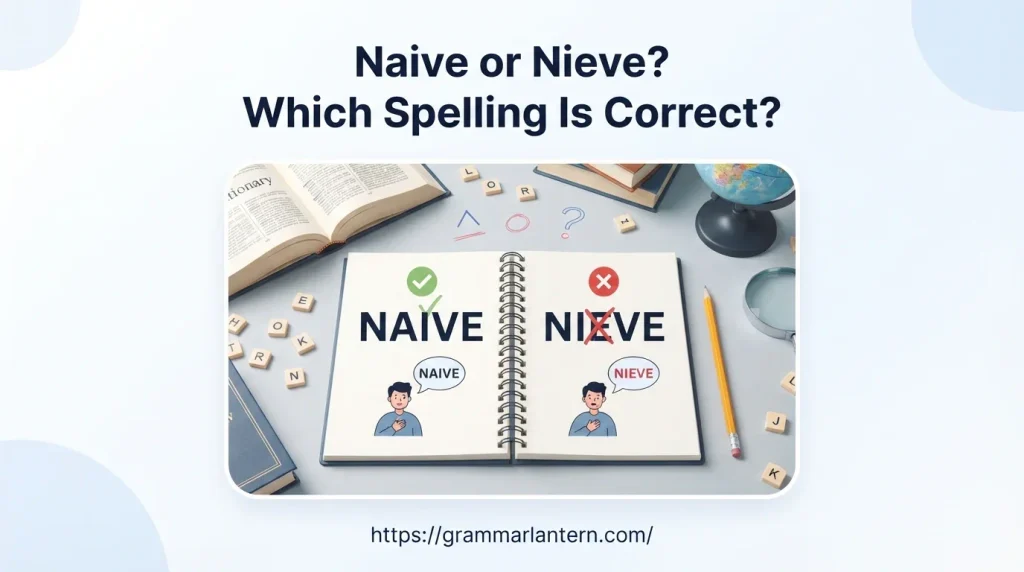
Naive is the correct spelling when describing someone who is innocent, inexperienced, or overly trusting. Naïve is also correct and carries exactly the same meaning. Nieve is a common misspelling of the adjective naive in standard English.
| Word | Correct spelling? | Meaning |
| Naive | Yes | Innocent, inexperienced, or lacking practical judgment |
| Naïve | Yes | Alternative spelling of naive |
| Nieve | No, not for this meaning | Common misspelling of naive; also a rare dialect word meaning a fist |
If you want to describe someone who believes everything they hear, use naive or naïve. Remember the letters i-v in the middle of the word. That small detail will help you avoid writing nieve by mistake.
What Does Naive Mean?
The word naive describes someone who lacks experience, knowledge, or good judgment in a particular situation. It can also describe someone who trusts others too easily or holds an overly simple view of how the world works.
For example, a person might believe every online offer is genuine. Someone else may assume that every business partner always tells the truth. Both situations can show naivety because the person hasn’t considered the risks involved.
However, naive doesn’t automatically mean foolish or unintelligent. Someone can have excellent academic knowledge and still be naive about relationships, business, money, or human behavior.
Naive Meaning in Everyday English
In everyday conversations, people use naive to describe someone who hasn’t experienced enough to recognize certain realities. The word often relates to trust, expectations, decisions, or assumptions.
Consider these examples:
- A teenager may be naive about managing money because they’ve never paid bills.
- A new employee may be naive about workplace politics.
- Someone may be naive about online scams because they assume every seller is honest.
- A first-time traveler may be naive about local customs or transportation problems.
- A person may be naive about relationships because they believe love always solves every disagreement.
The word can describe an individual or their particular belief. You don’t need to label someone’s entire personality as naive.
For example, saying “That was a naive decision” focuses on one choice. Saying “She’s naive” makes a broader judgment about the person.
Is Naive Always a Negative Word?
Not necessarily. Naive can sound critical, neutral, or even positive, depending on the situation.
When someone ignores obvious risks or trusts unreliable people, naive usually sounds negative. However, the word can describe innocence, simplicity, or an honest outlook without insulting anyone.
| Context | Example | Meaning |
| Negative | He was naive to believe the fake investment promise. | He lacked judgment or experience. |
| Neutral | I’m naive about the legal process. | I don’t have enough knowledge. |
| Positive | Her naive enthusiasm made the project exciting. | Her fresh and innocent outlook felt appealing. |
| Artistic | The artist used a naive painting style. | The art looked simple, childlike, or untrained by design. |
The context makes all the difference. A naive approach can sometimes bring fresh ideas because the person hasn’t become trapped by conventional thinking.
What Does Nieve Mean?
The spelling nieve is generally incorrect when you want to describe someone as innocent, inexperienced, or overly trusting. In that context, you should write naive or naïve.
However, nieve isn’t simply a meaningless collection of letters. It has a legitimate but uncommon meaning in English dialects.
In Scottish and some Northern British dialects, nieve can mean a closed hand or fist. Historical dictionaries record several related spellings, including neive, neaf, and neve. These forms have roots in older regional language traditions.
The word also appears in Spanish, where nieve means snow. That meaning belongs to Spanish rather than standard English.
Is Nieve a Real Word?
Yes, nieve is a real word in specific contexts. Its meaning depends on the language or dialect.
- Standard English spelling mistake: Nieve is incorrect when you mean innocent or inexperienced.
- Scottish and Northern British dialect: Nieve can mean a fist or closed hand.
- Spanish: Nieve means snow.
For example, a Spanish speaker might say “La nieve está blanca,” meaning “The snow is white.” Meanwhile, a Scottish dialect speaker may use nieve to refer to a fist.
These meanings don’t make nieve a correct substitute for naive in ordinary American English.
Meaning, Spelling, and Usage Differences
The difference between naive and nieve becomes clearer when you compare their spelling and meaning directly. Although they look similar, standard English uses them differently.
| Feature | Naive | Nieve |
| Standard spelling for the intended adjective | Correct | Incorrect |
| Meaning | Innocent, inexperienced, or overly trusting | Common spelling error for naive |
| Part of speech | Adjective | Usually a dialect noun in its legitimate English use |
| Pronunciation | Commonly /naɪˈiːv/ | Dialect pronunciations vary |
| Alternative spelling | Naïve | No standard adjective alternative |
| Professional writing | Acceptable | Avoid when intended to mean naive |
Naive vs. Nieve Examples
Here are some examples showing the difference between the incorrect spelling and the correct spelling.
| Incorrect sentence | Correct sentence |
| She was nieve enough to believe the stranger. | She was naive enough to believe the stranger. |
| His nieve attitude caused unnecessary problems. | His naive attitude caused unnecessary problems. |
| I was nieve about the cost of living. | I was naive about the cost of living. |
| That sounds like a nieve assumption. | That sounds like a naive assumption. |
| Don’t be nieve about online security. | Don’t be naive about online security. |
The correction is straightforward. Replace nieve with naive whenever you intend to describe inexperience, innocence, or excessive trust.
Naive vs. Naïve: Is There a Difference?
Both naive and naïve are correct English spellings. They have the same meaning and pronunciation. The only difference is the diacritical mark over the letter i.
That mark is called a diaeresis. It consists of two dots placed above a vowel to indicate that the vowel should be pronounced separately from the one before it.
The word naïve comes from French, where the diaeresis helps show the vowel pronunciation. English adopted the word and gradually accepted spellings both with and without the mark.
| Spelling | Correct? | Meaning |
| Naive | Yes | Innocent, inexperienced, or overly trusting |
| Naïve | Yes | Same meaning as naive |
| Nieve | Not for the intended adjective | Common misspelling of naive |
In modern American English, naive is often the more convenient spelling. Many writers prefer it because they don’t need to type a special character.
However, naïve remains perfectly acceptable. If a publication, school, or style guide prefers the accented form, you can use it consistently.
How to Pronounce Naive
The word naive has two syllables and places the primary stress on the second syllable. Its standard American pronunciation is commonly represented as /naɪˈiːv/.
You can break the sound into parts:
- The first part sounds like nigh.
- The second part sounds like eve.
- The stress falls on the second syllable.
The pronunciation explains why some people mistakenly write nieve. When you hear the word spoken quickly, its sound may encourage an incorrect spelling.
However, English spelling doesn’t always follow pronunciation perfectly. That’s why remembering the written form matters.
Examples in Sentences
Examples make the meaning easier to understand because naive can describe several situations. The following sentences show how the word works in everyday, professional, and personal contexts.
Naive Examples in Everyday Conversations
- He was naive enough to believe every excuse she made.
- I was naive about how difficult moving abroad could be.
- Her naive optimism helped her see possibilities others missed.
- Don’t be naive about the risks of sharing personal information.
- The child had a naive belief that every stranger was friendly.
- She sounded naive when she assumed everyone agreed with her.
These examples show that the word often describes a lack of practical experience. Sometimes the person has good intentions but doesn’t understand the situation fully.
Read More: Did vs. Done: Difference Explained With Helpful Examples
Naive Examples in Professional and Academic Writing
The word naive also appears in business, education, research, and formal discussions.
- The proposal reflects a naive understanding of the market.
- It would be naive to assume the project will finish without delays.
- His naive approach overlooked several financial risks.
- The study used a naive model that ignored important variables.
- A naive interpretation of the data could lead to misleading conclusions.
- The manager considered the employee’s expectations naive but encouraged further learning.
In professional writing, naive often describes assumptions or methods rather than people. This approach can sound more precise and less personal.
Naive Examples Showing Innocence or Simplicity
The word can also describe an innocent or naturally simple outlook.
- Her naive enthusiasm made everyone smile.
- The painting has a charmingly naive style.
- He maintained a naive belief that everyone acted honestly.
- Their naive approach gave the campaign a refreshing sense of sincerity.
- The child’s naive questions revealed a surprisingly thoughtful perspective.
In these sentences, naive doesn’t necessarily criticize someone. It may describe a fresh outlook that feels genuine or uncomplicated.
Incorrect and Correct Sentences
Spelling errors often appear in quick messages, online comments, essays, and everyday writing. The mistake becomes easier to avoid when you see it corrected repeatedly in context.
| Incorrect | Correct |
| She was nieve enough to trust the stranger. | She was naive enough to trust the stranger. |
| That sounds like a nieve assumption. | That sounds like a naive assumption. |
| I was nieve about the risks involved. | I was naive about the risks involved. |
| His nieve attitude caused problems. | His naive attitude caused problems. |
| Don’t be nieve about online scams. | Don’t be naive about online scams. |
| The plan seems nieve and unrealistic. | The plan seems naive and unrealistic. |
| It was a nieve mistake. | It was a naive mistake. |
| He made a nieve decision without checking the facts. | He made a naive decision without checking the facts. |
The easiest correction is to remember that the adjective contains I followed by V. The sequence n-i-a-v-e is the spelling you want.
Why Do People Spell Naive as Nieve?
The spelling nieve often appears because people rely on sound instead of remembering the original spelling. When someone hears naive spoken aloud, the final sound may seem to match the letters in nieve.
Several factors can contribute to this mistake.
- Pronunciation confusion: The word ends with a sound that may encourage people to write -eve.
- Unfamiliar vocabulary: Writers who rarely use naive may not remember its exact spelling.
- Typing quickly: Fast typing can lead to spelling errors that go unnoticed.
- Autocorrect limitations: Spell-check tools may not catch every mistake, especially in unusual contexts or names.
- Visual similarity: Both spellings contain the same letters except for the placement of i and e near the end.
The mistake is understandable. However, understanding the letter order makes it easier to correct.
Why Pronunciation Doesn’t Always Reveal the Correct Spelling
English contains many words whose spelling doesn’t match their pronunciation perfectly. For example, enough, though, through, and thought contain different vowel patterns despite sharing similar letter combinations.
The same principle applies to naive. Hearing the word may help you recognize it, but spelling requires remembering its written form.
If you’re unsure, check a dictionary or use the spelling trick below.
How to Remember the Correct Spelling
You don’t need a complicated spelling rule to remember naive. A few simple techniques can make the correct spelling stick.
Remember the I Before V
The easiest trick is to focus on the letters I-V in naive.
N-A-I-V-E → Correct
N-I-E-V-E → Incorrect for the intended adjective
Remember the phrase: “I view the truth.”
The word view contains the letter sequence i-v. Think of naive as a word where the i comes before the v. This small mental reminder can help you avoid switching the letters.
Connect Naive With Naivety
Another helpful strategy is to remember the related noun naivety.
For example:
- She showed naivety when she trusted the stranger.
- His naivety about business costs caused problems.
- The proposal revealed a certain degree of naivety.
The word naivety reinforces the spelling pattern naiv-. Once you remember the related word, the spelling of naive becomes easier.
Use Naive in a Sentence
Writing a memorable sentence can help you remember a word’s spelling for longer.
Try this sentence:
A naive person may believe a promise without checking the facts.
You can also create a sentence that directly reinforces the spelling:
Naive begins with N and ends with E but keeps I before V.
Repeating the correct spelling in a meaningful sentence is more effective than memorizing random letters.
Synonyms and Antonyms
Understanding synonyms and antonyms helps you use naive more accurately. Some related words describe innocence while others emphasize poor judgment or a lack of experience.
Synonyms of Naive
Here are several useful alternatives:
| Synonym | Meaning | Example |
| Innocent | Lacking guilt or worldly knowledge | She had an innocent view of the situation. |
| Inexperienced | Lacking practical experience | He was inexperienced with business negotiations. |
| Gullible | Easily fooled or deceived | The gullible buyer believed the fake advertisement. |
| Trusting | Willing to believe others | She was trusting with people she barely knew. |
| Unsophisticated | Lacking knowledge of complex situations | His unsophisticated approach missed several details. |
| Unworldly | Lacking experience of practical life | The unworldly student struggled with office politics. |
| Artless | Natural, sincere, or without calculated behavior | Her artless response made everyone laugh. |
| Ingenuous | Innocent, honest, and straightforward | He gave an ingenuous answer to the question. |
| Credulous | Too willing to believe something | Credulous readers accepted the rumor immediately. |
These synonyms aren’t interchangeable in every sentence. For example, gullible usually sounds more negative than naive. Meanwhile, innocent can suggest a lack of wrongdoing rather than a lack of experience.
Choose the word that matches the exact meaning you want.
Antonyms of Naive
Antonyms describe qualities that contrast with naivety.
| Antonym | Meaning |
| Experienced | Having practical knowledge from past situations |
| Sophisticated | Understanding complex ideas or social situations |
| Knowledgeable | Possessing information or expertise |
| Street-smart | Skilled at handling practical problems |
| Skeptical | Questioning claims instead of accepting them easily |
| Cautious | Careful about possible risks |
| Shrewd | Showing sharp judgment and practical intelligence |
| Worldly | Familiar with life, society, and practical realities |
For example, a naive investor may trust an unfamiliar company without researching it. A cautious or skeptical investor checks the company’s background before making a decision.
Related Words: Naivety, Naiveté, Naiveness, and Naively
The word naive has several related forms. Understanding these words will help you use them correctly in essays, articles, emails, and conversations.
Naivety
Naivety is the noun form of naive. It describes the quality or state of being innocent, inexperienced, or overly trusting.
Examples:
- His naivety about financial matters became expensive.
- Her naivety made her vulnerable to dishonest people.
- The proposal showed a surprising level of naivety.
- I learned from my naivety during my first year at work.
Use naivety when you want to discuss the quality itself rather than describe a person or action.
Naiveté
Naiveté is another accepted spelling of the noun naivety. It uses an accent mark over the final e.
Both forms have the same meaning.
| Word | Correct? | Example |
| Naivety | Yes | His naivety caused him to overlook the warning signs. |
| Naiveté | Yes | Her naiveté was obvious during the discussion. |
| Nieveity | No | Incorrect spelling |
| Nieve | No for this intended meaning | Common misspelling of naive |
The choice between naivety and naiveté usually depends on personal preference or editorial style. Both are accepted in English.
Naiveness
Naiveness is also a recognized noun form of naive. It refers to the quality of being naive.
However, naivety is generally more familiar and widely used in everyday writing.
Example:
– His naiveness about the industry became clear after the meeting.
Although this form is acceptable, naivety may sound more natural to many readers.
Naively
Naively is the adverb form of naive. It describes how someone performs an action or expresses a belief.
Examples:
- She naively trusted the online seller.
- He naively assumed the agreement would protect everyone.
- They naively believed the problem would disappear.
- I naively thought the process would take only one day.
Remember the difference:
- Naive: adjective
- Naivety / naiveté / naiveness: noun
- Naively: adverb
When Should You Use Naive or Naïve?
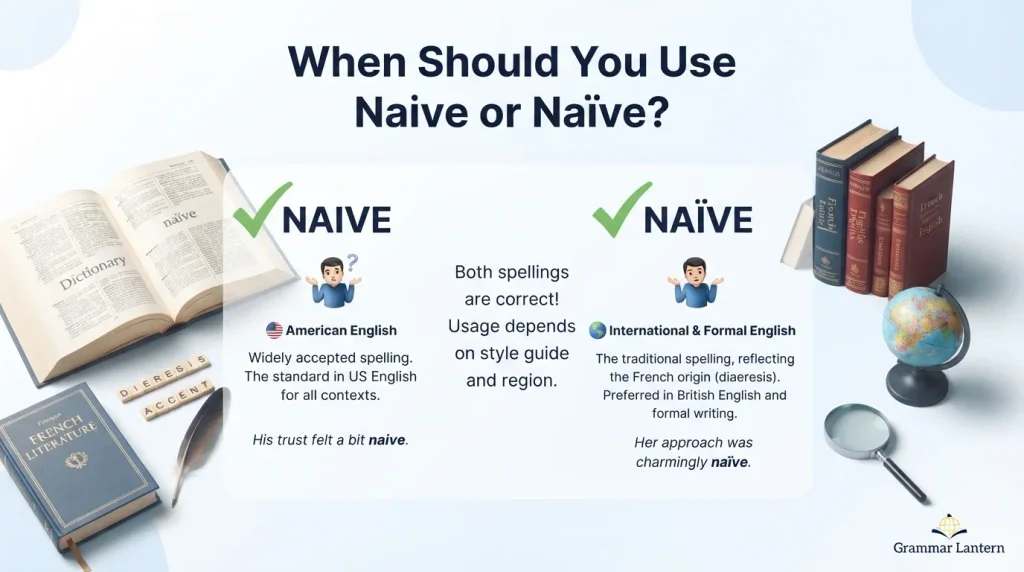
Both spellings are correct. Your choice depends mainly on your writing style, publication requirements, or personal preference.
In American English, naive is a convenient spelling because it avoids the diacritical mark. Many modern writers use it in emails, articles, essays, reports, and everyday communication.
However, naïve remains acceptable and may appear in edited books, newspapers, magazines, and formal writing.
Which Spelling Should You Use in Professional Writing?
Use naive when:
- You’re writing in standard American English.
- You want a spelling that doesn’t require special characters.
- Your organization or publication doesn’t require naïve.
- You’re writing online and want easy typing and formatting.
Use naïve when:
- Your publication’s style guide prefers the accented spelling.
- You’re following a particular editorial convention.
- You want to preserve the traditional French-derived form.
- You’re using the spelling consistently throughout your document.
The most important rule is consistency. Avoid switching between naive and naïve without a clear reason.
Common Mistakes to Avoid
Even after learning the correct spelling, writers sometimes make mistakes with the word’s meaning, forms, or punctuation. Here are the most common problems to watch for.
- Writing nieve instead of naive: Use naive when describing someone who lacks experience or judgment.
- Treating naive and naïve as different words: Both spellings carry the same meaning.
- Assuming naive means unintelligent: A person can be intelligent yet inexperienced in a particular area.
- Using naive when another word fits better: Gullible may describe someone easily fooled while inexperienced may be more precise.
- Confusing naive with naivety: The first is an adjective while the second is a noun.
- Writing naively incorrectly: Remember that the adverb ends in -ly.
- Switching between naive and naïve: Choose one spelling and maintain consistency.
A good writer doesn’t just choose the correct spelling. They also choose the word that communicates the intended meaning clearly.
Naive or Nieve: Quick Summary
If you’re still wondering whether to write naive or nieve, remember these key points:
- Naive is the correct standard spelling for someone innocent, inexperienced, or overly trusting.
- Naïve is an accepted alternative spelling with the same meaning.
- Nieve is incorrect when used as a substitute for the adjective naive.
- Nieve has a separate, uncommon dialect meaning referring to a fist or closed hand.
- In Spanish, nieve means snow.
- Naive is an adjective while naivety and naiveté are nouns.
- Naively is the adverb form.
- Remember the letter order I before V to avoid the spelling mistake.
The easiest way to remember the correct spelling is to keep the letters i-v together in the right order. When describing someone inexperienced or overly trusting, write naive.
Read More: Attornies or Attorneys: Which Spelling Is Correct?
FAQs
1. Is naive or nieve the correct spelling?
Naive is the correct spelling in standard English. Nieve is a misspelling when you intend to describe someone as innocent, inexperienced, or overly trusting.
2. What does naive mean?
Naive describes someone who lacks experience, knowledge, or judgment about certain situations. It can also refer to a person who trusts others too easily or expects things to be better than they really are.
3. Is nieve a real English word?
Nieve is not the standard spelling of naive. However, it may appear as a name, surname, or word in another language. When describing an inexperienced or overly trusting person, use naive.
4. How do you pronounce naive?
The word naive is commonly pronounced nah-EEV or ny-EEV, depending on the speaker and accent. It has two syllables, with stress on the second syllable.
5. Is naive a positive or negative word?
Naive can have either a positive or negative meaning, depending on the context. It may describe someone innocent, sincere, and hopeful. However, it can also suggest poor judgment, lack of experience, or excessive trust.
6. Is naive the same as innocent?
Not exactly. Innocent usually suggests a lack of guilt, wrongdoing, or harmful intention. Naive specifically suggests a lack of experience, awareness, or understanding. Someone can be innocent without being naive.
7. Can I use naive in professional writing?
Yes, you can use naive in professional writing when it accurately describes a situation or person’s lack of experience. However, be careful when describing colleagues because the word may sound critical or disrespectful.
8. Does naive have an accent mark?
The word can be written as naive or naïve. Both spellings are accepted in English. The diaeresis (two dots over the i) indicates that the vowel is pronounced separately, but it is optional in modern English.
9. What is the opposite of naive?
Depending on the context, antonyms of naive include experienced, wise, worldly, cautious, skeptical, and knowledgeable. These words describe someone who understands situations better or doesn’t trust information too easily.
10. How can I remember the spelling of naive?
Remember that the correct word contains ai before the final ve. You can also remember the phrase “Naive has an I, not an E after the V.” Whenever you’re unsure, choose naive or naïve, never nieve for this meaning.
Conclusion
Choosing between naive or nieve is easy once you understand the correct spelling and meaning. Naive is the standard English word for someone who is inexperienced, innocent, or overly trusting. The spelling nieve is incorrect when used with this meaning. Although the word may seem unusual because of its French origin, it becomes easier to remember with regular practice and a few simple examples.
Whenever you use this word in essays, emails, conversations, or professional documents, stick with naive or naïve. Both spellings are acceptable, so you can choose the one that fits your writing style. Remembering this small difference can help you avoid common spelling errors, improve your vocabulary, and make your writing sound more polished and confident.

For Shafiq ur Rehman, writing is an art form and grammar is the toolbox that makes it beautiful. As a dedicated content writer at Grammar Lantern, Shafiq approaches every topic like an architect carefully laying down strong foundations of understanding before adding the finer details. He loves diving into the trickiest grammar points and resurfacing with simple, bite-sized takeaways that anyone can grasp. When he’s not crafting articles, you’ll likely find him strategizing over a game of chess, exploring dusty local bookshops, or quietly jotting down poetic observations in his notebook.