
Modern writing tools make everyday work easier, and Nonresponsive vs Unresponsive often becomes simpler to understand with the right guidance. In today’s modern era, writing is more accessible because electric, intelligent devices, software, and other tools help us fix mistakes. A good program suggests the right words and corrects spelling, making it easier to choose between two options.
Even with these tools, the English word choice can still confuse native speakers because both terms sound similar and appear identical at first glance. From my experience editing documents, I have seen many people make the wrong choice after overlooking the subtle differences in meaning, usage, and context.
While exploring the origins and real-life examples, I realized that understanding these nuances is important for making your writing more precise and clear for readers. In medical situations, patients may not react, so doctors often describe them as Unresponsive, showing a lack of reaction. In contrast, Nonresponsive is a better fit for computers, systems, or a client who does not reply to a polite email.
I once stared at a frozen phone, tapped it as though it owed me money, and thought it was Nonresponsive before questioning life when I received no answer from someone. That confusing moment reminded me to learn the distinction correctly, know when to call, label, or explain something confidently. As you read this article, the funny scenarios and practical tips will help you master this crucial topic without feeling clueless, and you might even laugh along the way.
Quick Answer
Nonresponsive and unresponsive both describe a failure to respond, but they focus on different types of responses.
| Word | Main Meaning | Common Uses |
| Nonresponsive | Not providing a response, reply, or action | Businesses, organizations, legal matters, surveys, systems |
| Unresponsive | Not reacting, answering, or showing awareness | People, medical situations, emotions, devices |
A simple way to remember the difference:
- Use nonresponsive when someone or something fails to reply or take action.
- Use unresponsive when someone or something fails to react or respond physically.
For example:
- “The company was nonresponsive to my complaint.”
- “The patient was unresponsive after the accident.”
Both words are correct, but the context decides which one sounds natural.
What Does Nonresponsive Mean?
The word nonresponsive means failing to respond, answer, react, or take appropriate action when a response is expected.
It combines two parts:
- Non- means “not.”
- Responsive means “reacting, replying, or responding.”
So, nonresponsive literally means not responsive.
The word often appears in formal, professional, and technical settings. It usually describes a failure to communicate or provide a needed response.
For example, if a customer sends several emails to a company and receives no reply, the company may be described as nonresponsive.
The focus is not necessarily that the company cannot react. Instead, it means the company failed to provide the expected response.
Examples of Nonresponsive in Sentences
- “The customer service department was nonresponsive to repeated complaints.”
- “The organization remained nonresponsive despite receiving several requests.”
- “The lawyer reported that the opposing party was nonresponsive during the legal process.”
- “The application became nonresponsive after the software update.”
In each example, the main idea is a missing reply, action, or cooperation.
Common Uses of Nonresponsive
Nonresponsive in Customer Service
Businesses often receive criticism for being nonresponsive when they ignore customers or fail to solve problems.
For example:
A customer contacts a company about a billing mistake. The company receives multiple messages but never replies. The customer might say:
“The company was nonresponsive and failed to address my issue.”
Here, the problem is communication, not physical reaction.
Nonresponsive in Legal Situations
Legal professionals often use nonresponsive when someone does not provide requested information or does not cooperate.
Examples include:
- A person refusing to answer official questions.
- A party failing to provide documents.
- A witness avoiding direct answers.
Example:
“The defendant was considered nonresponsive during the information request process.”
Nonresponsive in Technology
Technology users often describe software, websites, or devices as nonresponsive.
For example:
- A program freezes and does not complete commands.
- A website stops accepting input.
- A system ignores user actions.
However, in everyday technology conversations, people often use unresponsive more frequently.
What Does Unresponsive Mean?
The word unresponsive means not reacting, replying, or showing a response when a reaction is expected.
It often describes a person who does not respond to communication, touch, sound, or events around them.
The word also contains two parts:
- Un- means “not.”
- Responsive means “reacting or answering.”
Therefore, unresponsive means not reacting or not responding.
The word appears commonly in medical, personal, and everyday situations.
Examples of Unresponsive in Sentences
- “The patient was unresponsive when emergency workers arrived.”
- “My computer became unresponsive while I was editing a document.”
- “She became unresponsive after hearing the news.”
- “The child was unresponsive to repeated questions.”
The word usually highlights a lack of reaction.
Common Uses of Unresponsive
Unresponsive in Medical Situations
In healthcare, unresponsive is the standard word used when describing someone who does not react to their surroundings.
Doctors and emergency workers may use this term when a person:
- Does not answer questions.
- Does not open their eyes.
- Does not react to touch.
- Does not respond to commands.
Example:
“The patient was unconscious and unresponsive when the ambulance arrived.”
In medical language, “unresponsive” gives a clear picture of the person’s condition.
Unresponsive in Everyday Communication
People also use unresponsive when someone does not answer messages, calls, or questions.
Examples:
- “He has been unresponsive to my texts all day.”
- “The manager was unresponsive when I asked for help.”
In these situations, the word suggests silence or lack of reaction.
Unresponsive Technology
Devices can also become unresponsive.
For example:
- A phone screen stops working.
- A laptop freezes.
- An application stops accepting commands.
Example:
“My phone became unresponsive, so I had to restart it.”

Nonresponsive vs Unresponsive: Key Differences
Although these words overlap, they create different impressions.
| Difference | Nonresponsive | Unresponsive |
| Main idea | Failure to provide a response | Failure to react |
| Common focus | Communication, action, cooperation | Awareness, reaction, physical response |
| Tone | More formal | More common in everyday speech |
| Often describes | Organizations, systems, processes | People, devices, situations |
| Example | “The company was nonresponsive.” | “The patient was unresponsive.” |
The easiest distinction is this:
Nonresponsive is about a missing answer. Unresponsive is about a missing reaction.
Are Nonresponsive and Unresponsive Interchangeable?
Sometimes these words can replace each other. However, they do not always sound equally natural.
For example:
- “The computer became nonresponsive.”
- “The computer became unresponsive.”
Both sentences work because a computer can fail to react to commands.
However:
- “The patient was unresponsive.” ✅
- “The patient was nonresponsive.” ⚠️
The second sentence is understandable, but it does not sound as natural in a medical situation.
Likewise:
- “The company was nonresponsive to complaints.” ✅
- “The company was unresponsive to complaints.” ✅
Both can work, but nonresponsive sounds more professional when discussing businesses or organizations.
Nonresponsive vs Unresponsive in Different Contexts
Medical Context
When discussing health emergencies, unresponsive is usually the better choice.
Example:
“The injured person was unresponsive after the crash.”
Why?
Because the sentence focuses on the person’s inability to react.
Using nonresponsive may sound too formal or technical.
Technology Context
Technology creates one of the biggest areas where both words overlap.
Examples:
- “The application became unresponsive.”
- “The application became nonresponsive.”
Both describe software that stopped working correctly.
However, “unresponsive” is more common in everyday technology conversations.
Business Context
Businesses and organizations are usually described as nonresponsive.
Examples:
- “The company was nonresponsive to customer complaints.”
- “The government office remained nonresponsive to requests.”
The focus is on failure to communicate or take action.
Communication Context
When talking about people, either word may work depending on meaning.
Compare:
“He was unresponsive during the conversation.”
This suggests he did not react or participate.
“The company was nonresponsive to customer emails.”
This suggests the company failed to reply.
Read More: Encode vs Incode: Meaning, and Correct Usage Explained
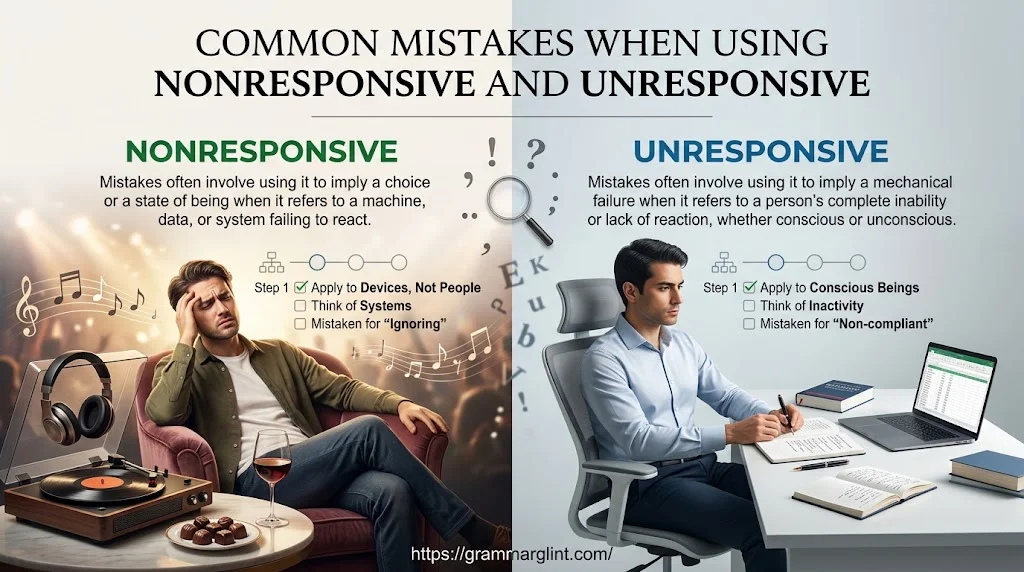
Common Mistakes When Using Nonresponsive and Unresponsive
Using Nonresponsive for Every Situation
A common mistake is assuming nonresponsive works everywhere.
Example:
“The patient was nonresponsive.”
Although understandable, unresponsive sounds more natural.
Better:
“The patient was unresponsive.”
Using Unresponsive for Formal Organizations
Unresponsive can describe businesses, but nonresponsive often fits better.
Example:
“The agency was nonresponsive to requests.”
This sounds more professional than:
“The agency was unresponsive to requests.”
Ignoring Context
The biggest mistake is choosing a word based only on spelling.
Instead, ask:
- Is the issue about a reply?
- Is the issue about a reaction?
- Is the subject a person, company, or device?
The answer usually reveals the correct choice.
Related Words: Responsive, Responsiveness, Nonresponsive, and Unresponsive
| Word | Meaning | Example |
| Responsive | Reacting quickly and appropriately | The website is responsive on mobile devices. |
| Responsiveness | Ability to respond effectively | Good customer responsiveness builds trust. |
| Nonresponsive | Not replying or taking action | The company was nonresponsive. |
| Unresponsive | Not reacting or showing awareness | The patient was unresponsive. |
Understanding these related terms makes it easier to use them correctly.
Real-Life Examples of Choosing the Right Word
| Situation | Best Word | Reason |
| A business ignores customer emails | Nonresponsive | It failed to reply |
| A person does not wake up after being called | Unresponsive | They failed to react |
| A laptop freezes | Unresponsive | It does not react to commands |
| A government department ignores requests | Nonresponsive | It failed to provide action |
| Someone ignores messages | Either | Depends on the tone and situation |
Memory Trick to Remember the Difference
Think of the difference this way:
Nonresponsive = no response given.
Unresponsive = no reaction shown.
Imagine sending an email to a company.
If the company never answers, it is nonresponsive.
Now imagine calling someone’s name and they do not move or react.
They are unresponsive.
A simple phrase to remember:
“Nonresponsive ignores communication. Unresponsive lacks reaction.”
FAQs
1. What is the difference between Nonresponsive and Unresponsive?
Unresponsive is most commonly used for a person or patient who does not react to stimuli. Nonresponsive is often used for computers, systems, software, devices, or people who fail to reply.
2. Is Nonresponsive a correct English word?
Yes. Nonresponsive is a standard English adjective and is widely used in technical, business, and general writing.
3. Is Unresponsive only used in medical situations?
No. Although it is very common in medicine, Unresponsive can also describe a person who does not react emotionally or physically in other contexts.
4. Can I use Nonresponsive and Unresponsive interchangeably?
Sometimes, but not always. Their meanings overlap, yet the best choice depends on the context. Unresponsive usually emphasizes a lack of reaction, while Nonresponsive often emphasizes a lack of response or reply.
5. Which word should I use for a frozen computer?
Use Nonresponsive. For example: The computer became nonresponsive after the update.
6. Which word is better for a patient who does not react?
Use Unresponsive. For example: The patient remained unresponsive throughout the examination.
7. Is Nonresponsive common in business communication?
Yes. It is frequently used to describe clients, customers, or vendors who do not answer emails, messages, or calls.
8. Why do people confuse Nonresponsive and Unresponsive?
They are confused because they sound similar and both describe the absence of a response. The difference mainly comes from how each word is used in different situations.
9. How can I remember the difference?
Think of Unresponsive as a lack of reaction and Nonresponsive as a lack of response. This simple rule works in most everyday situations.
10. Which word should I use in formal writing?
Choose the word that best matches the context. Using Unresponsive for medical situations and Nonresponsive for technical or communication-related situations will make your writing more accurate.
Conclusion
Understanding Nonresponsive vs Unresponsive helps you choose the right word with confidence. Although both terms describe the absence of a response, they are not always interchangeable. Paying attention to the context makes your writing clearer and more precise.
The next time you describe a patient, a frozen device, or someone who never replied to your email, you’ll know exactly which word fits best. Small vocabulary choices like these can make a big difference in both professional and everyday communication.