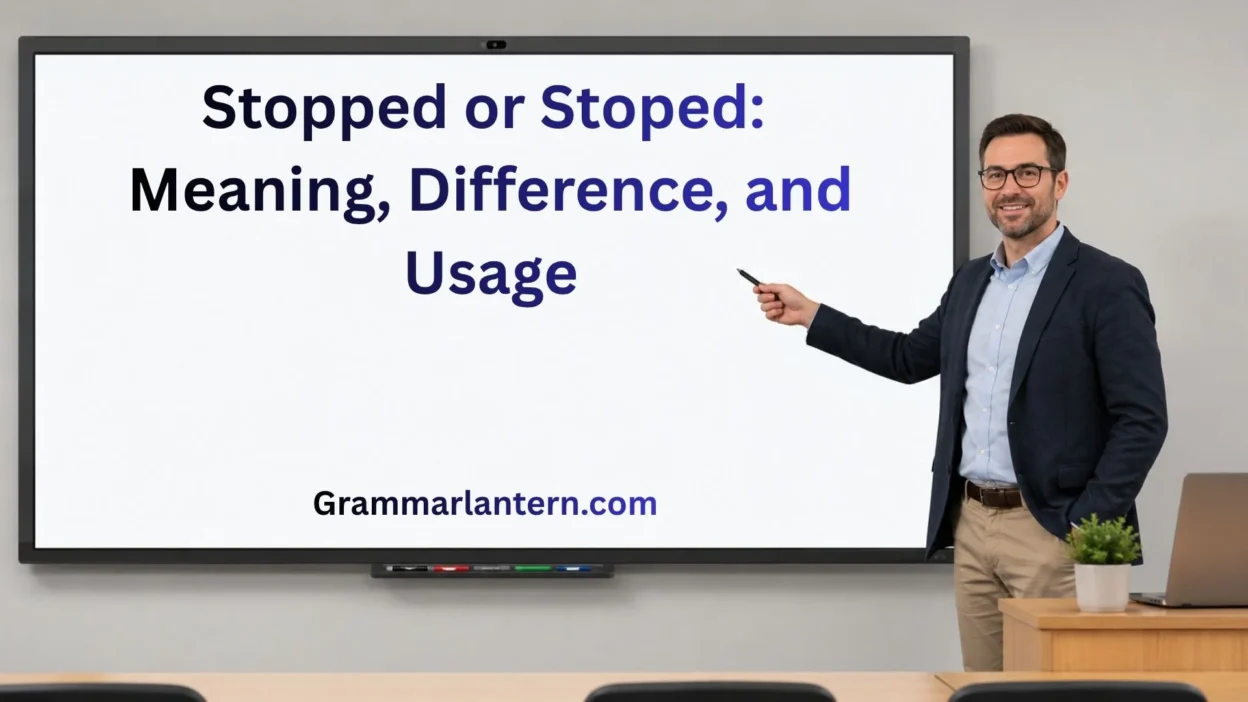
Many people search Stopped or Stoped because English spelling can feel like a maze when you are blindfolded and rules seem unclear at work.
A word may not always follow the clear rule or pattern you learned in school, which creates confusion. Many people become confused because both words sound similar, but standard spelling rules show that stopped is correct while stoped is incorrect in most contexts.
From my experience helping writers improve their writing skills and communication, I often see this common confusion with verbs, past tense, and -ed forms. The verb stop follows a spelling rule that requires doubling the final consonant before adding -ed, creating the past participle form stopped. Words such as opened, played, and cleaned have a different structure, which is why learners sometimes make grammar mistakes.
This understanding of logic builds confidence in writing for emails, essays, publishing blog posts, and social media content.
The word stoped is a completely different word with a specific meaning in mining terminology and is rarely used in everyday language. Using practical examples, simple rules, and real-world usage tips helps you ensure you never mix these spellings again. You can know the correct spelling and use practice questions with answers to reinforce your understanding through 1, 2, and 100 examples of usage that make the learning process easier.
Stopped or Stoped: Quick Answer
Stopped is the correct spelling. Stoped is usually incorrect when you mean the past tense of the verb stop.
| Word | Correct or Incorrect | Meaning | Example |
| Stopped | ✅ Correct | Past tense of stop; something ended or came to a halt | The car stopped suddenly. |
| Stoped | ❌ Incorrect | Not the correct past tense of stop | The car stoped suddenly. |
The correct forms are:
- Stop → Present tense
- Stops → Third-person singular
- Stopped → Past tense and past participle
- Stopping → Present participle
Examples:
- I stop at the traffic light every morning.
- She stops talking when the teacher enters.
- They stopped playing because it started raining.
- He is stopping the machine.
What Does Stopped Mean?
Stopped is the past tense and past participle form of the verb stop. It means something ended, paused, prevented an action, or came to a complete halt.
The word can describe physical movement, activities, habits, events, or situations.
For example:
- The train stopped at the station.
- The music stopped suddenly.
- She stopped drinking soda.
- The police stopped the thief.
The meaning changes slightly depending on the context.
Stopped Meaning: To Come to an End
When something stops, it no longer continues.
Examples:
- The rain stopped after midnight.
- The noise stopped when everyone left the room.
- The meeting stopped earlier than expected.
In these examples, an activity or event simply ended.
Stopped Meaning: To Prevent Something
Stopped can also mean preventing an action from happening.
Examples:
- The security guard stopped the person from entering.
- A warning message stopped me from clicking the wrong button.
- The coach stopped the game because of bad weather.
Here, “stopped” means someone or something caused an action to end before completion.
Stopped Meaning: To Pause Temporarily
Sometimes stopped does not mean something ended forever. It can mean taking a short break.
Examples:
- We stopped for coffee during the road trip.
- She stopped at the store on her way home.
- They stopped to rest after hiking.
The action may continue later.
Why Is Stopped Spelled With Two P’s?
The spelling of stopped follows an important English spelling rule called the consonant doubling rule.
When a short verb ends with a:
consonant + vowel + consonant (CVC) pattern
you usually double the final consonant before adding -ed or -ing.
The word stop follows this pattern:
| Letter | Role |
| S | Consonant |
| O | Vowel |
| P | Consonant |
Because “stop” is a one-syllable CVC word, the final p doubles:
Stop + p + ed = stopped
The same pattern appears in many other words.
| Base Word | Correct Past Form |
| Stop | Stopped |
| Drop | Dropped |
| Plan | Planned |
| Rob | Robbed |
| Clap | Clapped |
| Hop | Hopped |
A simple way to remember this rule is:
Short word + one vowel sound + one final consonant = double the final consonant before adding -ed.
What Does Stoped Mean?
In normal English writing, stoped is not the correct past tense of stop.
Most of the time, people write “stoped” because they forget the spelling rule and add -ed directly:
Incorrect:
She stoped the car near the house.
Correct:
She stopped the car near the house.
Although “stoped” may appear in rare specialized contexts or unusual references, it does not work as the everyday past form of the verb stop.
For regular communication, writing, school assignments, and professional documents, always use stopped.
Stopped vs Stoped: Main Differences
The difference between these two words is mainly spelling and correctness.
| Feature | Stopped | Stoped |
| Correct spelling | Yes | No |
| Used as past tense of stop | Yes | No |
| Contains double “p” | Yes | No |
| Common in English writing | Very common | Usually a mistake |
The extra “p” may seem small, but it changes whether the word follows English grammar rules.
Common Mistakes With Stopped
Many English learners make the same mistake because they apply a simple adding rule:
Stop + ed = stoped
However, English spelling does not always work by simply attaching endings. Some words need letter changes before adding suffixes.
Mistake: Forgetting the Double P
Incorrect:
- The bus stoped near my house.
- The computer stoped working.
- The rain stoped yesterday.
Correct:
- The bus stopped near my house.
- The computer stopped working.
- The rain stopped yesterday.
Mistake: Confusing Stopped and Stopping
The same doubling rule applies to stopping.
Correct:
- He is stopping the car.
- She is stopping the conversation.
Incorrect:
- He is stoping the car.
- She is stoping the conversation.
The final “p” doubles because the word follows the same CVC pattern.
Read More: Emaculate vs. Immaculate: Usage, and Common Mistakes
Different Forms of Stop in English
Learning the complete word family makes it easier to remember the correct spelling.
| Verb Form | Word | Example |
| Base form | Stop | Please stop talking. |
| Third person | Stops | The machine stops automatically. |
| Past tense | Stopped | The machine stopped suddenly. |
| Past participle | Stopped | The work has stopped. |
| -ing form | Stopping | They are stopping the project. |
A strong vocabulary habit is learning words in groups rather than memorizing one form alone.
Stopped vs Paused: What Is the Difference?
People sometimes confuse stopped with paused because both can mean something temporarily ends.
However, they are not exactly the same.
Stopped usually suggests a complete halt.
Example:
- The engine stopped.
This means the engine is no longer running.
Paused suggests a temporary break.
Example:
- The movie paused.
This means the movie can continue later.
Think of it like pressing buttons:
- Stop is like turning off a machine.
- Pause is like pressing a temporary break button.
Stopped vs Quit: What Is the Difference?
The word “Stopped” and “quit” can overlap, but they often have different meanings.
“Stopped” simply means an action ended.
Example:
- He stopped smoking.
This focuses on ending the habit.
Quit often suggests giving up, leaving, or permanently leaving something.
Example:
- He quit his job.
You can stop an activity without quitting something.
Examples:
- She stopped studying for an hour.
- She quit studying completely.
The context decides the best word.
How to Remember Stopped Spelling Easily
If you often forget whether it is stopped or stoped, use this simple trick:
Remember that stop has a short sound and ends with one consonant after one vowel.
So:
Stop → Double the P → Stopped
You can connect it with other familiar words:
- Stop → Stopped
- Drop → Dropped
- Shop → Shopped
- Plan → Planned
Once you recognize the pattern, many spelling decisions become automatic.
Examples of Stopped in Everyday Sentences
Here are common examples showing how native speakers use stopped:
Daily Life Examples
- The alarm stopped ringing after five minutes.
- I stopped checking my phone before bed.
- She stopped by the bakery after work.
- The children stopped playing when it got dark.
Workplace Examples
- The company stopped production during maintenance.
- The manager stopped the meeting to answer questions.
- The team stopped using the old software.
Academic Examples
- The professor stopped the lecture for a discussion.
- The student stopped making the same mistake after practice.
- The research stopped because of missing data.
Why Correct Spelling Matters
Spelling mistakes may seem minor, but they can affect how others understand and judge your writing.
Using stopped instead of stoped helps your writing look:
- More professional
- More accurate
- Easier to understand
- More trustworthy
A single missing letter can change the impression your writing creates. Good spelling shows attention to detail.
FAQs
1. Is “stopped” the correct spelling?
Yes, stopped is the correct spelling in standard English. It is the past tense and past participle form of the verb stop.
2. Why is “stoped” considered incorrect?
Stoped is incorrect when you mean the past form of stop. The verb follows the rule of doubling the final consonant before adding -ed, which creates stopped.
3. Why do we double the “p” in stopped?
The word stop has one syllable and ends with a consonant after a short vowel sound. According to the spelling rule, the final consonant is doubled before adding -ed.
4. Is “stoped” ever a real word?
Yes, stoped is a real word, but it has a different meaning. It is related to mining terminology and is rarely used in everyday English.
5. What is the difference between stopped and stoped?
Stopped means to cease an action or movement. Stoped refers to a mining process or an area created during mining activities.
6. Can I use stopped in formal writing?
Yes, stopped is completely acceptable in formal documents, reports, essays, emails, and professional writing.
7. Why do people confuse stopped and stoped?
People often confuse these words because they sound similar. Many learners apply the simple -ed rule without noticing the spelling pattern that requires doubling the final consonant.
8. Are there other words that follow the same rule as stopped?
Yes, many verbs follow the same pattern, such as planned, stopped, running, and jogged, where the final consonant is doubled before adding a suffix.
9. How can I remember the correct spelling of stopped?
Remember that stop becomes stopped by adding another p before -ed. Thinking about the short vowel sound can help you remember this rule.
10. What is the easiest way to avoid spelling mistakes with stopped?
Practice common spelling patterns, read regularly, and check your writing when you are unsure. Learning the reason behind the rule makes it easier to remember.
Conclusion
Understanding the difference between stopped and stoped helps you improve your English spelling and avoid common writing mistakes. Although both words may look similar, they have different meanings and uses. In everyday English, stopped is the correct choice when talking about the past form of the verb stop.
Learning spelling rules does not have to feel confusing. By understanding patterns like doubling the final consonant before adding -ed, you can write with more confidence in emails, essays, reports, and other forms of communication. Small spelling details can make a big difference in clear and effective writing.

Muhammad Haroon is the voice behind many of the clear, practical grammar guides you’ll find on Grammar Lantern. With a strong background in content writing and a genuine love for the English language, Haroon specializes in breaking down intimidating grammar topics into simple, digestible lessons. His goal is simple: to empower readers to write with confidence and clarity. Whether he’s explaining tricky tenses or demystifying punctuation, Haroon approaches each topic with patience, precision, and a touch of warmth—because he knows that learning grammar is a journey, not a race.