
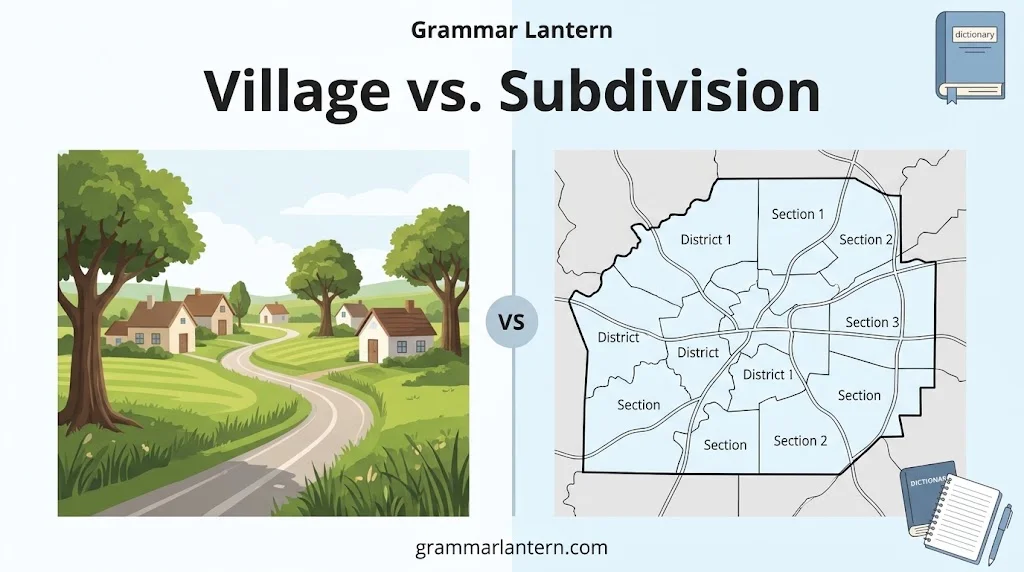
The village vs subdivision debate can be confusing at first. Both describe places where people live, but they aren’t the same thing. Imagine a small community with local shops, familiar faces, and a strong sense of belonging. Now picture a planned residential area with organized streets, individual lots, and carefully arranged homes. Although both may look similar, their purposes and characteristics differ. Understanding these differences helps you choose the right term when talking about communities, neighborhoods, or real estate.
A village is generally a small settlement where people live and interact as a community. It may have a long history, local traditions, and shared public spaces. A subdivision, however, is a piece of land divided into smaller plots, often to build homes or other properties. Developers typically create subdivisions to organize residential growth and make land available for sale.
Knowing the difference between village vs subdivision makes everyday conversations and property descriptions easier to understand. While a village describes a settlement or community, a subdivision focuses on how land is divided and developed. Once you recognize this distinction, you can use both terms confidently in writing, geography, and real estate discussions.
Quick Answer
A village is a settlement or community, while a subdivision is a division of a larger geographic area or parcel of land.
For example, a rural settlement with homes, shops, a school, and surrounding farmland may be called a village. A developer who divides a large property into 50 residential lots creates a residential subdivision. Meanwhile, a government may divide a district into smaller administrative subdivisions.
| Feature | Village | Subdivision |
| Basic meaning | A settlement or community | An administrative division or division of land |
| Main purpose | Residential and community life | Territorial administration or land development |
| Common setting | Rural areas, small settlements, and some urbanized areas | Administrative regions or residential developments |
| Boundaries | Historical, geographic, or legally defined | Established through administrative arrangements or land plans |
| Population | Varies by location | Varies according to the type and size of the subdivision |
| Housing | Traditional homes, modern houses, and other buildings | Residential subdivisions contain individual lots or housing units |
| Infrastructure | Depends on local development and investment | Depends on planning requirements and completed services |
| Legal status | May or may not have separate government recognition | Depends on whether it is an administrative unit or a land development |
The most important point is that a village describes a settlement, while a subdivision describes a division or the resulting area.
What Is a Village?
A village is a settlement where people live within a recognizable geographic area. Villages often have a shared community identity, local facilities, and a history shaped by the surrounding environment.
Many villages developed around agriculture, rivers, roads, marketplaces, or religious centers. Others grew around fishing, tourism, manufacturing, or trade. Their economies and lifestyles can differ considerably.
There is no single population limit that defines every village worldwide. Some countries use legal definitions, while others classify villages according to administrative, historical, or statistical criteria.
Definition of a Village
In everyday language, a village is a community of homes and other buildings that forms a recognizable settlement. Residents may share local markets, schools, religious buildings, public spaces, and community traditions.
However, the word doesn’t automatically establish a place’s legal status. A village might have its own local governing body, or it might fall under a larger municipality or administrative authority.
For example, a settlement that developed around a historic marketplace may continue to be called a village after new roads, businesses, and homes appear. Its population and infrastructure may change while its name remains the same.
In Pakistan, the meaning can also have a formal legal dimension. The Punjab Local Government Act, 2013, defined a village as an integrated and contiguous human habitation commonly identified by a name, including comparable settlements such as a chak, basti, or dhok. The applicable legislation and local administrative arrangements must be checked for current legal classifications.
Common Characteristics of a Village
Although villages differ across countries, several features commonly appear.
- Community identity: Residents may share traditions, local history, and gathering places.
- Residential settlement: Homes form a recognizable community rather than an isolated collection of properties.
- Local facilities: Shops, schools, markets, religious buildings, and other services may serve residents.
- Mixed land use: Some villages contain homes, farmland, workshops, and small businesses.
- Historical development: Many villages grow gradually instead of following one comprehensive development plan.
- Variable infrastructure: Roads, water systems, electricity, drainage, and transportation depend on local conditions.
These are common characteristics, not strict requirements. A village doesn’t have to contain farmland, traditional buildings, or limited infrastructure to qualify as one.
Examples of Villages
Villages appear in different forms around the world.
In England, a village may have a historic center, homes, local businesses, and community facilities, In Pakistan, a village may include residential lanes, agricultural plots, shops, schools, and surrounding farmland. In other countries, villages may depend on fishing, tourism, or small industries.
These examples show why the word village shouldn’t be tied to one particular lifestyle.
Some villages have modern roads, reliable utilities, and convenient access to nearby cities. Others remain geographically isolated. The surrounding economy, transportation network, and public services often matter more than the label itself.
What Is a Subdivision?
A subdivision is a division of a larger unit into smaller parts. In geography, government, and real estate, the term has two important meanings: an administrative subdivision and a land subdivision.
An administrative subdivision divides a larger territory into smaller units for government purposes. A residential subdivision divides land into individual parcels, commonly for housing.
Although both meanings involve division, their purposes are different.
Definition of a Subdivision
The general meaning of subdivision is the process or result of separating a larger area or unit into smaller parts.
In government administration, the larger unit might be a district, province, or state. In real estate, it might be a large property divided into individual lots.
Imagine a landowner who has a large parcel and wants to create several building lots. The owner may need to prepare a subdivision plan showing the boundaries of each lot, access roads, easements, and other required features.
Depending on local regulations, the plan may need approval before the owner can sell the lots or begin development.
The resulting development may be called a residential subdivision. However, if a government uses subdivision to describe an administrative region, the term refers to a territorial unit rather than a housing project.
Read More: Sang or Sung: Which Is Correct? Helpful Examples
Administrative Subdivision
An administrative subdivision is a smaller territorial unit within a larger government area. Governments use administrative divisions to organize public administration, planning, governance, and service delivery.
Depending on the country, administrative divisions may include districts, counties, subdistricts, or other locally defined units.
For example, some Indian states divide districts into administrative subdivisions. Such a subdivision may contain several villages and towns, rather than a single residential neighborhood.
Administrative subdivisions may help authorities coordinate:
- Land and revenue administration.
- Public records and administrative services.
- Government planning and coordination.
- Implementation of applicable laws and regulations.
- Services delivered through local administrative offices.
Not every administrative subdivision has an elected government of its own. Some operate as territorial units managed by appointed officials or government departments.
The exact responsibilities depend on local law. The term alone doesn’t establish which powers an administrative subdivision possesses.
Residential Subdivision
A residential subdivision is a parcel of land divided into smaller lots, usually for housing.
In the United States, developers commonly create subdivisions by dividing larger tracts into individual residential properties. Depending on the project, the development plan may include roads, sidewalks, drainage systems, utility connections, and shared open spaces.
Residential subdivisions can contain detached houses, townhouses, or other permitted residential building types.
Common features include:
- Individual lots: Each lot has defined boundaries and may be separately owned.
- Roads and access: Streets connect properties to nearby roads and services.
- Utilities: Water, electricity, sewer connections, or other systems may be installed.
- Development rules: Zoning and recorded restrictions may regulate building designs and permitted uses.
- Shared amenities: Some subdivisions include parks, playgrounds, or recreational areas.
- Recorded plans: Official plats or subdivision maps may document property boundaries and access arrangements.
Not every subdivision has all these features. Some have private roads, while others use public streets. Some include homeowners’ associations, but others don’t.
A subdivision also doesn’t have to be gated or expensive. It may contain modest homes, large lots, or a mixture of housing types.
Examples of Subdivisions
Consider a developer who purchases 20 acres of land outside a growing city. After obtaining the necessary approvals, the developer divides the property into 50 residential lots and establishes access roads.
That development is a residential subdivision if it meets the applicable local definition.
Now imagine a district divided into several administrative subdivisions. Each unit contains multiple villages, towns, and other settlements.
In this case, subdivision refers to government administration rather than land development. The two examples demonstrate why context matters whenever you compare a village with a subdivision.
Key Differences
The clearest way to understand the difference between a village and a subdivision is to compare their purpose, boundaries, size, housing, infrastructure, and legal status.
Meaning and Purpose
A village describes a settlement where people live. Its identity may come from its history, geographic location, local name, or legal recognition.
A subdivision describes a division. Depending on the context, that division may organize government territory or create smaller parcels of land for development.
For example, a village might have existed for generations before a nearby city expanded toward it. A residential subdivision might have been created recently when a developer divided a large property into building lots.
The distinction is straightforward: a village describes a settlement, while a subdivision describes a division or the resulting area.
Location and Boundaries
Villages often develop gradually. Their boundaries may reflect historical settlement patterns, surrounding farmland, natural features, or official records.
Residential subdivisions generally have documented property boundaries. An approved plan may identify individual lots, roads, easements, and areas reserved for particular purposes.
Administrative subdivisions have different boundaries. Governments establish these through applicable administrative arrangements and legal procedures.
A village’s location doesn’t automatically determine its legal status. Likewise, a subdivision’s mapped boundary doesn’t mean it has a separate municipal government.
Population and Size
Neither term has a universal population or acreage limit.
A village may contain a few hundred residents or grow into a much larger settlement. Its population depends on housing, employment, geography, and historical development.
A residential subdivision may contain a handful of lots or hundreds of homes. Its size depends on the original land parcel, planning rules, density requirements, and development goals.
Administrative subdivisions follow another pattern. Their size depends on the government’s territorial structure and the responsibilities assigned to each unit.
For this reason, asking whether a village is always bigger than a subdivision doesn’t have one reliable answer. The terms describe different things.
Housing and Land Use
Villages may contain homes, shops, workshops, agricultural land, and community facilities. In older settlements, buildings and streets often reflect gradual growth over many years.
Residential subdivisions usually follow a development plan. That plan may establish lot sizes, building setbacks, road access, drainage arrangements, and permitted land uses.
However, a subdivision doesn’t always consist of identical houses on identical lots. Some developments allow different home designs and property sizes, subject to local regulations.
Villages can also contain modern housing developments. The presence of planned homes doesn’t automatically erase a settlement’s village identity.
Infrastructure and Public Services
Infrastructure varies widely in both settings.
A village may rely on public roads, private wells, community water systems, or government-provided services. Other villages have paved streets, public transportation, modern sewer systems, and extensive facilities.
Residential subdivisions may include planned utilities, drainage, sidewalks, and roads. However, the developer’s responsibilities and eventual maintenance arrangements depend on local requirements and project agreements.
Before buying property in either setting, check these practical details:
- Water supply: Is the connection reliable, and who maintains the system?
- Sanitation: Does the property use a public sewer, septic system, or another arrangement?
- Road access: Are the roads public or private, and who pays for repairs?
- Electricity: Are connections available, and are installation charges required?
- Drainage: Does the area face flooding or poor stormwater management?
- Public services: How accessible are schools, healthcare, waste collection, and emergency services?
A planned subdivision isn’t automatically better equipped than an established village. Actual infrastructure matters more than the label.
Governance and Legal Status
A village may be an officially recognized local area, part of a municipality, or a settlement without separate municipal authority.
A residential subdivision generally doesn’t become a separate government simply because a developer divides the land. Its residents remain subject to the relevant local government and applicable property rules.
An administrative subdivision forms part of a government’s territorial organization. Officials may manage records, coordinate services, or carry out other responsibilities within its boundaries.
The name of a place alone doesn’t tell you who governs it. Local legislation, official maps, property records, and administrative documents provide more reliable answers.
Community Life and Development
Villages often develop a shared identity through local history, family connections, markets, schools, and community events.
Residential subdivisions may begin as newly planned housing developments. Over time, residents can establish neighborhood associations, organize activities, and build strong social connections.
Neither environment guarantees a particular lifestyle. Some villages have heavy traffic and limited open space, while some subdivisions offer quiet streets and parks.
The surrounding area, available services, and residents’ needs make the real difference.
Comparison Table
This table summarizes the main differences between a village and the two common types of subdivision.
| Comparison point | Village | Administrative subdivision | Residential subdivision |
| What it describes | A settlement | A government territorial unit | Divided land or a planned development |
| Main purpose | Community and residential life | Organizing administration | Creating separate parcels for development |
| Typical contents | Homes, shops, facilities, and possibly farmland | Villages, towns, and other local areas | Residential lots, roads, and possibly shared amenities |
| Boundaries | Historical, geographic, or legally defined | Established through administrative arrangements | Defined by approved plans and property records |
| Government status | Depends on local law | Part of a larger administrative system | Usually remains under the relevant local government |
| Population | Varies widely | Depends on the territory covered | Depends on the number and occupancy of lots |
| Property ownership | Individual or shared ownership may exist | Not determined by the administrative label | Individual lots may be separately owned |
| Common example | A rural settlement | A subdivision within a district | A planned housing development |
Remember that administrative and residential subdivisions serve different purposes. An administrative subdivision isn’t the same as a housing development.
Can a Village Be Part of a Subdivision?
Yes. A village can lie within an administrative subdivision if the local government’s territorial structure allows that arrangement.
Imagine a district containing three administrative subdivisions. One subdivision includes several villages, a market town, and surrounding rural land.
The villages remain settlements, while the administrative subdivision provides a broader territorial framework. Both terms describe the same region at different levels.
A residential subdivision can also exist within or near a village. For example, a developer might build a group of homes on land at the edge of an established settlement.
The development has its own lot plan, but the wider area may still be known as a village. The exact legal relationship depends on local planning rules, property records, and administrative boundaries.
Can a Subdivision Be Considered a Village?
A subdivision isn’t automatically a village, but the two concepts can overlap in everyday descriptions.
Suppose a residential subdivision begins with 80 homes on the edge of a town. Over the next 20 years, shops, schools, community facilities, and additional homes appear nearby.
Residents may begin referring to the broader area as a village or neighborhood. That everyday usage doesn’t necessarily change the property’s official classification.
Three distinctions help avoid confusion:
- Everyday usage: Residents may use village to describe a close-knit settlement.
- Planning terminology: A subdivision may refer to the approved division of land into lots.
- Legal classification: Government records determine whether an area has a specific official status.
An administrative subdivision is even less likely to be interchangeable with a village because it refers to a territorial unit that may contain several settlements.
In Different Countries
The meaning of village and subdivision changes across jurisdictions. Understanding local usage is essential when researching geography, government services, or property ownership.
Village vs. Subdivision in the United States
In the United States, a village can refer to a settlement or an incorporated municipality, depending on the state. The term doesn’t have one identical legal meaning throughout the country.
Some states recognize villages as local government entities, while other areas use the word informally to describe a community.
In real estate, subdivision commonly describes land divided into individual lots. A developer may submit a subdivision plat showing lot boundaries, access roads, easements, and other details required by local authorities.
The approval process varies by state and municipality. Local governments may impose planning and infrastructure standards before allowing a subdivision to proceed.
Therefore, when someone in the United States compares a village with a subdivision, they often mean a settlement versus a planned housing development. The surrounding context determines the intended meaning.
Village vs. Subdivision in Pakistan and South Asia
In Pakistan, village commonly refers to a rural settlement, while subdivision can describe an administrative unit or the division of land for development.
The country’s administrative structure includes provinces, divisions, districts, and smaller administrative units. The precise hierarchy and terminology vary according to context and applicable rules.
Punjab’s official local-government framework also addresses villages, local government areas, and land-use regulation. For instance, the Punjab government’s Local Government and Community Development Department publishes rules covering local administration and private housing schemes.
In India, subdivision can refer to a territorial unit within a district. Such an administrative subdivision may contain several villages and towns.
For readers researching property in either country, the distinction is particularly important. A village name doesn’t prove that a housing scheme has approval, and the word subdivision doesn’t establish that land is legally suitable for construction.
Check the relevant revenue records, development authority documents, and local planning rules before making decisions involving land or housing.
Village vs. Subdivision in Other Countries
Other countries use different terms for settlements and administrative areas. A territory called a district in one country might have a different name or structure elsewhere.
Some governments use subdivisions as formal territorial units. Others use the term mainly for land development, especially in property regulations.
Even English-speaking countries differ in how they define a village. Some recognize villages through legislation, while others use the word primarily for geographic or historical settlements.
When comparing places internationally, don’t assume that familiar English terms have identical legal meanings. Check the local definition and how authorities apply it.
Advantages and Limitations of Villages and Residential Subdivisions
Choosing between village living and a residential subdivision requires more than comparing labels. Property prices, commute times, utility access, maintenance costs, and local regulations can have a greater effect on daily life.
Potential Advantages of Village Living
Village life may offer a strong sense of community and access to open spaces, particularly in rural areas.
Some villages also provide opportunities to purchase larger plots of land than buyers might find in nearby urban neighborhoods. However, prices depend on location, road access, demand, and the property’s legal status.
Potential advantages include:
- Established community relationships and local traditions.
- Access to farmland, natural surroundings, or open spaces.
- A range of housing types and property sizes.
- Opportunities for small businesses or agricultural activities.
- A quieter environment in locations away from major traffic routes.
Village living can also present challenges. Public transportation may be limited, some jobs may require a long commute, and certain healthcare or educational facilities may be farther away.
These limitations aren’t universal. A village near a major city may offer convenient services and reliable transport, while a remote residential development may lack both.
Potential Advantages of Residential Subdivisions
A residential subdivision may appeal to people who prefer a planned layout and clearly defined property boundaries.
Developers often design these areas with access roads, utilities, and specific building lots in mind. Depending on the project, residents may also have access to parks, sidewalks, or shared recreational facilities.
Potential advantages include:
- Clearly identified property lots and boundaries.
- Planned street layouts and access routes.
- Utility infrastructure arranged as part of development.
- Building standards that support a consistent development pattern.
- Shared facilities in developments that provide them.
However, a subdivision can also impose costs or restrictions. Private roads may require resident contributions, homeowners’ associations may charge fees, and recorded covenants may limit building designs or permitted activities.
Construction quality and infrastructure also vary. A newly created subdivision may have planned services on paper but still require verification of completed installations and maintenance responsibilities.
Which Option Is Better?
Neither option is automatically better. The right choice depends on your priorities and the actual conditions of the property.
| Your priority | What to examine |
| Lower purchase price | Compare total property costs, not just the advertised price |
| Larger land area | Check lot dimensions, land-use restrictions, and lawful access |
| Reliable utilities | Verify water, electricity, sanitation, and drainage |
| Short commute | Measure actual travel times to work, school, and essential services |
| Quiet surroundings | Visit at different times and assess traffic and nearby development |
| Flexible construction | Review zoning, building rules, and property restrictions |
| Long-term investment | Examine ownership records, development approvals, demand, and infrastructure |
Before choosing, visit the location, review the documents, and calculate ongoing expenses. A low purchase price may lose its appeal if the property needs expensive utility connections or road improvements.
Practical Case Studies
The following hypothetical examples show how the distinction works in everyday situations. They illustrate common scenarios rather than describe specific real properties.
Case Study: An Established Village Near a Growing City
Imagine a village located 15 miles from a major city. It contains older homes, a local market, a school, agricultural plots, and several newer houses.
As the city expands, developers begin building homes on nearby land. Some residents sell portions of their property, while others continue farming.
The village remains a settlement with an established identity. New residential subdivisions may appear within its surrounding area, but those developments don’t automatically replace the village’s identity.
What this example shows: A village can grow and change while residential subdivisions develop nearby. The two terms describe different aspects of the same broader area.
Case Study: A Planned Housing Development
Consider a developer who divides a large tract into 120 residential lots. The approved plan identifies individual parcels, roads, drainage arrangements, and spaces reserved for shared facilities.
Buyers purchase lots and construct homes according to applicable rules. Over time, residents establish community groups and local businesses open nearby.
The development remains a residential subdivision in planning and property records, even if residents eventually describe it as a neighborhood.
What this example shows: A subdivision begins with a land-planning process. A community may develop afterward, but its social identity doesn’t automatically change its legal classification.
Case Study: An Administrative Subdivision Containing Villages
Imagine a district divided into three administrative subdivisions. One subdivision includes six villages and two small towns.
The government uses the administrative unit to organize territorial responsibilities. The villages remain separate settlements within the larger area.
Calling the administrative subdivision a village would confuse the government structure with the communities it contains.
What this example shows: An administrative subdivision can include multiple settlements, so it isn’t equivalent to any single village.
Common Misconceptions
Several assumptions create confusion when people compare these terms. Understanding the distinctions helps you avoid mistakes when researching geography or property.
- Misconception: Every village is small. Villages vary in population and can expand substantially over time.
- Misconception: Every subdivision is residential. Governments also use subdivisions to describe administrative territories.
- Misconception: All villages are rural. Some villages become integrated into expanding urban areas.
- Misconception: Every residential subdivision is gated. Many have ordinary public streets and no gated entrance.
- Misconception: A subdivision always has better infrastructure. Services depend on actual construction, maintenance, and local arrangements.
- Misconception: Every village has its own government. Some villages have official municipal status, while others fall under a larger local authority.
- Misconception: A village and subdivision cannot overlap. A village may lie within an administrative subdivision or contain a residential subdivision.
- Misconception: A property is legal because it lies in a recognized village. Property ownership, land-use permissions, and development approvals require separate verification.
The safest approach is to identify which meaning of subdivision applies before making comparisons.
Read More: Plaque vs. Plack: Meaning, Spelling, and Examples
FAQs
1. What is the main difference between a village and a subdivision?
A village is a small settlement or community where people live, work, and interact. A subdivision is a piece of land divided into smaller lots, usually for residential or commercial development. The main difference is that a village describes a community, while a subdivision describes a land-development arrangement.
2. Is a village the same as a subdivision?
No, a village and a subdivision are not the same. A village is a settlement with its own community identity, while a subdivision consists of individual land parcels created through a division process. However, a subdivision can exist within a village.
3. Can a subdivision be located in a village?
Yes, a subdivision can be located within a village. For example, a developer might divide land near an existing village into residential lots and build new homes. The original village and the newer subdivision can remain distinct parts of the same general area.
4. Is a subdivision always residential?
No, a subdivision is not always residential. Although many subdivisions contain houses and residential lots, land can also be divided for commercial, industrial, or other purposes. The intended use depends on local zoning regulations and the development plan.
5. Are villages usually older than subdivisions?
Villages are often older because many developed gradually through generations of settlement. Subdivisions, particularly planned residential developments, are frequently created as part of modern land development. However, a village can be relatively new, and subdivisions can exist in areas with long histories.
6. Does a village have its own government?
It depends on the country and local laws. Some villages have recognized local governments or administrative responsibilities, while others fall under a larger municipality or regional authority. The word village does not automatically mean a place has an independent government.
7. Do subdivisions have homeowners’ associations?
Some subdivisions have homeowners’ associations (HOAs), but not all do. An HOA may establish community rules, maintain shared amenities, and collect fees from property owners. Whether an HOA exists depends on the development’s legal arrangements and local requirements.
8. Which is better for living: a village or a subdivision?
Neither is automatically better. A village may appeal to people who value a traditional community atmosphere, local connections, and a less densely developed environment. A subdivision may suit those who prefer planned streets, newer homes, and organized residential layouts. Your best choice depends on your budget, lifestyle, and personal preferences.
9. Can a subdivision become a village?
A subdivision does not automatically become a village simply because more people move into it. However, a residential development may grow into a larger community over time. Whether it can officially become a village depends on local laws, population requirements, and government recognition.
10. How can I tell whether a property is in a village or a subdivision?
Start by checking the property’s address, land records, and local planning documents. A village designation may identify the broader settlement, while a subdivision name may appear on a property deed or development plan. If you need the official classification, contact the relevant local planning or land-records office.
Conclusion
Understanding village vs subdivision becomes much easier when you focus on what each term describes. A village is generally a settlement or community with residents, shared spaces, and a local identity. A subdivision, on the other hand, is land divided into smaller parcels, often to create residential neighborhoods or other developments. Although both can contain homes, roads, and families, they serve different purposes.
The key is to consider the context. Use village when referring to a settlement or community, and use subdivision when discussing divided land or a planned development. Remember that a subdivision can exist within a village, town, or city, depending on local conditions. Once you understand this distinction, you’ll find it easier to use both terms accurately in everyday conversations, property searches, and writing.

For Shafiq ur Rehman, writing is an art form and grammar is the toolbox that makes it beautiful. As a dedicated content writer at Grammar Lantern, Shafiq approaches every topic like an architect carefully laying down strong foundations of understanding before adding the finer details. He loves diving into the trickiest grammar points and resurfacing with simple, bite-sized takeaways that anyone can grasp. When he’s not crafting articles, you’ll likely find him strategizing over a game of chess, exploring dusty local bookshops, or quietly jotting down poetic observations in his notebook.