Have you ever struggled to describe two things that seem alike but aren’t exactly the same? Finding the right word can make your message clearer and more accurate. Learning 5 words for something that is similar but different helps you express subtle distinctions without repeating the same descriptions. In English usage, grammar, and formal writing, choosing precise vocabulary makes a real difference.
Although synonyms and alternatives may share similar meanings, they aren’t always interchangeable. Words such as comparable, analogous, and distinct describe different kinds of similarities and differences. Understanding their meaning, context, and usage helps you make accurate comparisons in everyday conversations and professional communication.
Whether you’re writing reports, participating in business meetings, handling project management, or explaining related concepts, precise language improves clarity. Through practical examples and regular vocabulary practice, you can strengthen your writing accuracy, improve word choice, and communicate subtle differences with greater confidence.
Quick Answer
Five useful words for something that is similar but different are comparable, analogous, related, alike, and parallel. Each describes a particular kind of resemblance without necessarily suggesting that two things are identical.
| Word | Meaning | Example |
| Comparable | Similar enough to evaluate or compare | The two laptops are comparable in speed. |
| Analogous | Similar in function, purpose, or relationship | The brain is often compared to a computer. |
| Related | Connected through a subject, feature, origin, or association | Psychology and sociology are related fields. |
| Alike | Similar in appearance, characteristics, or behavior | The sisters look alike. |
| Parallel | Similar in structure, development, pattern, or circumstances | Their careers followed parallel paths. |
These words aren’t interchangeable in every sentence. The best choice depends on what kind of similarity you want to express.
What Are Words for Something That Is Similar but Different?
Words describing something similar but different help explain how two things share certain qualities while retaining their individual characteristics. They allow you to recognize common ground without overlooking important distinctions.
For example, two businesses might offer the same service but target different customers. Two books may explore similar themes but tell entirely different stories. Two people might share interests yet have opposite personalities.
The word you choose depends on the relationship between those things. Some words focus on shared qualities while others describe connections, patterns, or functions.
Here are five words that express these differences clearly.
Comparable
Comparable describes two or more things that share enough similarities to make a meaningful comparison. They may have similar quality, value, size, performance, ability, or characteristics without being exactly the same.
You can use this word when evaluating products, people, services, experiences, prices, or results. It doesn’t mean that two things are identical. Instead, it means that their similarities make comparing them reasonable.
For example, two smartphones may offer comparable camera quality despite having different brands, designs, and prices. Likewise, two employees may have comparable experience while possessing different strengths.
When to Use Comparable
Use comparable when you want to evaluate two things side by side. It works particularly well in professional writing, academic discussions, product reviews, business reports, and everyday conversations.
Common situations include:
- Comparing product quality or performance
- Evaluating prices and costs
- Discussing people’s skills or qualifications
- Comparing experiences or achievements
- Examining statistics or research findings
- Assessing services offered by different companies
Examples of Comparable in Sentences
- The two laptops offer comparable performance despite their different prices.
- Her qualifications are comparable to those of the other candidates.
- The restaurant provides quality comparable to that of expensive dining establishments.
- Their salaries are comparable, but their responsibilities differ considerably.
- The new software delivers comparable results with fewer steps.
Comparable vs. Identical
These words have different meanings. Comparable means that two things share enough qualities for comparison. Identical means they are exactly the same in relevant characteristics.
Consider two apartments in the same neighborhood. They may have comparable rent, floor space, and amenities. However, their layouts, views, and interior designs might differ.
| Comparable | Identical |
| Similar enough to compare | Exactly the same in relevant respects |
| Differences are possible | Differences are absent in the relevant characteristics |
| Two comparable products | Two identical copies |
Example: These two cameras have comparable image quality, but their lenses and controls differ.
Comparable is especially useful when you want to acknowledge similarity without exaggerating it.
Analogous
Analogous describes things that resemble each other in a particular way, especially in function, purpose, structure, or relationship.
Unlike alike, which often describes visible or general similarities, analogous usually highlights a meaningful correspondence. Two things may look completely different yet be analogous because they perform similar roles or follow similar principles.
For example, a heart and a mechanical pump are analogous in one important respect. Both move fluid through a system. Their structures and operating mechanisms differ, but their functions share a meaningful similarity.
When to Use Analogous
Use analogous when explaining one concept through another or identifying similarities between different systems.
It commonly appears in:
- Academic writing
- Scientific explanations
- Business analysis
- Educational discussions
- Comparisons between systems
- Explanations of abstract concepts
Analogous comparisons can make complicated ideas easier to understand. Instead of explaining every detail of an unfamiliar system, you can compare it with something readers already recognize.
Examples of Analogous in Sentences
- The heart is analogous to a pump because it circulates blood throughout the body.
- Managing a classroom is analogous to leading a team because both require organization and communication.
- The relationship between roots and plants is analogous to the relationship between foundations and buildings.
- A computer’s memory is analogous to a person’s ability to retain information, although the processes differ.
- Running a business is analogous to navigating a ship because both require planning and adapting to changing conditions.
Read More: Headcount or Head Count: Which Spelling Is Correct?
Analogous vs. Similar
Similar is a broad word that describes resemblance in general. Analogous is more specific and often emphasizes a shared function, principle, or relationship.
For example:
- Similar: The two cars have similar colors and designs.
- Analogous: The braking systems of the two vehicles serve analogous purposes.
The first sentence describes resemblance. The second emphasizes a corresponding function.
You can also use analogous to explain abstract ideas. For example, comparing a company’s organizational structure with a military hierarchy may help explain how authority and responsibility flow through different levels.
However, an analogy doesn’t prove that two things work exactly the same way. It highlights a particular similarity while leaving other differences intact.
Related
Related describes things that have a connection or association with one another. That connection may involve a shared subject, origin, category, purpose, feature, or circumstance.
Related things don’t always look alike. They may share only one meaningful connection.
For example, biology and chemistry are related sciences because both study aspects of the natural world. However, they examine different subjects and use different approaches.
Similarly, two problems may be related because one contributes to the other. Their connection doesn’t necessarily mean they have the same cause or solution.
When to Use Related
Use related when two things share a connection but may not necessarily resemble each other closely.
It works well when discussing:
- Academic subjects
- Ideas and concepts
- Problems and solutions
- Events and circumstances
- Products within a category
- Family relationships
- Topics within a discussion
Examples of Related in Sentences
- English grammar and vocabulary are related areas of language learning.
- The two complaints are related, but they require different solutions.
- These products are related because they belong to the same category.
- Climate change and rising sea levels are closely related environmental concerns.
- Her research examines several related questions about human behavior.
Related vs. Similar
These two words overlap, but their meanings aren’t exactly the same.
Similar focuses on shared characteristics. Related focuses on a connection.
Two paintings may be similar because they use the same colors and artistic style. Two paintings may be related because the same artist created them, even if their styles differ completely.
| Similar | Related |
| Shares characteristics | Shares a connection |
| Often involves resemblance | May involve association without resemblance |
| Similar clothing styles | Related fashion brands |
| Similar problems | Related problems |
You can say that two subjects are related without claiming they are similar in every respect.
This distinction makes related especially helpful when discussing broader connections rather than direct comparisons.
Alike
Alike means similar in appearance, characteristics, behavior, qualities, opinions, or other features. It describes things that share noticeable similarities without necessarily being identical.
The word often appears in everyday conversations because it sounds natural and straightforward. You can use it when describing people, objects, opinions, habits, designs, and experiences.
For example, siblings may look alike but have different personalities. Two houses may be alike in size and style but have different interiors.
When to Use Alike
Use alike when you want to describe similarities between two or more people or things.
Common uses include:
- Physical appearance
- Personality traits
- Behavior
- Opinions
- Designs
- Habits
- Characteristics
Examples of Alike in Sentences
- The two sisters look alike, but their personalities are completely different.
- These shoes are alike in style but differ in comfort.
- The students think alike when solving difficult problems.
- Both restaurants are alike in atmosphere and menu selection.
- The two paintings look alike from a distance.
Common Expressions With Alike
Several common expressions make this word especially useful.
| Expression | Meaning | Example |
| Look alike | Have a similar appearance | The twins look alike. |
| Think alike | Have similar ideas or opinions | We think alike about this issue. |
| Be alike | Share similar qualities | The two designs are alike. |
| Treat alike | Treat people in the same manner | The manager treats everyone alike. |
Alike vs. Like
Alike and like may seem interchangeable, but their grammatical use differs.
Like commonly introduces a comparison, while alike usually describes the similarity between subjects.
- Like: Her dress looks like mine.
- Alike: Our dresses look alike.
- Like: He behaves like his older brother.
- Alike: The brothers behave alike.
The distinction is simple once you recognize the sentence structure. Like often connects one thing to another. Alike describes the resemblance directly.
Also, alike doesn’t always mean two things are exactly the same. It can describe shared qualities while allowing noticeable differences.
Parallel
Parallel describes things that share a similar pattern, structure, direction, development, experience, or circumstance.
The word has a literal meaning in geometry. Parallel lines remain the same distance apart and never intersect. In everyday writing, however, parallel often describes figurative similarities between different things.
For example, two careers may follow parallel paths if both develop through similar stages. Their paths don’t need to be identical. They simply share a recognizable pattern.
When to Use Parallel
Use parallel when comparing things that follow similar developments, structures, patterns, or circumstances.
It commonly appears in:
- Career development
- Historical events
- Personal experiences
- Business strategies
- Processes and systems
- Stories and situations
- Social trends
Examples of Parallel in Sentences
- Their careers followed parallel paths despite working in different industries.
- The two countries experienced parallel economic developments.
- Her childhood experiences were parallel to those of her best friend.
- The company’s growth followed a parallel pattern to its competitor’s expansion.
- Two historical events show parallel circumstances but different outcomes.
Parallel vs. Comparable
Comparable describes things that can reasonably be compared because they share qualities. Parallel often emphasizes similar patterns, structures, or developments.
For example, two restaurants may offer comparable food quality. However, their business histories may follow parallel paths if both expanded from small family businesses into regional chains.
| Comparable | Parallel |
| Similar qualities or value | Similar patterns or development |
| Useful for evaluating things | Useful for examining paths or structures |
| Comparable performance | Parallel careers |
| Comparable prices | Parallel historical developments |
Parallel is a strong choice when the similarities involve a process or progression rather than merely shared qualities.
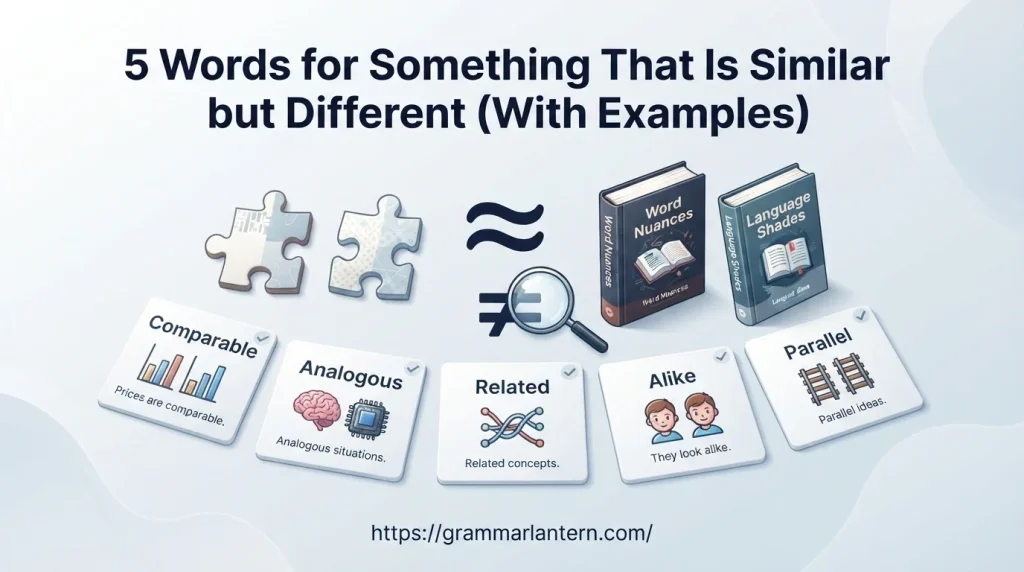
Comparison Table
The five words overlap in meaning, but each emphasizes a different kind of similarity. This table helps you choose the most accurate term for your sentence.
| Word | Main Focus | Common Context | Example |
| Comparable | Similar qualities or value | Products, prices, skills, results | Their test scores are comparable. |
| Analogous | Similar function or relationship | Systems, concepts, explanations | A heart is analogous to a pump. |
| Related | Connection or association | Subjects, ideas, events | The two issues are related. |
| Alike | Shared characteristics or appearance | People, objects, behavior | The sisters look alike. |
| Parallel | Similar patterns or developments | Careers, events, processes | Their careers followed parallel paths. |
Which Word Should You Choose?
Use this quick guide when you’re unsure:
- Choose comparable when you want to evaluate two things against each other.
- Choose analogous when two things share a function, purpose, or relationship.
- Choose related when two things have a connection or association.
- Choose alike when two things share noticeable qualities or characteristics.
- Choose parallel when two things follow similar patterns, structures, or developments.
The difference may seem small, but choosing the right word can make your sentence more precise.
How to Choose the Right Word for Something Similar but Different
The easiest way to choose the right word is to identify the type of similarity you’re describing. Instead of searching for a synonym randomly, think about the relationship between the two things.
Use Comparable for Similar Qualities or Value
Choose comparable when you’re evaluating two things against the same standard.
For example, you might compare two phones based on camera quality, battery life, storage, or price. Their specifications don’t have to match perfectly. They only need to share enough qualities for a useful comparison.
Example: The two laptops have comparable processing speeds but different screen sizes.
Use Analogous for Similar Functions or Relationships
Choose analogous when two things perform similar roles or share a particular principle.
This word helps explain unfamiliar concepts through familiar examples.
Example: A company’s departments are analogous to different parts of an organized system because each performs a specific role.
Use Related for Connections Between Things
Choose related when two things share an association, subject, origin, or connection.
They don’t need to look alike or perform the same function.
Example: Reading comprehension and vocabulary development are related skills.
Use Alike for Shared Characteristics
Choose alike when two things share noticeable qualities, appearances, opinions, or behavior.
Example: The two houses look alike because they have similar designs and colors.
Use Parallel for Similar Patterns or Paths
Choose parallel when two things develop or progress in similar ways.
Example: The two companies followed parallel expansion strategies over several years.
Similar but Different vs. Same: What’s the Difference?
People often use similar and same as though they mean the same thing. However, they describe different relationships.
Similar means two things share some characteristics. Same generally means they are identical or refer to one identical thing, depending on the context.
For example, two people may wear similar shirts. Their shirts share colors, patterns, or styles. However, if they wear the same shirt, they may be wearing an identical design or referring to one particular shirt.
| Word | Meaning | Example |
| Similar | Shares some characteristics | We have similar interests. |
| Same | Identical or one shared thing | We work at the same company. |
| Identical | Exactly alike in relevant characteristics | The copies are identical. |
| Equivalent | Equal in value, meaning, or function | The two measurements are equivalent. |
| Comparable | Similar enough for a fair comparison | The products offer comparable features. |
| Different | Not the same | Their opinions are different. |
Examples of Similar but Different
- Two phones have similar features but different operating systems.
- Two recipes use similar ingredients but produce different flavors.
- Two students have similar study habits but different learning strengths.
- Two cars have similar designs but different engines.
- Two books discuss similar topics but present different arguments.
Understanding this distinction helps you avoid overstating similarities. Two things can share important qualities without becoming interchangeable.
Examples
Similarities and differences appear everywhere. Everyday examples make these vocabulary words easier to understand and remember.
Everyday Objects
Many everyday objects share similar designs or functions while differing in details.
- Two smartphones may offer similar features but use different operating systems.
- Two cars may have comparable safety ratings but different fuel efficiency.
- Two chairs may look alike but use different materials.
- Two kitchen appliances may serve related purposes but operate differently.
For example, a blender and a food processor are related kitchen appliances. Both help prepare food. However, they perform different tasks and aren’t always interchangeable.
People
People may share traits without having identical personalities, abilities, or experiences.
- Twins may look alike but think differently.
- Two coworkers may have comparable qualifications but different working styles.
- Friends may share similar interests but disagree about important issues.
- Two athletes may have parallel training routines but different strengths.
These examples show why the right word depends on what you’re comparing.
Ideas and Concepts
Abstract concepts can share similarities while maintaining distinct meanings.
| Concepts | Similarity | Difference |
| Weather and climate | Both describe atmospheric conditions | Weather concerns short-term conditions; climate describes long-term patterns |
| Sympathy and empathy | Both involve understanding another person’s feelings | Sympathy involves concern; empathy involves understanding or sharing feelings |
| Democracy and republic | Both involve systems of government | Their structures, principles, and definitions can differ |
| Accuracy and precision | Both relate to measurement quality | Accuracy concerns closeness to the true value; precision concerns consistency or detail |
| Revenue and profit | Both concern business finances | Revenue is income from sales; profit is what remains after relevant costs |
These distinctions are useful in educational writing because similar concepts can easily become confused.
Situations and Experiences
Different situations may share circumstances while producing different outcomes.
- Two jobs may have similar responsibilities but different workplace cultures.
- Two students may follow comparable study schedules but receive different grades.
- Two businesses may experience parallel growth but serve different markets.
- Two families may face related financial challenges but use different solutions.
The shared circumstances make comparisons possible. The differences explain why their experiences aren’t identical.
Common Mistakes
Although these words overlap, using them incorrectly can change your meaning. Here are some common mistakes worth avoiding.
Using Comparable When You Mean Identical
Comparable doesn’t mean exactly the same. It means that two things share enough qualities for comparison.
Incorrect interpretation: These phones are comparable, so they have identical features.
Correct interpretation: These phones have comparable performance, although their features differ.
Using Analogous as a General Replacement for Similar
Analogous usually suggests a particular correspondence in function, structure, purpose, or relationship.
Less precise: The two dresses are analogous in color.
More natural: The two dresses are similar in color.
Analogous is more useful when explaining a meaningful relationship between different systems or concepts.
Confusing Related With Similar
Two things may be related without sharing many visible characteristics.
Example: Mathematics and physics are related fields. However, they aren’t necessarily similar in every aspect of their methods or subject matter.
Use related when the connection matters more than the resemblance.
Using Alike Incorrectly in a Sentence
Alike generally describes similarity. It doesn’t usually replace like in every grammatical structure.
- Correct: The two paintings look alike.
- Correct: The painting looks like the photograph.
- Incorrect: The painting looks alike the photograph.
Remember that alike often works naturally after verbs such as look, seem, and be.
Using Parallel Without a Meaningful Pattern
Parallel suggests some correspondence in structure, development, direction, or circumstances.
You shouldn’t use it merely because two things share one random feature.
For example, two books with blue covers aren’t necessarily parallel. However, two novels that follow similar story structures or explore corresponding themes may have parallel narratives.
The word works best when you can identify a recognizable pattern or correspondence.
Read More: Midday or Mid-Day: Which Spelling Is Correct?
FAQs
1. What is a word for something that is similar but different?
Comparable is a useful word for describing two things that share similarities but aren’t exactly the same. For example, two smartphones may have comparable features but different designs, prices, and performance.
2. What is another word for similar but not the same?
You can use words such as comparable, analogous, related, distinct, and equivalent, depending on the context. Each word expresses a slightly different relationship between two things.
3. What does analogous mean?
Analogous describes two things that are similar in certain ways, especially in their functions, purposes, or relationships. For example, the human heart is analogous to a pump because both move fluid through a system.
4. What is the difference between similar and identical?
Similar means two things share certain qualities but may have noticeable differences. Identical means two things are exactly alike in the relevant characteristics. For example, two similar shirts might have different colors, while identical shirts have matching designs and colors.
5. Can I use comparable in formal writing?
Yes. Comparable works well in academic papers, professional reports, business communication, and formal discussions. It helps explain that two subjects share qualities that make a meaningful comparison possible.
6. What word describes two things that are related but different?
Distinct is a useful choice when you want to emphasize that two things are separate or different, even if they share some characteristics. For example, marketing and advertising are distinct but closely related business activities.
7. Is equivalent the same as similar?
No. Equivalent means two things have the same value, purpose, meaning, or function in a particular context. Similar only indicates that they share certain qualities. For example, two qualifications may be equivalent without having identical course structures.
8. What is the difference between analogous and comparable?
Analogous emphasizes a similarity in function, structure, or relationship. Comparable means two things share enough qualities to be meaningfully compared. For example, two business strategies may be comparable because they target similar customers, while their processes may be analogous because they follow similar patterns.
9. How do I choose the right word for something similar but different?
Start by identifying what the two things have in common and how they differ. Use comparable for meaningful comparisons, analogous for similar relationships or functions, and distinct to emphasize differences. Always consider your sentence and intended meaning before choosing a word.
10. Why is it important to learn synonyms for similar but different?
Learning these synonyms improves your vocabulary, writing accuracy, and communication skills. It also helps you avoid repetitive language and express subtle differences more clearly. These skills are especially useful in academic writing, professional conversations, business reports, and everyday communication.
Conclusion
Finding the right words for something that is similar but different helps you communicate with greater precision. Words such as comparable, analogous, related, distinct, and equivalent offer different ways to describe similarities and differences. However, they aren’t always interchangeable. Understanding their meanings and appropriate usage allows you to make clearer comparisons and avoid misunderstandings.
The next time you compare two ideas, products, situations, or concepts, think about what makes them alike and what sets them apart. Choose a word that communicates that relationship accurately. With regular reading, writing, and vocabulary practice, you’ll develop stronger word choice, improve your English usage, and express your thoughts more confidently in everyday and professional contexts.

Muhammad Haroon is the voice behind many of the clear, practical grammar guides you’ll find on Grammar Lantern. With a strong background in content writing and a genuine love for the English language, Haroon specializes in breaking down intimidating grammar topics into simple, digestible lessons. His goal is simple: to empower readers to write with confidence and clarity. Whether he’s explaining tricky tenses or demystifying punctuation, Haroon approaches each topic with patience, precision, and a touch of warmth—because he knows that learning grammar is a journey, not a race.