Writers often need a vivid way to represent the sound of spitting in dialogue, fiction, comics, or creative scenes. The right onomatopoeia can make an action feel immediate, helping readers almost hear what is happening. Different sound effect words and spelling variations can create different impressions, from a quick spit to a forceful spray. Choosing the best expression depends on the scene, tone, and level of detail you want to convey.
In this guide, you’ll discover four common ways to spell the sound of spitting and learn how each one works in context. You’ll also see how these expressions fit into English usage, grammar, and creative writing. Simple examples can help you understand when a particular spelling sounds natural and when another option may work better.
Whether you’re writing dialogue, a comic scene, a script, or descriptive narration, clear word choice matters. These expressive terms can add personality and movement to your writing while keeping the meaning easy to understand. By the end, you’ll know how to use each spelling naturally and effectively.
Quick Answer
The most useful ways to spell the sound of spitting include ptui, ptooey, ptooie, and ptew. These forms are variations of the same general sound rather than four completely different noises.
| Spelling | General sound | Best use |
| Ptui | A sharp, quick spit | Direct sound effect or literary dialogue |
| Ptooey | A more expressive spit | Disgust, contempt, rejection |
| Ptooie | A playful or exaggerated spit | Fiction, comics, informal writing |
| Ptew | A very short spit-like burst | Stylized dialogue and sound effects |
The spelling ptui is especially useful when you want the sound to look like an actual onomatopoeic interjection. Ptooey is more familiar to many readers and often carries an emotional flavor.
There isn’t a single official spelling that every writer must use. Onomatopoeia works by suggesting sound through letters, so writers have some creative freedom.
What Is Spit Onomatopoeia?
Spit onomatopoeia is a written sound effect that imitates or suggests the noise associated with spitting.
The idea is simple. You choose letters that give readers a visual impression of the sound. Clusters such as pt- create a sudden, compressed opening, while the long vowel and ending in ptooey make the sound feel more extended.
Think of it as turning a tiny physical action into typography.
When someone spits, the sound may begin with a brief pressure from the lips and tongue. The written form tries to capture that sudden release. That’s why spellings such as ptui and ptooey often begin with unusual consonant combinations.
The result doesn’t need to reproduce the sound scientifically. It needs to make sense to the reader.
For example:
“Ptui!” He spat onto the dusty road.
The word immediately signals what happened. You don’t need a long explanation.
Why Spitting Sounds Have Flexible Spellings
Unlike standardized vocabulary, onomatopoeia often develops through imitation rather than strict spelling rules.
Different writers hear the same noise differently. One person may hear ptui, while another may prefer ptooey. A comic-book writer might stretch the word into ptooooey to exaggerate the action.
That doesn’t mean every invented spelling works equally well.
Readers need to recognize the intended sound quickly. Familiar forms usually work better because the visual pattern already suggests the action.
Ptui
Ptui is one of the clearest spellings for the sound of spitting.
It looks short, abrupt, and slightly unusual. That visual quality fits the action itself. A quick spit doesn’t usually sound like a long, flowing word.
The form can work as a standalone interjection:
“Ptui!” He spat onto the ground.
It can also appear within narrative prose:
She turned away, muttered something under her breath, and ptui, spat into the gutter.
The spelling is particularly effective when the sound itself matters. Instead of describing every movement, you can let the sound effect carry part of the scene.
Read More: “My Wife And I” vs. “My Wife And Me” vs. “Me And My Wife”
What Does “Ptui” Suggest?
The sound often carries more than physical action. Depending on context, ptui can suggest:
- Disgust
- Contempt
- Rejection
- Annoyance
- Disapproval
- A deliberate act of spitting
- A quick physical expulsion of saliva
For example:
“Ptui! That stuff tastes awful.”
Here, the sound communicates disgust before the sentence even finishes.
In another scene, the emotional meaning could be stronger:
He looked at the muddy photograph, shook his head, and “Ptui!” spat beside his boot.
The same sound now feels contemptuous.
When Should You Use “Ptui”?
Choose ptui when you want a compact and recognizable sound effect.
It works especially well in:
- Fiction
- Dialogue
- Comics
- Humorous writing
- Character-driven scenes
- Descriptions of contempt or disgust
Because the word is short, it doesn’t interrupt the rhythm of a paragraph.
Ptooey
Ptooey is another familiar way to spell a spitting sound. It generally feels more expressive than ptui.
The ending gives the sound a slightly stretched quality. As a result, ptooey can feel theatrical, humorous, disgusted, or exaggerated.
For example:
“Ptooey! Get that awful smell away from me.”
The sound doesn’t merely tell readers that the character spat. It gives the character an attitude.
That distinction matters.
Good sound effects don’t just describe physical noise. They can reveal personality.
When Does “Ptooey” Work Best?
Ptooey fits scenes where the character is reacting emotionally.
Common situations include:
- Tasting something unpleasant
- Showing disgust
- Rejecting an idea
- Spitting something from the mouth
- Expressing contempt
- Creating a humorous reaction
Consider these two examples:
“Ptui.” He spat into the dirt.
“Ptooey!” She tasted the bitter medicine and immediately spat it out.
The first feels restrained. The second feels expressive.
That’s the power of small spelling choices.
Ptooie
Ptooie is a close variation of ptooey. It uses the same basic sound pattern but gives the ending a different visual shape.
This form can work particularly well in playful fiction or exaggerated dialogue.
For example:
“Ptooie!” The character spat out the mouthful and reached for a glass of water.
The spelling looks informal, which can be useful when the surrounding writing has a light or comic tone.
However, ptooie isn’t necessarily a completely different sound from ptooey. Both forms are creative representations of a similar spitting noise.
Ptooie vs. Ptooey
The distinction is mostly about style and visual effect, not a strict difference in physical sound.
| Form | Impression | Suitable context |
| Ptooey | Familiar and expressive | Disgust, contempt, comic reaction |
| Ptooie | Playful and stylized | Fiction, dialogue, humorous scenes |
| Ptui | Short and sharp | Direct spitting sound |
If you want the most immediately recognizable option, ptooey is a strong choice.
If you want something shorter and punchier, ptui works nicely.
Ptew
Ptew is a more stylized representation of a quick spit-like burst.
It has a clipped appearance. The spelling doesn’t linger on the vowel, so it can make the action feel fast.
For example:
“Ptew!” He spat the seed onto the sidewalk.
This kind of spelling is particularly useful in creative writing where visual rhythm matters.
It may also work in comics or scripts where sound effects need to be short enough to sit beside an action.
Why “Ptew” Feels Different
The spelling ptew is visually compressed.
Compare:
Ptew!
with:
Ptooey!
The first looks like a quick burst. The second feels more drawn out.
That’s an important principle when writing onomatopoeia: the appearance of the word can influence how readers imagine the sound.
A stretched spelling can suggest duration. A compact spelling can suggest speed.
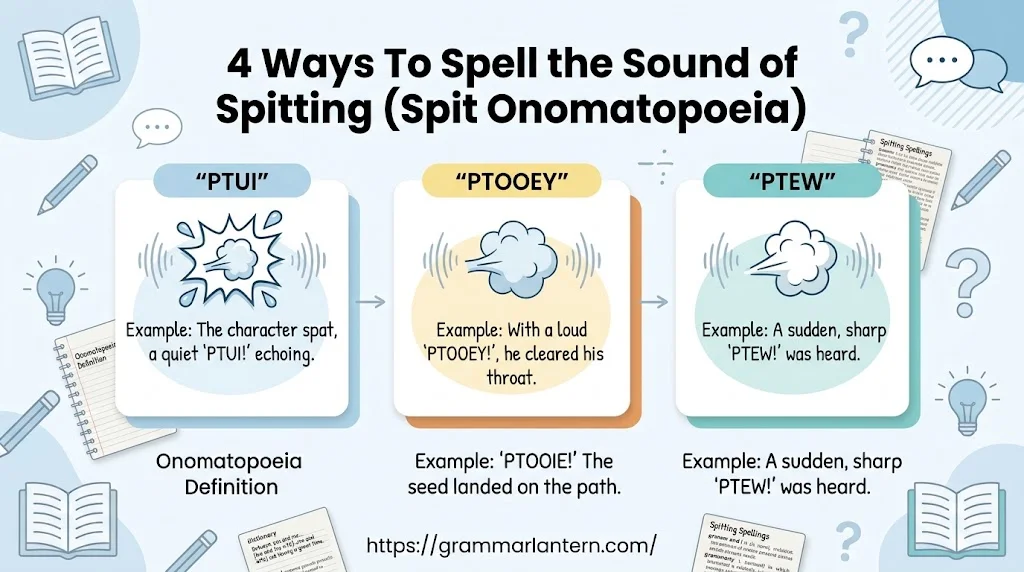
Four Ways To Spell the Sound of Spitting Compared
Choosing a spit sound becomes easier when you compare the forms side by side.
| Sound spelling | Length | Tone | Main impression |
| Ptui | Short | Direct | Sharp spit |
| Ptooey | Medium | Expressive | Disgust or contempt |
| Ptooie | Medium | Playful | Stylized spit |
| Ptew | Very short | Abrupt | Quick burst |
These aren’t rigid categories. A creative writer can bend them to fit a scene.
Still, the table gives you a useful starting point.
If the character is calmly spitting onto the ground, ptui may fit better. If the character tastes something revolting, ptooey gives you more emotional color.
For a comic scene, ptooie can add personality. If you need a tiny sound effect that disappears quickly into the action, ptew may work.
How To Choose the Right Spit Onomatopoeia
The best sound spelling depends on what actually happens in the scene.
Start by asking what kind of spitting you’re describing.
1.Is the character showing disgust?
2.Is the action quick and almost silent?
3.Is the character spitting something out after tasting it?
4. Does the saliva hit a hard surface?
Each detail can influence your choice.
Consider the Emotion
Emotion often matters more than the physical sound.
For example:
“Ptui.” He turned away in disgust.
The short sound feels controlled.
Now compare it with:
“Ptooey!” She recoiled from the bitter drink.
The second version feels bigger and more expressive.
Consider the Speed
A fast action usually benefits from a short spelling.
Ptew or ptui can suggest a quick burst.
A more exaggerated action can use ptooey or ptooie.
Consider the Setting
A fantasy novel, children’s story, comedy, graphic novel, and realistic literary scene may all handle sound effects differently.
A comic can tolerate exaggerated spelling:
PTOOEY!
A serious novel might use something quieter:
He spat onto the pavement.
Sometimes the strongest choice is not an onomatopoeia at all.
That’s worth remembering.
Spit Sound Effects in Dialogue
Sound effects can make dialogue feel physical.
Suppose a character tastes a suspicious drink:
“Ptooey!” Marcus spat it onto the floor. “What is that?”
The sound creates an immediate reaction. Readers can picture the character’s face and almost hear the action.
However, don’t force an onomatopoeic word into every scene.
If the action doesn’t need emphasis, plain narration may be stronger:
Marcus tasted the drink and spat it onto the floor.
The second version is cleaner. The first is more dramatic.
Use the sound effect when you want impact, personality, or comic timing.
Spitting vs. Splattering: Don’t Confuse the Sounds
One important distinction can prevent awkward word choices.
The sound of spitting isn’t necessarily the same as the sound of something wet hitting a surface.
Words such as splat, splash, and splatter generally focus on impact or scattered liquid. They don’t specifically mean the sound of saliva leaving someone’s mouth.
For example:
“Ptui!” He spat onto the ground.
Here, ptui represents the act or sound of spitting.
Now consider:
The glob of liquid hit the wall with a wet splat.
The emphasis has shifted. The sound comes from impact.
Spit Sound vs. Impact Sound
| Situation | Better sound direction |
| Saliva leaving the mouth | Ptui / ptooey |
| Something wet hitting a surface | Splat |
| Liquid scattering | Splatter |
| Repeated sputtering or ejection | Splutter |
| A quick stylized spit | Ptew |
This distinction helps keep your descriptions precise.
You don’t want a sound effect to tell readers something different from what the character actually does.
How To Write Spit Sounds Naturally
A sound effect works best when it supports the action instead of replacing it.
Compare these examples:
“Ptooey!”
“Ptooey!” She spat the sour candy onto the napkin.
The second sentence gives readers more context.
You can also place the sound inside a larger action:
He sucked the bitter taste from his teeth, grimaced, and ptui.
The rhythm creates a miniature scene.
Punctuation Matters
Punctuation can change the energy of an onomatopoeia.
Ptui.
Feels flat or restrained.
Ptui!
Feels sharper.
Ptooey!
Feels expressive.
PTOOEY!
Feels loud, exaggerated, or comic.
You can even stretch a word in highly stylized fiction:
Ptoooey!
That isn’t necessary in ordinary prose, but it can work when the visual exaggeration matches the scene.
Common Mistakes
A good sound effect should clarify the scene rather than make readers stop and decode it.
Treating One Spelling as the Only Correct Answer
Onomatopoeia doesn’t behave like ordinary vocabulary.
There can be several accepted or recognizable spellings for the same general sound.
Using “Splat” for Every Spitting Scene
Splat usually emphasizes something wet hitting a surface.
It isn’t the best choice when the focus is the sound made by the person spitting.
Overusing Sound Effects
A sound effect loses its punch when every sentence contains one.
Use it strategically.
One well-placed “Ptooey!” can be much funnier than five unnecessary sound effects.
Ignoring the Character’s Personality
A gruff character, a child, a cartoon villain, and a sarcastic teenager might all spit differently.
The written sound can reflect that personality.
Read More: Rung or Rang? Difference Explained with Helpful Examples
Choosing a Sound That Doesn’t Match the Action
A short, sharp spit shouldn’t suddenly look like a long, dramatic noise unless the scene intentionally exaggerates it.
Think about the physical action first. Then choose the spelling.
Are Spit Onomatopoeias Real Words?
Some spit-related sound forms have dictionary recognition, while others function mainly as informal or creative spellings.
Ptui is an established interjection used to represent the sound or act of spitting. Ptooey also appears as a spelling variant.
Other forms may be less standardized and more dependent on creative convention.
That’s normal for onomatopoeia.
Words such as buzz, hiss, and clang have become ordinary vocabulary. Other sound effects remain much more flexible.
The important question isn’t always, “Is this word in a dictionary?”
Instead, ask:
“Will my reader understand the sound I intend?”
If the answer is yes, the spelling is doing its job.
A Practical Guide for Writers
When you need to write a spitting sound, use this quick process.
- Identify the action. Is someone actually spitting or simply making a disgusted noise?
- Identify the emotion. Is the character angry, disgusted, amused, or dismissive?
- Choose the intensity. Keep the spelling short for a quick burst.
- Think about the audience. Children’s fiction can tolerate more playful sound effects.
- Use punctuation carefully. An exclamation point adds force.
- Avoid unnecessary exaggeration. Not every spit needs a cartoon-style effect.
- Let context do some work. A sound effect becomes clearer when paired with physical action.
This approach produces writing that feels deliberate rather than random.
Examples in Sentences
Here are several natural examples:
“Ptui!” He spat the bitter taste onto the grass.
“Ptooey!” She rejected the foul-smelling medicine.
“Ptooie!” The child spat out the watermelon seed and laughed.
“Ptew!” He flicked the tiny piece of food from his tongue.
He tasted the strange sauce, grimaced, and muttered, “Ptui.”
“Ptooey! That’s disgusting,” she said, wiping her mouth.
These examples show why context matters. The sound itself is only part of the description.
The surrounding verbs, facial expressions, and dialogue tell readers how the sound should feel.
What Is the Best Word for the Sound of Spitting?
If you need one strong choice, ptui is a useful starting point because it directly represents a spitting sound.
For a more expressive reaction, ptooey works well.
If you want a playful variation, ptooie can fit. For an extremely short, stylized burst, ptew may work in creative writing.
The right choice ultimately depends on the scene.
| Your goal | Recommended spelling |
| Direct spitting sound | Ptui |
| Disgust or contempt | Ptooey |
| Playful exaggeration | Ptooie |
| Very short stylized burst | Ptew |
The key is to match the sound to the action rather than searching for one supposedly perfect spelling.
FAQs
1. What is the sound of spitting called?
The sound of spitting can be represented with onomatopoeia, such as “ptoo,” “ptui,” “pfft,” or “thoo,” depending on the action and style.
2. What is the most common spelling for a spitting sound?
“Ptoo” is a common spelling used to represent a short, sharp spitting sound, especially in dialogue and informal writing.
3. Is “ptui” a real word?
“Ptui” is an informal sound-effect spelling rather than a standard dictionary word. Writers use it to imitate the sound of spitting.
4. Can I use spitting sounds in dialogue?
Yes. Spitting sounds can make dialogue more expressive in fiction, comics, scripts, and humorous writing.
5. Is “pfft” the same as a spitting sound?
Not exactly. “Pfft” usually represents a burst of air, dismissal, or irritation. However, a writer may use it creatively to suggest a quick spit.
6. Should I use onomatopoeia in formal writing?
Usually, no. Onomatopoeia for spitting works best in creative, informal, or narrative writing rather than academic or professional documents.
7. Can spelling change the way the sound feels?
Yes. A spelling such as “ptoo” may feel sharper, while another variation can suggest a softer, shorter, or more exaggerated action.
8. Should spitting sounds be capitalized?
Capitalize them when they begin a sentence. In dialogue or comic-style writing, capitalization can also be used for emphasis.
9. Can I invent my own spelling?
Yes. Creative writing allows some flexibility. However, choose a spelling that readers can easily understand and connect with the intended sound.
10. What is the best way to write a spitting sound?
There isn’t one universal choice. Consider the scene, character, tone, and intensity, then choose the spelling that makes the action easiest for your reader to imagine.
Conclusion
The sound of spitting can be surprisingly difficult to capture because written sounds don’t have one fixed spelling. Words such as ptoo, ptui, and other creative variations can help readers imagine the action more clearly. The best choice depends on the scene and the effect you want to create.
If you’re writing fiction, dialogue, comics, or scripts, don’t be afraid to experiment. Keep the spelling clear, match it to the action, and avoid using an exaggerated sound when a simple one will do. With the right onomatopoeia, even a small action like spitting can become more vivid, natural, and memorable.


[…] Read More: 4 Ways To Spell the Sound of Spitting and Spit Onomatopoeia […]