Onomatopoeia gives you words that imitate or suggest sounds, making descriptions more vivid. In 6 Words for the Sound of Throwing Up, vomit onomatopoeia offers practical sound words for describing throwing up. When someone is sick, words like Blech, Blargh, Gack, Retching noises, Barf, and Keck can add a clear sense of sound. Each option creates a different effect, so choose the word that best matches the scene and the sounds being made.
From my experience with writing, I find that vomit words work best when they sound natural rather than forced. You can explore different onomatopoeic words and words that refer to sounds to find the right fit. For example, Blech may feel short and sharp, while Retching noises can suggest repeated sickness. These choices can help readers imagine the sound of throwing up and the sound of vomit more clearly.
This approach can spice up your content while keeping your writing simple and natural. When describing being sick, consider the situation, the person, and the mood of the scene. The goal is to describe the sound without using unusual vocabulary just for effect. With the right word, you can make a scene clearer and help readers understand what is happening without distracting them from the writing.
Quick Answer
The sound of throwing up varies from person to person and from one stage of vomiting to another. Retching and heaving often create harsh, strained sounds, while liquid movement can produce bubbling or gurgling noises.
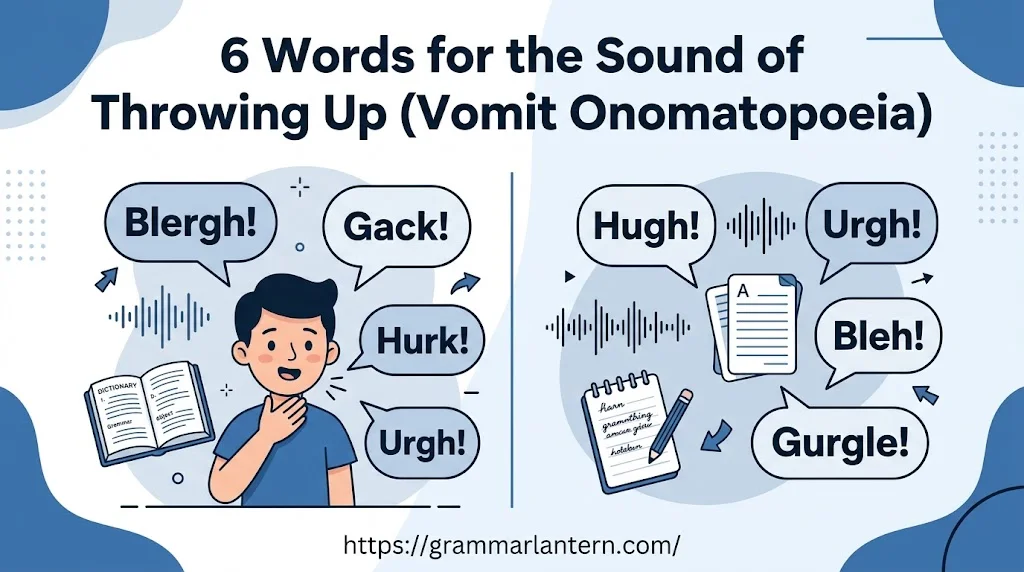
Here are six informal words and sound expressions that can represent different parts of the experience:
| Word | What it suggests | Best use |
| Bleh | Disgust or nausea | Informal reactions |
| Blergh | Exaggerated vomiting or gagging | Comics and humorous writing |
| Urgh | Disgust, nausea, or revulsion | Dialogue and reactions |
| Gack | Gagging, choking, or retching | Comic or dramatic scenes |
| Hurk | Retching or forceful heaving | Fiction and sound effects |
| Gurgle | Bubbling or liquid movement | Throat or stomach sounds |
One important distinction matters here: not every word in this list is strict onomatopoeia. Some are interjections that communicate disgust rather than directly imitate a physical sound.
6 Words for the Sound of Throwing Up
Bleh
Bleh is a casual expression that communicates disgust, unpleasantness, or nausea. It doesn’t precisely reproduce the mechanical sound of vomiting, but it can work well when a character reacts to something that makes them feel sick.
For example:
“Bleh! That smell is awful.”
A writer might also use it immediately before a vomiting scene. In that context, the word signals the character’s reaction rather than the actual noise produced by their body.
Bleh works especially well for:
- Disgust
- Nausea
- An unpleasant taste
- A reaction to something revolting
- Informal dialogue
- Humorous writing
Because bleh is so short, it feels spontaneous. You can almost hear someone recoiling from an unpleasant smell or sight.
However, don’t treat it as a precise substitute for retch or vomit. Those verbs describe physical actions, while bleh mainly communicates a reaction.
Blergh
If you’re looking for a more exaggerated vomit sound effect, blergh is a useful informal choice.
The spelling itself suggests an ugly, messy noise. That’s exactly why it appears naturally in comics, humorous fiction, internet writing, and exaggerated dialogue.
For example:
“Blergh!” He leaned over the sink and emptied his stomach.
Unlike bleh, which often expresses disgust, blergh can evoke the unpleasant sound of someone gagging or vomiting.
Its strength comes from its deliberately awkward spelling. The combination of consonants gives it a rough, throaty quality.
Blergh is most suitable for:
- Comics
- Humor
- Informal fiction
- Exaggerated sound effects
- Cartoon-style scenes
- Casual online writing
It isn’t a formal medical term. You wouldn’t normally use it in a clinical description. Instead, it gives creative writing a vivid, almost cartoonish sound.
Urgh
Urgh is another informal expression associated with disgust, nausea, frustration, or discomfort.
For example:
“Urgh, I feel sick.”
The expression can appear around a vomiting scene, but it doesn’t specifically mean the sound of vomiting. Instead, it communicates the person’s unpleasant reaction.
That difference is useful when choosing words for a story.
Imagine a character sees something disgusting. They might say “Urgh!” before covering their mouth. The word tells the reader how they feel. It doesn’t necessarily describe what their stomach or throat sounds like.
Urgh can suggest:
- Nausea
- Revulsion
- Disgust
- Physical discomfort
- An unpleasant reaction
In other words, urgh is more about the human response than the vomiting mechanism itself.
Read More: Drew or Drawn: Which Is Correct?
Gack
Gack is an informal sound expression associated with gagging, choking, or a sudden unpleasant throat reaction.
It can fit a scene in which someone struggles to keep something down.
For example:
“Gack!” He covered his mouth and stumbled toward the bathroom.
The word has a sharp, abrupt quality. That makes it particularly useful for sudden gagging.
A character doesn’t necessarily need to vomit after making a gack sound. They might simply gag because of a foul smell, bad taste, or something caught in their throat.
That distinction gives gack a wider range than a direct vomiting sound.
Hurk
Hurk works as an informal or comic representation of retching or heaving.
Retching happens when someone makes forceful attempts to vomit. Sometimes little or nothing comes up. That’s why a sound describing retching can be more accurate than simply writing vomit.
For example:
“Hurk!” He doubled over and gripped the edge of the table.
The word has a rough, abrupt sound that suits a physical action. It can make a fictional scene feel more animated, particularly when the writing intentionally exaggerates the noise.
Hurk works best in:
- Fiction
- Comics
- Humorous writing
- Sound-effect writing
- Exaggerated scenes
It’s also worth separating hurk from hurl. Hurl has several meanings, including “throw,” and informal English can use it to mean vomit. Hurk, by contrast, works as a sound-like expression for retching.
Gurgle
Gurgle describes a bubbling, liquid, or throat-like sound. It isn’t exclusive to vomiting, but it can be useful when describing noises that accompany nausea or the movement of liquid.
For example:
A strange gurgle rose from his throat before he rushed outside.
You can also use gurgle for water flowing through a pipe, a drink moving through a container, or other bubbling sounds. Context determines its meaning.
That makes it less specific than hurk or gack.
Still, when you’re describing a vomiting scene, gurgle can add an important sensory layer. Instead of relying entirely on exaggerated sound effects, you can use it to create a more descriptive scene.
Vomiting Sounds vs. Gagging and Retching Sounds
The biggest mistake writers make with vomit onomatopoeia is treating every unpleasant throat noise as the same thing.
Vomiting is a physical process. Several different actions can happen before, during, and after it.
| Term | Meaning | Typical role in a scene |
| Gagging | A reflex involving the throat | May happen before vomiting |
| Retching | Forceful attempts to vomit | Can occur with or without vomit |
| Heaving | Strong abdominal and respiratory effort | Common during vomiting |
| Vomiting | Expelling stomach contents | The main physical event |
| Gurgling | Bubbling or liquid-like sound | May accompany the event |
| Spitting | Expelling saliva or small amounts of liquid | May occur afterward |
These distinctions matter because they let you choose a sound that matches the action.
For example, gack may fit a sudden gag. Hurk can suggest retching. Gurgle can describe bubbling liquid. Meanwhile, bleh may show disgust.
Good descriptive writing doesn’t force one word to do every job.
Are These Words Really Onomatopoeia?
Here’s where terminology gets interesting.
Onomatopoeia refers to words that imitate or evoke sounds associated with what they describe. Classic examples include buzz, hiss, bang, and clang.
Vomit-related expressions are less straightforward.
Some informal spellings attempt to represent the sound itself. Others primarily communicate an emotional response.
Consider the difference:
- “Blergh!” → attempts to represent an unpleasant bodily sound.
- “Gack!” → evokes gagging or choking.
- “Hurk!” → evokes retching.
- “Urgh!” → mainly expresses disgust or discomfort.
- “Bleh!” → mainly expresses disgust or nausea.
- “Gurgle” → directly describes a bubbling sound but isn’t specific to vomiting.
So, calling every item vomit onomatopoeia would oversimplify the language.
A better approach is to think of them as a mixture of sound effects, interjections, and sound-descriptive words.
That distinction becomes especially important in formal writing. A novel can happily use an invented or exaggerated sound effect. A medical report needs much more precise language.
How to Write the Sound of Vomiting in a Story
A single sound effect rarely creates the strongest scene.
Instead, combine the sound with movement, physical reaction, and context.
For example:
“Hurk!” She bent over the sink, gripping its edge as another wave of nausea hit.
The sound gets attention. The action gives it meaning.
You can build a vomiting scene with three simple layers:
- Sound: What does the reader hear?
- Action: What is the character physically doing?
- Reaction: What happens immediately afterward?
This technique works because readers don’t experience a scene through sound alone.
For a humorous scene
Use exaggerated expressions such as blergh or gack.
“Blergh!” Tom stared at the ruined smoothie. “Never again.”
The sound effect creates comic timing without requiring a lengthy description.
For a realistic scene
Use ordinary descriptive verbs such as retch, heave, and gag.
He gagged twice before bending over the sink. His shoulders heaved as he tried to catch his breath.
This style usually feels more grounded because it focuses on physical action instead of cartoon-like spelling.
For a dramatic scene
Keep the sound effects restrained and emphasize the physical reaction.
A harsh retch broke the silence. She leaned against the wall and breathed slowly.
Here, the description creates tension without turning the moment into a comic sound effect.
How to Describe Different Stages of Vomiting
Vomiting scenes often become more vivid when you describe what happens in sequence.
Before Vomiting
Before someone vomits, they may experience:
- Nausea
- Gagging
- Retching
- Salivation
- Throat discomfort
- Stomach contractions
- Repeated swallowing
- A sudden urge to find a sink, toilet, or outdoor area
For fiction, you don’t need to list every symptom. Choose details that suit the scene.
His stomach tightened. He swallowed hard and hurried toward the bathroom.
That tells the reader something is coming without stating it bluntly.
During Vomiting
The actual event may involve:
- Heaving
- Retching
- Gurgling
- Coughing
- Wet sounds
- Sudden expulsion
- Repeated abdominal contractions
Here, hurk, gack, and gurgle can provide different sound textures.
After Vomiting
The scene doesn’t necessarily end when the vomiting stops.
A character may:
- Cough
- Spit
- Wipe their mouth
- Breathe heavily
- Rinse their mouth
- Sit or lean against something
- Clear their throat
- Feel temporarily relieved or exhausted
These small details often make a scene feel more authentic.
Vomit Onomatopoeia in Comics and Informal Writing
Comics have different needs from essays or realistic novels.
A comic might use:
“BLERGH!”
The oversized lettering immediately tells the reader what happened. The visual presentation carries part of the meaning.
Informal writing can do something similar with expressions such as gack or blergh.
However, sound effects work best when you don’t overuse them. If every action receives a dramatic noise, the scene can quickly become noisy rather than vivid.
One well-placed sound effect often beats five weak ones.
Typography can also change the feeling:
- Blergh! — ordinary emphasis
- BLERGH! — loud or exaggerated
- “Gack!” — sudden reaction
- Gurgle… — slower, quieter sound
In creative writing, punctuation becomes part of the sound design.
How to Choose the Right Vomiting Sound Word
The best word depends on what you actually want to describe.
1.Use bleh when:
- Someone feels disgusted.
- Something tastes terrible.
- A character reacts to something unpleasant.
- You want casual dialogue.
2.Use blergh when:
- You want an exaggerated vomiting sound.
- You’re writing humor or a comic.
- You want a deliberately ugly sound effect.
3.Use urgh when:
- Someone feels disgusted or nauseated.
- The focus is the character’s reaction.
- You’re writing informal dialogue.
4.Use gack when:
- Someone suddenly gags.
- A character chokes or struggles with something.
- You want a sharp comic sound effect.
5.Use hurk when:
- Someone retches.
- The scene needs a forceful, throaty sound.
- You’re using informal or exaggerated fiction.
6.Use gurgle when:
- You want a bubbling sound.
- Liquid movement matters.
- The sound comes from the throat or stomach.
The key is simple: match the word to the physical action.
A Practical Case Study: Choosing the Right Word
Imagine the same scene written three different ways.
Version A: The character feels disgusted
“Urgh,” Maya said as she opened the spoiled container.
Here, urgh communicates her reaction. Nothing suggests that she has actually vomited.
Version B: The character starts retching
“Gack!” Maya covered her mouth and rushed toward the sink.
Now, gack creates the impression of a sudden gagging response.
Version C: The character actually vomits
Maya doubled over with a harsh retch. A wet gurgle followed as she reached for the sink.
This version doesn’t depend on one cartoon-style word. Instead, it combines retch and gurgle to describe different sounds and actions.
That’s often the strongest technique for serious fiction.
What Is the Most Accurate Way to Describe Vomiting?
If accuracy matters more than humor, ordinary descriptive vocabulary usually works better than invented sound effects.
Useful verbs include:
- Gag
- Retch
- Heave
- Choke
- Cough
- Spit
- Vomit
- Regurgitate
These words tell the reader exactly what the character is doing.
Sound effects add personality. Descriptive verbs add precision.
For example, “He retched” communicates a specific physical action. “Hurk!” gives the same moment a more theatrical flavor.
Neither approach is universally right. The genre decides the tone.
Read More: 6 Words for the Sound of Throwing Up and Vomit Onomatopoeia
FAQs
1. What is vomit onomatopoeia?
Vomit onomatopoeia refers to words that imitate or suggest the sounds someone makes while throwing up, such as Blech, Blargh, or Gack.
2. What are some words for the sound of throwing up?
Common options include Blech, Blargh, Gack, Retching noises, Barf, and Keck.
3. Is “Blech” a sound of throwing up?
Yes. Blech can represent a short, unpleasant sound associated with disgust or vomiting.
4. What does “Blargh” mean?
Blargh is an informal sound word that can represent a loud, unpleasant vomiting or gagging sound.
5. Can “Gack” describe vomiting?
Yes. Gack can be used as an expressive sound word for gagging, choking, or throwing up.
6. What are “Retching noises”?
Retching noises describe the sounds produced when someone repeatedly tries to vomit, especially when little or nothing comes up.
7. Is “Barf” an onomatopoeia?
Not usually. Barf is mainly an informal verb or noun related to vomiting, although it can work effectively in sound-focused writing.
8. What does “Keck” mean?
Keck can describe a sharp sound or reaction associated with gagging or retching.
9. How should I use vomit sounds in writing?
Choose a sound that matches the scene, character, and intensity. A short word can create a quick effect, while descriptive phrases can show repeated or forceful retching.
10. Why use onomatopoeia for vomiting?
Onomatopoeia makes a scene more vivid by helping readers imagine the sound instead of simply being told that someone is sick.
Conclusion
Finding the right sound of throwing up can make a scene more vivid and memorable. Words such as Blech, Blargh, Gack, Retching noises, Barf, and Keck give you different ways to describe sickness, gagging, and vomiting. Each choice creates a slightly different feeling, so the best word depends on the situation and the effect you want.
Good writing doesn’t need complicated vocabulary to create a strong image. A simple, well-chosen sound can help readers understand exactly what is happening. Use vomit onomatopoeia naturally, match the word to the scene, and let the sound add detail without overwhelming the rest of your writing.

Muhammad Haroon is the voice behind many of the clear, practical grammar guides you’ll find on Grammar Lantern. With a strong background in content writing and a genuine love for the English language, Haroon specializes in breaking down intimidating grammar topics into simple, digestible lessons. His goal is simple: to empower readers to write with confidence and clarity. Whether he’s explaining tricky tenses or demystifying punctuation, Haroon approaches each topic with patience, precision, and a touch of warmth—because he knows that learning grammar is a journey, not a race.