Bachelor vs Batchelor often confuses writers because both forms sound similar, but bachelor is the correct spelling in standard English. The word bachelor has a clear meaning and can describe an unmarried man or an academic degree, such as a bachelor’s degree earned at a college or university.
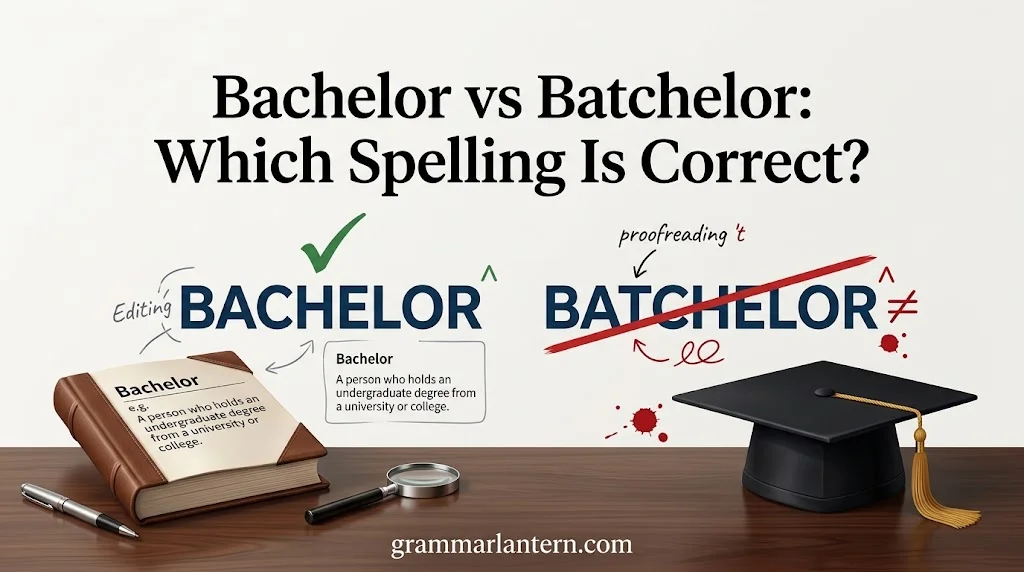
In writing and editing, using the correct form improves clarity, accuracy, and professionalism, especially in an important document, résumé, or formal content. The proper use becomes easier when you understand the difference and context. Bachelor is the accepted spelling found in dictionaries and style guides.
Batchelor usually appears as a surname, business name, or place name, so it can work as a proper name. This distinction matters in academic contexts, professional contexts, and everyday contexts, where small errors can affect first impressions. During proofreading, choosing the accepted form helps avoid confusion for readers, while removing the extra “t” prevents an unprofessional appearance.
Practical examples, grammar rules, and simple tips can help you spell bachelor confidently, avoid common mistakes and common spelling mistakes, and communicate with greater precision. This guide and article also explain why the alternative spelling batchelor should generally be avoided unless it is being used as a proper name.
Quick Answer
Bachelor is the correct standard spelling in modern English.
Batchelor is generally not the standard modern spelling of the common noun. It can appear as an archaic spelling in historical English and as a surname, however.
| Spelling | Modern standard English | Typical use |
| bachelor | Yes | Standard modern English |
| batchelor | No | Historical or archaic spelling |
| Batchelor | Yes, in the right context | Surname or proper name |
| bachelor’s | Yes | Possessive form or shortened degree reference |
| bachelor’s degree | Yes | General academic reference |
| Bachelor of Arts | Yes | Formal degree title |
| Bachelor of Science | Yes | Formal degree title |
So, if you’re writing a normal sentence today, choose bachelor.
Correct: He earned a bachelor’s degree in English.
Incorrect in standard modern usage: He earned a batchelor’s degree in English.
There are historical exceptions, but they don’t change the modern spelling rule.
What Does Bachelor Mean?
The word bachelor has more than one established meaning. Its modern uses developed from a much older word with several related senses.
Bachelor as an Unmarried Man
The most familiar meaning describes a man who isn’t married.
For example:
- He remained a bachelor for most of his life.
- The novel’s main character is a wealthy bachelor.
- Her brother is still a bachelor.
The word can also appear in familiar expressions such as eligible bachelor, which traditionally describes an unmarried man considered a desirable potential marriage partner.
Language changes with society, though. In contemporary writing, single man may be more neutral when marital status is relevant. Bachelor can carry cultural or stylistic associations that single doesn’t.
Bachelor as an Academic Degree
The word also has an important academic meaning.
A bachelor’s degree is an undergraduate degree awarded by a college or university. Merriam-Webster defines it as a degree generally awarded after a period of undergraduate study, commonly around four years in the US system.
Common examples include:
- Bachelor of Arts (BA)
- Bachelor of Science (BS or BSc)
- Bachelor of Engineering
- Bachelor of Fine Arts (BFA)
- Bachelor of Business Administration (BBA)
The exact structure, duration, and title can vary by country and institution. The spelling bachelor, however, remains the standard form.
Bachelor as a Description of a Male Animal
There’s another established but less common meaning.
A bachelor animal can refer to a male animal without a mate, particularly in species where males form separate groups outside breeding relationships. Merriam-Webster gives an unmated male fur seal as an example.
This use demonstrates how bachelor isn’t limited to human relationships.
Why Do People Spell Bachelor as Batchelor?
The confusion between bachelor vs batchelor isn’t completely random. The pronunciation makes the extra t feel tempting.
The word is commonly pronounced roughly like BACH-uh-ler or BACH-lər, depending on the speaker and variety of English. Merriam-Webster gives pronunciations including /ˈbach-lər/ and /ˈba-chə-/.
That “ch” sound can encourage a writer to imagine an additional consonant before it:
bat + chelor
instead of:
bach + elor
That’s a classic spelling trap. English contains many words whose sounds don’t provide a perfect map to their written forms.
For example, pronunciation alone doesn’t tell you whether a word should contain c, k, ck, or another spelling pattern. English spelling reflects centuries of linguistic change, borrowing, and convention.
The safest approach is therefore simple:
Don’t spell the word according to how the middle sound feels. Remember the established form: bachelor.
Read More: Wheaten vs. Wheat: What’s the Difference? A Complete Guide
Is Batchelor a Real Word?
This question deserves a more careful answer than simply saying “no.”
Batchelor as an Archaic Spelling
Batchelor has historical precedent.
Historical English sources contain forms that differ from the modern spelling of bachelor. Wiktionary identifies batcheler as an archaic spelling of bachelor, while reference material also records batchelor as an archaic British spelling.
That means you may encounter batchelor in:
- historical documents
- older books
- archival records
- genealogical material
- transcriptions of older documents
A historical spelling shouldn’t automatically be “corrected” when you’re reproducing an original document.
For example, imagine you’re transcribing a nineteenth-century census record that identifies someone as a batchelor. Preserving the original spelling may be appropriate because the spelling itself forms part of the historical evidence.
Batchelor as a Surname
There’s another important exception: Batchelor is a surname.
If someone’s family name is Batchelor, you should write it exactly that way.
For example:
Professor Batchelor presented the research at the conference.
Changing Batchelor to Bachelor would alter the person’s name.
This distinction is easy to remember:
A modern common noun: bachelor
A person’s surname: Batchelor, if that’s their actual name
The capital letter isn’t what makes the difference by itself. The context does.
A Historical Perspective
The history of bachelor helps explain why its spelling and meanings aren’t as straightforward as they might seem.
The word has therefore traveled through several social and linguistic settings:
Medieval vocabulary → young man/knight → university degree holder → unmarried man → modern academic and everyday uses
The modern spelling didn’t appear from nowhere. It developed through historical changes in English spelling and pronunciation.
That’s an important fact because it shows how misleading it can be to judge an old spelling by today’s conventions.
A spelling such as batchelor may look like a simple mistake to a modern reader. In a historical document, however, it can reflect the spelling practices of the period.
Bachelor vs Batchelor in Modern English
For contemporary writing, the distinction is much easier.
Use bachelor when you’re referring to:
- an unmarried man
- a bachelor’s degree
- a person holding a bachelor’s degree
- an academic qualification
- a bachelor animal
- established compounds containing bachelor
Use batchelor only when the context specifically calls for the historical spelling or the word is part of a proper name.
Modern Examples
Correct:
- He is a bachelor.
- She earned a bachelor’s degree.
- He completed a Bachelor of Science.
- She holds a Bachelor of Arts in English.
- The documentary follows a group of bachelor male seals.
Not standard in modern common-noun usage:
- He is a batchelor.
- She earned a batchelor’s degree.
- He completed a Batchelor of Science.
The difference is only one letter, but that letter matters.
Bachelor’s Degree: Why Is There an Apostrophe?
One of the most common questions connected to bachelor vs batchelor involves the phrase bachelor’s degree.
The correct general expression is:
bachelor’s degree
The apostrophe marks the possessive form of bachelor.
For example:
She earned a bachelor’s degree in sociology.
Merriam-Webster recognizes bachelor’s as a noun meaning a bachelor’s degree as well.
You can therefore say:
- She earned a bachelor’s degree.
- She earned a bachelor’s in economics.
The second version shortens bachelor’s degree because the context already makes the meaning clear.
Bachelor of Arts Is Different
Here’s where many writers stumble.
The formal degree title is:
Bachelor of Arts
Not:
Bachelor’s of Arts
Likewise:
Bachelor of Science
Not:
Bachelor’s of Science
Examples:
- She earned a Bachelor of Arts in History.
- He completed a Bachelor of Science in Biology.
The grammar changes because these are different constructions.
| Phrase | Correct? | Why |
| bachelor’s degree | Yes | Possessive general reference |
| a bachelor’s in history | Yes | Shortened form of bachelor’s degree |
| Bachelor of Arts | Yes | Formal degree title |
| Bachelor of Science | Yes | Formal degree title |
| Bachelor’s of Arts | No | Incorrect construction |
| bachelors degree | No | Missing apostrophe in the singular possessive |
In Academic Writing
Academic documents are one place where spelling mistakes can carry extra weight.
If you’re writing a résumé, CV, application, university profile, or academic biography, use the standard spelling bachelor.
On a Résumé
You might write:
Bachelor of Science in Computer Science
University Name
Or:
Bachelor’s degree in Computer Science
Both can work depending on the context and formatting style.
In a University Application
If you’re describing a completed qualification, write:
I earned a bachelor’s degree in sociology.
If you’re naming the official degree, write:
I earned a Bachelor of Arts in Sociology.
Don’t write:
I earned a batchelor’s degree in sociology.
The extra t immediately looks like a spelling error.
In Academic Prose
When the degree isn’t being used as a formal title, lowercase is often appropriate:
She holds a bachelor’s degree in history.
When you’re using an official degree title, capitalization depends on the style guide and institutional convention:
She earned a Bachelor of Arts in History.
The key point for this article is spelling: bachelor, never batchelor in ordinary modern usage.
Common Mistakes
The spelling question often leads to several related errors.
Mistake: Writing “Batchelor”
Wrong in modern standard usage: batchelor
Correct: bachelor
The extra t doesn’t belong in the standard modern spelling.
Mistake: Writing “Batchelor’s Degree”
Wrong: batchelor’s degree
Correct: bachelor’s degree
There are actually two issues here. The spelling needs correction, and the possessive form needs the correct apostrophe.
Mistake: Writing “Bachelor’s of Science”
Wrong: Bachelor’s of Science
Correct: Bachelor of Science
The formal title uses Bachelor of, not Bachelor’s of.
Mistake: Writing “Bachelors Degree”
Wrong: bachelors degree
Correct: bachelor’s degree
When you mean one bachelor’s degree, the apostrophe belongs before the s.
Mistake: Correcting the Surname “Batchelor”
If someone’s surname is Batchelor, don’t change it.
Correct:
Dr. Batchelor published the paper.
Incorrect:
Dr. Bachelor published the paper.
A spelling rule for common nouns doesn’t override a person’s established name.
A Practical Case Study
Consider three situations.
Case Study: A College Graduate
Maria wants to update her résumé. She writes:
Bachelor’s Degree in Marketing
That’s correct.
She could also write:
Bachelor of Science in Marketing
if that is the official name of her degree.
Case Study: A Historical Document
A researcher finds an old document containing the phrase:
Batchelor
The researcher shouldn’t automatically assume the document contains a modern spelling error. Historical records can preserve older spelling conventions.
In this context, the unusual spelling may itself be relevant evidence.
Case Study: A Family Name
A professor’s surname is Batchelor.
His conference biography says:
Professor James Batchelor teaches medieval history.
That spelling is completely correct because Batchelor is his surname.
These examples show why context matters. The same sequence of letters can be wrong as a modern common noun yet perfectly legitimate as a proper name.
Examples in Sentences
Here’s a quick reference you can use when proofreading.
| Sentence | Correct? | Explanation |
| He is a bachelor. | Yes | Standard modern spelling |
| He is a batchelor. | No | Nonstandard modern spelling |
| She earned a bachelor’s degree. | Yes | Correct possessive form |
| She earned a batchelor’s degree. | No | Nonstandard spelling |
| He earned a Bachelor of Science. | Yes | Formal degree title |
| He earned a Bachelor’s of Science. | No | Incorrect degree construction |
| Professor Batchelor spoke first. | Yes | Batchelor is a surname |
| The historical text uses “batchelor.” | Yes | Refers to historical spelling |
How to Remember the Spelling
If batchelor keeps sneaking into your writing, use a simple visual trick:
BA + CHELOR = BACHELOR
The word starts with:
B A C H
not:
B A T C H
Think of the first four letters as BACH.
That gives you:
BACH + ELOR = BACHELOR
You don’t need an elaborate mnemonic. The goal is simply to prevent the extra t from appearing.
Another useful connection is the academic abbreviation BA, which stands for Bachelor of Arts.
So when you’re writing about a degree, remember:
BA → Bachelor of Arts → bachelor
It’s a small association, but it can make the spelling stick.
Is Bachelor British or American English?
Bachelor is standard in both American and British English.
The spelling doesn’t change to batchelor when you switch varieties of English.
That’s worth emphasizing because British English has many spelling differences from American English. Think colour/color, centre/center, or organise/organize. Bachelor isn’t one of those differences.
So whether you’re writing for:
- a US university
- a UK university
- an international employer
- an academic journal
- a general English audience
the standard spelling remains bachelor.
What Is the Plural of Bachelor?
The ordinary plural is:
bachelors
For example:
Several bachelors attended the event.
Don’t add an apostrophe simply because the word ends in s after pluralization.
Compare:
- Singular: bachelor
- Plural: bachelors
- Singular possessive: bachelor’s
- Plural possessive: bachelors’
The final form is used when something belongs to multiple bachelors:
The bachelors’ apartments were located downtown.
However, the plural possessive is much less common than the singular bachelor’s in everyday academic writing.
Read More: Forgot or Forgotten? Difference Explained with Helpful Examples
What Is the Possessive Form of Bachelor?
The singular possessive is:
bachelor’s
Example:
The bachelor’s apartment was near the university.
When the word refers to a degree, the familiar expression is:
bachelor’s degree
The plural possessive is:
bachelors’
Example:
The bachelors’ opinions differed sharply.
This distinction follows the normal English rules for singular and plural possessives.
Why “Bachelor” Has Different Meanings
At first glance, bachelor, bachelor’s degree, and bachelor party may seem unrelated.
They aren’t simply random uses of the same spelling. The word has a long history in which ideas involving young men, social status, education, and unmarried men became connected.
That history explains why a word that now sounds strongly associated with marriage can also describe a university degree.
Language is full of these historical layers. Words don’t always stay in one lane.
Quick Reference
If you only need the rule, save this table.
| Question | Answer |
| Which spelling is correct today? | Bachelor |
| Is “batchelor” standard modern English? | No |
| Can “batchelor” appear in historical texts? | Yes |
| Can “Batchelor” be a surname? | Yes |
| Is “bachelor’s degree” correct? | Yes |
| Is “Bachelor of Arts” correct? | Yes |
| Is “Bachelor’s of Arts” correct? | No |
| Is “bachelors degree” correct? | No |
| Is “bachelor” used in both US and UK English? | Yes |
| What is the plural? | bachelors |
FAQs
1. Is “bachelor” or “batchelor” correct?
Bachelor is the correct spelling in standard English. Batchelor is generally a misspelling unless it appears as a proper name.
2. What does “bachelor” mean?
A bachelor commonly means an unmarried man. It can also refer to someone who has earned a bachelor’s degree from a college or university.
3. Is “batchelor” a word?
Batchelor isn’t normally used as a standard English vocabulary word. However, it can appear as a surname, business name, or place name.
4. Why do people spell bachelor as batchelor?
The mistake usually happens because both forms sound similar. People may add the extra “t” when spelling the word based on its pronunciation.
5. How do you spell bachelor correctly?
The correct spelling is bachelor: B-A-C-H-E-L-O-R. There is no “t” after the “ba.”
6. Is bachelor an academic term?
Yes. Bachelor is widely used for undergraduate academic degrees, such as a Bachelor of Arts (BA) or Bachelor of Science (BS).
7. Can “Batchelor” ever be correct?
Yes, but usually only when it is a proper name, such as someone’s surname or the name of a specific place or business.
8. Is “bachelor’s degree” correct?
Yes. Bachelor’s degree is the standard form when referring to an undergraduate degree earned by one person.
9. Is bachelor a formal or informal word?
Bachelor is a standard English word that works in both everyday and formal contexts. Its exact meaning depends on how you use it.
10. What is the easiest way to remember the spelling?
Remember that bachelor has no “t.” If you’re referring to an unmarried man or an academic degree, bachelor is almost certainly the spelling you need.
Conclusion
The difference between bachelor and batchelor is simple once you know the rule. Bachelor is the correct spelling for the standard English word, whether you’re talking about an unmarried man or a bachelor’s degree. Batchelor is generally reserved for proper names, such as surnames or place names. Keeping this distinction in mind can help you avoid spelling mistakes and make your academic, professional, and everyday writing more accurate.

Muhammad Haroon is the voice behind many of the clear, practical grammar guides you’ll find on Grammar Lantern. With a strong background in content writing and a genuine love for the English language, Haroon specializes in breaking down intimidating grammar topics into simple, digestible lessons. His goal is simple: to empower readers to write with confidence and clarity. Whether he’s explaining tricky tenses or demystifying punctuation, Haroon approaches each topic with patience, precision, and a touch of warmth—because he knows that learning grammar is a journey, not a race.

[…] Read More: Bachelor vs Batchelor: Which Spelling Is Correct? […]
[…] Read More: Bachelor vs Batchelor: Which Spelling Is Correct? […]
[…] Read More: Bachelor vs Batchelor: Which Spelling Is Correct? […]
[…] Read More: Bachelor vs Batchelor: Which Spelling Is Correct? […]