
Have you ever stopped while writing and wondered whether Louis’ or Louis’s is the correct possessive form? You’re not alone. Names ending in s often make English grammar feel more complicated than it really is. The good news is that the basic rule is easy to understand once you know how singular possessives work. For example, if something belongs to one person named Louis, you may encounter Louis’s or Louis’, depending on the style guide being followed.
The choice between these forms can matter in formal writing, business communication, academic work, and everyday messages. Different writing authorities follow slightly different grammar conventions, so consistency is important. Understanding these conventions can help you avoid awkward punctuation and make your writing look polished and professional.
In this guide, you’ll learn when to use Louis’s and Louis’, explore clear examples, and understand how the apostrophe changes the form. We’ll also look at practical situations where accurate possessive forms make your meaning easier to understand. By the end, this small grammar puzzle should feel much simpler.
Quick Answer
Louis’s and Louis’ can both be correct when Louis is a singular name showing possession.
The main difference is the style convention being used.
- Louis’s follows the common approach of adding ’s to a singular proper name.
- Louis’ follows an alternative convention that uses only an apostrophe after certain singular names ending in s.
- Louis without an apostrophe simply refers to the person and doesn’t show possession.
- Louises refers to more than one person named Louis.
- Louises’ shows possession belonging to multiple people named Louis.
For example:
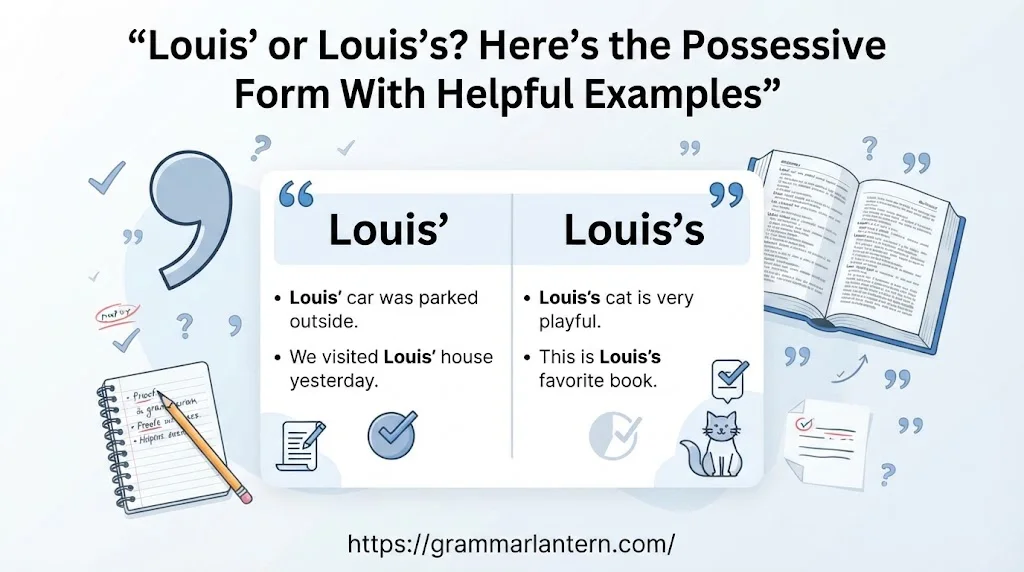
Louis’s car is parked outside.
You can also write:
Louis’ car is parked outside.
Both can express the same basic possessive relationship. Your choice should match the style guide or writing convention you’re following.
| Form | Meaning | Example |
| Louis | Singular name | Louis arrived early. |
| Louis’s | Singular possessive | Louis’s car is new. |
| Louis’ | Singular possessive under an alternative style | Louis’ car is new. |
| Louises | Plural | Two Louises attended. |
| Louises’ | Plural possessive | The two Louises’ project won. |
Is “Louis’s” Correct?
Yes, Louis’s is grammatically correct.
The form follows a straightforward possessive pattern: when a singular noun or name indicates ownership, you can generally add ’s.
For example:
- Louis’s jacket
- Louis’s bicycle
- Louis’s apartment
- Louis’s brother
- Louis’s decision
- Louis’s presentation
Consider this sentence:
Louis’s notebook was sitting on the desk.
The noun phrase Louis’s notebook tells you that the notebook belongs to, or is associated with, Louis.
The same pattern works with many singular names:
- James’s book
- Chris’s phone
- Charles’s office
- Jess’s idea
- Louis’s project
The important point is that Louis remains a singular name. The apostrophe and s create the possessive form.
Why “Louis’s” Often Feels Natural
For many readers, Louis’s provides an immediately recognizable possessive pattern. You see the name, the apostrophe, and the additional s, so the grammatical relationship is easy to identify.
This approach also aligns naturally with pronunciation in contexts where the possessive adds a final /z/ or /ɪz/ sound.
For example:
Louis’s car needs repairs.
The written form makes the possessive construction explicit.
However, English spelling conventions aren’t always a one-size-fits-all system. That’s where Louis’ enters the picture.
Read More: Healthcare vs. Health Care: Which Is Correct?
Is “Louis’” Correct?
Yes. Louis’ can also be a correct singular possessive form.
Some writing conventions use only an apostrophe after a singular proper name ending in s. Under that convention, you can write:
Louis’ car is parked outside.
The same pattern appears in:
- Louis’ house
- Louis’ office
- Louis’ brother
- Louis’ opinion
- Louis’ decision
The key point is that Louis’ doesn’t automatically mean multiple people named Louis own something.
It can still mean that one Louis owns or is associated with the following noun.
Why Does “Louis’” Exist?
English has developed more than one established approach to singular possessive names ending in s.
Some style systems prefer ’s. Others allow or prefer an apostrophe alone in certain cases.
That means you may encounter both forms in edited writing:
Louis’s restaurant
and
Louis’ restaurant
Neither should automatically be treated as a spelling mistake.
The surrounding style convention matters.
What’s the Difference?
The biggest difference between Louis’s and Louis’ is style, not basic meaning.
Both can indicate that something belongs to or relates to one person named Louis.
Compare these sentences:
Louis’s dog escaped from the yard.
Louis’ dog escaped from the yard.
The ownership relationship is the same. The punctuation convention differs.
| Point | Louis’s | Louis’ |
| Refers to one Louis | Yes | Yes |
| Can show possession | Yes | Yes |
| Uses an apostrophe | Yes | Yes |
| Adds s after the apostrophe | Yes | No |
| Used in general writing | Yes | Yes |
| May depend on style guide | Yes | Yes |
| Automatically plural? | No | No |
So, if you’re asking whether one form means possession while the other doesn’t, the answer is no.
Both forms can express singular possession.
How to Form the Possessive of “Louis”
Creating the possessive becomes much easier when you follow a few simple steps.
Identify the Number
First, determine whether Louis refers to one person or several.
If you’re talking about one person, Louis is singular.
For example:
Louis brought his laptop.
You’re discussing one Louis.
Add the Possessive Form
Under the ’s convention:
Louis → Louis’s
Example:
Louis’s laptop is on the table.
Under the apostrophe-only convention:
Louis → Louis’
Example:
Louis’ laptop is on the table.
Follow Your Required Style
If you’re writing for a school, company, publication, or professional organization, check its preferred style.
This matters because formal writing often requires consistency.
If your document uses Louis’s, don’t randomly switch to Louis’ halfway through the same piece without a reason.
Consistency makes your writing look deliberate rather than accidental.
When Should You Use “Louis’s”?
Use Louis’s when your chosen style forms singular possessives with ’s, including singular proper names that end in s.
This is often the clearest choice for general-purpose writing.
Examples of “Louis’s”
- Louis’s car was damaged.
- Louis’s house has a blue door.
- Louis’s brother called yesterday.
- Louis’s presentation impressed the team.
- Louis’s opinion changed after the discussion.
- Louis’s dog sleeps near the window.
- Louis’s manager approved the request.
Notice that the structure stays the same:
Louis + ’s + noun
The noun after the possessive can represent almost anything associated with Louis.
When Should You Use “Louis’”?
Use Louis’ when you’re following a style convention that forms certain singular possessives ending in s with an apostrophe alone.
For example:
- Louis’ car
- Louis’ office
- Louis’ project
- Louis’ family
- Louis’ decision
- Louis’ responsibilities
The important thing is to understand that this isn’t a plural construction.
Louis’ office
can mean the office belonging to one Louis.
By contrast:
Louises’ office
would refer to an office belonging to multiple people named Louis.
That extra es changes the grammatical picture completely.
Pronunciation of “Louis’s”
Pronunciation deserves special attention because Louis itself can have different established pronunciations depending on the particular person or name being referenced.
The possessive ending also interacts with pronunciation.
When the possessive form adds a final sound, speakers generally pronounce that possessive ending rather than simply ignoring it.
For example, a singular possessive ending written ’s can have a pronunciation associated with /s/, /z/, or /ɪz/ depending on the preceding sound.
With a name such as Louis, the actual pronunciation of the name matters.
That’s one reason spelling and pronunciation shouldn’t always be treated as perfectly interchangeable. Proper names can have established pronunciations that don’t follow what a reader might expect from ordinary spelling patterns.
Examples of “Louis’s” in Sentences
Context makes possessive forms much easier to understand.
Possessions
Louis’s phone was charging beside the bed.
Here, the phone is associated with Louis.
Family Relationships
Louis’s sister moved to Chicago.
The possessive identifies the relationship between Louis and his sister.
Work
Louis’s report contained several useful recommendations.
The report is associated with Louis because he prepared or owns it.
Opinions
Louis’s opinion changed after he reviewed the evidence.
The possessive connects Louis with his opinion.
Places
We met at Louis’s apartment.
The apartment belongs to or is associated with Louis.
Actions and Decisions
Louis’s decision surprised everyone.
The noun decision is linked to Louis.
These examples show that possessive constructions don’t always mean literal ownership. They can express association, relationship, authorship, responsibility, origin, or connection.
Examples of “Louis’” in Sentences
The same relationships can appear with the apostrophe-only form.
Possessions
Louis’ phone was charging beside the bed.
Family
Louis’ sister moved to Chicago.
Work
Louis’ report contained several useful recommendations.
Opinions
Louis’ opinion changed after he reviewed the evidence.
Places
We met at Louis’ apartment.
In each case, Louis’ functions as a singular possessive under the relevant convention.
Examples Side by Side
Seeing the forms next to each other makes the distinction easier.
| With Louis’s | With Louis’ |
| Louis’s car is outside. | Louis’ car is outside. |
| Louis’s book is missing. | Louis’ book is missing. |
| Louis’s house looks beautiful. | Louis’ house looks beautiful. |
| Louis’s brother called. | Louis’ brother called. |
| Louis’s idea worked. | Louis’ idea worked. |
| Louis’s company expanded. | Louis’ company expanded. |
| Louis’s office is upstairs. | Louis’ office is upstairs. |
| Louis’s decision was unexpected. | Louis’ decision was unexpected. |
The meaning generally remains unchanged.
The difference lies in the spelling convention used for the possessive.
Common Mistakes
Apostrophes cause trouble because they can signal several different grammatical relationships.
Mistake: Treating “Louis’” as Automatically Plural
This is one of the most common misunderstandings.
Louis’ can represent singular possession.
For example:
Louis’ bicycle was stolen.
This can mean one person named Louis owns the bicycle.
The apostrophe doesn’t make Louis plural.
Mistake: Writing “Louises” for Possession
Louises normally represents more than one person named Louis.
For example:
Three Louises attended the conference.
No apostrophe is needed merely because the noun is plural.
If those three people collectively own something, you can form the plural possessive:
The three Louises’ office was nearby.
The structure is different from Louis’s.
Mistake: Confusing “Louis” With “Louis’s”
Compare:
Louis likes the car.
and:
Louis’s car is expensive.
In the first sentence, Louis performs the action.
In the second, Louis’s identifies whose car you’re discussing.
Mistake: Switching Forms Randomly
Suppose an article begins with:
Louis’s company opened a new branch.
Later, it says:
Louis’ company hired ten employees.
The change isn’t necessarily grammatically wrong. However, unexplained switching can make the writing look inconsistent.
Choose a convention and stick with it.
Why the Difference Matters
This distinction is especially important.
Louis’
It can mean something belonging to one Louis.
Louis’ car is red.
Louises’
Louises’ means something belonging to multiple people named Louis.
The Louises’ cars were parked outside.
The difference is the plural ending.
| Form | Number | Possessive? |
| Louis | Singular | No |
| Louis’s | Singular | Yes |
| Louis’ | Singular | Yes |
| Louises | Plural | No |
| Louises’ | Plural | Yes |
This table provides a useful shortcut. First determine how many people you’re talking about. Then determine whether you need a possessive.
Is “Louis’s” or “Louis’” More Formal?
Neither form should automatically be labeled informal.
Both occur in serious, edited English. The deciding factor is usually the style convention being followed.
For formal writing, consistency matters more than casually switching between the two.
If you’re preparing an academic paper, professional report, publication, or institutional document, use the convention required by that context.
If no particular style has been specified, Louis’s is a straightforward choice because it clearly follows the singular possessive ’s pattern.
However, writers should avoid treating that preference as a universal rule. Different editorial systems handle singular names ending in s differently.
In Academic Writing
Academic writing rewards consistency.
If you’re writing an essay or research paper, first check whether your instructor, department, journal, or institution requires a particular style guide.
Then apply that convention throughout your work.
For example, if your chosen style uses Louis’s, write:
Louis’s argument provides an important example.
If your required convention uses Louis’, write:
Louis’ argument provides an important example.
The important lesson is simple: don’t invent a personal rule halfway through the paper.
A consistent punctuation system makes even small grammatical details easier for readers to process.
In Business Writing
Professional documents frequently contain possessive names:
- Louis’s department
- Louis’s report
- Louis’s proposal
- Louis’s client
- Louis’s office
- Louis’s responsibilities
The apostrophe may look minor, but polished business writing depends on thousands of these small choices.
Consider:
Please review Louis’s proposal before Friday.
The possessive relationship is immediately clear.
If the company’s style uses the apostrophe-only convention, the same idea could appear as:
Please review Louis’ proposal before Friday.
Either way, the document should follow the organization’s established editorial style.
In Everyday Writing
In personal writing, the choice is usually less consequential.
You might write:
Louis’s dog is adorable.
Or:
Louis’ dog is adorable.
The meaning remains clear.
Texts, personal notes, casual messages, and informal posts generally don’t require the same rigid editorial consistency as a published document.
Still, understanding the distinction helps you avoid errors when the same grammar appears in more formal writing.
“Louis’s” as a Possessive vs. a Contraction
There’s another interesting detail worth remembering.
The ending ’s doesn’t always indicate possession.
It can also form a contraction.
Compare:
Louis’s bicycle is outside.
Here, Louis’s is possessive. It means the bicycle belongs to or is associated with Louis.
Now consider:
Louis’s coming later.
Here, Louis’s can represent Louis is.
Context tells you which meaning applies.
| Sentence | Meaning of ’s |
| Louis’s car is new. | Possessive |
| Louis’s brother called. | Possessive |
| Louis’s coming later. | Contraction of Louis is |
| Louis’s already left. | Contraction of Louis has |
This is why punctuation alone doesn’t always tell the whole story.
Case Study: Choosing the Right Form in a Report
Imagine you’re preparing a company report about an employee named Louis.
Your first sentence reads:
Louis’s quarterly report showed strong results.
Later, another sentence says:
The team reviewed Louis’ recommendations.
Neither sentence necessarily contains a grammatical error. However, the report now uses two different possessive conventions.
If the organization prefers ’s for singular names ending in s, the second sentence should become:
The team reviewed Louis’s recommendations.
The lesson isn’t that one spelling is universally correct. Instead, the lesson is editorial consistency.
A professional document should have a predictable system.
A Simple Rule for Remembering
When you see Louis, ask two questions.
First: Is Louis singular?
If you’re talking about one person, you’re dealing with a singular name.
Second: Does the context require possession?
If yes, use the possessive convention required by your style.
That gives you:
- One Louis + possession → Louis’s or Louis’
- One Louis + no possession → Louis
- Multiple Louises + no possession → Louises
- Multiple Louises + possession → Louises’
Think of the apostrophe as a small signpost. It tells the reader that the following noun has a relationship with the name.
Quick Facts
- Louis’s is a valid singular possessive form.
- Louis’ can also be a valid singular possessive form.
- The difference usually reflects style convention.
- Louis’ does not automatically mean multiple people named Louis.
- Louises is a plural form.
- Louises’ is a plural possessive form.
- Louis’s can also appear as a contraction of Louis is or Louis has.
- Formal writing should follow the applicable style guide.
- Consistency matters when choosing between Louis’s and Louis’.
Read More: Courtesy vs. Curtesy: Which Spelling Is Correct?
FAQs
1. Is Louis’ grammatically correct?
Yes. Louis’ can be correct when showing possession by one person named Louis. Some style guides prefer this form for singular names ending in s.
2. Is Louis’s correct?
Yes. Louis’s is also a correct singular possessive form. Many grammar authorities recommend adding ’s to a singular proper name, even when the name ends in s.
3. Which is better: Louis’ or Louis’s?
Neither form is universally better. The choice depends on the style guide, publication, or organization you’re following. The most important thing is to use one convention consistently.
4. What does Louis’s mean?
Louis’s shows that something belongs to or is associated with one person named Louis. For example, “Louis’s jacket is on the chair.”
5. What does Louis’ mean?
Louis’ can also show possession by one person named Louis. For example, “Louis’ jacket is on the chair.” This form is accepted by some style conventions.
6. Should I use Louis’s in formal writing?
If you’re not required to follow a particular style guide, Louis’s is often a straightforward choice because it clearly follows the singular possessive pattern.
7. Does Louis’ mean that several people named Louis own something?
No. Louis’ can represent singular possession. It doesn’t automatically mean that multiple people named Louis are involved.
8. How do you make Louis plural?
If you mean several people named Louis, the plural form is generally Louises. For example, “Several Louises attended the event.”
9. What is the plural possessive of Louis?
The plural possessive is Louises’. For example, “The Louises’ offices are on different floors.”
10. How can I remember the difference?
First, determine whether Louis refers to one person or several. For one person, Louis’s or Louis’ may be used depending on style. For several people, use Louises, and use Louises’ to show plural possession.
Conclusion
Choosing between Louis’ and Louis’s becomes much easier when you understand the basic possessive rules. Both forms can show possession by one person named Louis, but different style guides may recommend different conventions. If your writing follows a specific style guide, use its preferred form consistently.
For everyday and formal writing where no particular style has been specified, Louis’s provides a clear way to represent singular possession. When referring to multiple people named Louis, remember that the plural is Louises, while the plural possessive is Louises’. Once you separate singular, plural, and possessive forms, apostrophe questions like this become far less confusing.

For Shafiq ur Rehman, writing is an art form and grammar is the toolbox that makes it beautiful. As a dedicated content writer at Grammar Lantern, Shafiq approaches every topic like an architect carefully laying down strong foundations of understanding before adding the finer details. He loves diving into the trickiest grammar points and resurfacing with simple, bite-sized takeaways that anyone can grasp. When he’s not crafting articles, you’ll likely find him strategizing over a game of chess, exploring dusty local bookshops, or quietly jotting down poetic observations in his notebook.