
Gases vs. Gasses explains how the plural of gas changes in English, while one spelling change can alter meaning, usage, and clarity. The correct plural of gas is gases, while gasses is a separate word with a different meaning and usage. This spelling difference can create confusion because English spelling has many patterns involving consonants, doubled letters, and an ending such as -es, -ed, or -ing.
For example, nag becomes nagged in the past tense under the double consonant rule. The same rule can influence pronunciation when a short vowel sound changes, while a silent e can also affect how a word sounds. Examples such as cave, kite, rope, barred, bared, and buses show why a small change in spelling can create a noticeable difference in meaning. Writers may mistakenly switch these forms without noticing the difference.
Learning these contextual usage patterns helps you follow standard spelling and grammar while improving correctness, clarity, accuracy, and credibility. A useful guide can teach the difference with simple tips, mnemonics, and clear examples. The article can use familiar vocabulary and language to help people avoid common mistakes. Once you understand these patterns, you can naturally stop making mistakes, start noticing spelling choices, and use similar forms more confidently in everyday writing. Regular practice also helps you make better choices when you mix related words.
Quick Answer
Gases is the best default choice when gas is being used as a plural noun.
Gasses isn’t simply a spelling mistake. It can function as an alternative plural of gas, and it can also be the third-person singular form of the verb gas.
| Word | Main use | Example |
| gas | Singular noun | Oxygen is a gas. |
| gases | Common plural noun | The atmosphere contains several gases. |
| gasses | Alternative plural noun | Some texts use gasses as the plural of gas. |
| gasses | Verb | The equipment gasses the chamber. |
| gassed | Past tense/past participle | The material was gassed before processing. |
| gassing | Present participle | The system is gassing the chamber. |
So, if you’re simply making gas plural, gases is usually the right choice.
What Does “Gases” Mean?
Gases is the plural form of the noun gas.
In science, a gas is a form of matter that doesn’t have a fixed shape or fixed volume. It can expand to fill the space available to it. Unlike solids, gases don’t maintain a definite shape. Unlike liquids, they aren’t confined to a fixed volume.
Common examples include:
- Oxygen
- Nitrogen
- Hydrogen
- Carbon dioxide
- Helium
- Argon
- Methane
- Neon
- Water vapor
For example:
The Earth’s atmosphere contains several different gases.
Here, gases refers to multiple substances that exist in gaseous form.
The word can also appear in many scientific combinations, including greenhouse gases, noble gases, toxic gases, industrial gases, and atmospheric gases.
Examples of “Gases”
You’ll normally use gases when the word functions as a plural noun.
- Scientists study how different gases behave under pressure.
- The atmosphere contains several important gases.
- The factory released toxic gases.
- The experiment produced two different gases.
- Greenhouse gases influence Earth’s climate.
- Some gases are highly flammable.
- The researchers measured the concentration of several gases.
- Certain gases dissolve easily in water.
In each example, gases names multiple gases.
What Does “Gasses” Mean?
Gasses has more than one legitimate use.
First, it can work as an alternative plural of gas. Dictionaries recognize this form, although gases is the more familiar choice for most readers.
Second, gasses can function as a verb.
For example:
The machine gasses the chamber before the experiment.
Here, gasses doesn’t mean “multiple gases.” It describes an action.
This distinction explains why the double s isn’t automatically wrong.
“Gasses” as a Plural Noun
You may encounter gasses in technical material, older writing, or texts that use the alternative plural.
For example:
The reaction produces several different gasses.
The sentence can be understood because gasses is a recognized plural form. However, gases would generally be the more conventional choice:
The reaction produces several different gases.
The meaning doesn’t change. The spelling does.
For most modern general and formal writing, choosing gases keeps the sentence familiar and straightforward.
Read More: United States’ or States’ or States’s? Correct Possessive
“Gasses” as a Verb
The verb gas has several meanings. One use involves exposing or treating something with gas. Its third-person singular form can be gasses.
Compare these sentences:
I gas the chamber.
You gas the chamber.
They gas the chamber.
The technician gasses the chamber.
The subject changes the verb form.
The same spelling pattern appears in other forms:
- gas
- gasses
- gassed
- gassing
The verb can also have other meanings depending on context. For example, gas can mean to injure or kill by exposure to poisonous gas. The past form is gassed.
Why Is the Plural “Gases” Instead of “Gasses”?
English spelling doesn’t always behave like a neat mathematical formula.
If you see gas, it may seem logical to add another s and write gasses. After all, English doubles consonants in some words when adding endings.
But the conventional plural is:
gas → gases
The alternative plural is also found:
gas → gasses
The important point is that gases is the standard form most readers expect when gas is a plural noun. Gasses remains valid in certain usage.
This distinction is worth remembering because simply declaring gasses “wrong” oversimplifies English grammar.
Compare the Different Forms
| Form | Meaning or function | Example |
| gas | Singular noun | Carbon dioxide is a gas. |
| gases | Common plural noun | Carbon dioxide and oxygen are gases. |
| gasses | Alternative plural noun | Some texts use gasses. |
| gas | Base verb | Workers gas the chamber. |
| gasses | Third-person singular verb | The system gasses the chamber. |
| gassed | Past tense | The chamber was gassed. |
| gassing | Present participle | The machine is gassing the chamber. |
Once you see the forms together, the pattern becomes much easier to remember.
Gases vs. Gasses Pronunciation
The two spellings can also signal different pronunciations.
Gases is commonly pronounced approximately:
GAY-ziz
It has two syllables.
Gasses is pronounced approximately:
GAS-iz
The first vowel sound is different. The pronunciation of gasses is represented as /ˈɡæs.ɪz/ in dictionary pronunciation notation.
This difference can help when you’re listening to someone speak. However, context remains the most reliable clue.
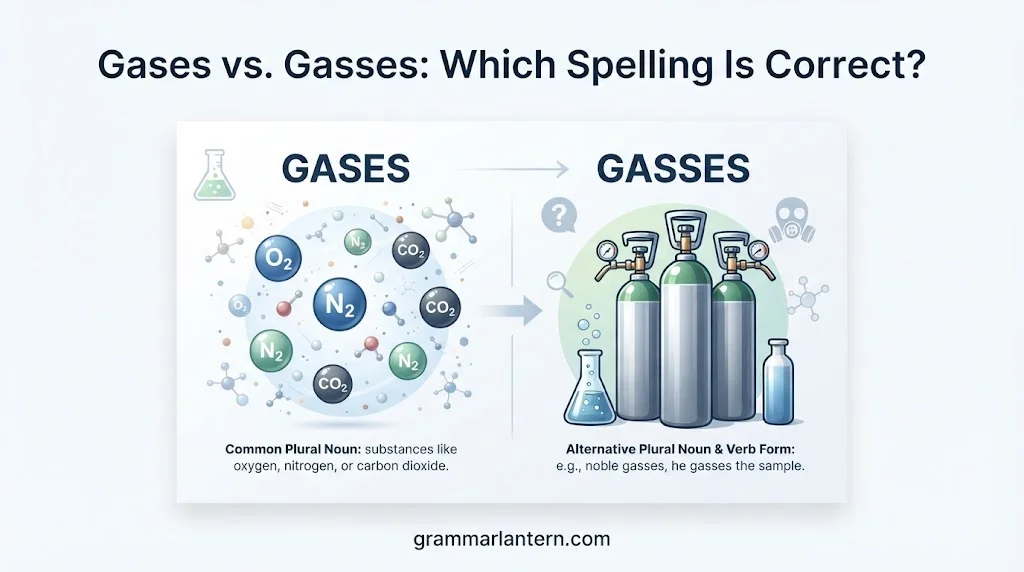
Gases vs. Gasses Examples
Seeing both words in real sentences makes the distinction much clearer.
Examples With “Gases”
The atmosphere contains several gases.
Here, gases is a plural noun.
Oxygen and nitrogen are important gases in Earth’s atmosphere.
Again, the word refers to multiple substances.
The chemical reaction released dangerous gases.
The sentence describes multiple gaseous substances produced by a reaction.
Scientists measured greenhouse gases in the atmosphere.
The phrase refers to several gases with heat-trapping properties.
Examples With “Gasses”
As an alternative plural:
The older report refers to several industrial gasses.
As a verb:
The machine gasses the chamber before sealing it.
Another example:
The technician gasses the material as part of the treatment process.
Notice how the grammar changes.
In industrial gasses, the word is a noun.
In the machine gasses, it is a verb.
A Simple Case Study: “The Factory Releases Gases”
Consider this sentence:
The factory releases several gases during production.
Ask a simple question:
What does “gases” name?
It names substances. The factory releases multiple types or quantities of gas.
Now change the sentence:
The equipment gasses the chamber during production.
Ask another question:
What does “gasses” describe?
It describes an action performed by the equipment.
That gives you a useful practical distinction:
Gases commonly names things.
Gasses can describe an action.
However, remember that gasses can also function as a plural noun. So this is a helpful shortcut, not an absolute grammar rule.
Common Mistakes
The confusion usually comes from treating spelling as an all-or-nothing question.
Mistake: Assuming “Gasses” Is Always Wrong
That’s not accurate.
Gasses is a recognized plural form of gas. It appears in real English usage and is listed as a plural form in dictionaries.
Therefore, correcting every instance of gasses to gases without considering context isn’t always justified.
Mistake: Using “Gasses” as the Default Plural
The opposite mistake is using gasses whenever you need the plural of gas.
For most readers, gases is the more natural and familiar form.
For example:
Better default:
The atmosphere contains several gases.
The alternative:
The atmosphere contains several gasses.
can be understood, but it isn’t usually the first choice for standard modern writing.
Mistake: Confusing the Noun and Verb
Compare:
The laboratory contains several gases.
with:
The equipment gasses the chamber.
The first word names substances.
The second word describes an action.
That’s a grammatical distinction, not merely a spelling preference.
Mistake: Applying a Spelling Rule Too Rigidly
English has many spelling patterns with exceptions and variations.
You can’t always predict the correct form by looking only at the final letter of the base word.
With gas, the practical forms are worth memorizing:
- gas
- gases
- gasses
- gassed
- gassing
In Scientific Writing
If you’re writing about chemistry, physics, biology, environmental science, or atmospheric science, gases is normally the strongest choice for the plural noun.
Consider:
Scientists measured several greenhouse gases.
That’s the conventional form used in scientific discussions.
You’ll also see familiar combinations such as:
- greenhouse gases
- noble gases
- toxic gases
- atmospheric gases
- industrial gases
- exhaust gases
- combustion gases
- trace gases
Scientific writing values precision and consistency. Using the conventional plural helps readers understand your meaning without stopping to wonder about an unusual spelling.
Why “Gases” Is Usually Better in Formal Writing
Formal writing isn’t the place to create unnecessary distractions.
If two forms communicate the same noun meaning, the more familiar form usually gives readers a smoother experience.
Compare:
Researchers analyzed five different gases.
Researchers analyzed five different gasses.
Both can communicate the intended plural meaning. Gases is the more conventional choice.
For academic assignments, reports, articles, and research writing, gases is therefore the safest default.
In Everyday Writing
The same principle applies to everyday English.
Use gases when you’re referring to multiple gaseous substances.
Common phrases include:
- toxic gases
- greenhouse gases
- natural gases
- industrial gases
- exhaust gases
- fuel gases
- atmospheric gases
- combustion gases
For example:
The workers wore protective equipment because the area contained toxic gases.
That’s clear and natural.
“Gas” Has Other Meanings
The word gas doesn’t only refer to a substance in the gaseous state.
In American English, gas can also mean gasoline.
For example:
We need to stop for gas.
Here, gas means gasoline rather than a gaseous substance.
The word can also refer to the accelerator in a vehicle:
He stepped on the gas.
In addition, gas can refer to air or digestive gas in the body.
So before deciding how to form the plural, first determine which meaning of gas you’re using.
When Should You Use Each?
A quick decision process can save you from second-guessing the spelling.
Use “Gases” When:
- You’re talking about multiple gaseous substances.
- You’re writing a science assignment.
- You’re describing atmospheric gases.
- You’re discussing greenhouse gases.
- You’re writing formal or academic content.
- You want the most familiar plural form.
Example:
Several gases contribute to the chemical reaction.
Use “Gasses” When:
- You’re using it as the third-person singular verb of gas.
- You’re intentionally using the alternative plural form.
- The surrounding context or style calls for that spelling.
Example:
The machine gasses the chamber.
The safest everyday rule is simple:
When you mean more than one gas, choose “gases” unless you have a specific reason to use “gasses.”
Quick Comparison
| Feature | Gases | Gasses |
| Singular form | Gas | Gas |
| Plural noun | Yes | Yes, as an alternative |
| Most familiar plural | Yes | No |
| Third-person verb | No | Yes |
| Common in scientific writing | Yes | Less common |
| Can be grammatically correct? | Yes | Yes |
| Best default for plural noun | Yes | Usually no |
The table highlights the most important point: gasses isn’t inherently incorrect. It’s simply not usually the form you should reach for first when you need the plural noun.
Is “Gases” the Plural of “Gas”?
Yes.
Gases is the standard plural form of gas.
For example:
One gas can react differently from another gas.
becomes:
Several gases can react differently from one another.
This is the form you’ll most often encounter in scientific, academic, and general writing.
Is “Gasses” a Real Word?
Yes.
Gasses is a legitimate English word. It can function as an alternative plural of gas, and it can also function as a verb.
So, if you see gasses in a sentence, don’t immediately assume someone made a spelling mistake.
Instead, check its role.
Several gasses were detected.
Here, it’s a plural noun.
The machine gasses the chamber.
Here, it’s a verb.
Is “Gasses” Grammatically Wrong?
No.
The better question is whether gasses is the most appropriate form for the sentence.
When you’re simply referring to multiple gases, gases is generally the better default.
When you’re using the verb gas in the third-person singular, gasses can be the correct grammatical form.
The distinction is subtle, but it prevents a common mistake: confusing a less common legitimate form with an outright error.
Should You Use “Gases” in Academic Writing?
In most situations, yes.
If you’re writing a paper, thesis, report, article, laboratory assignment, or educational guide, gases is the clearest choice when you mean multiple gases.
For example:
The researchers examined the interaction between several atmospheric gases.
This sounds natural, precise, and professional.
Using gasses as the plural noun isn’t automatically ungrammatical. However, the standard form makes the sentence easier for most readers to process.
How Do You Pronounce “Gases”?
Gases is commonly pronounced approximately:
GAY-ziz
It contains two syllables.
The final -es doesn’t sound like the ending in houses or boxes. Instead, the word has a sound close to “GAY-ziz.”
How Do You Pronounce “Gasses”?
Gasses is commonly pronounced approximately:
GAS-iz
The first syllable sounds like the word gas itself. The full pronunciation is represented as /ˈɡæs.ɪz/.
That gives you a useful listening clue:
- gases → roughly GAY-ziz
- gasses → roughly GAS-iz
The spelling and pronunciation therefore both help distinguish the forms.
Easy Way to Remember
If you want one quick memory trick, keep this pair in mind:
Gases = multiple gases
Gasses = can be the action of gassing
For example:
The laboratory stores several gases.
The equipment gasses the chamber.
There’s one important footnote: gasses can also be an alternative plural noun. That’s why the memory trick should guide you rather than replace context.
When you’re writing about oxygen, nitrogen, helium, carbon dioxide, or other gaseous substances, gases is almost always the form you want.
Read More: Really vs. Realy: Which Spelling Is Correct?
FAQs
1. What is the main difference between gases and gasses?
Gases is the standard plural form of gas. Gasses is a different word, usually used as the third-person singular form of the verb gas, meaning to expose someone or something to gas.
2. Is “gases” the correct plural of gas?
Yes. Gases is the standard and correct plural of gas in general English.
3. Is “gasses” a real word?
Yes. Gasses is a valid word, but it has a different grammatical function. It can mean “exposes to gas” or “fills with gas.”
4. Should I write “different gases” or “different gasses”?
You should write different gases when referring to more than one type or quantity of gas.
5. Why does “gases” have only one s in the middle?
English adds -es to words such as gas when forming the plural. This produces gases, which is pronounced with an extra syllable.
6. What does “gasses” mean as a verb?
Gasses is the third-person singular form of gas. For example: “The machine gasses the chamber.”
7. Is “gasses” ever used as a plural noun?
In standard modern English, gasses isn’t the normal plural of gas. Use gases for the plural noun.
8. How do you pronounce “gases”?
Gases is commonly pronounced GAS-iz, with two syllables.
9. How do you pronounce “gasses”?
Gasses is generally pronounced GAS-iz as well. The spelling and grammatical role distinguish it from gases.
10. What is an easy way to remember gases vs. gasses?
Remember this simple rule: gases = more than one gas, while gasses = someone or something gases another thing. If you’re talking about the noun, choose gases.
Conclusion
The difference between gases and gasses may look small, but the extra s changes the word’s grammatical role. Gases is the standard plural of gas, so use it when you’re talking about multiple gases. For example, “The atmosphere contains several different gases.”
Gasses, meanwhile, is a verb form. It means that someone or something exposes, fills, or treats something with gas. Once you connect gases with the plural noun and gasses with the verb, the distinction becomes much easier to remember.

For Shafiq ur Rehman, writing is an art form and grammar is the toolbox that makes it beautiful. As a dedicated content writer at Grammar Lantern, Shafiq approaches every topic like an architect carefully laying down strong foundations of understanding before adding the finer details. He loves diving into the trickiest grammar points and resurfacing with simple, bite-sized takeaways that anyone can grasp. When he’s not crafting articles, you’ll likely find him strategizing over a game of chess, exploring dusty local bookshops, or quietly jotting down poetic observations in his notebook.



[…] Read More: Gases vs. Gasses: Which Spelling Is Correct? […]
[…] Read More: Gases vs. Gasses: Which Spelling Is Correct? […]