Have you ever paused while writing and wondered whether you need a comma after “during” at the beginning of a sentence? You’re not alone. Understanding starting a sentence with “during” comma rules can help you improve your grammar, strengthen your English usage, and make your writing easier to read. Whether you’re writing an essay, an email, or a professional report, knowing where punctuation belongs makes a real difference.
The word “during” introduces a period when something happens. You’ll often see it in formal writing, business communication, meeting notes, and everyday conversations. However, many writers struggle to decide whether an opening phrase needs a comma. The answer depends on how the phrase connects to the main clause and whether a comma improves readability.
In this guide, you’ll learn the essential comma rules for sentences that begin with “during,” along with practical examples of correct and incorrect usage. We’ll also explore common mistakes and explain how to maintain consistency in your writing. By the end, you’ll know when to use a comma, when to leave it out, and how to apply these rules confidently in both casual and professional contexts.
Quick Answer
Yes, you can start a sentence with “during.” It is grammatically correct to begin a sentence with this preposition followed by a noun or noun phrase.
For example:
- During the meeting, we discussed the new schedule.
- During summer we often visit our grandparents.
- During the final minutes of the game, the home team scored twice.
The comma depends on the sentence’s structure, length, and clarity. A longer introductory phrase generally benefits from a comma, while a short, clear phrase may not need one.
Remember these three rules:
- Starting with “during” is correct: There is no grammatical rule against it.
- A comma may follow the introductory phrase: Use one when it improves clarity or follows your chosen style guide.
- “During” takes a noun or noun phrase: Use “while” when you need to introduce a clause with its own subject and verb.
For example, write “During the lesson, I took notes,” not “During I was taking the lesson, I took notes.”
What Does “During” Mean?
The word “during” is a preposition that indicates when something happens. It connects an action or situation to a period, event, or activity.
For example, in the sentence “During the concert, the lights suddenly went out,” the word “during” establishes the time of the power failure. It tells readers that the event happened while the concert was taking place.
You can use “during” in many everyday situations, including school, work, travel, entertainment, and personal conversations.
Consider these examples:
- During lunch, I received an important phone call.
- During the interview, she answered every question confidently.
- During our vacation, we explored several small towns.
- During the storm, the electricity went out twice.
- During the exam, students must keep their phones switched off.
In each example, “during” introduces a time-related expression. The rest of the sentence explains what happened within that period.
Is “During” a Preposition?
Yes. “During” is a preposition, and it normally takes a noun or noun phrase as its object.
A noun phrase can consist of a single noun or several words that work together as a noun unit.
Examples include:
- During class
- During the afternoon
- During the school holidays
- During the final stage of the competition
- During my first year at college
Notice that the phrase following “during” doesn’t need to contain a verb. It identifies a time period or event.
This distinction matters because “during” cannot normally introduce a complete clause directly. A clause contains a subject and a verb, as in “I was studying.”
Compare the following sentences:
| Correct construction | Incorrect construction | Why? |
| During the meeting, I took notes. | During the meeting was taking place, I took notes. | The second sentence uses a clause where a noun phrase is required. |
| During the summer, we traveled abroad. | During we traveled abroad, we visited museums. | “During” cannot normally introduce the clause “we traveled abroad.” |
| During my lunch break, I called home. | During I was eating lunch, I called home. | “While” is appropriate before a complete clause. |
The easiest way to remember this rule is to look at the words immediately following “during.” If you see a noun phrase, the construction will often be correct. If you see a subject followed by a verb, consider using “while” instead.
“During” vs. “While”
Although “during” and “while” can express similar time relationships, they follow different grammatical patterns.
“During” normally precedes a noun or noun phrase, while “while” can introduce a clause containing a subject and verb.
For example:
- During the meeting, I answered several questions.
- While the meeting was taking place, I answered several questions.
Both sentences communicate a similar idea. However, the grammatical structures differ.
Here are more examples:
| Using “during” | Using “while” |
| During the movie, I fell asleep. | While I was watching the movie, I fell asleep. |
| During the journey, we stopped twice. | While we were traveling, we stopped twice. |
| During the lesson, the teacher explained the topic. | While the teacher was explaining the topic, students took notes. |
| During the storm, several trees fell. | While the storm was passing through, several trees fell. |
The choice depends on how you want to construct the sentence. If you want a compact time expression, “during” is often useful. If you need to describe an action with its own subject and verb, “while” may be the better choice.
Can You Start a Sentence With “During”?
Absolutely. Beginning a sentence with “during” is a common and grammatically acceptable writing technique.
An introductory phrase can establish the time before the main clause explains the action. This arrangement helps readers understand the circumstances immediately.
For example:
During the final interview, the candidate impressed the entire panel.
The introductory phrase tells readers when the candidate made an impression. The main clause then delivers the central information.
You could also write:
The candidate impressed the entire panel during the final interview.
Both sentences are correct. The first emphasizes the interview as the setting. The second places more emphasis on the candidate’s performance before mentioning the time.
Starting with “during” is useful when chronology matters or when you want to establish the setting before explaining an event.
Starting a Sentence With “During” in Everyday Writing
You probably use introductory time phrases more often than you realize. They help you explain when something happened without adding unnecessary sentences.
For example:
- During breakfast, my brother told us the news.
- During the weekend, we cleaned the garage.
- During the flight, I watched two movies.
- During the break, the students went outside.
- During the conversation, I realized we had misunderstood each other.
These sentences sound natural because the introductory phrases provide context before the main actions.
You can also use this structure in text messages and informal conversations:
“During lunch, I’ll call you.”
“During the game, please keep your phone nearby.”
“During my break, I can help you finish the assignment.”
The construction works in casual writing as well as formal prose. You simply need to make sure the phrase fits the sentence’s meaning.
Read More: Payments or Payment: Which One Is Correct?
Starting a Sentence With “During” in Academic and Professional Writing
Introductory “during” phrases can make academic papers, business reports, and professional emails more precise.
For instance:
- During the observation period, researchers recorded changes in participant behavior.
- During the second phase of the project, the team revised its testing process.
- During the review meeting, the committee identified several areas for improvement.
- During the trial period, employees received additional training.
These examples establish the relevant time frame before describing the results or actions.
In research writing, the distinction between a specific event and an extended period can be especially important. “During the experiment” places an action within the experiment’s time frame, while “throughout the experiment” suggests that it continued across the period.
That difference can help readers interpret your findings more accurately.
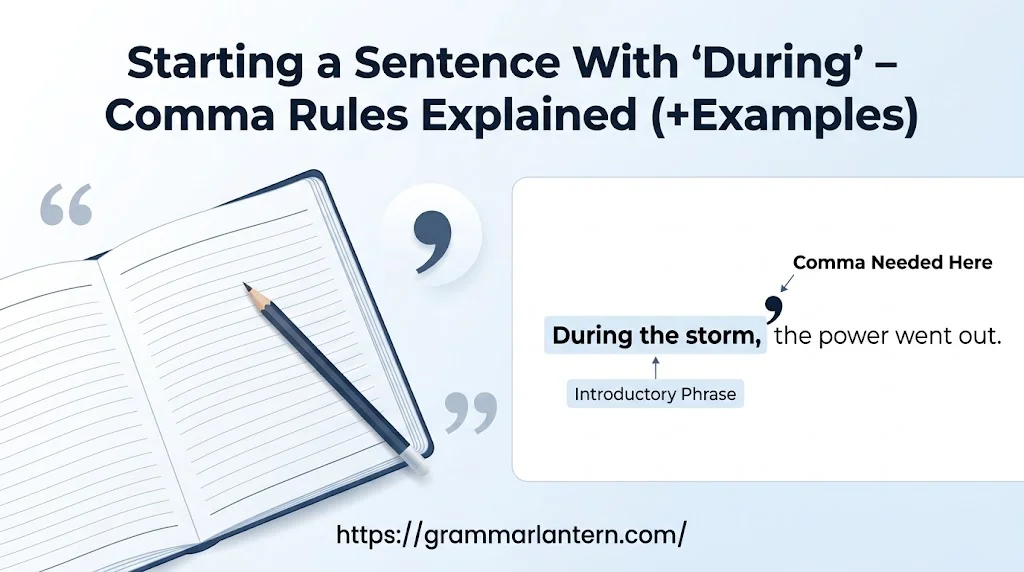
Comma Rules for Sentences Starting With “During”
The main punctuation question is whether you should place a comma after an introductory phrase beginning with “during.”
There is no universal rule requiring a comma after every opening “during” phrase. The decision depends on the phrase, the sentence’s clarity, and the punctuation style you follow.
Many style guides recommend or favor commas after introductory elements, especially when those elements are long. Other contexts allow short introductory phrases to stand without commas.
Let’s examine the main situations.
When to Use a Comma After a “During” Phrase
A comma is often helpful after a long introductory phrase because it separates the time information from the main clause.
For example:
During the final meeting of the academic year, the principal announced several changes to the school schedule.
The opening phrase contains several words. The comma makes it easier to identify where the introductory information ends and the main clause begins.
Consider these additional examples:
- During the last few minutes of the championship match, the visiting team scored the winning goal.
- During the annual conference held in Chicago, the company introduced its latest product.
- During the first week of the training program, new employees learned the organization’s safety procedures.
- During the unexpected power outage on Monday evening, several departments temporarily lost access to their computers.
- During the final stage of the investigation, detectives interviewed additional witnesses.
In each case, the comma provides a useful pause between the introductory phrase and the main clause.
A comma can also improve readability when the opening phrase contains several details. Readers can process the time information before moving to the central statement.
However, don’t assume that a phrase needs a comma simply because it contains a particular number of words. Length is a helpful consideration, not an absolute grammatical test.
When You Can Omit the Comma After “During”
Short introductory phrases can sometimes appear without a comma, especially when the meaning remains clear.
For example:
- During summer we visit our grandparents.
- During lunch I checked my messages.
- During class students should listen carefully.
- During winter the roads often become icy.
- During recess the children played outside.
These constructions can work without commas in contexts where the introductory phrases are short and the sentences are easy to understand.
However, conventions vary. Some writers and editors prefer a comma after even short introductory phrases, particularly in formal writing.
For example, you might write “During lunch, I checked my messages” in a report or article. The comma creates a slight pause and clearly separates the introductory phrase from the main clause.
Neither choice should be judged solely by counting words. The sentence’s structure, readability, and intended style matter more.
Practical tip: When you’re unsure, adding a comma after an introductory “during” phrase is often a sensible choice in formal prose, especially if the phrase is long.
Does the Length of the Introductory Phrase Matter?
Yes, phrase length can influence comma placement. Longer introductory phrases often benefit from punctuation because they contain more information for readers to process.
Compare these examples:
| Introductory phrase | Example sentence | Punctuation guidance |
| Short | During lunch I called my sister. | A comma may be omitted in some styles. |
| Medium | During the morning meeting, we reviewed the budget. | A comma improves separation and readability. |
| Long | During the final presentation of the annual research conference, the team revealed its findings. | A comma is strongly helpful after the introductory phrase. |
The longer the opening phrase becomes, the more useful a comma may be.
Still, word count alone doesn’t determine punctuation. A short phrase can benefit from a comma, while some longer phrases remain understandable without one.
The goal is to help readers follow the sentence without stumbling over its structure.
Does the Main Clause Affect Comma Placement?
The main clause also matters because punctuation should make the relationship between the introductory phrase and the central statement clear.
Consider this sentence:
“During the meeting, the manager explained the revised policy.”
The introductory phrase identifies when the explanation occurred. The comma separates that information from the main clause.
Now consider:
“During the meeting the manager attended last Tuesday, the team discussed its concerns.”
The introductory phrase is longer and contains additional information. The comma after “Tuesday” makes the transition into the main clause easier to follow.
Compare that with:
“During lunch, employees can use the break room.”
Here, the comma helps readers distinguish the time phrase from the main statement, even though the opening phrase is relatively short.
A useful punctuation test is to read the sentence aloud. If a brief pause helps clarify the structure, a comma may improve the sentence. However, reading aloud should support grammatical judgment rather than replace it.
Correct Examples
Examples make comma rules easier to understand because they show how punctuation works in real sentences.
The following sections demonstrate several common patterns.
Short Sentences Starting With “During”
Short introductory phrases may appear with or without a comma, depending on the style and context.
Examples without a comma:
- During summer we visit our grandparents.
- During lunch I read the newspaper.
- During class students take notes.
- During winter the lake sometimes freezes.
- During recess the children play outside.
Examples with a comma:
- During summer, we visit our grandparents.
- During lunch, I read the newspaper.
- During class, students take notes.
- During winter, the lake sometimes freezes.
- During recess, the children play outside.
Both sets illustrate the same grammatical structure. The second set follows a consistent comma pattern that many writers prefer for clarity.
For a blog post, school assignment, or professional article, using a comma after an introductory phrase can be a practical way to maintain consistent punctuation.
Long Sentences Starting With “During”
Longer introductory phrases usually benefit from a comma because they establish more context before the main clause appears.
Examples include:
- During the final week of the semester, students completed their remaining assignments and prepared for their examinations.
- During the company’s annual planning session, department heads presented their goals for the upcoming year.
- During the unexpected delay at the airport, passengers received updates about their revised departure times.
- During the first three months of the research project, the team collected data from several participating schools.
- During the closing ceremony of the international competition, the organizers recognized the athletes who had demonstrated exceptional sportsmanship.
Each sentence begins with a time expression. The comma marks the end of that introductory element and helps readers move into the main clause.
Long opening phrases can contain several details, so punctuation becomes especially useful. Without it, readers may have to work harder to identify the sentence’s main point.
Examples From Everyday Conversations
“During” works naturally in ordinary conversations when you want to explain when something happened.
Here are a few realistic examples:
- During the movie, my phone kept buzzing.
- During our trip, we found a fantastic little restaurant.
- During the party, someone accidentally spilled juice on the carpet.
- During the meeting, I realized that I had forgotten my notebook.
- During the weekend, we plan to visit our cousins.
In informal messages, writers sometimes omit commas after short opening phrases. In carefully edited writing, however, a consistent comma style can make sentences easier to read.
The important thing is to avoid letting punctuation distract from your message.
Examples in Academic and Professional Writing
In formal writing, introductory time phrases can help establish when a study, decision, or event took place.
| Context | Example |
| Academic research | During the observation period, researchers documented changes in student participation. |
| Business reports | During the second quarter, the department completed three major projects. |
| Education | During the examination, students were required to work independently. |
| Healthcare administration | During the review period, staff members evaluated the updated procedures. |
| Project management | During the final testing phase, engineers identified and corrected several errors. |
These sentences use a comma to separate each introductory phrase from its main clause.
Notice that “during” doesn’t tell readers how long an action lasted by itself. It places the action within a particular period. If you need to emphasize that something continued for the entire period, another expression, such as “throughout,” may be more precise.
Incorrect Ways to Start a Sentence With “During”
Starting a sentence with “during” is perfectly acceptable, but certain constructions can create grammatical problems.
Most mistakes happen when writers confuse prepositions with conjunctions or place commas where they don’t belong.
Using “During” Before a Complete Clause
One common mistake is using “during” directly before a subject and verb.
Incorrect: During I was studying, my friend called me.
Correct: While I was studying, my friend called me.
The problem isn’t the opening position. The problem is the grammatical structure following “during.”
The phrase “I was studying” is a clause containing a subject (“I”) and a verb phrase (“was studying”). The conjunction “while” can introduce that clause, but “during” normally requires a noun phrase.
Here are more examples:
| Incorrect sentence | Correct sentence |
| During I was cooking, the doorbell rang. | While I was cooking, the doorbell rang. |
| During she was working, her computer stopped. | While she was working, her computer stopped. |
| During they were traveling, they met an old friend. | While they were traveling, they met an old friend. |
| During we were watching television, the lights went out. | While we were watching television, the lights went out. |
You can also rewrite these sentences by using “during” with a noun phrase.
For example:
- During my cooking session, the doorbell rang.
- During her shift, her computer stopped working.
- During their trip, they met an old friend.
- During the television program, the lights went out.
These alternatives preserve the time relationship while following the grammatical pattern associated with “during.”
Confusing “During” With “While”
Because both words relate to time, writers sometimes use them interchangeably without checking what follows.
Consider these examples:
Incorrect: During I waited for the bus, it started raining.
Correct: While I waited for the bus, it started raining.
Another option is:
Correct: During my wait for the bus, it started raining.
The difference is straightforward. “While” introduces the clause “I waited for the bus,” whereas “during” introduces the noun phrase “my wait for the bus.”
Here is another comparison:
- Correct: During the interview, the candidate answered confidently.
- Correct: While the interviewer asked questions, the candidate answered confidently.
- Incorrect: During the interviewer asked questions, the candidate answered confidently.
When you spot a subject and verb immediately after “during,” pause and reconsider the sentence. You may need “while,” or you may need to change the clause into a noun phrase.
Adding an Unnecessary Comma
A comma can help clarify a sentence, but punctuation can also interrupt the flow when used carelessly.
For example:
Awkward: During, the meeting we discussed the budget.
Correct: During the meeting, we discussed the budget.
The comma should not separate “during” from its object. The complete introductory phrase is “during the meeting,” so the comma belongs after that phrase.
Consider these additional corrections:
| Incorrect punctuation | Correct punctuation |
| During, lunch I called my mother. | During lunch, I called my mother. |
| During the class, the teacher, explained the lesson. | During the class, the teacher explained the lesson. |
| During the final meeting of the year the manager announced the changes. | During the final meeting of the year, the manager announced the changes. |
In the final example, the comma is helpful because the introductory phrase is long. The first two examples show commas placed incorrectly within a phrase or between the subject and verb.
Forgetting a Helpful Comma After a Long Phrase
A long introductory phrase can make a sentence harder to process when punctuation doesn’t clearly separate it from the main clause.
For example:
Less readable: During the final stage of the competition when the remaining teams had only minutes to finish the challenge the judges announced a change in the rules.
Clearer: During the final stage of the competition, when the remaining teams had only minutes to finish the challenge, the judges announced a change in the rules.
The revised version uses commas to separate the introductory time expression and the additional information from the main clause.
This example also illustrates an important distinction: the introductory section contains more than a simple prepositional phrase. The words “when the remaining teams had only minutes to finish the challenge” form a subordinate clause that adds information about the time.
The best punctuation depends on the complete structure, not just on the first word.
“During” at the Beginning vs. in the Middle of a Sentence
Moving a “during” phrase can change the emphasis of a sentence without changing its basic meaning.
Compare these examples:
At the beginning: During the conference, we discussed the proposed changes.
At the end: We discussed the proposed changes during the conference.
Both sentences are grammatically correct. In the first version, the time setting comes before the action. In the second, the main action appears first.
This difference can be useful when you’re trying to vary sentence structure or improve the flow of a paragraph.
Consider a few more comparisons:
| Introductory placement | Later placement |
| During the storm, several roads flooded. | Several roads flooded during the storm. |
| During the interview, she discussed her experience. | She discussed her experience during the interview. |
| During the experiment, the researchers recorded the results. | The researchers recorded the results during the experiment. |
| During the final quarter, the company reduced its expenses. | The company reduced its expenses during the final quarter. |
When the phrase begins the sentence, a comma often separates it from the main clause. When the phrase appears at the end, a comma is generally unnecessary.
However, punctuation may change when other elements, such as parenthetical information or additional clauses, appear in the sentence.
“During” vs. Other Time-Related Words
Choosing the right preposition can improve accuracy and prevent unnecessary wording. Although “during” is useful, it doesn’t express every time relationship equally well.
“During” vs. “In”
Both words can refer to periods, but their meanings and usage differ by context.
Use “during” when you want to place an event within a period or activity.
Use “in” for certain periods, seasons, years, and other conventional time expressions.
Examples:
- During the meeting, the manager announced the decision.
- In the summer, many families travel.
- During the investigation, detectives interviewed several witnesses.
- In 2025, the company opened a new office.
You generally wouldn’t replace “in 2025” with “during 2025” unless the surrounding context calls for a different emphasis.
Similarly, “during the meeting” naturally describes an event taking place within a meeting, while “in the meeting” can refer to participation or discussion within that meeting.
“During” vs. “Throughout”
The distinction between these words can be subtle but important.
“During” indicates that something happens within a period. It doesn’t necessarily mean the action continues for the entire period.
“Throughout” emphasizes that something occurs across the whole period or at multiple points during it.
For example:
- During the afternoon, it rained.
- Throughout the afternoon, it rained.
The first sentence places the rain within the afternoon. The second more strongly suggests that the rain continued across the afternoon.
Here are more examples:
| During | Throughout |
| During the meeting, someone asked a question. | Throughout the meeting, participants asked questions. |
| During the trip, we visited a museum. | Throughout the trip, we took photographs. |
| During the year, the company introduced a new policy. | Throughout the year, the company monitored its progress. |
Choose the word that matches the duration you intend to communicate.
“During” vs. “For”
“During” identifies the period in which an event occurs. “For” often specifies how long an activity lasts.
Compare:
- During the meeting, I took notes.
- I took notes for an hour.
The first sentence identifies the context. The second describes duration.
You can combine the two:
“During the meeting, I took notes for an hour.”
Here, “during the meeting” identifies the event, while “for an hour” tells readers how long the note-taking lasted.
More examples include:
- During the flight, I slept for two hours.
- During the vacation, we stayed in the mountains for five days.
- During the training session, the instructor spoke for thirty minutes.
Understanding this distinction helps you avoid vague or awkward time expressions.
“During Which” and “During That”
The phrases “during which” and “during that” can appear in more complex sentences, particularly in formal writing.
“During which” often introduces additional information about a previously mentioned period or event.
For example:
“The company held a three-day workshop, during which employees learned the new procedures.”
The phrase “during which” refers to the workshop. It introduces a clause explaining what happened during that event.
Another example:
“She completed an internship during which she gained practical experience.”
Here, “during which” connects the internship with the experience she gained.
“During that” can also be correct when “that” refers to a particular period or event.
For example:
“During that summer, we visited several national parks.”
The key is to make sure the reference is clear. Readers should understand which event or period the phrase describes.
Practical Tips for Using “During” Correctly
A few simple checks can help you use “during” confidently in everyday and formal writing.
- Identify the object: Make sure “during” introduces a noun or noun phrase.
- Check the sentence structure: If a complete clause follows, consider using “while.”
- Review comma placement: Place a comma after the introductory phrase when it improves clarity or suits your style guide.
- Consider the phrase’s length: Longer introductory expressions often benefit from a comma.
- Read the sentence aloud: Listen for places where punctuation could improve readability.
- Avoid rigid word-count rules: Don’t assume that a phrase always needs or doesn’t need a comma because it contains a particular number of words.
- Maintain consistency: Follow the same punctuation approach throughout your article, report, or essay.
- Choose precise time expressions: Use “throughout” when you want to emphasize an entire period and “for” when you want to express duration.
These habits will help you write sentences that are grammatically sound and easy to understand.
Practice Exercises: Add a Comma Where Needed
Test your understanding of sentences beginning with “during.” Decide whether each sentence needs a comma and identify any grammatical mistakes.
Exercise Sentences
- During the meeting we reviewed the new proposal.
- During the final minutes of the match the referee stopped the game.
- During I was preparing dinner the doorbell rang.
- During the summer we usually visit our relatives.
- During the first week of training employees learned the safety rules.
- During the lecture the students asked several questions.
- During the flight I watched a documentary.
- During she was working the internet connection failed.
Answer Key and Explanations
During the meeting, we reviewed the new proposal.
The comma separates the introductory phrase from the main clause. Because the phrase is short, some styles allow its omission.
During the final minutes of the match, the referee stopped the game.
The introductory phrase is longer, so the comma makes the sentence easier to read.
While I was preparing dinner, the doorbell rang.
“During I was preparing dinner” is incorrect because “I was preparing dinner” is a clause. “While” correctly introduces it.
During the summer, we usually visit our relatives.
The comma is appropriate after the introductory time phrase. Some styles may omit it in short constructions.
During the first week of training, employees learned the safety rules.
The introductory phrase contains several details. A comma clearly separates it from the main clause.
During the lecture, the students asked several questions.
The comma separates the introductory phrase from the main clause. It also maintains a consistent punctuation style.
During the flight, I watched a documentary.
The sentence is correct with a comma. In some contexts, the comma could be omitted because the opening phrase is short.
While she was working, the internet connection failed.
The original construction is incorrect because “she was working” is a clause. Replacing “during” with “while” fixes the problem.
The main lesson is that comma placement and grammatical structure are separate issues. A comma cannot fix an incorrect use of “during.” First make sure the phrase is grammatically correct, then decide which punctuation best supports readability.
Read More: Holliday or Holiday: Which Spelling Is Correct?
FAQs
1. Can you start a sentence with “during”?
Yes, you can start a sentence with “during.” It introduces a time-related phrase that explains when something happens.
Example: During the meeting, everyone discussed the new project.
2. Do you always need a comma after “during”?
No, you don’t always need a comma after “during.” The comma depends on the length and structure of the introductory phrase. Short phrases may not need one, while longer phrases often benefit from a comma.
Example: During lunch, we talked about our plans.
3. Is a comma necessary after a short introductory phrase beginning with “during”?
Not always. A comma after a short introductory phrase is sometimes optional, depending on the sentence’s clarity and your chosen style. However, using one can help readers understand the sentence more easily.
Example: During class, the students took notes.
4. What is the correct punctuation for “during the meeting”?
Both the phrase itself and the surrounding sentence determine the punctuation. When it begins a sentence, a comma often follows the complete introductory phrase.
Example: During the meeting, we reviewed the budget.
5. Can you use “during” at the beginning of a formal sentence?
Yes, starting a sentence with “during” is perfectly acceptable in formal writing. It provides a clear time reference and helps establish context before the main idea.
Example: During the evaluation period, employees received regular feedback.
6. What is the difference between “during” and “while” at the beginning of a sentence?
“During” is generally followed by a noun phrase, while “while” introduces a clause containing a subject and a verb.
Examples:
- During the presentation, the audience took notes.
- While the presenter spoke, the audience took notes.
Both constructions are correct, but their grammatical structures differ.
7. Should you put a comma after “during the summer”?
Usually, yes, when the phrase introduces a sentence and a comma helps separate it from the main clause. For a short introductory phrase, the comma may sometimes be omitted.
Example: During the summer, we visit our grandparents.
8. Can a sentence beginning with “during” be grammatically incorrect?
Yes. A sentence can be incorrect if the introductory phrase doesn’t connect logically to the main clause or if the sentence lacks a complete thought.
Incorrect: During the heavy rain.
Correct: During the heavy rain, we stayed inside.
The corrected version includes a complete main clause.
9. Does the comma rule for “during” change in American English?
The basic grammatical principles remain the same in American English. A comma often follows an introductory time phrase, although punctuation may vary with the phrase’s length, clarity, and the publication’s style guide.
10. How can you remember when to use a comma after “during”?
Read the sentence aloud and check whether the introductory phrase is clearly separated from the main clause. For longer opening phrases, a comma usually improves readability. For shorter phrases, consider clarity and consistency.
Example: During the final week of the semester, students prepared for their exams.
Conclusion
Learning starting a sentence with “during” comma rules doesn’t have to be complicated. You can begin a sentence with “during” whenever you want to establish a time frame or provide context for the main idea. The key is knowing where the introductory phrase ends and the main clause begins.
In many cases, placing a comma after the introductory phrase makes your writing clearer and easier to follow. However, a comma isn’t automatically required immediately after the word “during.” Instead, consider the entire phrase, the sentence structure, and the punctuation style you’re following.
With a little practice, you’ll find it easier to apply these grammar rules naturally. Pay attention to how introductory phrases work in your everyday reading, and use examples to guide your writing. Most importantly, prioritize clarity and consistency so your readers can understand your message without unnecessary confusion.