
Have you ever stopped while writing to wonder whether wore or worn is the correct word? You’re not alone. These two forms of the verb wear often confuse English learners and fluent speakers alike. Although both describe clothing, shoes, glasses, and other items people use, they serve different grammatical purposes. Choosing the right form helps you write clearly and avoid common grammar mistakes.
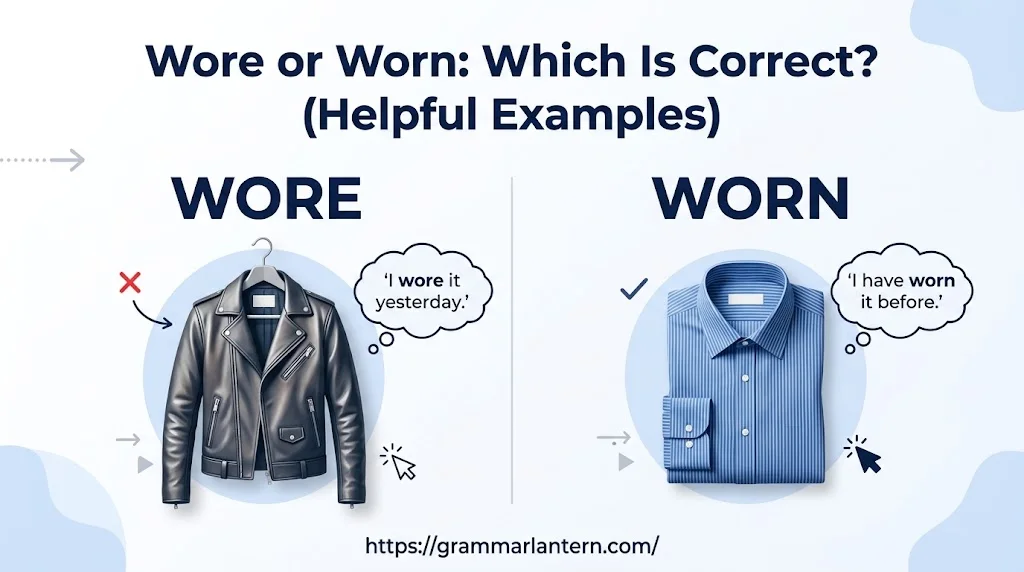
The difference is easier to understand than you might think. Wore is the simple past tense, while worn is the past participle, which usually appears with helping verbs such as have, has, or had. Once you recognize this simple pattern, you can choose the correct word without second-guessing yourself.
In this guide, you’ll learn when to use wore or worn through simple explanations and everyday examples. We’ll also cover common mistakes and practical tips to improve your English grammar, sentence structure, and confidence in both casual conversations and formal writing. By the end, you’ll know exactly which word fits your sentence.
Quick Answer
Wore is the simple past tense of wear, while worn is its past participle. Both are correct, but you use them in different sentence structures.
- Wore: Describes an action that happened in the past. Example: “She wore a blue dress yesterday.”
- Worn: Usually appears with an auxiliary verb in perfect tenses or passive constructions. It can also function as an adjective. Example: “She has worn that dress before.”
Here’s a quick comparison:
| Word | Grammatical form | Example |
| Wear | Base form and present tense | I wear glasses every day. |
| Wore | Simple past tense | I wore glasses yesterday. |
| Worn | Past participle | I have worn glasses for years. |
Easy rule to remember: Use wore for a completed past action. Use worn after have, has, or had when forming perfect tenses.
However, worn also appears in passive constructions and adjective phrases, so the surrounding words always matter.
What Does Wore Mean?
Wore is the simple past tense of the verb wear. It describes something someone put on, had on, or used on their body at a particular time in the past.
Although clothing is the most familiar example, wear has several meanings. You can wear a uniform, wear a smile, wear a particular expression, or wear someone down through repeated pressure.
When you describe one of these actions in the simple past tense, you generally use wore.
For example:
- I wore my new sneakers to school yesterday.
- Daniel wore a suit to the interview.
- They wore matching shirts at the family reunion.
- She wore a cheerful smile throughout the meeting.
- The long journey wore him down.
Notice that wore doesn’t need an auxiliary verb in an ordinary affirmative sentence. It can serve as the main verb by itself.
Examples of Wore in Sentences
The following examples show how wore works in different situations.
Clothing and outfits
- Maya wore a black dress to the wedding.
- I wore my warmest coat during the snowstorm.
- He wore the same sweater two days in a row.
- We wore comfortable clothes for the road trip.
Accessories and personal items
- She wore her grandmother’s necklace to dinner.
- Marcus wore sunglasses while driving.
- I wore my new watch to work.
- The children wore matching hats for the photograph.
Work, school, and special occasions
- The students wore their uniforms on Monday.
- The firefighters wore protective equipment during the exercise.
- He wore a graduation gown for the ceremony.
- Everyone wore formal clothing at the reception.
Figurative meanings
- She wore a confident expression during the presentation.
- His constant complaints wore everyone down.
- The team’s patience wore thin after several delays.
- The years of hard work wore on him.
These examples demonstrate that wore isn’t limited to clothes. It can describe expressions, emotional effects, and gradual changes as well.
When Should You Use Wore?
Use wore when you’re describing an action in the simple past tense.
Often, the sentence refers to a specific time that has already passed. Words such as yesterday, last night, last month, and during the ceremony can help you recognize this pattern.
For example:
- I wore my favorite shirt yesterday.
- She wore a red scarf last winter.
- We wore costumes during the school play.
- He wore his work boots throughout the shift.
However, a sentence doesn’t need an explicit past-time expression to use wore.
Consider this example: “She opened the closet, selected a jacket, and wore it to dinner.”
The surrounding verbs establish a sequence of past events. The word wore fits naturally into that sequence.
You can also use wore in negative sentences and questions. In these constructions, the auxiliary verb did takes the past-tense marking, so the main verb returns to its base form.
Correct examples:
- I didn’t wear my new shoes yesterday.
- Did you wear your uniform to school?
- She didn’t wear a coat because it was warm.
- Did they wear matching outfits?
Avoid writing “I didn’t wore my jacket.” Because didn’t already marks the past tense, the correct form is wear, not wore.
Read More: 8 Words for Someone Who Follows the Rules
What Does Worn Mean?
Worn is the past participle of wear. Unlike wore, it usually doesn’t function as the main verb by itself in a standard affirmative sentence describing a past action.
Instead, it commonly works with auxiliary verbs such as have, has, and had to form perfect tenses.
For example:
- I have worn this jacket before.
- She has worn glasses since childhood.
- They had worn their uniforms before the ceremony began.
In each sentence, worn works with an auxiliary verb to complete the verb phrase.
The word also appears in passive constructions and as an adjective. These uses are important because they explain why you might encounter worn without have, has, or had.
For instance, “The uniform was worn during the ceremony” uses a passive construction. Meanwhile, “The uniform looks worn” uses worn as an adjective describing its condition.
Examples of Worn in Sentences
Let’s look at how worn works in several grammatical contexts.
Present perfect tense
The present perfect connects a past action with the present. It commonly describes experiences, repeated actions, or situations that began earlier and remain relevant.
- I have worn these shoes many times.
- She has worn glasses since she was ten.
- We have worn our team jerseys at every home game.
- He has worn that watch for years.
Past perfect tense
The past perfect describes an action completed before another past event.
- I had worn the jacket before I noticed the tear.
- She had worn her uniform all morning before changing.
- They had worn protective gloves before entering the laboratory.
- He had worn the shoes only twice before they became uncomfortable.
Passive constructions
A passive construction emphasizes the person or thing affected by an action rather than the person performing it.
- The costume was worn by the lead actor.
- The uniforms were worn during the official ceremony.
- The protective equipment had been worn by every team member.
- The dress has been worn at several important events.
Adjective use
The word worn can describe something that looks old, damaged, faded, or affected by regular use.
- The leather bag looks worn.
- He walked into the office wearing worn shoes.
- The old carpet had a worn patch near the doorway.
- Her face looked worn after several sleepless nights.
These examples show why context matters. The word worn can describe an action or a condition, depending on how you use it.
When Should You Use Worn?
Use worn when the sentence calls for a past participle or an adjective.
The easiest pattern to recognize is the perfect tense:
- Have worn: I have worn this coat before.
- Has worn: She has worn this dress twice.
- Had worn: They had worn their uniforms before the inspection.
However, worn also appears in other constructions.
For example, “The shoes were worn by the player” uses the past participle in a passive construction. In contrast, “The shoes were worn” may describe either the act of wearing them or their condition, depending on context.
As an adjective, worn doesn’t need an auxiliary verb from the perfect tense pattern.
Consider these sentences:
- The worn leather looked faded.
- His jacket appeared worn around the elbows.
- The old book had worn pages.
In the last example, worn describes the pages, while had belongs to the larger sentence structure. You should identify the grammatical role of each word instead of relying on one memorized pattern.
Key Differences
The main difference between wore and worn is their grammatical function.
Wore is a finite past-tense verb. It directly expresses a past action and can serve as the main verb in an ordinary affirmative sentence.
Worn is a past participle that appears in perfect tenses and passive constructions. It can also function as an adjective.
The following table summarizes their differences.
| Feature | Wore | Worn |
| Verb form | Simple past tense | Past participle |
| Typical use | Describes a past action | Forms perfect tenses and passive constructions |
| Auxiliary required | Usually no | Usually yes when used as a verb |
| Adjective use | Not typical | Common |
| Example | She wore a coat yesterday. | She has worn that coat before. |
| Another example | He wore his uniform. | His uniform looked worn. |
Compare Wore and Worn Side by Side
Sometimes, comparing two sentences makes the distinction easier to understand.
Example one
- Correct: I wore my new shoes yesterday.
- Correct: I have worn my new shoes several times.
The first sentence describes a past action. The second emphasizes previous experience or repeated use.
Example two
- Correct: She wore a beautiful dress to the party.
- Correct: She had worn the dress before the party started.
The first sentence reports what she did. The second places one past action before another past event.
Example three
- Correct: The actor wore a costume during the performance.
- Correct: The costume was worn by the actor during the performance.
The first sentence uses the active voice. The second uses the passive voice to emphasize the costume.
Both forms can communicate similar information, but their grammatical structures differ.
Wore vs. Worn vs. Wear
Understanding all three forms of wear helps you avoid mistakes with wore and worn.
The verb wear is irregular. That means it doesn’t form its past tense by simply adding -ed. Instead, its principal forms are wear, wore, worn.
| Verb form | When to use it | Example |
| Wear | Base form and present tense | I wear glasses every day. |
| Wore | Simple past tense | I wore glasses yesterday. |
| Worn | Past participle | I have worn glasses for years. |
| Wearing | Present participle and gerund | She is wearing a blue jacket. |
How to Choose the Correct Form
1.Use wear when the sentence calls for the base form or present tense.
- I wear a uniform at work.
- You should wear comfortable shoes.
- They usually wear casual clothes.
2.Use wore for an action in the simple past.
- I wore a uniform yesterday.
- She wore comfortable shoes during the hike.
- They wore casual clothes to the gathering.
3.Use worn when the sentence calls for the past participle or adjective.
- I have worn this uniform for months.
- She had worn those shoes before.
- The jacket looks worn around the cuffs.
4.Use wearing for continuous verb forms or when the word functions as a gerund.
- He is wearing a gray sweater.
- They were wearing matching jackets.
- Wearing comfortable shoes makes long walks easier.
A useful way to remember the sequence is to learn the three principal forms together: wear, wore, worn. Once the pattern becomes familiar, you’ll recognize the correct form more quickly.
Wore Out vs. Worn Out: What’s the Difference?
The expressions wore out and worn out follow the same grammatical distinction as wore and worn. Both come from the phrasal verb wear out, which can mean to damage something through use or to exhaust someone.
However, their sentence structures differ.
Wore out is the simple past form. It describes an action that happened in the past.
Examples:
- The constant friction wore out the soles of my shoes.
- That exhausting schedule wore me out.
- Years of use wore out the old sofa.
- The long meeting wore everyone out.
Worn out is the past participle or an adjective. It often describes something that has become unusable, damaged, or extremely tired.
Examples:
- The soles of my shoes are worn out.
- I have worn out two pairs of sneakers this year.
- She felt worn out after working all day.
- The old sofa looked worn out after years of use.
Wore Out vs. Worn Out in a Table
| Expression | Function | Example |
| Wore out | Simple past | The hard work wore me out. |
| Have worn out | Present perfect | I have worn out these shoes. |
| Had worn out | Past perfect | She had worn out her old boots. |
| Worn out | Adjective | My boots are worn out. |
Here’s a simple comparison to remember:
“The long walk wore me out” describes what caused the exhaustion.
“I’m worn out after the long walk” describes your current condition.
The first focuses on an action. The second focuses on a result.
Common Mistakes
Even experienced English speakers occasionally confuse irregular verb forms. The good news is that most mistakes become easier to correct once you recognize the sentence pattern.
Using Worn Instead of Wore
Incorrect: I worn my favorite shirt yesterday.
Correct: I wore my favorite shirt yesterday.
The sentence describes a completed past action, so it needs the simple past tense.
Using Wore After Have, Has, or Had
Incorrect: She has wore that dress before.
Correct: She has worn that dress before.
The auxiliary has requires the past participle to form the present perfect tense. The same rule applies to have and had.
Additional examples:
- Incorrect: I have wore these shoes before.
- Correct: I have worn these shoes before.
- Incorrect: They had wore their uniforms already.
- Correct: They had worn their uniforms already.
Using Wore After Did
Incorrect: Did you wore your new jacket?
Correct: Did you wear your new jacket?
The auxiliary did already marks the question as past tense. Therefore, the main verb must use its base form.
The same principle applies to negative sentences.
- Incorrect: He didn’t wore a coat.
- Correct: He didn’t wear a coat.
Assuming Worn Always Needs Have, Has, or Had
Incorrect rule: You can only use worn after have, has, or had.
Better rule: Those auxiliaries commonly introduce worn in perfect tenses, but the word also appears in passive constructions and adjective phrases.
Examples:
- The uniform was worn during the event.
- The leather looks worn.
- The carpet had worn patches near the entrance.
Recognizing these different uses will help you avoid overgeneralizing the rule.
Case Study: Choosing Between Wore and Worn in Real Sentences
Imagine that a student named Emma is writing a short paragraph about a school event.
Her first draft reads:
“Yesterday, I worn my new uniform to school. I have wore it only twice before. By the afternoon, my shoes looked wore because I had walked across the muddy playground.”
Although the meaning is understandable, three verb forms need correction.
Here’s the revised version:
“Yesterday, I wore my new uniform to school. I have worn it only twice before. By the afternoon, my shoes looked worn because I had walked across the muddy playground.”
Why are these corrections necessary?
- Wore: The first sentence describes a completed action that happened yesterday.
- Worn: The second sentence uses the present perfect tense with have.
- Worn: The third sentence uses the word as an adjective to describe the condition of the shoes.
This example highlights an important lesson: the correct word depends on the sentence’s grammatical structure, not simply on whether the action happened in the past.
When you edit your own writing, check the words immediately surrounding wore or worn. They often reveal which form you need.
How to Remember the Difference
You don’t need a complicated memory trick. A few simple patterns can help you choose correctly.
Remember the Simple Past: Wore
Think of a completed action in the past.
- Yesterday, I wore a jacket.
- Last weekend, she wore a costume.
- During the game, they wore matching jerseys.
The word wore usually works directly as the main verb in these sentences.
Remember the Perfect Tenses: Have, Has, or Had Worn
When you see have, has, or had forming a perfect tense, use worn.
- I have worn this coat before.
- She has worn glasses for years.
- They had worn their uniforms before the inspection.
The auxiliary verb provides a useful clue.
Remember the Adjective: Worn
If you’re describing the condition of something, worn may be the right choice.
- The jacket looks worn.
- His shoes are worn around the heels.
- The old table has a worn surface.
One final trick is to memorize this pattern:
Wear → Wore → Worn
Say it aloud a few times and create one example for each form. Practicing with real sentences is more useful than memorizing isolated words.
Practice
Test your understanding with these sentences. Fill in each blank with wore or worn.
- I _____ my favorite jacket to the concert last night.
- She has _____ those shoes many times.
- They had _____ their uniforms before the guests arrived.
- The old backpack looks _____ around the edges.
- He _____ a blue tie to the interview yesterday.
- Have you ever _____ a traditional costume?
- The costume was _____ by the lead actor.
- My brother _____ his sneakers during the basketball game.
- The leather seats looked _____ after years of use.
- We have _____ these team shirts at every tournament.
Answer Key and Explanations
Wore: I wore my favorite jacket to the concert last night.
The sentence describes a completed past action.
Worn: She has worn those shoes many times.
The present perfect tense uses has followed by the past participle.
Worn: They had worn their uniforms before the guests arrived.
The past perfect tense uses had followed by the past participle.
Worn: The old backpack looks worn around the edges.
Here, worn describes the backpack’s condition.
Wore: He wore a blue tie to the interview yesterday.
The sentence describes a past action.
Worn: Have you ever worn a traditional costume?
The present perfect question uses have followed by the past participle.
Worn: The costume was worn by the lead actor.
The sentence uses a passive construction.
Wore: My brother wore his sneakers during the basketball game.
The simple past tense describes the completed action.
Worn: The leather seats looked worn after years of use.
The word describes the condition of the seats.
Worn: We have worn these team shirts at every tournament.
The present perfect tense uses have followed by the past participle.
If you answered all ten correctly, you’ve grasped the main distinction. If you missed a few, revisit the sentence patterns and try again.
Read More: TM Meaning in Text: What Does TM Mean?
FAQs
1. What Is the Difference Between Wore and Worn?
Wore is the simple past tense of wear, while worn is its past participle. Use wore for a completed action in the past and worn with helping verbs such as have, has, or had.
Examples:
- I wore my favorite jacket yesterday.
- I have worn this jacket many times.
2. Is Wore or Worn Grammatically Correct?
Both wore and worn are grammatically correct. The right choice depends on how you construct your sentence. Use wore when describing a past action without a helping verb, and use worn when a perfect-tense construction requires the past participle.
3. Is It I Wore or I Worn?
I wore is correct when you describe something you had on in the past.
For example, “I wore a blue shirt to the party.”
However, you can say, “I have worn that shirt before.” The helping verb have makes worn the correct choice.
4. Should I Say Have Wore or Have Worn?
You should say have worn, not have wore. The verb have requires the past participle in this construction.
Correct: I have worn these shoes all week.
Incorrect: I have wore these shoes all week.
Remember this simple pattern: have, has, or had + worn.
5. Is It Had Wore or Had Worn?
Had worn is correct because had is followed by the past participle of the verb.
For example, “She had worn the dress before the wedding.”
The phrase had wore is grammatically incorrect in standard English. Whenever you use had to form the past perfect tense, choose worn instead.
6. What Is the Past Tense of Wear?
The simple past tense of wear is wore.
For example, “He wore a warm coat during the winter.”
The three main forms are wear, wore, and worn. Learning these forms together makes it easier to use the verb correctly in different sentences.
7. What Is the Past Participle of Wear?
The past participle of wear is worn. It commonly appears with have, has, and had to form perfect tenses.
Examples:
- I have worn this hat before.
- She has worn glasses since childhood.
- They had worn matching uniforms for years.
8. Can I Use Worn Without a Helping Verb?
Yes. Worn can appear without a helping verb when it functions as an adjective.
For example, “He bought a worn leather jacket.”
Here, worn describes the jacket’s condition. It suggests that the jacket has been used and may show signs of age or damage.
9. What Is the Difference Between Wore and Worn in Everyday English?
In everyday English, the main difference is how each word fits into a sentence. Use wore to describe a past action and worn after a helping verb or as an adjective.
For example, “I wore sneakers yesterday” describes a past action. “I have worn these sneakers for months” describes an experience or situation continuing into the present.
10. How Can I Remember When to Use Wore or Worn?
The easiest way is to remember this pattern: wear – wore – worn.
- Wear: I wear comfortable shoes every day.
- Wore: I wore boots yesterday.
- Worn: I have worn those boots before.
Practice these three forms in your own sentences. With a little repetition, choosing the correct word will become much more natural.
Conclusion
Understanding wore or worn doesn’t have to be difficult. Both words come from the verb wear, but each has a different job. Wore describes an action that happened in the past, while worn is the past participle used with helping verbs such as have, has, and had. It can also describe something that shows signs of use.
The next time you’re unsure which word to choose, look at the structure of your sentence. If you’re talking about yesterday, last week, or another finished moment, wore will often be the right choice. If your sentence uses have, has, or had, you’ll generally need worn.
Keep practicing with everyday examples, and these two words will soon feel much easier to use. A little attention to irregular verbs can make a big difference in your English grammar and writing confidence.

Muhammad Haroon is the voice behind many of the clear, practical grammar guides you’ll find on Grammar Lantern. With a strong background in content writing and a genuine love for the English language, Haroon specializes in breaking down intimidating grammar topics into simple, digestible lessons. His goal is simple: to empower readers to write with confidence and clarity. Whether he’s explaining tricky tenses or demystifying punctuation, Haroon approaches each topic with patience, precision, and a touch of warmth—because he knows that learning grammar is a journey, not a race.