
Have you ever stopped while writing because you weren’t sure whether to use rose or risen? You’re not alone. These two forms of the verb rise often confuse writers because they describe similar actions but follow different grammatical rules. Whether you’re talking about the sun appearing in the sky, prices increasing, or someone achieving success, choosing the correct form makes your sentences clearer and more natural.
The key to understanding rose or risen is knowing how verb tenses work. Rose is the simple past tense, while risen is the past participle, which usually needs a helping verb such as has, have, or had. Although the words share the same meaning at their core, you can’t always use them interchangeably. Recognizing their sentence patterns will help you avoid common grammar mistakes.
In this guide, you’ll learn the difference between rose and risen through straightforward explanations and practical examples. You’ll discover when to use each form in everyday conversations, professional emails, and formal writing. You’ll also explore common mistakes and simple tricks for remembering the correct usage. By the end, you’ll feel more confident choosing the right word and expressing your ideas accurately.
Quick Answer
Rose is the simple past tense of rise. Use it when describing an action that happened in the past. Risen is the past participle of rise. It typically appears with a helping verb such as has, have, or had.
Compare these examples:
- Rose: The temperature rose sharply yesterday.
- Risen: The temperature has risen sharply this week.
- Rose: She rose from her chair when the meeting ended.
- Risen: She has risen to a leadership position.
The easiest way to remember the difference is to learn the three main forms of the verb:
| Verb form | Grammatical name | Example |
| Rise | Base form | Prices rise during periods of high demand. |
| Rose | Simple past tense | Prices rose last month. |
| Risen | Past participle | Prices have risen this month. |
| Rising | Present participle | Prices are rising again. |
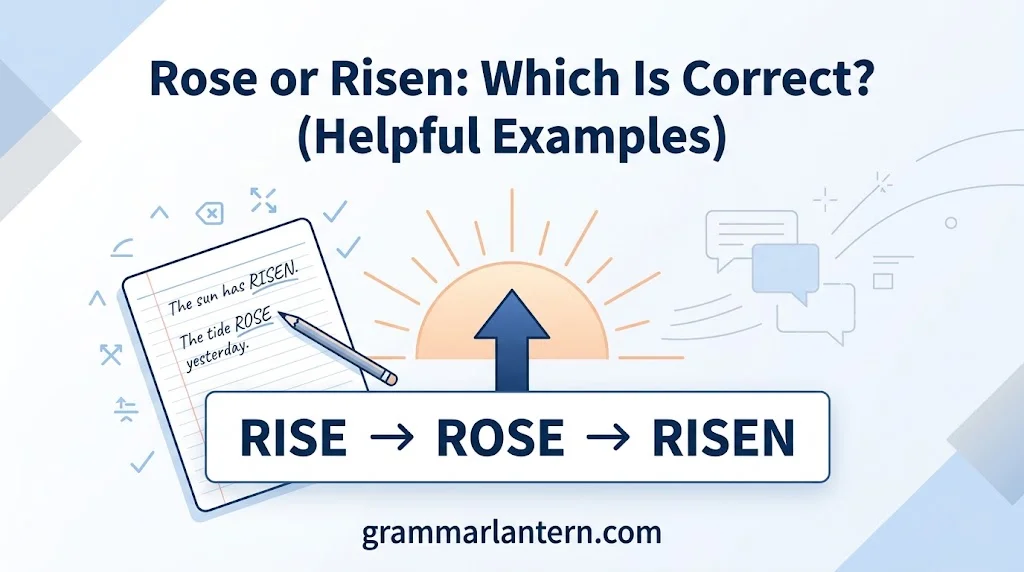
Remember this pattern: rise → rose → risen. Once you recognize these forms, choosing the correct word becomes much easier.
What Does Rose Mean?
Rose is the simple past tense of the verb rise. It describes an upward movement, an increase, or a change in position that happened in the past.
The word doesn’t always refer to physical movement. It can also describe growing costs, improving status, increasing numbers, or a person getting out of bed.
Consider this sentence: “The river rose after the heavy rain.” The word rose tells you that the water level increased during a past event.
Here are the most common meanings of rose:
- Moved upward: The balloon rose into the sky.
- Increased: Grocery prices rose last month.
- Got up: He rose from his seat.
- Advanced in position: She rose through the company ranks.
- Became more intense: Anger rose during the argument.
In each example, rose describes an action or change in the past. You don’t need a helping verb to use it as the main verb in a simple past sentence.
When to Use Rose
Use rose when you want to describe a completed past action without forming a perfect tense.
A sentence may include a specific time reference, such as yesterday, last week, or in 2025. However, the time expression isn’t required if the past context is already clear.
For example:
- The sun rose before six o’clock.
- The company’s revenue rose last quarter.
- My grandmother rose early every morning.
- The number of visitors rose during the festival.
Notice that each sentence describes an event or situation in the past. The verb rose carries the past-tense meaning by itself.
You can also use rose when telling a story. For instance, “When the alarm rang, Daniel rose from bed, opened the curtains, and looked outside.” The simple past form keeps the sequence of events clear.
Example Sentences With Rose
The following examples show how rose works in different situations.
| Sentence | Meaning |
| The sun rose above the mountains. | The sun appeared higher in the sky. |
| The temperature rose by five degrees. | The temperature increased. |
| She rose from her chair. | She stood up from a seated position. |
| The river rose after the storm. | The water level increased. |
| His confidence rose after the presentation. | He became more confident. |
| The employee rose through the ranks. | The employee advanced to higher positions. |
Each sentence uses rose to describe a past action or change. The surrounding words tell you exactly what moved, increased, or advanced.
Is Rose Always a Verb?
No. The word rose can also be a noun referring to a flower or a color associated with it.
For example, “She planted a red rose in the garden” uses rose as a noun. In “The sun rose at dawn,” it functions as a verb.
Context makes the difference clear. When comparing rose and risen, the discussion usually concerns the past-tense form of rise, not the flower.
What Does Risen Mean?
Risen is the past participle of the verb rise. It describes an upward movement, increase, or change using a grammatical construction that requires a past participle.
Unlike rose, risen usually doesn’t stand alone as the main verb in a standard statement about a past event. It commonly appears with helping verbs such as has, have, and had.
For example:
- The sun has risen above the horizon.
- Food prices have risen this year.
- The river had risen before the rescue team arrived.
In these sentences, the helping verb works with risen to establish the tense and connect the action to a particular point in time.
You may also encounter risen in passive-like descriptions or participial phrases. For instance, “The risen bread was ready for baking” uses the participle as a modifier. The key lesson is that risen serves a different grammatical role from rose.
Read More: MYF Meaning in Text: What Does MYF Stand For?
When to Use Risen
Use risen when your sentence calls for the past participle of rise. The most common situations involve the perfect tenses.
Present perfect: has risen or have risen
The present perfect connects a past action or change to the present. It often appears when you want to describe a result, development, or experience without focusing solely on when it happened.
Examples:
- The cost of groceries has risen considerably.
- Temperatures have risen since Monday.
- Her confidence has risen with experience.
Use has with a singular third-person subject, such as the price or she. Use have with I, you, we, they, and plural subjects.
Past perfect: had risen
The past perfect describes an action or change that happened before another past event.
Examples:
- The river had risen before the rain stopped.
- By the time we arrived, the sun had risen.
- Food prices had risen before the new policy took effect.
The word had establishes the earlier time frame. The participle risen completes the verb phrase.
Future perfect: will have risen
The future perfect describes something expected to happen before a specific future point.
Examples:
- By noon, the sun will have risen.
- By the end of the year, costs will have risen further.
- The water level will have risen by the time the engineers return.
In each case, will have combines with risen to express an expected future result.
Example Sentences With Risen
Here are additional examples showing how risen works in everyday English.
| Sentence | Why risen is correct |
| The sun has risen above the hills. | The present perfect uses has. |
| Prices have risen since January. | The present perfect uses have. |
| The water had risen before dawn. | The past perfect uses had. |
| Her confidence has risen considerably. | The sentence connects a change to the present. |
| The bread dough has risen enough. | The present perfect describes the dough’s current state. |
| By evening, the river will have risen further. | The future perfect describes an expected result. |
A useful detail is that risen doesn’t automatically mean an action is still happening. In “The river has risen,” the increase may already be complete. The sentence emphasizes the change and its relevance to the present.
Key Differences
The difference between rose and risen comes down to grammar, not meaning alone. Both words can describe upward movement or an increase, but they fit different sentence structures.
Rose expresses the simple past. Risen is the past participle, which commonly appears with an auxiliary verb.
| Feature | Rose | Risen |
| Verb form | Simple past tense | Past participle |
| Basic pattern | Subject + rose | Subject + has/have/had + risen |
| Helping verb required in the usual construction? | No | Yes, in perfect-tense constructions |
| Example about prices | Prices rose yesterday. | Prices have risen recently. |
| Example about the sun | The sun rose at dawn. | The sun has risen. |
| Example about water | The water rose overnight. | The water had risen before noon. |
The distinction becomes clearer when you compare sentences about the same event.
- Simple past: The temperature rose overnight.
- Present perfect: The temperature has risen overnight.
- Past perfect: The temperature had risen before sunrise.
All three sentences describe an increase in temperature. However, each places that change in a different grammatical time frame.
Can You Replace Rose With Risen?
Not without changing the sentence structure.
Consider these examples:
- Incorrect in standard English: The sun risen at six o’clock.
- Correct: The sun rose at six o’clock.
- Incorrect in standard English: The sun has rose.
- Correct: The sun has risen.
The first incorrect sentence lacks the helping verb needed for the intended construction. The second incorrect sentence uses the simple past form after has, where the past participle is required.
There is a simple way to check your writing: identify the verb phrase before deciding which form to use. If you are describing a completed past event directly, rose may be appropriate. If you are forming a perfect tense, use risen.
Rise, Rose, and Risen: Understanding All Three Forms
Learning rose and risen becomes easier when you understand the entire verb pattern. English has several irregular verbs whose past forms don’t follow the usual rule of adding -ed.
For example, regular verbs follow patterns such as walk, walked, walked. The verb rise follows a different pattern: rise, rose, risen.
These are the main forms to remember:
| Form | Main use | Example |
| Rise | Base form | I expect prices to rise. |
| Rises | Present tense with he, she, or it | The sun rises early in summer. |
| Rose | Simple past | The sun rose at six. |
| Risen | Past participle | The sun has risen. |
| Rising | -ing form | The sun is rising. |
How Rise Works in the Present Tense
Use rise for present-tense statements with I, you, we, and they. It also follows modal verbs such as can, may, and will, as well as the word to in an infinitive.
Examples:
- Prices rise when demand exceeds supply.
- We rise early on weekdays.
- The river may rise after heavy rain.
- They expect costs to rise next year.
With he, she, or it in the simple present, use rises.
For example, “The sun rises in the east.” This describes a general fact rather than one specific past event.
How Rose Works in the Simple Past
Use rose when the action occurred in the past and you aren’t using a perfect-tense construction.
Examples:
- The balloon rose into the air.
- The company’s profits rose last quarter.
- He rose to answer the question.
The form stays rose regardless of whether the subject is singular or plural. You would say both “The price rose” and “The prices rose.”
How Risen Works With Helping Verbs
Use risen when the sentence requires the past participle of rise. In perfect tenses, it follows has, have, or had, or appears in a longer construction such as will have risen.
Examples:
- The balloon has risen above the trees.
- Profits have risen since the company expanded.
- The water had risen before the crew arrived.
- The sun will have risen by the time we reach the beach.
Don’t confuse the helping verb with the main verb. In “The balloon has risen,” has is the helping verb and risen carries the main verb’s meaning.
How Rising Works in Continuous Tenses
The -ing form, rising, is used in continuous constructions to describe an action or change in progress.
Examples:
- Temperatures are rising this afternoon.
- The river was rising when the rescue team arrived.
- Prices have been rising for several months.
These examples show another important distinction. Risen often describes a change that has occurred, while rising emphasizes an ongoing process in continuous constructions.
Common Mistakes
Even experienced English speakers sometimes mix up irregular verb forms. The best way to avoid these mistakes is to learn the sentence patterns rather than memorize isolated words.
Using Rose After Has, Have, or Had
One common mistake is using rose after a helping verb that requires the past participle.
Incorrect: The price has rose sharply.
Correct: The price has risen sharply.
Why? The present perfect follows the pattern has/have + past participle. Since risen is the past participle of rise, it fits the construction.
Here are more examples:
- Incorrect: Sales have rose this month.
- Correct: Sales have risen this month.
- Incorrect: The water had rose overnight.
- Correct: The water had risen overnight.
Whenever you see has, have, or had before the main verb in a perfect-tense construction, check whether you need the past participle.
Using Risen as the Simple Past
Another common mistake is using risen without the helping verb required for the intended sentence.
Incorrect: She risen early yesterday.
Correct: She rose early yesterday.
The sentence describes a past action directly, so the simple past form rose is appropriate.
Compare these examples:
- The child rose from bed.
- The child has risen from bed.
- The child had risen before the alarm sounded.
The meaning stays similar, but the grammatical construction changes.
Confusing Rise With Raise
The words rise and raise are related in meaning, but they aren’t interchangeable. This distinction matters because each verb follows its own pattern.
Rise generally describes something moving upward or increasing. It doesn’t normally take a direct object.
Examples:
- The balloon rose into the air.
- Prices have risen sharply.
- The sun rises every morning.
Raise means to lift something, increase something, or bring something to a higher level. It normally takes a direct object.
Examples:
- She raised the flag.
- The company has raised its prices.
- He raised his hand to ask a question.
Notice the different verb forms:
| Base form | Simple past | Past participle |
| Rise | Rose | Risen |
| Raise | Raised | Raised |
A practical test can help you choose. Ask whether the subject moves upward or causes something else to move upward.
- The flag rose in the wind. The flag moved upward.
- She raised the flag. She caused the flag to move upward.
This distinction is particularly useful when writing about prices, salaries, hands, flags, and water levels.
In Different Contexts
Although the grammatical rule stays the same, the meaning of rise can change depending on the situation. Looking at common contexts helps you recognize which form sounds right and why.
Rose or Risen When Talking About the Sun
When describing sunrise, choose the form that matches the sentence’s tense.
- Rose: The sun rose at 6:15 a.m. yesterday.
- Risen: The sun has risen, so let’s start our hike.
- Rising: The sun is rising behind the mountains.
The first sentence reports a past event. The second emphasizes the present result, while the third describes an action in progress.
For example, if you’re telling a friend what happened yesterday, “The sun rose early” is a natural choice. If you’re explaining why it’s already bright outside, “The sun has risen” may fit better.
Rose or Risen When Talking About Prices and Costs
Financial writing often uses rose and risen to describe changes in prices, expenses, wages, and revenue.
Consider these examples:
- Grocery prices rose last month.
- Grocery prices have risen since January.
- The company’s operating costs had risen before management changed suppliers.
The simple past focuses on a past event. The present perfect connects a change to the present, while the past perfect places it before another past event.
Be careful not to assume that the choice depends only on whether the increase continues. A price might have risen and then stabilized. The tense depends on the intended time frame and sentence structure.
Rose or Risen When Talking About Water Levels
Water levels provide another clear illustration of the difference.
- The river rose after heavy rainfall.
- The river has risen by several inches.
- The river had risen above the warning mark before the authorities issued an alert.
Each sentence describes an increase in water level. However, the verb form tells readers how that increase relates to the time being discussed.
In a news report, for example, “The river rose overnight” reports a past development. “The river has risen overnight” can emphasize the current situation and its consequences.
Rose or Risen When Talking About Personal Growth
The verb rise can also describe progress, achievement, or improvement in someone’s position.
Examples include:
- She rose through the company’s ranks.
- He has risen to become a respected manager.
- Their confidence has risen after months of practice.
These expressions don’t describe physical movement. Instead, they communicate advancement or change.
The same grammar applies whether someone rises in a building, in a profession, or in public esteem. The meaning changes with the context, but the forms remain consistent.
How to Choose
If you’re unsure which word belongs in your sentence, follow a simple decision process. You don’t need to memorize complicated grammar terminology to make the right choice.
Step one: Identify the action.
Determine whether you mean rise, meaning to move upward, increase, or advance.
Step two: Check whether you’re describing a simple past event.
If the sentence reports something that happened in the past, rose is often correct.
Example: The number of applicants rose last year.
Step three: Check whether your sentence needs a past participle.
If you’re using a perfect-tense construction, you’ll generally need risen.
Example: The number of applicants has risen this year.
Step four: Look at the helping verb and the surrounding sentence.
Words such as has, have, and had often signal a perfect tense. However, always consider the complete construction rather than relying on one word alone.
Step five: Read the sentence aloud.
Reading your sentence aloud can help you notice awkward wording, especially when you’re comparing two similar forms. Still, use the grammatical rule to confirm your choice.
Here is a quick reference:
| If your sentence says… | Choose… | Example |
| Something happened yesterday | Rose | The price rose yesterday. |
| Something has changed by now | Risen | The price has risen. |
| Something changed before another past event | Risen | The price had risen before the sale. |
| Something is increasing right now | Rising | The price is rising. |
| Something usually increases | Rise or rises | Prices rise; the price rises. |
A Practical Example: Editing a Short Report
Imagine you’re writing a report about rising electricity costs. Your first draft says:
“Electricity prices have rose since January. Last year, they also risen during the summer.”
Both verb forms need correction, but for different reasons.
The revised version reads:
“Electricity prices have risen since January. Last year, they also rose during the summer.”
The first sentence uses the present perfect because the increase connects to the current period. The second uses the simple past because it reports an event during a completed period.
This example shows why the time frame matters as much as the verb itself.
Practice Exercise
Now it’s time to test your understanding. Fill in each blank with either rose or risen. Pay attention to the helping verbs and time expressions.
- The sun ___ above the hills yesterday.
- Prices have ___ significantly this year.
- She ___ from her seat when the judge entered.
- The water had ___ before the storm ended.
- The bread dough has ___ enough to bake.
- Temperatures ___ sharply last weekend.
- By sunrise, the fog will have ___.
- The number of visitors ___ during the holiday.
Answers and Explanations
- Rose — The sentence describes a past event that happened yesterday.
- Risen — The helping verb have forms the present perfect.
- Rose — The simple past describes her action when the judge entered.
- Risen — The helping verb had forms the past perfect.
- Risen — The present perfect describes the dough’s resulting state.
- Rose — The sentence reports a completed past change.
- Risen — The construction will have + past participle forms the future perfect.
- Rose — The sentence describes an increase during a past holiday.
If you missed any answers, review the complete verb pattern: rise, rose, risen. Then check whether the sentence needs the simple past or a past participle.
Read More: Snowball Kisses Meaning: What Does It Mean in Slang?
FAQs
1. What is the difference between rose and risen?
Rose is the simple past tense of rise, while risen is its past participle. Use rose to describe a completed past action, such as “The sun rose early.” Use risen with a helping verb, as in “The sun has risen.”
2. Is rose or risen grammatically correct?
Both rose and risen are grammatically correct, but they serve different purposes. The correct choice depends on your sentence structure. For example, “Prices rose last month” is correct, while “Prices have risen this month” uses the past participle properly.
3. Is risen the past tense of rise?
No. Risen is the past participle of rise, not its simple past tense. The simple past form is rose. For example, you would say, “She rose from her chair,” but “She has risen from her chair.”
4. Can I use risen without a helping verb?
In standard English, risen generally needs a helping verb when used as part of a verb phrase. Common examples include has risen, have risen, and had risen. For instance, “The water has risen overnight” is correct, while “The water risen overnight” is not a complete standard construction.
5. What is the past participle of rise?
The past participle of rise is risen. The three principal forms are rise, rose, and risen. You can use them in sentences such as “I rise early,” “I rose early yesterday,” and “I have risen early all week.”
6. Is it correct to say the sun has rose?
No, the standard grammatical form is “The sun has risen.” The word has requires the past participle risen, not the simple past form rose. However, “The sun rose at six o’clock” is correct because the sentence uses the simple past tense.
7. Should I use rose or risen when talking about prices?
Both words can be correct when discussing prices, depending on the sentence. Use rose for a completed past event, such as “Prices rose last year.” Use risen with a helping verb, as in “Prices have risen significantly this year.”
8. What is the difference between rose, risen, and raised?
Rose and risen are forms of rise, which usually describes something moving upward or increasing without a direct object. Raised is the past tense and past participle of raise, which generally means to lift or increase something.
For example:
- The balloon rose into the sky.
- The balloon has risen above the trees.
- She raised the balloon above her head.
9. How can I remember when to use rose and risen?
Remember this simple pattern: rise, rose, risen. Use rose when describing something that happened in the past. Use risen after helping verbs such as has, have, and had. Practicing sentences like “The temperature rose yesterday” and “The temperature has risen today” will help you recognize the difference.
10. Can rose and risen be used in formal writing?
Yes, both words are appropriate for formal writing, including reports, business emails, academic assignments, and professional documents. The important thing is to use the correct verb form. For example, “Operating costs rose last quarter” and “Operating costs have risen considerably” are both suitable for professional communication.
Conclusion
Understanding rose or risen becomes much easier when you remember their different grammatical roles. Rose is the simple past tense of rise, while risen is the past participle, usually used with a helping verb such as has, have, or had. Although both words describe upward movement or an increase, they fit different sentence structures. Choosing the right form helps your writing sound clear, natural, and grammatically correct.
The next time you write about rising prices, the morning sun, increasing temperatures, or personal achievements, consider the tense before choosing your word. Say “The sun rose early” when describing a past event, but use “The sun has risen” when forming the present perfect tense. With a little practice, you’ll recognize the correct form more quickly and avoid common mistakes. Remember the simple sequence rise, rose, risen, and you’ll have a reliable guide whenever these two words cause confusion.

Muhammad Haroon is the voice behind many of the clear, practical grammar guides you’ll find on Grammar Lantern. With a strong background in content writing and a genuine love for the English language, Haroon specializes in breaking down intimidating grammar topics into simple, digestible lessons. His goal is simple: to empower readers to write with confidence and clarity. Whether he’s explaining tricky tenses or demystifying punctuation, Haroon approaches each topic with patience, precision, and a touch of warmth—because he knows that learning grammar is a journey, not a race.