
Have you ever wondered whether to use quantify or qualify in a sentence? These words look similar, but their meanings, usage, and purposes differ. Understanding quantify vs qualify is essential for improving your English grammar, vocabulary, and professional writing.
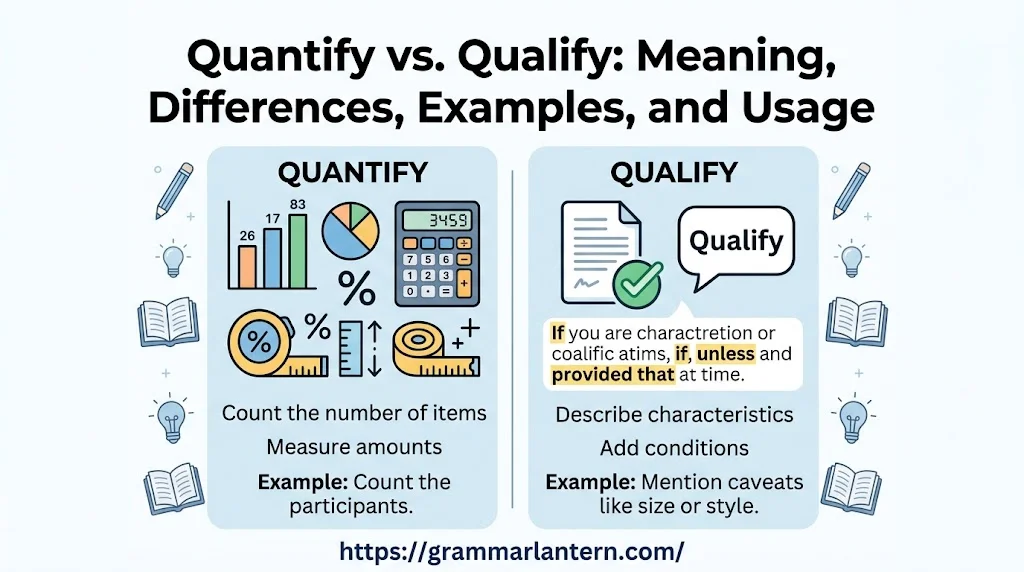
The main difference is simple: quantify means to measure or express something using numbers, figures, or data. For example, a researcher might quantify the number of students who passed an exam. In contrast, qualify means to meet specific requirements, become eligible, or add conditions that clarify a statement. For instance, a student may qualify for a scholarship by meeting certain academic standards. Knowing when to use each word helps you communicate clearly and accurately.
In this guide, you’ll learn the definitions, key differences, and practical examples of quantify vs qualify. We’ll also explore their meanings in academic writing, business communication, and everyday conversations. Whether you’re a student, teacher, professional, or English learner, these simple explanations will help you choose the correct word with confidence and improve your overall writing skills.
Quick Answer
Quantify means to measure or express something as a number or amount. Qualify means to modify or limit a statement, add an important condition, or meet the requirements for something.
| Feature | Quantify | Qualify |
| Meaning | Measure or express an amount | Modify, limit, or meet requirements |
| Main purpose | Show how much or how many | Add context or establish eligibility |
| Focus | Numbers, quantities, and measurable values | Conditions, limitations, descriptions, and requirements |
| Common contexts | Statistics, finance, science, and performance | Academic writing, professional communication, and eligibility |
| Example | We quantified the increase in sales. | We qualified our conclusion with a limitation. |
| Related noun | Quantification | Qualification |
Here are two simple examples:
- Quantify: The team quantified its progress by measuring a 15% increase in productivity.
- Qualify: The team qualified its claim by explaining that the improvement occurred during a particularly busy month.
Remember this simple distinction: quantify means measure; qualify means modify, limit, or meet a requirement.
What Does Quantify Mean?
To quantify something means to measure it, calculate its amount, or express it numerically. The word helps you turn an observation or general idea into information you can count, compare, or analyze.
For example, saying that a company attracted more customers describes a general change. Saying that the company attracted 2,500 additional customers during the year quantifies that change.
Quantification doesn’t always require an exact number. You can use estimates, ranges, percentages, ratios, or other numerical measures when precise figures aren’t available.
Consider these examples:
- The researcher quantified the effects of sleep deprivation by measuring participants’ reaction times.
- The manager quantified employee productivity using completed tasks and average processing times.
- The homeowner quantified monthly expenses by adding up bills, groceries, and transportation costs.
- The environmental team quantified waste reduction by comparing the amount of waste produced before and after a new policy.
In each sentence, quantify emphasizes measurement. It helps answer questions such as how much, how many, how often, or to what measurable degree.
Examples of Quantify in Sentences
The best way to understand quantify is to see how it works in different situations.
Everyday life: You can quantify your daily screen time by checking how many hours you spend on your phone.
Business: A company can quantify its marketing results by calculating how many sales came from a particular campaign.
Education: A teacher can quantify students’ progress by comparing assessment scores across a semester.
Healthcare: A clinical researcher can quantify changes in blood pressure by recording measurements before and after an intervention.
Environmental research: Scientists can quantify carbon emissions by estimating or measuring the amount released during a specific activity.
Notice that the word doesn’t describe whether the result is good or bad. It simply indicates that someone measures or expresses something in numerical terms.
For instance, a company might quantify a 20% increase in customer complaints. The increase itself could be concerning, but quantify refers to measuring the change rather than judging it.
Read More: 6 More Formal Ways to Say “Please Provide…” at Work
Common Contexts for Quantify
Quantification is useful whenever people need evidence, comparisons, or measurable results.
- Business and finance: Companies quantify revenue, operating costs, profits, losses, and investment returns.
- Scientific research: Researchers quantify variables, experimental results, and observed changes.
- Education: Schools quantify attendance, assessment performance, completion rates, and enrollment.
- Healthcare: Medical professionals and researchers quantify measurements, treatment outcomes, and certain health risks.
- Marketing: Teams quantify website traffic, conversion rates, sales, and customer retention.
- Environmental studies: Researchers quantify emissions, water consumption, pollution levels, and changes in wildlife populations.
In these settings, quantification makes information easier to evaluate. Instead of relying entirely on impressions, people can examine measurements and compare results.
However, not every important quality fits neatly into a number. Trust, creativity, and customer satisfaction may require interviews, observations, or written feedback alongside numerical data.
What Does Qualify Mean?
The verb qualify has several meanings, so context plays an important role in understanding it.
First, qualify can mean to modify or limit a statement by adding information that makes it more accurate. This use is common in academic writing, discussions, and professional communication.
Second, qualify can mean to meet the requirements needed to receive something, enter a competition, or perform a particular role.
These meanings are different, but both involve establishing some kind of condition, limitation, or standard.
For example:
- The researcher qualified the conclusion by explaining the study’s limitations.
- Maya qualified for the scholarship by meeting the academic and financial requirements.
- The lawyer qualified the statement by specifying the circumstances under which it applied.
- The athlete qualified for the final after finishing among the top competitors.
In the first and third examples, qualify adds precision or limits a statement. In the second and fourth, it means meeting the requirements for an opportunity.
Examples of Qualify in Sentences
Let’s examine the main uses of qualify more closely.
Qualifying a claim: The report qualified its findings by noting that the sample included only 100 participants.
The qualification helps readers understand the limits of the evidence. It doesn’t necessarily mean the findings are incorrect.
Qualifying an opinion: I support the proposal, but I would qualify my approval by asking for a clearer budget.
Here, the speaker expresses support while adding a condition.
Qualifying for a scholarship: Elena qualified for the scholarship because she met the academic requirements.
In this sentence, qualify means becoming eligible by satisfying established criteria.
Qualifying for a competition: The runner qualified for the national championship after meeting the required time.
The runner earned a place by achieving the necessary standard.
Qualifying a description: Calling the product inexpensive requires some qualification because its price is low but its maintenance costs are high.
The additional information makes the description more complete and accurate.
These examples demonstrate why you shouldn’t assume that qualify always means adding a limitation. Sometimes it refers to eligibility, while in other situations it changes how readers should interpret a statement.
Common Contexts for Qualify
The word qualify appears in several everyday and professional situations.
- Academic writing: Writers qualify arguments, conclusions, and interpretations to reflect the strength and limits of their evidence.
- Employment: Applicants qualify for positions by meeting education, experience, licensing, or other requirements.
- Sports: Athletes qualify for tournaments by meeting performance standards or advancing through preliminary rounds.
- Education: Students qualify for programs, scholarships, or awards by satisfying specified criteria.
- Legal communication: Lawyers may qualify statements by explaining the conditions or circumstances under which they apply.
- Business communication: Professionals qualify forecasts, recommendations, and commitments by stating assumptions or restrictions.
For example, a financial adviser might say, “This investment could produce strong returns, although the outcome depends on market conditions.”
The second part qualifies the first statement. It makes the recommendation more precise by acknowledging uncertainty.
Key Differences
Although quantify and qualify look similar, they answer different questions.
Quantify asks, “How much is there?” or “How can we measure it?” Qualify asks, “Under what conditions does this apply?” or “What requirements must someone meet?”
The distinction matters because the words aren’t interchangeable.
Consider a company evaluating its customer service. It might quantify customer satisfaction by calculating survey scores. It might then qualify its conclusion by explaining that the survey included only customers who responded voluntarily.
The first action measures a result. The second explains how readers should interpret it.
Comparison Table
| Comparison | Quantify | Qualify |
| Core idea | Express a quantity | Add a condition or establish eligibility |
| Typical question | How much or how many? | Under what conditions, or does someone meet the requirements? |
| Common objects | Costs, changes, results, risks, and quantities | Claims, conclusions, statements, applicants, and competitors |
| Evidence | Measurements, calculations, estimates, or counts | Conditions, limitations, criteria, or supporting context |
| Example in research | We quantified the change in test scores. | We qualified the conclusion because the sample was small. |
| Example in employment | The company quantified recruitment costs. | The applicant qualified for the position. |
| Related noun | Quantification | Qualification |
One important distinction is that quantify typically involves a measurable quantity, while qualify can have several meanings depending on the sentence.
For instance, “The manager qualified the employee” might mean the manager established that the employee met certain requirements, although a more natural sentence would explain the specific qualification. In contrast, “The manager quantified the employee’s output” means the manager measured the employee’s work numerically.
Examples Side by Side
Comparing similar sentences can make the difference much easier to remember.
| Quantify | Qualify |
| We quantified the company’s growth at 12% annually. | We qualified our growth forecast by noting the uncertain market conditions. |
| The team quantified the project’s risks using probability estimates. | The team qualified its risk assessment by identifying its assumptions. |
| Researchers quantified the improvement in test scores. | Researchers qualified their conclusion because the study involved a small sample. |
| The business quantified its environmental impact. | The business qualified its environmental claim by explaining which activities it measured. |
| The analyst quantified the potential savings. | The analyst qualified the recommendation by requiring further testing. |
Each pair illustrates a different purpose. Quantification measures something, while qualification adds context, establishes limits, or states conditions.
Can Quantify and Qualify Appear in the Same Sentence?
Yes. In fact, using both words can make your writing more precise.
Consider this example:
“The researchers quantified a 25% improvement in test performance but qualified their conclusion by noting that the study lasted only four weeks.”
The word quantified describes the numerical result. The word qualified explains why readers should interpret that result cautiously.
Here are two more examples:
- The company quantified a 10% reduction in operating costs but qualified its forecast because future energy prices remained uncertain.
- The school quantified improvements in attendance and qualified its assessment by explaining that the data covered only one semester.
In each case, the writer reports measurable information and then explains its limitations.
This approach is particularly valuable when writing reports, interpreting research, or presenting results to an audience that needs both evidence and context.
When to Use Quantify
Use quantify when you want to express an amount, measure a change, or describe something numerically.
A useful test is to ask whether you can answer the question how much, how many, or to what measurable extent. If the sentence focuses on one of these questions, quantify may be the right choice.
For example, consider the sentence, “The business wants to understand its delivery problems.”
The sentence communicates a goal, but it doesn’t specify how the business will measure those problems.
You could make the meaning more precise by writing, “The business wants to quantify delivery problems by tracking late shipments, average delays, and customer complaints.”
The revised sentence explains how the business plans to measure the issue.
When Quantification Is Useful
Quantification is especially helpful when you need to:
- Compare performance across different periods.
- Measure the effect of a policy or decision.
- Track progress toward a measurable goal.
- Support a report with numerical evidence.
- Estimate costs, risks, or potential savings.
- Evaluate whether a change has produced a measurable result.
Suppose a store owner believes a new display increases sales. Rather than relying on a general impression, the owner can compare sales figures before and after introducing the display.
If sales rise from $8,000 to $9,200 per week, the increase is $1,200, or 15%.
That calculation quantifies the change. It doesn’t prove that the display caused the increase, however. Other factors, such as seasonal demand or a promotional campaign, might have contributed.
This example highlights an important principle: quantifying a result measures its size, but it doesn’t automatically explain its cause.
Can You Quantify Something Without Exact Numbers?
Yes. Quantification can involve estimates, ranges, and approximations when exact measurements aren’t available.
For example, a project manager might estimate that a task will take between six and eight hours. A researcher might estimate the number of people affected by an event using available population data.
These estimates still quantify the situation because they express an amount numerically.
However, your writing should distinguish measured results from estimates. A precise-looking number isn’t necessarily accurate simply because it contains several digits.
When to Use Qualify
Use qualify when you need to add a condition, limit a statement, clarify a claim, or describe eligibility.
Before choosing this word, identify what you’re trying to communicate. Are you making a statement more precise? Or are you explaining that someone meets a specific requirement?
Both situations can call for qualify, but the sentence structure and meaning will differ.
Qualify a Statement or Claim
Writers often qualify statements when the available evidence doesn’t support an absolute conclusion.
For example, “The new teaching method improves student performance” sounds broad and definitive.
If the method improved performance in one small study, a more careful version would be:
“The new teaching method improved student performance in a small study, although further research is needed to determine whether the results apply more broadly.”
The added information qualifies the original claim by identifying the limits of the evidence.
Writers can qualify statements by using phrases such as:
- In some cases
- Under certain conditions
- Based on the available evidence
- To a limited extent
- For the participants in this study
- Assuming other factors remain unchanged
These expressions help readers understand exactly how far a claim extends.
However, qualification shouldn’t become an excuse for vague writing. A strong qualification identifies a real limitation rather than weakening every statement unnecessarily.
Qualify for an Opportunity
Use qualify when someone meets the requirements for a position, competition, benefit, or program.
Examples include:
- Applicants must qualify for admission by meeting the minimum entry requirements.
- The athlete qualified for the championship after winning the regional event.
- The employee qualified for a professional certification after completing the required examination.
- The family qualified for assistance under the program’s eligibility rules.
In these sentences, qualify describes eligibility rather than measurement or qualification of a statement.
Notice the common structure: qualify for + noun.
You can say, “She qualified for the scholarship,” or “They qualified for the final.” The word for introduces the opportunity or status the person became eligible to receive.
In Academic Writing and Research
Academic writing provides some of the clearest examples of the difference between these words.
Researchers quantify observations by measuring variables, counting outcomes, or analyzing numerical data. They qualify interpretations by acknowledging limitations, explaining assumptions, or restricting claims to what their evidence supports.
For example, a researcher studying reading comprehension might measure students’ test scores before and after a teaching intervention.
If the average score rises from 70 to 77, the researcher can quantify the seven-point increase. However, the researcher might qualify the conclusion by explaining that the study involved only one classroom.
The two actions serve different purposes. One reports the measured result. The other helps readers interpret that result responsibly.
Quantifying Research Findings
Researchers may quantify:
- Changes in test scores.
- The percentage of participants who completed a study.
- Differences between experimental groups.
- The frequency of a particular behavior.
- Relationships between measured variables.
For instance, a study might report that 68% of participants completed a training program. That percentage quantifies the completion rate.
The number becomes more useful when researchers explain the sample size, measurement method, and relevant comparison.
Qualifying Research Conclusions
Researchers qualify conclusions when their findings have limitations that affect interpretation.
These limitations might include a small sample, a short observation period, missing data, or a study design that cannot establish causation.
Suppose researchers find that people who exercise more frequently report better sleep. They might qualify their conclusion by explaining that the study identifies an association rather than proving that exercise caused the improvement.
This qualification matters because a relationship between two variables doesn’t necessarily establish cause and effect.
In short, good research often combines numerical precision with careful interpretation. Quantification tells readers what the data show, while qualification explains what those findings can reasonably support.
In Business and Professional Communication
Businesses use both words to make decisions, evaluate performance, and communicate recommendations.
A company might quantify its revenue growth, customer retention, employee productivity, or operating expenses. At the same time, its managers might qualify forecasts by explaining the assumptions behind them.
Consider a company that reports a 12% increase in revenue over six months. That figure quantifies the increase.
However, if the company earned most of the additional revenue from a one-time contract, management should qualify any claim that the business has achieved sustained growth.
Without that context, readers might assume the increase reflects a lasting improvement in ordinary sales.
Business Examples
Financial reporting: An accountant quantifies expenses by category and qualifies a forecast by identifying assumptions about future costs.
Marketing: A marketing team quantifies campaign performance through conversions and sales. It qualifies its conclusions if the campaign ran during a seasonal shopping period.
Human resources: A company quantifies employee turnover by calculating the percentage of staff who leave. It qualifies its interpretation by explaining whether the figures include temporary workers.
Project management: A project manager quantifies delays in days or hours and qualifies the delivery forecast by identifying unresolved risks.
A Practical Business Case Study
Imagine that an online store launches a new checkout process.
Before the change, 200 out of 1,000 customers completed their purchases. After the change, 250 out of 1,000 customers completed their purchases.
The completion rate increased from 20% to 25%, a rise of five percentage points. Relative to the original rate, that represents a 25% increase.
The store has quantified the improvement.
However, the team also discovers that the second measurement occurred during a major holiday promotion. The team therefore qualifies its conclusion by explaining that the promotional period may have influenced the results.
The company now has two useful pieces of information:
- Quantification: The checkout completion rate increased from 20% to 25%.
- Qualification: The team cannot attribute the entire improvement to the new checkout process because other factors may have influenced customer behavior.
This example shows why measurement and interpretation belong together. Numbers provide evidence, but context helps prevent misleading conclusions.
Common Mistakes
Even experienced writers sometimes confuse quantify vs. qualify, especially when discussing research, results, and professional decisions. Fortunately, a few simple checks can help you choose the correct word.
Using Qualify When You Mean Quantify
Incorrect: The analyst qualified the company’s expenses by calculating their total.
Correct: The analyst quantified the company’s expenses by calculating their total.
The second sentence is correct because the analyst measured an amount. The first would make sense only if the analyst added conditions or limitations to a statement about the expenses.
Using Quantify When You Mean Qualify
Incorrect: The researcher quantified the conclusion by explaining the study’s limitations.
Correct: The researcher qualified the conclusion by explaining the study’s limitations.
The researcher isn’t measuring the conclusion. Instead, the researcher is explaining how readers should interpret it.
Assuming Qualify Always Means Eligibility
The word qualify doesn’t always refer to passing a test or meeting requirements.
For example, “The evidence qualifies the conclusion” means the evidence places limits on how the conclusion should be understood.
By contrast, “The applicant qualifies for the position” means the applicant meets the necessary requirements.
Always consider the surrounding words before deciding which meaning applies.
Assuming Quantify Requires Perfectly Exact Numbers
Quantification can involve estimates, ranges, and approximations.
For example, “The team quantified the repair costs at approximately $5,000” is perfectly reasonable when the final bill isn’t available.
The important point is that the team expressed the costs numerically, even though the amount remains an estimate.
Synonyms and Related Words
It can help you express your ideas more precisely, but not every related word works in every sentence.
Synonyms for Quantify
| Word | Meaning | Example |
| Measure | Determine the size, amount, or degree of something | We measured the increase in demand. |
| Calculate | Find a value using mathematical operations | We calculated the total expenses. |
| Count | Determine how many items exist | We counted the completed applications. |
| Estimate | Make an informed approximation | We estimated the repair costs. |
| Assess | Evaluate a situation or quality | We assessed the project’s overall impact. |
| Determine | Establish or discover something | We determined the total amount of waste. |
Although these words overlap, they have different uses. Count focuses on the number of items, while estimate emphasizes approximation. Assess can involve numerical and nonnumerical judgments.
Synonyms for Qualify
| Word | Meaning | Example |
| Modify | Change something to some degree | We modified the statement to reflect the evidence. |
| Limit | Restrict the scope or extent of something | We limited the claim to the available data. |
| Clarify | Make something easier to understand | We clarified the conditions of the agreement. |
| Restrict | Confine something within certain boundaries | The policy restricts access to eligible applicants. |
| Meet requirements | Satisfy established conditions | She met the requirements for admission. |
| Become eligible | Gain the right to receive or participate in something | He became eligible for the program. |
These alternatives depend on the intended meaning. For example, clarify means making something clearer, while qualify may mean adding a limitation. They aren’t always interchangeable.
Word Forms of Quantify and Qualify
Understanding related word forms helps you use both words correctly in different sentence structures.
| Word | Part of speech | Meaning or use |
| Quantify | Verb | Measure or express an amount |
| Quantifies | Verb | Present-tense form used with a singular subject |
| Quantified | Verb or participle | Past form of quantify |
| Quantifying | Verb form | The act of measuring or expressing an amount |
| Quantification | Noun | The process of expressing something numerically |
| Quantifiable | Adjective | Capable of being measured or expressed numerically |
| Qualify | Verb | Modify a statement or meet requirements |
| Qualifies | Verb | Present-tense form used with a singular subject |
| Qualified | Verb or adjective | Having met requirements or having a relevant qualification |
| Qualifying | Verb form or adjective | Describing the act or process of meeting requirements |
| Qualification | Noun | A condition, credential, or act of qualifying |
Here are a few examples:
- Quantification: The quantification of energy use helped the company identify waste.
- Quantifiable: The team focused on quantifiable improvements in productivity.
- Qualified: The applicant was qualified for the position.
- Qualification: A professional qualification may be required for certain roles.
Pay attention to the difference between quantification and qualification. The first refers to measurement, while the second can refer to eligibility, credentials, or a limitation placed on a statement.
Easy Ways to Remember
If you frequently mix up these words, connect each one with a familiar idea.
Associate Quantify With Quantity
The word quantify resembles quantity, which refers to an amount or number.
When you quantify something, you measure it or express it numerically.
For example, counting 45 applications or calculating a 12% increase both involve quantification.
Associate Qualify With Qualifications
The word qualify connects naturally with qualification and qualified.
You might qualify for a job by meeting its requirements. You might also qualify a statement by adding a condition that limits its meaning.
Both uses involve establishing requirements, conditions, or boundaries.
Ask Yourself One Simple Question
Before choosing between the two words, consider what you want to communicate.
- Are you measuring an amount, counting items, or expressing a numerical result? Use quantify.
- Are you adding a limitation or condition to a statement? Use qualify.
- Are you explaining that someone meets the requirements for an opportunity? Use qualify.
For example, if you’re writing about employee performance, you might quantify the number of tasks completed each week. You might then qualify your conclusion by explaining that some tasks require more time than others.
Once you identify the purpose of your sentence, the correct word usually becomes obvious.
Read More: Wore or Worn: Which Is Correct? Helpful Examples
FAQs
1. What is the main difference between quantify and qualify?
Quantify means to measure or express something using numbers, while qualify means to meet specific requirements or add conditions to a statement. For example, you quantify sales by counting units sold, but you qualify for a job by meeting its requirements.
2. What does quantify mean in simple words?
Quantify means to measure, count, or describe something numerically. For example, a company may quantify its monthly profits by calculating its total earnings.
3. What does qualify mean in simple words?
Qualify means to meet certain requirements, become eligible, or clarify a statement by adding limitations. For example, a student may qualify for a scholarship by achieving the required grades.
4. Can quantify and qualify be used interchangeably?
No, quantify and qualify have different meanings and cannot usually replace each other. Quantify focuses on amounts or numbers, whereas qualify focuses on eligibility, conditions, or clarification.
5. What is an example of quantify in a sentence?
Here is an example: “The researcher used survey results to quantify customer satisfaction.”
In this sentence, quantify means measuring customer satisfaction using numerical data.
6. What is an example of qualify in a sentence?
Here is an example: “She worked hard to qualify for the national swimming competition.”
In this sentence, qualify means meeting the requirements to participate in the competition.
7. What is the difference between quantitative and qualitative?
Quantitative refers to information expressed through numbers, measurements, or statistics. Qualitative refers to qualities, characteristics, or descriptive information. For example, a quantitative study might measure customer ratings, while a qualitative study might examine customers’ opinions.
8. How are quantify and qualify used in academic writing?
In academic writing, researchers use quantify to measure results, analyze numerical data, and calculate differences. They use qualify to clarify arguments, acknowledge limitations, or specify conditions that affect a conclusion.
9. What are the synonyms of quantify and qualify?
Synonyms of quantify include measure, calculate, count, and determine numerically. Synonyms of qualify include meet requirements, become eligible, modify, and clarify. The best synonym depends on the context.
10. How can I remember the difference between quantify and qualify?
Remember this simple rule: quantify = quantity, while qualify = qualification. If you are measuring an amount, use quantify. If you are discussing eligibility, requirements, or adding conditions to a statement, use qualify.
Conclusion
Understanding quantify vs qualify becomes easier when you focus on what each word expresses. Quantify means measuring or expressing something numerically, while qualify refers to meeting requirements, becoming eligible, or adding conditions to clarify a statement. Although these words look similar, they serve different purposes in English grammar and communication.
The best way to remember the difference is to connect quantify with quantities and qualify with qualifications. Practice using both words in everyday conversations, academic assignments, and professional writing. With a clear understanding of their meanings and examples, you can avoid common mistakes, improve your vocabulary, and communicate your ideas with greater confidence and accuracy.

For Shafiq ur Rehman, writing is an art form and grammar is the toolbox that makes it beautiful. As a dedicated content writer at Grammar Lantern, Shafiq approaches every topic like an architect carefully laying down strong foundations of understanding before adding the finer details. He loves diving into the trickiest grammar points and resurfacing with simple, bite-sized takeaways that anyone can grasp. When he’s not crafting articles, you’ll likely find him strategizing over a game of chess, exploring dusty local bookshops, or quietly jotting down poetic observations in his notebook.