Pedantic vs. Semantic explains the difference between focusing on small rules and understanding the actual meaning of words. A pedantic person often annoys others by nitpicking trivial rules, minor details, and technicalities. For example, a teacher who scolds a student for a misplaced comma instead of appreciating the essay’s main point may seem overly pedantic. This behavior can create a negative tone and make conversations frustrating.
In contrast, semantic relates to meaning, language, and interpretation. Semantics is a branch of linguistics that studies word meanings and how they shape understanding. It helps people clarify confusing terms, arguments, and concepts. For instance, discussing whether a software feature qualifies as AI or simple automation involves examining definitions rather than correcting minor errors.
Understanding Pedantic vs. Semantic helps you communicate clearly. Pedantry may involve showing off knowledge or enforcing strict rules, while semantic analysis aims to clear up confusion. Both focus on language, but their purposes differ significantly.
Quick Answer
Pedantic describes someone who pays excessive attention to minor details, rules, or technical correctness, often in a way that seems unnecessary or annoying.
Semantic means related to the meaning of words, phrases, sentences, or other symbols.
Consider these examples:
- Pedantic: “Mark was so pedantic that he interrupted the discussion to correct a minor punctuation error.”
- Semantic: “The disagreement was semantic because both coworkers understood the facts but interpreted the word reasonable differently.”
The main difference is straightforward: pedantic describes an attitude or approach, while semantic describes something related to meaning.
| Feature | Pedantic | Semantic |
| Basic meaning | Excessively concerned with details or rules | Related to meaning |
| Part of speech | Adjective | Adjective |
| Typical use | Describing a person, comment, or style | Describing language, interpretation, or meaning |
| Common tone | Often negative | Usually neutral |
| Related noun | Pedantry or pedant | Semantics |
| Example | “His pedantic correction annoyed the team.” | “The semantic difference changed the sentence’s meaning.” |
Although both words appear in discussions about language, they are not synonyms. Knowing when to use each one will make your writing more precise and your explanations easier to understand.
What Does Pedantic Mean?
The word pedantic describes an excessive concern with small details, formal rules, or specialized knowledge. A pedantic person may insist on technical correctness even when the correction adds little value to the conversation.
Imagine telling a friend that you had a great time at a restaurant. Instead of asking about the food, your friend interrupts to explain that your description of the restaurant’s architectural style was technically inaccurate.
If that correction has no bearing on your story, the response might feel pedantic.
Pedantic behavior often involves accuracy, but accuracy itself is not the problem. The issue is how someone applies it. A useful correction helps people understand something better. A pedantic correction can distract them from the point.
Definition of Pedantic in Simple English
In simple terms, pedantic means being too concerned with small details or rules, especially when they aren’t important to the situation.
Here are a few examples:
- A teacher spends ten minutes correcting a minor wording choice that doesn’t affect a student’s argument.
- A coworker refuses to discuss a project’s main problem until everyone follows an unnecessary formatting preference.
- A friend interrupts a casual story to correct a harmless grammatical mistake.
- A writer focuses on tiny technical distinctions while ignoring whether readers understand the message.
Each example involves an emphasis on details that may be less important than the larger goal.
However, being precise doesn’t automatically make someone pedantic. A lawyer checking the exact wording of a contract or an editor correcting an important grammatical error may be doing necessary work. Context matters.
Pedantic Examples in Sentences
The best way to understand pedantic is to see how it works in different situations.
Everyday conversation: “His pedantic response turned a friendly discussion into an unnecessary debate about grammar.”
The adjective describes a response that focuses excessively on a minor language issue.
Education: “The instructor’s pedantic approach made students afraid to ask simple questions.”
Here, pedantic suggests that the instructor emphasizes technical details in an unhelpful way.
Workplace communication: “Her pedantic comments about the report’s formatting distracted the team from its missing financial data.”
The sentence contrasts minor presentation details with a more important problem.
Academic writing: “The essay became pedantic when the author spent several paragraphs explaining distinctions that didn’t support the main argument.”
In this case, the writing itself displays excessive attention to details.
Online discussions: “The commenter sounded pedantic when he corrected everyone’s word choices without addressing the original question.”
The word highlights an unhelpful communication style.
Read More: 6 More Formal Ways to Say “Please Provide…” at Work
Common Characteristics of Pedantic Behavior
Pedantic behavior can take several forms. Recognizing these patterns helps you distinguish useful precision from unnecessary nitpicking.
- Correcting insignificant mistakes: Someone focuses on a minor error that doesn’t interfere with understanding.
- Overemphasizing technical rules: A person insists on strict conventions even when the situation allows flexibility.
- Missing the main point: Small details become more important than the question or problem under discussion.
- Displaying knowledge unnecessarily: Someone introduces specialized terminology to demonstrate expertise rather than clarify an issue.
- Insisting on irrelevant distinctions: A person argues over differences that don’t affect the outcome.
- Making communication harder: Corrections interrupt the flow of a conversation instead of helping it move forward.
These characteristics don’t mean that every detailed explanation is pedantic. A technical discussion may require exact definitions, and a student may genuinely need a thorough explanation.
The important question is whether the detail serves a useful purpose.
Pedantic, Pedantry, and Pedant: What’s the Difference?
These three related words describe different aspects of the same idea.
| Word | Part of speech | Meaning | Example |
| Pedantic | Adjective | Excessively concerned with minor details or rules | “His pedantic reply frustrated the group.” |
| Pedantry | Noun | The behavior or quality of being pedantic | “Her constant pedantry slowed the meeting.” |
| Pedant | Noun | A person who displays pedantic behavior | “The pedant corrected every minor expression.” |
Use pedantic when describing a person’s behavior, writing, or manner of speaking. Use pedantry when referring to the behavior itself. Use pedant when referring to the person.
For example, you might say, “The editor isn’t a pedant; she corrects errors that could confuse readers.”
This distinction matters because pedantry is not the same as expertise. An expert can explain complicated material clearly and correct mistakes when necessary without becoming pedantic.
What Does Semantic Mean?
The word semantic relates to meaning. People use it when discussing how words, phrases, sentences, signs, or other expressions communicate information.
For example, a language teacher might explain the semantic difference between house and home. Both words can refer to a place where someone lives, but home often carries emotional associations that house doesn’t necessarily express.
Similarly, two coworkers might disagree about whether a task is urgent. Their disagreement could be semantic if they understand the situation but attach different meanings to that word.
Unlike pedantic, the word semantic doesn’t usually describe someone’s personality or conversational style. It identifies a relationship with meaning.
Definition of Semantic in Simple English
In simple English, semantic means related to the meaning of something, especially words and language.
Here are a few examples:
- A semantic difference exists when two expressions communicate different meanings.
- A semantic error occurs when a word, expression, or interpretation conveys the wrong meaning.
- A semantic analysis examines the meaning of words, sentences, or other expressions.
- A semantic misunderstanding happens when people interpret the meaning of an expression differently.
Consider the sentence, “The bank is closed.”
Depending on the context, bank could refer to a financial institution or the land beside a river. The surrounding words and circumstances help readers determine the intended meaning.
This illustrates why semantics matters. Understanding individual words is useful, but understanding how they work together is just as important.
Semantic Examples in Sentences
Here are several examples showing how semantic works in different contexts.
Everyday communication: “The two friends had a semantic disagreement about what the word success meant.”
The disagreement concerns the meaning of a word rather than necessarily involving a factual dispute.
Education: “The students explored the semantic relationship between synonyms and antonyms.”
The sentence describes a lesson about how word meanings relate to one another.
Technology: “The search engine uses semantic information to understand the meaning behind a query.”
The word describes the interpretation of meaning rather than merely matching exact characters.
Writing: “Changing one word created a semantic difference between the original sentence and the revision.”
The new wording changed what the sentence communicated.
Linguistics: “The researcher conducted a semantic analysis of the expressions used in the conversation.”
The researcher examined meaning as part of a language study.
In each example, semantic connects directly to meaning. It doesn’t suggest that a person is excessively concerned with small details.
What Is Semantics?
Semantics is the study of meaning. In linguistics, it examines how words, phrases, and sentences convey meaning and how those meanings relate to one another.
For example, consider these two sentences:
- “The dog chased the cat.”
- “The cat chased the dog.”
Both sentences contain the same main nouns and verb. However, changing their grammatical arrangement changes who performs the action and who receives it.
That difference involves sentence structure and meaning. Syntax helps explain the grammatical arrangement, while semantics helps explain what the sentences mean.
Semantics also examines relationships such as synonymy, antonymy, ambiguity, and entailment.
- Synonymy: Two expressions have similar meanings, such as begin and start.
- Antonymy: Two words have contrasting meanings, such as hot and cold.
- Ambiguity: An expression allows more than one interpretation.
- Entailment: One statement’s truth guarantees another statement’s truth under the relevant interpretation. For example, “Maya owns a poodle” entails “Maya owns a dog.”
These concepts show that semantics is a broad field, not simply another word for a disagreement.
Semantic Meaning, Semantic Difference, and Semantic Ambiguity
Several expressions containing semantic appear frequently in language discussions.
| Expression | Meaning | Example |
| Semantic meaning | The meaning conveyed by an expression | “The semantic meaning of generous involves giving freely.” |
| Semantic difference | A distinction between meanings | “There is a semantic difference between borrow and lend.” |
| Semantic error | An error involving meaning or interpretation | “The translation contained a semantic error that changed the instruction.” |
| Semantic ambiguity | The possibility of multiple interpretations | “The sentence’s semantic ambiguity confused the readers.” |
| Semantic relationship | A connection between meanings | “The semantic relationship between tiny and small is synonymy.” |
These expressions are useful in writing, teaching, translation, linguistics, and communication analysis.
One important distinction: a semantic error isn’t necessarily a grammatical error. A sentence can follow grammatical rules yet communicate something different from what its writer intended.
Key Differences
Now that both words have clear definitions, let’s compare them directly.
The simplest distinction is that pedantic concerns an approach to details, while semantic concerns meaning. One often describes behavior; the other identifies a subject or type of relationship.
Meaning and Definition: Pedantic vs. Semantic
Imagine two people discussing the sentence, “She has less books than I do.”
Person A interrupts to complain about the wording, even though everyone understands the intended message. If the correction distracts from the discussion, the behavior might seem pedantic.
Person B explains that fewer is traditionally preferred with countable nouns such as books, while less is commonly used with uncountable nouns such as water. That explanation addresses grammar and usage.
Now imagine the two people disagree about whether books refers to printed volumes or digital publications. Their discussion may involve semantics because they’re examining meaning.
The examples reveal an important point: a discussion about meaning can be precise without being pedantic. Likewise, someone can be pedantic about grammar, formatting, pronunciation, or almost any other detail.
Pedantic vs. Semantic: Parts of Speech
Both words function as adjectives, but they modify different kinds of things.
- Pedantic: Describes a person, attitude, explanation, correction, or writing style that emphasizes minor details excessively.
- Semantic: Describes something related to meaning, including a distinction, error, relationship, analysis, or interpretation.
Consider these sentences:
- “The reviewer made a pedantic objection.”
- “The reviewer identified a semantic difference.”
In the first sentence, pedantic describes the nature of the objection. In the second, semantic identifies the type of difference.
Their related nouns also differ. Pedantry refers to the behavior of being pedantic, while semantics refers to the study or system of meaning, depending on context.
Pedantic vs. Semantic: Usage and Connotation
Another important difference is tone.
Pedantic often carries a negative connotation because it suggests that someone gives too much attention to details that aren’t particularly useful. However, the word can be used playfully or neutrally in some contexts.
Semantic is generally neutral. A semantic distinction may be important, unimportant, helpful, or confusing. The adjective itself doesn’t tell you whether the distinction is worthwhile.
Compare the following:
- “His pedantic explanation made a simple question unnecessarily complicated.”
- “His semantic explanation clarified why the two statements meant different things.”
The first sentence criticizes the explanation’s approach. The second describes its subject or purpose.
Comparison Table
| Comparison point | Pedantic | Semantic |
| Central idea | Excessive attention to details | Meaning and interpretation |
| What it describes | Behavior, attitude, style, or explanation | Words, expressions, distinctions, and analyses |
| Typical context | Conversations, editing, criticism, and teaching | Linguistics, writing, translation, and communication |
| Emotional tone | Often critical | Usually neutral |
| Common phrase | Pedantic correction | Semantic distinction |
| Related noun | Pedantry | Semantics |
| Key question | Is someone overemphasizing details? | What does this expression mean? |
Remember this table when you’re unsure which word fits. Ask yourself whether you’re describing someone’s approach or the meaning of an expression.
In Real-Life Situations
These words become easier to distinguish when you see how they apply outside a dictionary.
In Everyday Conversations
Everyday conversations often involve imprecise wording. People use informal expressions, exaggerations, and shortcuts because their listeners usually understand the intended message.
A pedantic listener may focus on those small imperfections instead of responding to the main point.
For example:
“I’ve told you a million times to close the door.”
A pedantic response might be, “You haven’t told me a million times. That’s mathematically impossible.”
Unless the exaggeration matters to the discussion, the correction misses the speaker’s point.
A semantic misunderstanding works differently. Suppose someone says, “Let’s meet in the afternoon,” and the other person assumes that means 12:30 p.m. The first person means 4:00 p.m. Their disagreement concerns how they interpret afternoon.
The first situation illustrates pedantry. The second illustrates a difference in interpretation.
In Academic Writing and Education
Academic work requires precision. Students need to distinguish similar concepts, follow disciplinary conventions, and support claims with clear definitions.
However, precision becomes pedantic when minor distinctions consume attention without improving the argument.
For example, an essay comparing two political theories might devote several paragraphs to a tiny wording difference that has no bearing on either theory. That choice could make the essay less effective.
Semantic analysis serves a different purpose. A literature student might examine how the word freedom changes meaning throughout a novel. The analysis is semantic because it investigates meaning within the text.
The key difference is relevance. Detailed work is valuable when it helps answer the question being asked.
In Workplace Communication
Workplace disagreements often arise because people attach different meanings to the same words.
Imagine a manager tells an employee, “Send me the report soon.”
The employee interprets soon as the end of the day. The manager expects the report within an hour.
This misunderstanding involves the meaning and interpretation of an ambiguous instruction. A clearer deadline would prevent the problem.
Now imagine the manager receives the report on time but criticizes an irrelevant spacing choice for several minutes. That reaction could be pedantic if the formatting doesn’t affect readability or compliance with a real requirement.
Clear definitions, specific deadlines, and relevant feedback help prevent both problems.
In Linguistics and Language Learning
Linguists study semantics to understand how language communicates meaning. They examine word relationships, sentence interpretation, ambiguity, and the ways expressions convey information.
Pedantic, meanwhile, describes a possible attitude toward language learning or linguistic discussion.
A language teacher who carefully explains the difference between affect and effect isn’t necessarily pedantic. The distinction matters because the words serve different grammatical functions in standard usage.
However, a teacher who interrupts every student to criticize harmless slips, even when those slips don’t affect comprehension or the lesson’s goal, may come across as pedantic.
Expertise focuses on helping people understand. Pedantry can turn the details into the main event.
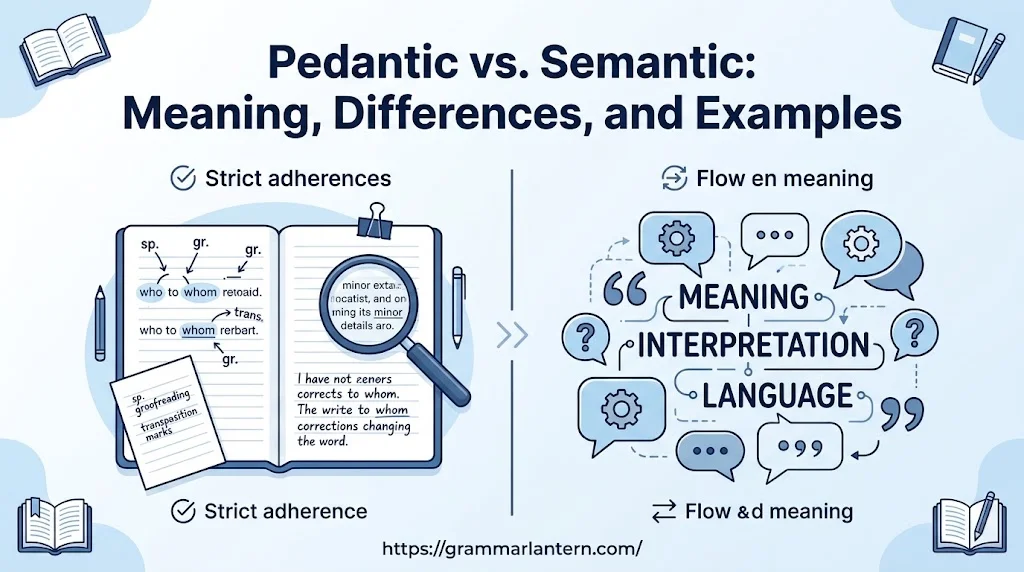
Can Someone Be Both Pedantic and Semantic?
Yes. Someone can be pedantic while discussing semantics because the words describe different things.
Imagine a conversation about the words house and home. One person explains that house usually refers to a physical building, while home can also suggest belonging, comfort, and personal attachment.
That’s a useful semantic distinction.
However, suppose that person repeatedly interrupts everyone to correct tiny wording differences, even when those corrections don’t help the discussion. Their approach may become pedantic.
The same person can therefore make a valid semantic observation in a pedantic way.
Consider this example:
“You said you feel ‘at home’ here, but you don’t own the building. Technically, you should say you feel comfortable in this house.”
The correction overlooks the figurative meaning of at home. More importantly, it ignores what the speaker actually intended to communicate.
This example illustrates two lessons:
- Discussing semantics doesn’t automatically make someone pedantic.
- Correct information can still be delivered in an unhelpful or unnecessarily critical way.
The difference depends on both the meaning being discussed and the manner in which someone discusses it.
Common Mistakes
Because pedantic and semantic can appear in conversations about language, people sometimes confuse their meanings. A few common mistakes are worth avoiding.
Using Pedantic as a Synonym for Semantic
Incorrect: “The semantic person kept correcting everyone’s grammar.”
Better: “The pedantic person kept correcting everyone’s grammar.”
The second sentence works because pedantic describes the person’s behavior. Semantic would need to describe something related to meaning.
Using Semantic to Describe Someone Who Nitpicks
Incorrect: “She’s so semantic about punctuation.”
Better: “She’s so pedantic about punctuation.”
Punctuation usually concerns writing conventions and structure rather than meaning itself. If someone excessively emphasizes minor punctuation rules, pedantic is the more suitable word.
However, punctuation can affect meaning. A discussion about whether a comma changes a sentence’s interpretation may involve semantics as well.
Assuming Pedantic Always Means Accurate
A pedantic person may care deeply about correctness, but that doesn’t guarantee every correction is correct.
For example, someone might insist that a particular informal expression is always grammatically wrong. Yet language conventions vary across contexts, dialects, and registers.
The person’s confidence doesn’t make the claim accurate.
Confusing Semantics With Syntax
Semantics concerns meaning, while syntax concerns how words combine into grammatical structures.
Consider these sentences:
- “The child ate the apple.”
- “The apple ate the child.”
Both follow a recognizable English subject-verb-object structure. However, they express different meanings because the nouns occupy different grammatical roles.
The example shows how syntax and semantics interact without being identical.
Treating Every Disagreement About Meaning as Pedantry
People sometimes dismiss a discussion as pedantic simply because someone distinguishes between similar words.
That judgment isn’t always fair. Word choice can have real consequences in contracts, medical instructions, technical documentation, and everyday communication.
If a distinction changes the meaning or prevents confusion, discussing it may be useful rather than pedantic.
Similar Words
Understanding related terms makes the distinction even clearer. Some words overlap with pedantic or semantic, but they aren’t interchangeable.
Pedantic vs. Precise
Precise means exact, accurate, or clearly defined. Pedantic suggests excessive concern with details or rules.
For example, a precise instruction tells employees to submit a report by 3 p.m. on Friday. A pedantic response might spend unnecessary time criticizing a harmless wording choice in that instruction.
Precision usually improves communication. Pedantry can interfere with it.
Read More: Wore or Worn: Which Is Correct? Helpful Examples
Pedantic vs. Nitpicky
Nitpicky is an informal term for paying excessive attention to small or unimportant details. It often overlaps with pedantic.
However, pedantic can suggest excessive concern with technical knowledge, formal rules, or scholarly distinctions. Nitpicky more broadly describes finding fault with minor details.
Compare these examples:
- “The reviewer was nitpicky about the spacing between paragraphs.”
- “The lecturer sounded pedantic while explaining an obscure grammatical rule.”
Both words can express criticism, but their emphasis differs slightly.
Semantic vs. Syntactic
These two terms are closely related in linguistics.
- Semantic: Relating to meaning.
- Syntactic: Relating to sentence structure and the arrangement of words.
Consider the sentence, “The boy kicked the ball.”
A syntactic analysis examines how the boy, kicked, and the ball function within the sentence. A semantic analysis examines the action and the relationship between the person performing it and the object receiving it.
Both perspectives help explain how language works.
Semantic vs. Pragmatic
Semantic generally concerns linguistic meaning, while pragmatic concerns how people interpret language in context, including speaker intentions and circumstances.
Suppose someone looks at an open window on a cold day and says, “It’s chilly in here.”
Semantically, the sentence describes the temperature. Pragmatically, it might function as an indirect request to close the window.
The speaker doesn’t explicitly say, “Please close the window,” yet the listener may understand that intention from the situation.
This distinction is particularly useful when studying conversation, implied meaning, politeness, and indirect requests.
Semantic vs. Literal
Semantic relates broadly to meaning, while literal describes an interpretation that follows the direct, nonfigurative sense of an expression.
For example, “I’m drowning in work” usually doesn’t describe someone physically underwater. The expression figuratively communicates that the person has too much work.
Semantics can examine both literal and figurative meanings. Therefore, semantic and literal aren’t synonyms.
How to Remember the Difference
If you often confuse these words, use a simple memory trick.
- Pedantic = picky about details.
- Semantic = centered on meaning.
The first word often describes how someone behaves. The second describes what an expression means or how meaning works.
Here’s another quick comparison:
| Situation | Best word | Why |
| Someone repeatedly corrects minor mistakes | Pedantic | The focus is excessive attention to details |
| Two people interpret a word differently | Semantic | The issue concerns meaning |
| A writer overexplains irrelevant technical rules | Pedantic | The explanation emphasizes unnecessary details |
| A sentence has two possible interpretations | Semantic | The expression involves meaning-related ambiguity |
| A teacher explains the difference between lend and borrow | Semantic | The lesson examines word meanings and their relationships |
When choosing between the words, ask yourself one question: Am I describing someone’s approach, or am I describing meaning?
If you’re describing someone’s excessive attention to small details, pedantic is probably appropriate. If you’re discussing the meaning of a word, phrase, or sentence, semantic is usually the better choice.
FAQs
1. What is the difference between pedantic and semantic?
Pedantic describes someone who focuses too much on minor rules and details. Semantic relates to the meaning of words, phrases, and language.
2. What does pedantic mean in simple English?
Pedantic means paying excessive attention to small details or rules, often in a way that annoys other people.
3. What does semantic mean in simple English?
Semantic means relating to the meaning of words, expressions, symbols, or other forms of communication.
4. Is being pedantic a negative trait?
Usually, yes. Being pedantic can make someone seem annoying or overly critical, especially when minor errors matter less than the main message.
5. Is semantic a positive or negative word?
Semantic is generally a neutral word. Understanding semantics can help clarify meanings and improve communication.
6. Can a person be both pedantic and semantic?
Yes. Someone can understand word meanings deeply while also paying excessive attention to minor language rules.
7. What is an example of pedantic behavior?
Correcting someone who says, “I’m starving,” by explaining that they are not literally starving because they ate breakfast is a common example of pedantry.
8. What is an example of semantic discussion?
Discussing whether a machine demonstrates creativity or simply recognizes patterns is a semantic discussion because it examines the meaning of creativity.
9. What does arguing semantics mean?
Arguing semantics means debating the meaning or definition of words. People sometimes use this phrase to dismiss a disagreement as unimportant.
10. How can you remember the difference between pedantic and semantic?
Remember that pedantic focuses on minor details and rules, while semantic focuses on meaning and interpretation.
Conclusion
Understanding Pedantic vs. Semantic helps you recognize the difference between unnecessary nitpicking and meaningful discussions about language. A pedantic person may focus on small mistakes, technicalities, or strict rules, while a semantic discussion explores what words and expressions actually mean.
Both terms relate to language, but they serve different purposes. Use pedantic when describing excessive attention to minor details, and use semantic when discussing meaning or interpretation. Choosing the correct word makes your writing clearer and helps you communicate your ideas more accurately.

For Shafiq ur Rehman, writing is an art form and grammar is the toolbox that makes it beautiful. As a dedicated content writer at Grammar Lantern, Shafiq approaches every topic like an architect carefully laying down strong foundations of understanding before adding the finer details. He loves diving into the trickiest grammar points and resurfacing with simple, bite-sized takeaways that anyone can grasp. When he’s not crafting articles, you’ll likely find him strategizing over a game of chess, exploring dusty local bookshops, or quietly jotting down poetic observations in his notebook.