
Choosing between sung and sang depends on English grammar and how you structure your sentence. Both words come from the verb sing, but they serve different grammatical purposes. Understanding this distinction helps you avoid common mistakes in everyday conversations, school assignments, and professional writing.
Use sang as the simple past tense when describing an action that happened in the past. For example, “She sang beautifully at the concert.” The sentence is complete because sang expresses the past action without needing a helping verb. You can use it when telling stories, describing performances, or sharing memories.
Use sung as the past participle, usually with a helping verb such as has, have, or had. For example, “She has sung at that venue before.” Remember this simple rule: sang works independently in the simple past, while sung usually needs a helping verb. Practicing these forms will make your writing clearer and more accurate.
Quick Answer
Both sang and sung are correct, but you must use them in different grammatical structures.
- Sang is the simple past tense of sing. Use it to describe an action that happened in the past.
- Sung is the past participle of sing. Use it with helping verbs in perfect tenses and passive constructions.
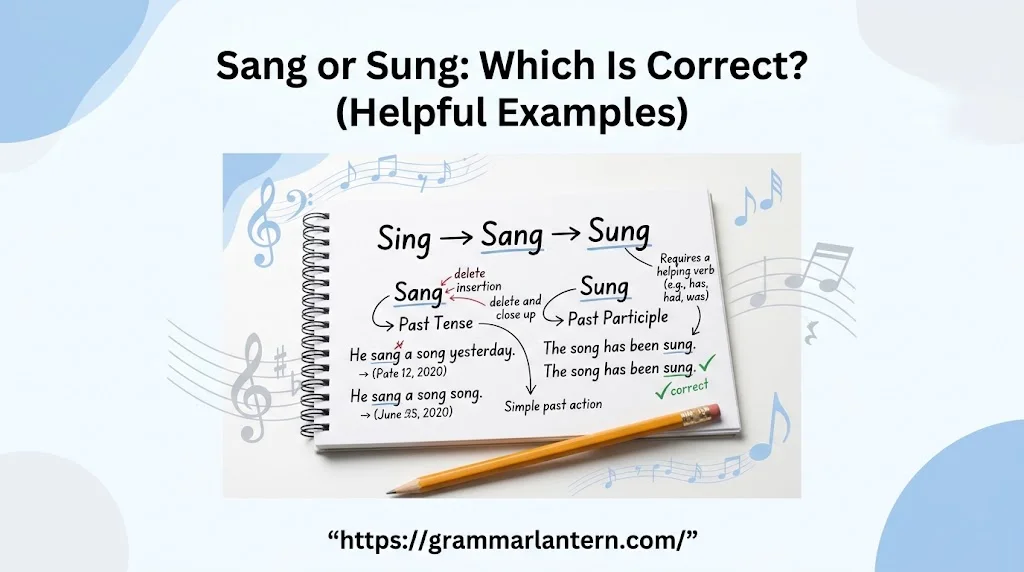
The three main forms of the verb follow this pattern:
Sing → Sang → Sung
| Verb form | Example sentence | Explanation |
| Present tense | I sing every morning. | Describes a habit or present action. |
| Simple past | I sang yesterday. | Describes a completed past action. |
| Present perfect | I have sung this song before. | Connects a past action to the present. |
| Past perfect | I had sung before the guests arrived. | Describes an action completed before another past event. |
| Passive voice | The song was sung by Maya. | Focuses on the song and the action performed on it. |
Remember this quick rule: Use sang for the simple past and sung for the past participle.
For example, “She sang beautifully last night” is correct. So is “She has sung beautifully at several concerts.” However, “She has sang beautifully” is incorrect in standard US English.
What Does Sang Mean?
Sang is the simple past tense of the verb sing. It describes an action that happened and finished in the past.
You don’t need have, has, or had to use sang in an ordinary simple past sentence. The word itself expresses the past action.
For example:
- Emma sang at the school concert yesterday.
- We sang our favorite songs during the road trip.
- My brother sang while playing his guitar.
- The children sang together at the celebration.
- The performer sang three songs before taking a break.
Each sentence describes a singing action that occurred in the past.
Notice that the verb stays sang regardless of whether the subject is singular or plural. You say “He sang,” “She sang,” and “They sang.” You don’t add an -s or change the form to match the subject.
Read More: Safeness vs. Safetyness: Which Word Is Correct?
When to Use Sang
Use sang when you’re talking about a completed past action. It works particularly well when the sentence identifies when the singing happened or describes it as part of a past event.
Use sang for specific past events.
For example:
- I sang at my cousin’s wedding last weekend.
- Daniel sang the national anthem before the match.
- Our class sang a song during the graduation ceremony.
Words such as yesterday, last night, last year, and two days ago often appear with the simple past tense.
However, these time expressions aren’t required. You can also write, “The audience sang along with the band.” The past tense is clear from the context.
Use sang when describing a sequence of past actions.
For example:
“Lily walked onto the stage, greeted the audience, and sang her favorite song.”
The verbs walked, greeted, and sang describe actions in a sequence. Each verb uses the simple past tense.
This structure is common in storytelling because it helps readers follow events in the order they happened.
Use sang when asking about a past singing event.
For example:
- Who sang at the ceremony?
- Which song did she sing?
- Did the children sing at the festival?
Notice the final two examples. When you use did to form a question, the main verb returns to its base form, sing. You don’t say “Did she sang?” or “Did she sung?”
Sang in Different Sentence Types
Understanding how sang works in statements, negative sentences, and questions can prevent several common mistakes.
| Sentence type | Correct example |
| Affirmative | She sang at the concert. |
| Negative | She did not sing at the concert. |
| Question | Did she sing at the concert? |
| Negative question | Didn’t she sing at the concert? |
| Wh-question | Why did she sing that song? |
The important detail is that did already carries the past-tense meaning. Therefore, the main verb takes its base form.
For example, “They did not sing yesterday” is correct, even though the sentence refers to the past. You don’t need to change sing to sang because did already marks the tense.
What Does Sung Mean?
Sung is the past participle of the verb sing. Unlike sang, it usually needs another verb to form a complete verb phrase.
You commonly use sung with have, has, and had. These combinations help form perfect tenses, which describe relationships between actions and time.
For example:
- I have sung this song before.
- She has sung in several competitions.
- They had sung three songs before dinner.
- We have sung together for many years.
In each sentence, sung works with a helping verb.
The distinction becomes clearer when you compare two sentences:
- Simple past: He sang at the festival.
- Present perfect: He has sung at the festival before.
The first sentence reports a past event. The second describes a past experience without specifying exactly when it happened.
When to Use Sung With Have, Has, and Had
The words have, has, and had can help you identify when to use sung.
Use have sung with I, you, we, and they in the present perfect tense.
Examples:
- I have sung that song many times.
- You have sung in front of a large audience.
- We have sung together since childhood.
- They have sung at several local events.
The present perfect connects a past action or experience to the present. For instance, “We have sung together since childhood” describes an activity that began in the past and continues as a relevant part of the present.
Use has sung with he, she, it, and singular nouns.
Examples:
- She has sung professionally for several years.
- He has sung that melody before.
- The singer has sung at this venue many times.
- My daughter has sung in the school choir since September.
The subject determines whether you use have or has. The past participle remains sung in both cases.
Use had sung for the past perfect tense.
Examples:
- She had sung two songs before the power went out.
- We had sung the final verse before the audience applauded.
- He had sung at the venue once before he returned as a guest performer.
The past perfect shows that one action happened before another past event.
Consider this example: “The guests arrived after Maya had sung her final song.”
Maya finished singing before the guests arrived. The phrase had sung makes that sequence clear.
The basic patterns are:
- Present perfect: have/has + sung
- Past perfect: had + sung
These combinations are useful in conversations, essays, reports, and narratives.
When to Use Sung in Passive Voice
You also use sung in passive constructions. In these sentences, the subject receives the action rather than performing it.
For example:
- The national anthem was sung before the game.
- The song is sung by the choir every Sunday.
- Several traditional songs were sung at the ceremony.
- The final verse will be sung by the entire group.
The structure typically combines a form of be with the past participle.
Compare these sentences:
- Active: The choir sang the hymn.
- Passive: The hymn was sung by the choir.
In the active sentence, the choir performs the action. In the passive sentence, the hymn receives the focus.
Both sentences describe the same basic event, but their emphasis differs.
This is why “The hymn was sung” is correct in standard US English, while “The hymn was sang” is not the standard form.
Sung in Participial Phrases
Sometimes, sung appears in a phrase that describes a noun rather than forming the main verb of a sentence.
For example:
- The song sung at the wedding brought everyone to tears.
- The hymns sung by the choir filled the room.
- The melody sung by the young performer sounded familiar.
- The songs sung during the celebration reminded us of childhood.
In “The song sung at the wedding brought everyone to tears,” the phrase sung at the wedding describes the song.
The main verb is brought. The word sung helps identify which song the sentence describes.
You can often expand this kind of phrase into a relative clause:
“The song that was sung at the wedding brought everyone to tears.”
Both versions are grammatical. The shorter version simply removes the words that was.
Key Differences
Although sang and sung come from the same verb, they aren’t interchangeable in standard English grammar.
The key is to look at the structure of the sentence rather than simply asking whether the action happened in the past.
| Feature | Sang | Sung |
| Verb form | Simple past | Past participle |
| Basic use | Reports a past action | Forms perfect tenses and passive constructions |
| Common pattern | Subject + sang | Subject + have/has/had + sung |
| Passive construction | Not used as the standard participle | The song was sung |
| Example | She sang yesterday. | She has sung before. |
Let’s examine a few pairs.
Pair one:
- Correct: Mark sang at the party last night.
- Correct: Mark has sung at many parties.
The first sentence describes a specific past event. The second refers to his experience singing at parties.
Pair two:
- Correct: The children sang the song.
- Correct: The song was sung by the children.
The first sentence uses the simple past in active voice. The second uses the past participle in passive voice.
Pair three:
- Correct: We sang before lunch.
- Correct: We had sung before lunch began.
The first sentence simply reports a past action. The second emphasizes that the singing was already complete before another event.
The easiest way to choose correctly is to identify the verb pattern first. Once you recognize the structure, the right form usually becomes obvious.
Helpful Examples
Examples can make the difference between these two verb forms much easier to remember. The following sentences show how each word works in everyday English.
Examples of Sang in Sentences
Use sang when the main verb describes a completed past action.
- I sang along with the radio on my way to work.
- The children sang at the school assembly yesterday.
- She sang her favorite song at the birthday party.
- We sang together during the family celebration.
- He sang while playing the guitar.
- The audience sang the chorus with the band.
- My sister sang in a local music competition.
- They sang until the concert ended.
- Who sang the opening song at the event?
- She sang one verse and then stopped.
In each example, sang expresses a past action. Some sentences include a specific time, while others rely on the surrounding context.
Examples of Sung in Sentences
Use sung with the appropriate helping verb or in a participial phrase.
- I have sung this song before.
- She has sung in several competitions.
- They have sung together since childhood.
- He had sung three songs before dinner.
- We have sung every song on the list.
- The national anthem was sung before kickoff.
- This song is sung in several languages.
- The traditional songs were sung by local musicians.
- The melody sung by the children sounded familiar.
- Have you ever sung in front of a large audience?
These examples demonstrate several grammatical patterns. The first five use perfect tenses or questions built around the present perfect. The next three use passive constructions. The ninth contains a participial phrase, and the final example asks about life experience.
Side-by-Side Sentence Comparisons
Compare the following examples to see how the grammatical structure changes.
| Sang | Sung |
| She sang yesterday. | She has sung before. |
| They sang at the festival. | They have sung at several festivals. |
| He sang before dinner. | He had sung before dinner began. |
| The choir sang the hymn. | The hymn was sung by the choir. |
| Maya sang the song. | The song has been sung by Maya. |
The last example uses the present perfect passive: has been sung. Here, been is the past participle of be, while sung is the past participle of sing.
These examples show why choosing between sang and sung depends on the entire verb phrase. A sentence’s time reference matters, but its grammatical structure matters just as much.
Common Mistakes
Many mistakes happen because writers assume that every verb referring to the past should use its simple past form. English doesn’t work that way.
Irregular verbs often have different forms for different grammatical patterns. The verb sing is a good example.
Is It Have Sang or Have Sung?
The correct form is have sung.
- Incorrect: We have sang together many times.
- Correct: We have sung together many times.
The present perfect uses have or has followed by the past participle. Because sung is the past participle of sing, it belongs in this construction.
You can apply the same rule to other verbs:
- I have written the letter.
- She has eaten lunch.
- They have taken the test.
You wouldn’t normally write “have wrote,” “has ate,” or “have took” in these perfect-tense constructions. The same principle explains why have sung is correct.
Is It Has Sang or Has Sung?
The correct form is has sung.
- Incorrect: She has sang that song before.
- Correct: She has sung that song before.
Use has with singular third-person subjects such as he, she, it, and singular nouns.
For example:
- The performer has sung here before.
- My brother has sung in a choir.
- The bird has sung throughout the morning.
In each sentence, has is followed by sung, not sang.
Is It Had Sang or Had Sung?
The correct form is had sung.
- Incorrect: He had sang before the show started.
- Correct: He had sung before the show started.
The past perfect follows the pattern had + past participle. This pattern stays the same regardless of the subject.
For example:
- I had sung.
- She had sung.
- We had sung.
- The performers had sung.
Because had already establishes the past perfect construction, you need the participle sung.
Is It Would Have Sang or Would Have Sung?
The correct form is would have sung.
- Incorrect: I would have sang if I had known.
- Correct: I would have sung if I had known.
After would have, use the past participle. The same rule applies to several other modal constructions:
- I could have sung at the concert.
- She should have sung the final verse.
- They might have sung another song.
- We would have sung if we had been invited.
These phrases often describe imagined, possible, or expected past actions.
For example, “She could have sung at the event” means singing was a possibility, but the sentence doesn’t confirm that she actually did it.
The grammatical pattern is straightforward: modal verb + have + past participle.
Is It Was Sang or Was Sung?
The correct form in standard US English is was sung.
- Incorrect: The song was sang by the choir.
- Correct: The song was sung by the choir.
Passive voice requires a form of be followed by the past participle.
More examples include:
- The melody was sung beautifully.
- The song was sung in Spanish.
- The final verse was sung by the audience.
- The traditional hymn was sung during the ceremony.
Remember that the subject receives the action in these sentences. The song doesn’t perform the singing; someone sings it.
Is It Did Sang, Did Sung, or Did Sing?
The correct form is did sing.
- Incorrect: Did you sang at the concert?
- Incorrect: Did you sung at the concert?
- Correct: Did you sing at the concert?
The same rule applies to negative statements:
- Incorrect: She didn’t sang the song.
- Incorrect: She didn’t sung the song.
- Correct: She didn’t sing the song.
The reason is simple. In questions and negative statements using did, the auxiliary verb carries the past-tense marking. The main verb therefore stays in its base form.
Compare these sentences:
- She sang at the concert.
- Did she sing at the concert?
- She didn’t sing at the concert.
The meaning remains connected to the past, but the verb structure changes.
Sang, Sung, and Singing: Understanding All Three Forms
The verb sing has several forms, and each one serves a different purpose. Understanding the complete pattern makes it easier to use sang and sung correctly.
| Verb form | Grammatical use | Example |
| Sing | Base form | I sing every morning. |
| Sings | Third-person singular present | She sings every morning. |
| Singing | Present participle or gerund | She is singing now. |
| Sang | Simple past | She sang yesterday. |
| Sung | Past participle | She has sung before. |
Sing is the base form. You use it after modal verbs such as can, could, will, and should.
For example, “She can sing beautifully” is correct. You wouldn’t say “She can sang” or “She can sung.”
Sings is the present-tense form used with third-person singular subjects. For example, “My brother sings in a choir.”
Singing appears in continuous tenses and can function as a noun. For example, “They are singing now” uses the present continuous tense, while “Singing makes her happy” uses singing as a gerund.
Sang expresses the simple past, as in “We sang last night.”
Sung appears in perfect tenses and passive constructions, as in “We have sung together” and “The song was sung by the choir.”
One additional distinction matters: singed belongs to the separate verb singe, which means to burn or scorch something slightly. For example, “The flame singed the edge of the paper.” It isn’t the past tense of sing.
Read More: 35 Best Replies to “Good Night” For All Situations
An Easy Way to Remember
If you regularly mix up sang and sung, use a simple three-part memory trick:
Today, I sing. Yesterday, I sang. Before now, I have sung.
Each sentence demonstrates a different form of the same verb.
- Sing: The base form.
- Sang: The simple past.
- Sung: The past participle.
You can also look for a helping verb before deciding which form to use.
If the sentence uses have, has, or had to form a perfect tense, choose sung.
For example:
- I have sung at this venue.
- She has sung this song before.
- They had sung before the audience arrived.
For passive constructions, look for a form of be followed by the participle:
- The song was sung.
- The anthem is sung.
- The final verse will be sung.
However, don’t assume that every sentence containing a helping verb must use sung. Consider “She was singing when I arrived.” The correct form is singing because the sentence uses the past continuous tense.
The best habit is to identify the complete verb structure before choosing the word.
Practice Quiz
Test your understanding with these sentences. Fill in each blank with the correct form of the verb in parentheses.
- She ___ at the school concert last night. (sing)
- We have ___ that song many times. (sing)
- The anthem was ___ before the match. (sing)
- Did you ___ at the party? (sing)
- He had ___ three songs before dinner. (sing)
- They ___ together during the ceremony. (sing)
- I would have ___ if I had been invited. (sing)
- The song ___ by a local musician yesterday. (sing)
- My sister is ___ her favorite song right now. (sing)
- The children didn’t ___ during the performance. (sing)
Practice Quiz Answers and Explanations
| Question | Answer | Explanation |
| 1 | Sang | The sentence describes a completed past action. |
| 2 | Sung | Present perfect uses have + past participle. |
| 3 | Sung | Passive voice uses was + past participle. |
| 4 | Sing | The auxiliary did takes the base form. |
| 5 | Sung | Past perfect uses had + past participle. |
| 6 | Sang | The sentence describes a past event. |
| 7 | Sung | The construction would have requires a past participle. |
| 8 | Was sung | The sentence uses passive voice in the simple past. |
| 9 | Singing | The present continuous uses is + verb-ing. |
| 10 | Sing | The negative auxiliary didn’t takes the base form. |
If you answered all ten correctly, you’ve grasped the main rules. If a few answers surprised you, revisit the sections about helping verbs and passive voice. Those patterns account for many common errors.
FAQs
1. What is the difference between sung and sang?
Sang is the simple past tense of sing, while sung is its past participle. Use sang for a completed past action, such as “He sang yesterday.” Use sung with a helping verb, as in “He has sung before.”
2. Is sang or sung correct?
Both sang and sung are correct, but they serve different grammatical purposes. Your choice depends on the sentence structure and verb tense.
3. Is sung the past tense of sing?
No. Sung is the past participle of sing. The simple past tense is sang. For example, “She sang at the event” is correct, while “She has sung at the event” uses the past participle correctly.
4. When should I use sang in a sentence?
Use sang when describing an action that happened in the past. For example, “The children sang their favorite song yesterday.” You don’t need a helping verb to use sang in this way.
5. When should I use sung in a sentence?
Use sung with a helping verb such as has, have, or had. For example, “They have sung together for years.” This structure is common in perfect tenses.
6. Is “I have sang” grammatically correct?
No. The correct phrase is “I have sung.” The verb have requires the past participle sung, not the simple past form sang.
7. Is “I sang a song” correct?
Yes. “I sang a song” is grammatically correct because sang expresses a completed action in the simple past tense.
8. Can I use sung without a helping verb?
Sometimes, sung can appear without a helping verb when it functions as a participle or adjective in a particular construction. For example, “The song sung by the choir received applause.” However, when using it as the main verb in a perfect tense, you need a helping verb.
9. What are the three forms of the verb sing?
The three principal forms are:
- Sing: Present tense
- Sang: Simple past tense
- Sung: Past participle
For example, “I sing every day,” “I sang yesterday,” and “I have sung before.”
10. How can I remember when to use sung or sang?
Remember this simple rule: sang usually stands alone to describe a past action, while sung generally appears with a helping verb in perfect tenses. Practice examples such as “She sang yesterday” and “She has sung before” to remember the difference.
Conclusion
Understanding the difference between sung and sang helps you use the verb sing correctly. Although both forms describe singing, sang expresses the simple past, while sung serves as the past participle and commonly appears with helping verbs such as has, have, and had.
When you’re unsure which form to choose, check the sentence structure. Say “He sang at the concert” for a past action, but “He has sung at the concert” when using the present perfect tense. With a little practice, you’ll find it easier to choose the correct form in everyday conversations and formal writing.

Muhammad Haroon is the voice behind many of the clear, practical grammar guides you’ll find on Grammar Lantern. With a strong background in content writing and a genuine love for the English language, Haroon specializes in breaking down intimidating grammar topics into simple, digestible lessons. His goal is simple: to empower readers to write with confidence and clarity. Whether he’s explaining tricky tenses or demystifying punctuation, Haroon approaches each topic with patience, precision, and a touch of warmth—because he knows that learning grammar is a journey, not a race.